Anja Dodevska

Pain medication chart: Strength tiers, DEA schedules and free PDF
What is a pain medication chart and how do clinicians use it? A pain medication ...

4
Last Updated: Nov 4, 2026
Free PDF 1 page, print-ready Clinician-reviewed
The MRC dyspnea scale grades how much breathlessness limits a person's daily activity, from strenuous exercise only to being unable to leave the house. Most respiratory teams now record the modified version, the mMRC, which numbers the same five statements 0 to 4. The patient picks the statement that matches a usual day, so the score takes under a minute to record. GOLD treats an mMRC grade of 2 or higher as a high symptom burden in COPD. This free one-page template records today's grade, the reviewer and each follow-up score.
Start from scratch, or upload this PDF or any form you already use, and Pabau's AI Form rebuilds it with tick boxes, text fields and a signature. Attach it to the treatment once, and every patient gets it on time.
AI Form rebuilds the consent, history and aftercare forms you already use. You review each one, then publish.
Patients complete forms on their phone before they arrive, so the front desk stops retyping paper.
Every signed form is versioned and attached to the treatment record, ready when you need it.
Set how long a consent stays valid. Returning patients skip forms they have already signed.
Supports HIPAA and GDPR compliance AES-256 encryption 4.8 on G2 4.7 on Capterra Trusted by 4,000+ practices worldwide

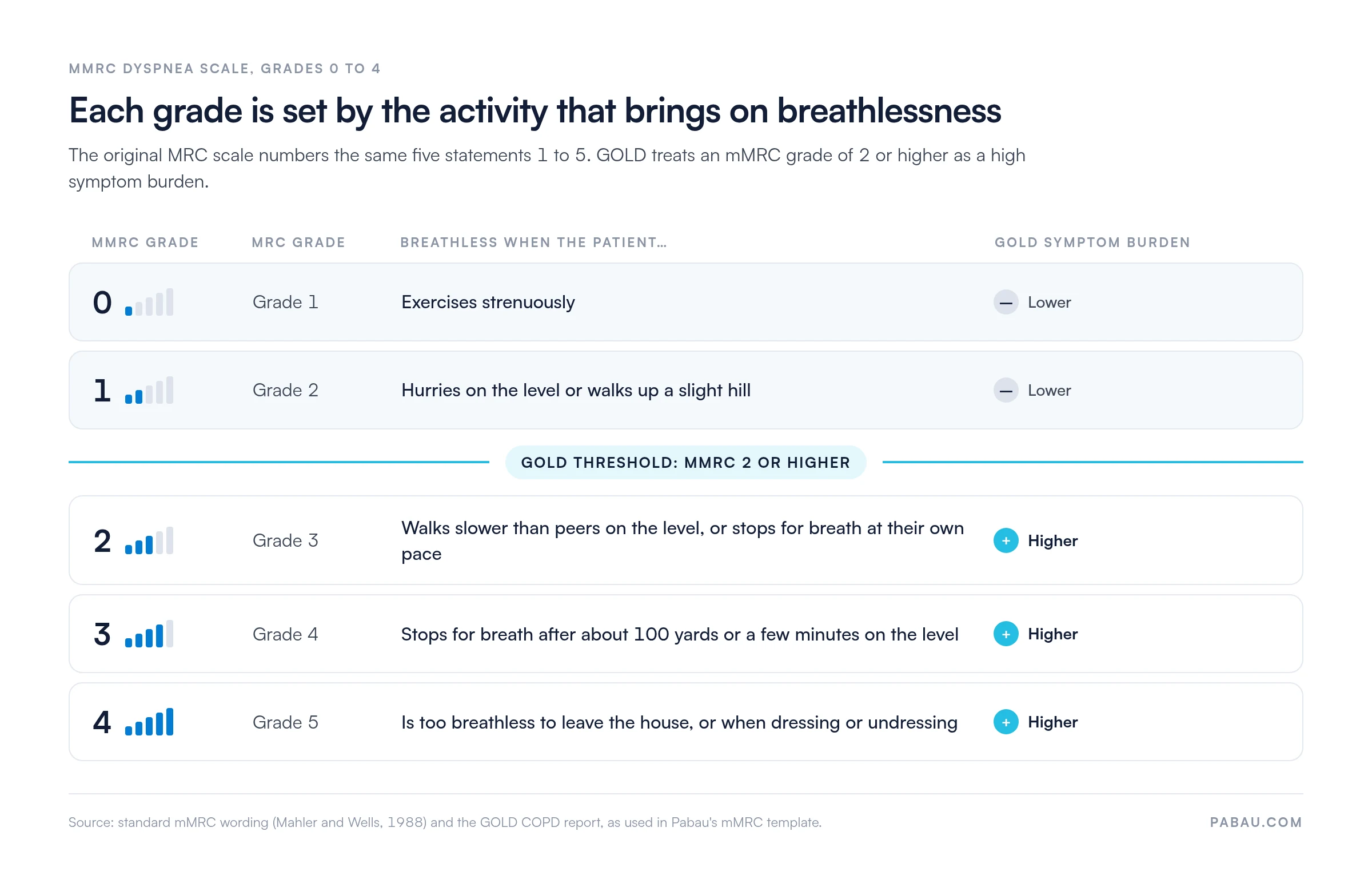
The mMRC dyspnea scale grades baseline breathlessness from 0 (none beyond strenuous exercise) to 4 (too breathless to leave the house).
An mMRC grade of 2 or higher is the GOLD threshold for a high symptom burden in COPD.
The original MRC scale numbers the same statements 1 to 5, so record which version each grade uses.
The scale measures symptoms rather than lung function, so pair it with spirometry and exacerbation history.
Pabau, the practice software we build, saves each grade to the patient record so every review’s score sits in one history.
The MRC dyspnea scale was developed by the UK Medical Research Council and grades breathlessness according to how far it limits physical activity. Its original form has five grades.
Grade 1 is breathlessness only with strenuous exercise, and grade 5 is breathlessness that keeps the patient at home or comes on while dressing. It is a patient-reported measure, so the score reflects what the person tells you about their daily limits.
Clinicians use it to set a baseline for chronic breathlessness, track change over time, and compare patients within a service.
Because it describes function in everyday terms, a nurse, primary care physician or rehabilitation team can apply it at the first appointment. It sits comfortably next to the observation and auscultation steps of a nursing lung assessment.
The MRC scale (grades 1 to 5) and the modified mMRC scale (grades 0 to 4) describe the same underlying symptom, but the numbering differs. The mMRC is the version recommended in current COPD guidance, so most respiratory services now record it.
The one-point offset matters most when you inherit older records. An original MRC grade of 2 equals an mMRC grade of 1, which sits below the GOLD threshold. Read that old number as an mMRC score and the patient appears to cross the threshold with no change in symptoms. Writing the scale version next to every grade prevents the error.
Each mMRC grade describes a level of activity limitation. The score is easiest to record when you read the descriptors aloud and let the patient choose the closest match. The grades below follow the standard mMRC wording.
A grade of 2 or higher is the threshold the GOLD COPD report uses to separate lower from higher symptom burden. That is why many services record the score at every COPD review. The chart below lines each grade up with its original MRC number and its side of that threshold.
For a patient at grade 2 or above, carry the score into the COPD nursing care plan, where breathlessness goals and interventions are written down.
Administration takes less than a minute when the patient answers in their own words. Use the steps below so every clinician records the score the same way.
Keeping the score in a consistent place makes trend review straightforward, and it gives reviewers clear evidence of what was assessed. The template suits respiratory, primary care, nursing and rehabilitation teams. Adapt the fields to match your local documentation standards before you put it into use.
Clinicians use the scale to record baseline breathlessness, support COPD staging alongside spirometry, and decide when a patient needs a fuller respiratory assessment. It is also used to monitor response to pulmonary rehabilitation and to flag patients whose symptoms are out of step with their lung function results.
The Borg dyspnea scale measures breathlessness during exertion in the moment, while the mMRC measures usual, baseline functional limitation. The two answer different questions, so they are used in different settings.
For a routine clinic review, the mMRC is usually the right choice. For a six-minute walk test or an exercise session, the Borg is the better fit, and many services record both.
The scale is subjective, since it depends on what the patient reports and how they interpret the descriptors. Two clinicians can record different grades for the same patient unless they read the descriptors in the same way.
On paper, each review produces a separate sheet. Comparing this year’s grade with last year’s means pulling the file and reading several forms side by side. A grade written on the wrong version of the scale is also easy to miss.
Pabau’s digital forms turn this template into a form your team completes on a tablet during the consultation. The grade, date and reviewer save to the patient file in Client records. At the next COPD review, the full history of scores is in one place.

That history is what makes a change visible. A patient who moves from grade 1 to grade 2 has crossed the GOLD threshold. The record shows when it happened and who assessed it.

Pabau’s digital forms save each mMRC grade, date and reviewer to the patient record. Trends between reviews then show at a glance, ready for the next consultation.

The mMRC grade is only as useful as its consistency. Read the same five statements the same way at every review and write the scale version beside the number. A run of grades recorded like that shows which way the patient is heading.
The mMRC measures what breathlessness stops a patient doing, so it cannot stand in for lung function. Pair a rising grade with spirometry and exacerbation history before you change treatment. A grade that disagrees with lung function is a reason to look further.
Book a demo to see how Pabau keeps each mMRC grade in the patient record, so trends between COPD reviews are easy to spot.

Caring for a patient in acute respiratory failure? Respiratory failure nursing care plan sets out goals, interventions and evaluation for an acute deterioration.
Reviewing inhalers at the same appointment? Asthma medication list groups controller and reliever drugs by class, with devices and monitoring.
Is breathlessness pointing to the pulmonary circulation? Pulmonary hypertension medication list covers each drug class used in pulmonary arterial hypertension.
Recording observations alongside the grade? Vital signs record template keeps respiratory rate, oxygen saturation and other observations on one dated sheet.
Need a fast consciousness check on a deteriorating patient? AVPU scale explains the four-point alertness check and when to escalate.
The MRC dyspnea scale is a five-grade measure of breathlessness that grades how far it limits daily activity. The modified mMRC version uses grades 0 to 4 and is the form most COPD guidance recommends.
A grade of 4 indicates the most severe breathlessness, where the patient is too breathless to leave the house or is breathless while dressing. A grade of 2 or higher is the GOLD threshold for significant symptom burden.
The MRC scale grades usual baseline limitation, while the Borg scale rates breathlessness during exertion in the moment. Use the mMRC for routine reviews and the Borg for exercise testing.
Yes, the mMRC is used in COPD guidance from GOLD to assess symptom burden. It measures symptoms rather than lung function, so it complements spirometry rather than replacing it.
A free mMRC dyspnea scale PDF template is available from Pabau. Adapt the fields to your local documentation requirements before using it.