OSHA inspection checklist: Free PDF + what inspectors check first
An OSHA inspection checklist is a self-audit form for finding workplace hazards,...

2
Last Updated: Oct 7, 2026
A professional development record is a structured log of a healthcare practitioner’s continuing professional development (CPD). It keeps learning activities, hours, goals, reflection notes and evidence in one document, ready for appraisal and revalidation.
UK regulators expect one from every registered professional. The Nursing and Midwifery Council (NMC) asks nurses for 35 hours of CPD every three years. The General Medical Council (GMC) reviews doctors’ learning at annual appraisal. The Care Quality Commission (CQC) looks for staff development records when it inspects a practice. The free template below gives you every field those reviews ask for.
Fields for personal and role details, up to three SMART goals, a dated CPD activity log with hours, reflection notes, evidence references and manager sign-off. Use it for annual appraisal, NMC revalidation, or HCPC and GPhC renewal.
Download template
A professional development record (PDR) logs a practitioner’s CPD activities, hours, goals and evidence of learning in one document.
The NMC, GMC, HCPC and GPhC all expect a CPD record at revalidation or renewal, and CQC inspectors look for staff development records.
The template covers personal details, professional goals, dated CPD activities with hours, reflection notes, evidence and manager sign-off.
Only the NMC sets an hour target: 35 hours over three years, with at least 20 hours of participatory learning.
Team management software such as Pabau stores each staff member’s certificates and qualifications in their own folder, with role-based access.
A professional development record is a dated log of a practitioner’s learning, skill development and career progress over a set period, usually one year. A simple training log lists the courses someone attended. A PDR also records why each activity mattered, how it changed practice, and what evidence proves it happened.
The record serves three functions. First, it provides accountability: Practitioners evidence their commitment to staying current. Second, it supports appraisal conversations, because managers can review the practitioner’s learning and plan next steps. Third, it creates an audit trail for regulators and inspectors who assess whether the organization invests in staff learning.
In healthcare, a professional development record is a compliance document as much as a career tool. Each regulator frames the expectation differently, and the CQC requirements apply to the practice as a whole.
Every professional development record template should capture the core fields below. Together they satisfy regulators and give inspectors a meaningful audit trail.
Follow these five steps to build a complete record over the course of a year.
Professional goals connect day-to-day learning to your long-term career and to your practice’s patient care. Write them using the SMART framework: Specific, Measurable, Achievable, Relevant and Time-bound.
Example goals by role:
Align goals to three domains: Clinical (skills directly affecting patient care), professional (compliance, regulation, revalidation), and personal (leadership, confidence, career progression). A balanced year typically has one clinical goal, one professional goal, and one personal or leadership goal.
Regulators define CPD differently, so the template accepts every recognized learning type.
For evidence, keep one document per activity: A certificate, course completion email, journal club attendance sheet, or your own dated reflection note. Store the PDFs in compliance software for practices so the records stay secure and searchable without a filing cabinet.
Hour requirements vary: The NMC expects 35 hours over three years (roughly 12 per year), with at least 20 of them participatory. For each NMC entry, log the method, dates, hours, how the topic relates to your practice, and proof of completion. The HCPC and GPhC require CPD without a minimum hour target, and the GMC ties learning to the doctor’s scope and specialty. The table below sets the five expectations side by side.
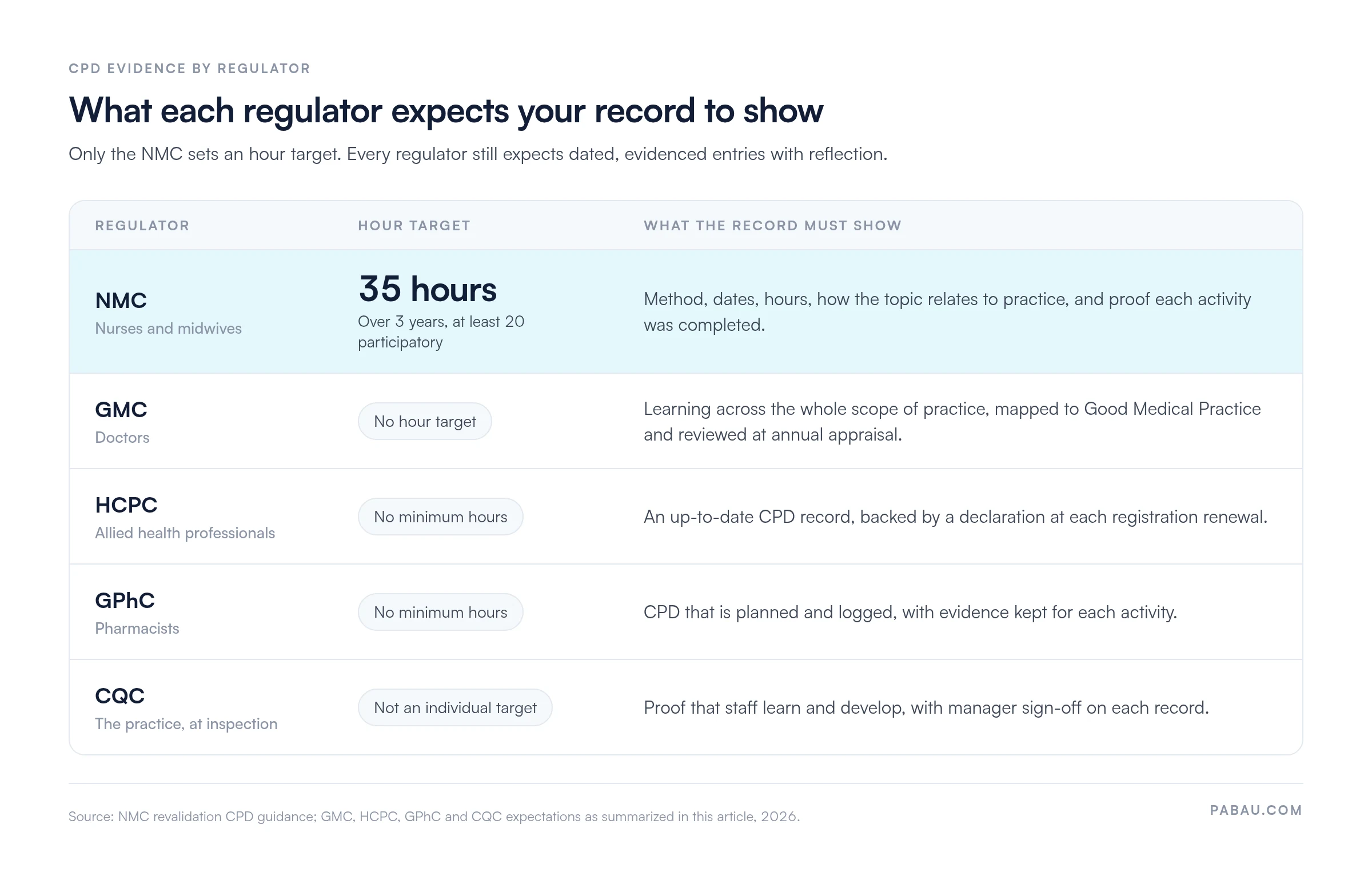
The template’s activity log fits all of these frameworks. Your practice’s compliance lead should confirm which one applies to each team member.
Practice managers responsible for several practitioners need one central place for development records. Once a team passes five or so staff, manual tracking breaks down. Spreadsheets get lost, review dates slip, and evidence ends up scattered across inboxes.
A simple workflow keeps the team ready for inspection:
Then build a register in a spreadsheet or team management software. List each practitioner’s review date, CPD hours to date, goal status and sign-off date. Inspectors may ask to see it during a CQC inspection, and a complete register shows that staff development is overseen.
Many practices start with a shared drive and a spreadsheet. Certificates sit in email attachments, and the manager rebuilds the register before every appraisal round or inspection.
In Pabau, you upload each person’s qualifications, certificates, DBS checks and contracts into folders organized by staff member. Roles decide what each person can see and do, so personal documents stay with the managers who need them.
You can also assign the annual review as a task with an owner and a due date. When an inspector asks for evidence, the documents are already filed against the right person.

Pabau stores each team member’s certificates and qualifications in their own folder, with role-based access. Your development records stay organized for appraisals and CQC inspections.

A professional development record only protects you if you keep it as you go. Entries logged the week of a course, with a reflection and a certificate attached, stand up at appraisal and inspection. A year of entries rebuilt in March rarely does.
Download the template, set two or three goals, and put the annual review on the calendar now. For a practice with several practitioners, the bigger payoff is one register that shows every record’s status at a glance. Book a demo to see how Pabau keeps your team’s certificates and CPD evidence filed and ready for inspection.

Preparing for an inspection? CQC inspection: What it is and how to prepare walks through what inspectors check and what happens on the day.
Not sure what the CQC expects of your practice? CQC requirements every provider must prove breaks down the standards behind each inspection rating.
Opening a new practice? How to get CQC registered covers each step of the registration application.
New to CQC regulation? Understanding the CQC and its role explains what the regulator does and how it assesses providers.
Storing staff and patient data? The GDPR checklist UK practices need lists the data protection controls to check.
A professional development record can be paper-based, a Word or Excel document, or a digital form stored in practice software. Regulators don’t mandate a format. They require records that exist, are contemporaneous (recorded as learning happens, not backdated), and include evidence. Digital storage is easier to secure and search, especially for multi-practitioner practices.
Update your record after each learning activity, ideally within a week while the learning is fresh. A contemporaneous log is auditable and credible to inspectors and revalidation bodies. Entries backdated 12 months later look suspicious and may not satisfy a regulator.
Yes. Every regulated healthcare professional is required or strongly expected to keep a record of professional development. That covers nurses (NMC), allied health professionals (HCPC), pharmacists (GPhC), doctors (GMC) and dentists (GDC). CQC inspectors also look at staff development records when they assess the “Well-led” key question. Non-regulated staff, such as receptionists and support workers, benefit from a PDR too, though no law requires one.
Yes. The template is a PDF you can print or fill in digitally. Complete it by hand, convert it to an editable Word document, or upload it to your practice’s compliance software. The download link above gives instant access.
Yes. Regulators and the CQC expect managers to review staff development records at least once a year, usually during the appraisal cycle. Manager sign-off shows oversight and creates accountability. Many practices also hold quarterly check-ins to keep development on track.