The best EHR for mental health is the platform that matches how your practice documents, bills, and prescribes. TherapyNotes and SimplePractice lead for therapy-only practices, and ICANotes leads for psychiatry. Pabau, the practice management software we build, is the strongest fit where therapy runs alongside aesthetics, physical therapy, or wellness.
Written for practice owners, practice managers, and clinicians, this guide compares seven platforms: Pabau, SimplePractice, TherapyNotes, Valant, TheraNest, ICANotes, and AdvancedMD. Each is judged on clinical documentation, telehealth, billing, e-prescribing, scheduling, pricing, and user satisfaction. Capterra ratings are current as of early 2026, and every price comes from the vendor’s own pricing page, checked in September 2026.
These behavioral health records systems overlap heavily with the wider category, which our guide to behavioral health practice management covers across therapy, psychiatry, and counseling.
Key takeaways
1. Pabau — best for practices that combine therapy with aesthetics, physical therapy, or wellness services.
2. SimplePractice — best for solo therapists who want a polished interface and built-in marketing tools.
3. TherapyNotes — best for documentation-heavy behavioral health practices that bill insurance.
4. Valant — best for behavioral health group practices that need outcome measurement built in.
5. TheraNest — the cheapest entry point here, at $29 per therapist per month.
6. ICANotes — best for psychiatry practices that need DEA-compliant e-prescribing of controlled substances.
7. AdvancedMD — best for larger practices that need a full revenue cycle management suite.
Found our content helpful?
How the seven platforms compare
Here is how the seven platforms compare on the criteria that decide most shortlists. Each row covers who the platform suits, its standout feature, its entry price, and its user rating.
Name
Best for
Standout feature
Starting price
Rating
Pabau
Multi-disciplinary and mixed-specialty practices
AI-assisted clinical notes plus multi-industry workflow automation
From $69/user per month
4.7/5
SimplePractice
Solo therapists and small group practices
Polished interface with built-in telehealth and marketing tools
From $49/month (Starter)
4.6/5
TherapyNotes
Documentation-focused behavioral health practices
Best-in-class behavioral health note templates
From $69/month (solo)
4.7/5
Valant
Behavioral health group practices
Outcome measurement tools built into clinical workflows
No published pricing
3.9/5
TheraNest
Affordable solo and small mental health practices
Wiley Practice Planner content and client portal
From $29/therapist per month
4.4/5
ICANotes
Psychiatry-heavy practices with e-prescribing needs
Psychiatrist-designed templates with DEA-compliant EPCS
From $55/clinician per month
4.7/5
AdvancedMD
Larger practices with complex billing and RCM needs
Full RCM suite with teletherapy and insurance workflows
From $130/provider per month
3.6/5
All seven platforms are HIPAA-compliant at their core, though specific compliance features vary by plan tier. Verify current compliance certifications and the Business Associate Agreement directly with each vendor before you buy.
Pabau: Best EHR for mental health and multi-disciplinary practices
Rating4.7/5★★★★★Top pick
The bottom line
Pabau holds therapy notes, scheduling, and payments in one platform, even when the practice also treats non-therapy clients.
Who it’s for
Practices combining therapy with aesthetics, physical therapy or wellness
Counseling teams that want AI-assisted notes
Group practices adding clinicians and locations
Practices that need booking, deposits and marketing in one place
PricingFrom $69/user per monthper user, per location
One calendar and one client record across services
What doesn’t
No DEA-compliant e-prescribing of controlled substances
Not purpose-built for psychiatric documentation
Takes two to four weeks to learn properly
Pabau is practice management software built for practices that do not fit neatly into a single-specialty box. It serves mental health providers alongside aesthetic, wellness, physical therapy, and multi-disciplinary practices. That makes it the strongest option here when your practice combines therapy with other services.
Clinical documentation, scheduling, online booking, automated client communications, telehealth, invoicing, and marketing all run from one interface. Every subscription includes every feature, with no tier locking functionality. Optional Plus add-ons, such as Marketing Plus and Care Plus, sit on top for practices that want to go further in one area.
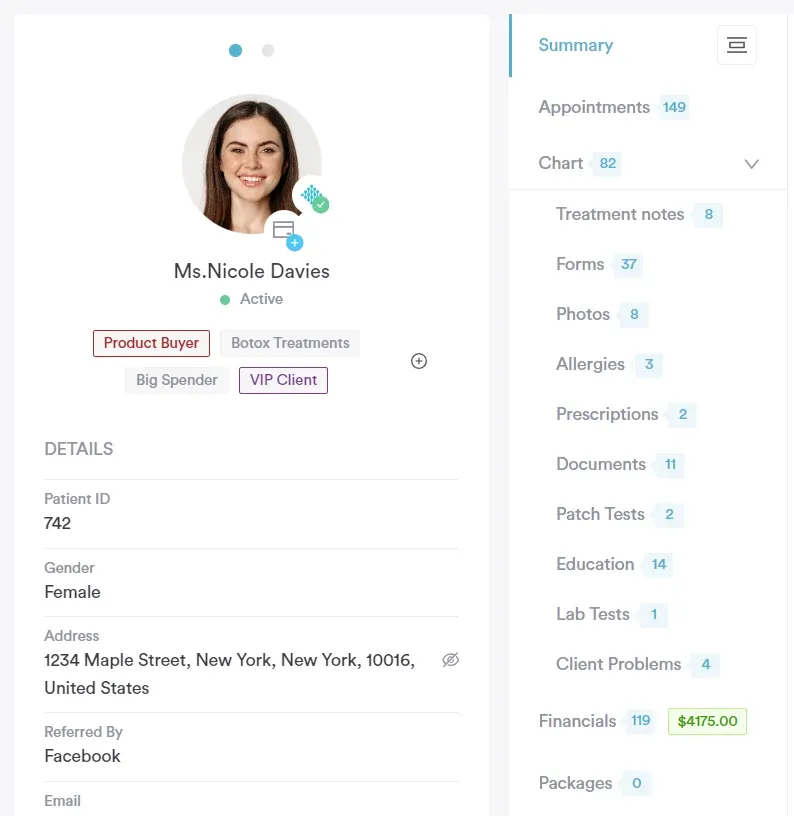
Pabau’s client record keeps notes, intake forms, prescriptions, and balances on one card, so a therapist stops hunting across systems mid-session.
Pabau’s customizable digital forms matter most to mental health providers. Practices build their own therapy intake forms, consent documents, risk assessments, and progress note templates. Pabau Scribe, its built-in AI scribe, drafts structured clinical notes from voice or text input, which cuts post-session documentation time. Many practices anchor those notes to established worksheets, such as a polyvagal ladder for regulation work or a progressive muscle relaxation script for session handouts.
Telehealth is available on every plan tier rather than reserved for a premium one. Video consultations run on Pabau’s credit system, so a practice tops up credits to cover the sessions it delivers. Pabau Scribe usage works the same way.
Pabau’s AI checks a client’s medications against drug references and drafts the summary into their record, so prescribing risk is documented as you work.
Key features
AI-assisted clinical documentation: Pabau Scribe drafts session notes from voice dictation or typed prompts, with customizable templates for progress notes, treatment plans, and assessments
Customizable digital forms: Build therapy intake forms, consent documents, risk screening tools, and progress note templates in a drag-and-drop builder
Built-in telehealth: Integrated video consultations on every plan tier, with no third-party integration to manage and no premium upgrade to buy
Online booking: Client self-scheduling with automated SMS and email reminders, deposit collection, and cancellation policy enforcement
Client record management: One record per client covering medical history, treatment notes, uploaded documents, and clinical photos
Automated workflows: Recall campaigns, re-booking reminders, pre-appointment forms, and post-session aftercare messages run automatically
Invoicing and payment processing: Online payments, invoice generation, and package management built into the core platform
Multi-location support: Manage several practice locations, staff calendars, and permissions from a single account
Where Pabau shines
Multi-disciplinary flexibility: One platform runs the clinical and operational work of a practice that combines mental health with aesthetics, physical therapy, primary care, or wellness
Telehealth on every tier: Built-in video consultations come with every plan level, where competitors restrict telehealth to a premium tier or sell it separately
AI-assisted documentation: Pabau Scribe drafts structured clinical notes from voice or text, with prompts you can tune to therapy and psychiatric workflows
Marketing and patient acquisition tools: Recall campaigns, email and SMS marketing, a client portal, and booking widgets, with no separate marketing software
Every feature in one subscription: No feature sits behind a higher tier, so a growing practice gets telehealth, marketing, and AI notes at every level
Where Pabau falls short
Learning curve: The depth of the feature set means new users typically need two to four weeks to get comfortable, especially without dedicated admin staff
No native e-prescribing for controlled substances: Pabau does not support DEA-compliant EPCS workflows, which rules it out for psychiatry practices prescribing controlled medications regularly
Less purpose-built for psychiatry: ICANotes and TherapyNotes align more closely out of the box with psychiatric workflow patterns and DSM-aligned documentation
Customer reviews
According to Capterra reviewers, Pabau earns 4.7 out of 5. Users highlight the all-in-one functionality, the scheduling and online booking tools, and responsive support. Practices that combine mental health with other services cite the single workflow as their reason for choosing Pabau over a specialist alternative.
Who Pabau is best for
Multi-disciplinary practices combining mental health therapy with aesthetics, physical therapy, or wellness services
Psychology and counseling practices that want AI-assisted note-taking and automated client communications in one platform
Group practices that want every feature included as the team grows, rather than paid module by module
Mental health practices that also need strong front-desk tools, including online booking, deposits, and marketing automation
Pricing
Plan
Price
Who it’s for
Key inclusions
Per user, per location
From $69/user per month
Solo to multi-location practices
Every feature included, with telehealth, AI notes, automation, and multi-location support
Pabau prices per user and per location, and every tier carries every feature. Telehealth and Pabau Scribe run on credits you top up, and Plus add-ons are optional.
SimplePractice: Best mental health EHR for solo practitioners
Rating4.6/5★★★★★
The bottom line
The most polished therapy EHR on this list, until per-practitioner fees start stacking up.
Who it’s for
Solo therapists, counselors and psychologists
Small psychotherapy groups of two to five clinicians
Website builder and client acquisition tools included
What doesn’t
$74 per additional practitioner on the Plus plan
Telehealth only on the Plus plan
Little room for non-therapy services
SimplePractice is the most widely used EHR in the therapy and counseling space, serving hundreds of thousands of health and wellness professionals. Therapists pick it for the interface, which keeps daily clinical work feeling manageable rather than bureaucratic. For a solo therapist or a small psychotherapy group, it covers the job without unnecessary complexity.
SimplePractice sells to solo private practice first, and its 250,000-practitioner base is why most therapists meet this platform before any other.
Key features
Scheduling and client portal: Online appointment requests, automated reminders, and a client-facing portal for forms and messaging
Built-in telehealth: Native video sessions on HIPAA-compliant infrastructure, available on the Plus plan
AI note-taker: AI-assisted documentation that transcribes and structures therapy session notes
Billing and insurance: ERA and EOB processing, insurance billing, and online payment collection
Documentation templates: Pre-built progress note and treatment plan templates aligned to therapy workflows
Where SimplePractice shines
Industry-leading interface, consistently rated the most intuitive platform among solo therapists
Strong insurance billing, with ERA and EOB processing included from the Essential plan onward
Marketing extras, including a website builder and client acquisition tools aimed at growing a therapy caseload
Where SimplePractice falls short
Per-practitioner pricing at $74 a month for each clinician after the first makes it expensive for a growing group
Limited customization outside therapy, so a practice that adds other services quickly hits constraints
Telehealth restricted to the Plus tier rather than available on all plans
Customer reviews
According to Capterra reviewers, SimplePractice scores 4.6 out of 5. The most consistent praise goes to its ease of use and the quality of its telehealth experience. Group practice owners note that cost scales steeply with team size.
Who SimplePractice is best for
Solo therapists, counselors, and psychologists in private practice
Small group practices of two to five clinicians working only in psychotherapy and counseling
Pricing
Plan
Price
Who it’s for
Key inclusions
Starter
$49/month
Solo clinicians starting out
Scheduling, notes, client portal, payments
Essential
$79/month
Solo practices billing insurance
Adds ERA and EOB processing
Plus
$99/month, plus $74 per extra practitioner
Solo and group practices
Adds telehealth and group scheduling
ePrescribe add-on
$49/month
Prescribing clinicians
E-prescribing, plus a one-time $89 setup fee
SimplePractice discounts the first three months by half on every plan, and groups of six or more practitioners are quoted custom pricing instead.
TherapyNotes: Best behavioral health EHR for documentation-heavy practices
Rating4.7/5★★★★★
The bottom line
The best behavioral health notes on this list, with billing built around mental health claims.
Who it’s for
Therapists who rank documentation quality first
Behavioral health groups with heavy insurance billing
Claims and ERA workflows built for mental health codes
Support with a strong reputation for responsiveness
What doesn’t
$50 per additional clinician on the group plan
Telehealth sits in a premium add-on
Almost no marketing or acquisition tools
TherapyNotes occupies a specific niche. It is built almost entirely around therapists who want excellent notes and reliable billing, without extra modules in the way. It is tied for the highest Capterra rating on this list, driven by note template quality and the simplicity of its design. Where documentation speed is the main pain point, TherapyNotes is a serious contender. Its templates often draw on standard tools like a primary emotions list or a primary and secondary emotions worksheet for building patients’ vocabulary.
TherapyNotes positions itself squarely as a behavioral health EHR, and the product scope stays deliberately close to notes, scheduling, and claims.
Key features
Behavioral health note templates: Pre-built progress notes, treatment plans, and intake forms aligned to psychotherapy and psychiatric workflows
Insurance billing: Claims submission, ERA processing, and billing workflows designed for mental health codes
Telehealth: Built-in HIPAA-compliant video sessions, available as a premium add-on
Scheduling and client reminders: Appointment management with automated reminders and a client portal for form completion
Secure messaging: HIPAA-compliant messaging between practitioners and clients
Where TherapyNotes shines
Tied for the highest user satisfaction rating on this list at 4.7 out of 5 on Capterra, driven by ease of use and template quality
Strong billing workflows built specifically around mental health CPT codes and insurance claims
Reliable customer support, with a reputation for responsive assistance
Where TherapyNotes falls short
Per-clinician pricing adds up for larger groups, at $50 a month for every clinician after the first
Limited marketing or patient acquisition tools compared with SimplePractice or Pabau
Not designed for multi-specialty or mixed-service practices
Customer reviews
According to Capterra reviewers, TherapyNotes scores 4.7 out of 5. Reviewers consistently highlight the quality of its behavioral health forms and templates. They also note that its billing workflow handles mental health insurance claims more cleanly than many general-purpose EHRs.
Who TherapyNotes is best for
Individual therapists, psychologists, and counselors who put documentation quality first
Behavioral health group practices where insurance billing complexity is the main operational challenge
Pricing
Plan
Price
Who it’s for
Key inclusions
Solo
$69/month
Individual practitioners
Notes, scheduling, billing, client portal
Group
$79/month, plus $50 per extra clinician
Group practices
Multi-clinician access, group billing, unlimited non-clinical users
The group plan bills per clinician, so a five-clinician practice pays $279 a month at list price, with non-clinical staff accounts included.
Valant: Best EHR for behavioral health group practices
Rating3.9/5★★★★★
The bottom line
Valant puts validated outcome measures inside the clinical workflow, which few behavioral health EHRs do.
Who it’s for
Behavioral health groups of five or more providers
Valant was built specifically for behavioral health solo and group practices. Its defining feature is outcome measurement, which many general-purpose EHRs leave out.
Validated instruments such as PHQ-9, GAD-7, and PCL-5 sit directly in the clinical workflow, so clinicians track treatment progress without switching systems. A group practice that has to demonstrate clinical outcomes draws its reporting from that data without extra work. Practices treating perinatal patients often pair those scores with take-home material, such as a postpartum depression handout, to support the conversation after screening.
Key features
Outcome measurement tools: Validated screening instruments built into the clinical workflow for tracking patient progress
Behavioral health scheduling: Group appointment management built for multi-provider behavioral health practices
Clinical documentation: Note templates and treatment planning tools designed for psychiatric and therapy workflows
Insurance billing: Claims management and ERA processing built for behavioral health coding
Where Valant shines
Built specifically for behavioral health, with validated outcome measurement inside clinical workflows
Strong group scheduling and multi-provider management for larger behavioral health teams
Where Valant falls short
Lower user satisfaction rating at 3.9 out of 5 on Capterra, below most alternatives here
Steeper learning curve and a higher price point than solo-focused alternatives
Customer reviews
According to Capterra reviewers, Valant earns 3.9 out of 5. Users praise the behavioral health focus and the outcome tools. They also note that the platform needs significant onboarding investment and costs more than competitors.
Who Valant is best for
Behavioral health group practices of five or more providers that need integrated outcome measurement
Practices serving Medicare and Medicaid populations where clinical outcome data is required
Pricing
Plan
Price
Who it’s for
Key inclusions
Custom
No published pricing, contact sales
Behavioral health group practices
Full behavioral health EHR, outcome tools, billing, scheduling
Valant publishes no prices at all, so you need a quote before you can compare it on cost with the platforms above.
Pro Tip
Before you shortlist any platform, run a documentation test with your own workload. Ask each vendor for hands-on access or a guided walkthrough, then complete five full session note cycles. Cover scheduling, note creation, billing code assignment, and claim submission each time. Platforms that feel smooth in a demo often behave differently under a full caseload.
TheraNest: Most affordable mental health EHR for solo and small teams
Rating4.4/5★★★★★
The bottom line
The cheapest route onto a purpose-built mental health EHR, now sold per therapist by Ensora Health.
Who it’s for
Solo therapists with smaller caseloads
Small teams watching the monthly software bill
Practices that want Wiley treatment planning content
Wiley Practice Planner included on the Premier plan
Client portal for scheduling and messaging
What doesn’t
Interface feels dated next to newer platforms
Fewer integrations than AdvancedMD or SimplePractice
Telehealth is an add-on on the entry plan
TheraNest is now part of Ensora Health, the company Therapy Brands rebranded to in 2025. It is a purpose-built mental health EHR priced per therapist, which keeps the entry cost low for a solo practice. Wiley Practice Planner content is what separates it from cheaper rivals, for practices working from evidence-based treatment planning frameworks. Practices without Wiley access can use standalone tools instead, such as a problem solving worksheet for CBT sessions or a power and control wheel.
TheraNest now sits inside the Ensora Health product line, so support articles and billing paperwork arrive under the newer brand name.
Key features
Wiley Practice Planner: Standardized evidence-based treatment planning content, included on the Premier plan
Telehealth: Unlimited individual and group video sessions from the Advanced plan, and an add-on on Essentials
Billing and invoicing: Insurance claims, eligibility checks, and billing automation on the higher tiers
Client portal: Appointment scheduling, form completion, and secure messaging for clients
Where TheraNest shines
The lowest entry price in this comparison at $29 per therapist per month
Wiley Practice Planner gives Premier-plan practices evidence-based treatment frameworks without leaving the EHR
Where TheraNest falls short
The interface draws criticism for feeling dated compared with more modern alternatives
Fewer integrations and less ecosystem depth than AdvancedMD or SimplePractice
Customer reviews
According to Capterra reviewers, TheraNest scores 4.4 out of 5. Users appreciate the purpose-built mental health focus and the low entry price. Some note that the interface design lags behind newer competitors.
Who TheraNest is best for
Solo therapists and counselors with smaller caseloads who want affordable, purpose-built software
Practices that work from evidence-based treatment planning tools such as the Wiley Practice Planner
Pricing
Plan
Price
Who it’s for
Key inclusions
Essentials
$29/therapist per month
Solo therapists starting out
Scheduling, client portal, basic intake forms and notes
The prescribing plan costs $213 per full-time clinician
Telehealth costs $20 per user each month
ICANotes was designed by a practicing psychiatrist, and that origin shows throughout the platform. Its menu-driven note system follows the clinical reasoning of a psychiatric evaluation rather than adapting a general medical EHR. That evaluation-first design extends to structured diagnostic checklists too, such as psychopath criteria for antisocial personality disorder assessment.
That makes it the strongest choice here for practices where prescribing sits at the center of the workflow. It is also a frequent pick when clinicians compare the best EHR for psychiatry.
DEA-compliant EPCS is supported natively, which matters for any practice managing patients on Schedule II and III medications. ICANotes also integrates with labs and pharmacies, and includes an AI layer that helps complete behavioral health records faster.
Key features
DEA-compliant EPCS: E-prescribing of controlled substances with full DEA compliance, essential for psychiatric prescribing
Psychiatrist-designed note templates: Menu-driven documentation built around psychiatric evaluation and treatment patterns
Lab and pharmacy integrations: Order labs and send prescriptions from inside the EHR
Telehealth: Integrated video sessions for remote psychiatric consultations, priced as a $20 monthly add-on per user
AI documentation assistance: An AI Scribe add-on that speeds up notes without sacrificing clinical specificity
Where ICANotes shines
DEA-compliant EPCS for controlled substance prescribing, which makes it the top choice for psychiatry practices that prescribe
Clinical depth in its note templates, designed by a psychiatrist rather than adapted from generic ones
Where ICANotes falls short
The menu-driven interface can feel outdated compared with more modern platforms
Less suited to therapy-only or non-prescribing mental health workflows
Customer reviews
According to Capterra reviewers, ICANotes scores 4.7 out of 5. Psychiatrists consistently cite the depth and specificity of its clinical templates as the defining strength. Some users note that the interface feels less modern than alternatives.
Who ICANotes is best for
Psychiatry practices where e-prescribing of controlled substances is a core clinical requirement
Behavioral health providers managing complex patients with significant medication management
Pricing
Plan
Price
Who it’s for
Key inclusions
Notes Only
$55/month full-time, $35 part-time
Non-prescribing clinicians
Clinical notes only
Non-prescribing
$75/month full-time, $45 part-time
Therapists needing scheduling and billing
Adds scheduling, messaging, and billing
Prescribing
$213/month full-time, $138 part-time
Psychiatrists and other prescribers
Adds e-prescribing and lab ordering, plus a $99 activation fee
Add-ons
Telehealth $20, AI Scribe $49
Any plan
Priced per user, per month
ICANotes prices per clinician and separates prescribers from non-prescribers, so a psychiatry practice pays roughly three times what a therapy-only practice pays.
AdvancedMD: Full-suite mental health EHR for behavioral care
Rating3.6/5★★★★★
The bottom line
A full revenue cycle suite for mental health practices with enough billing complexity to justify it.
Who it’s for
Mental health groups of five or more providers
Practices with dedicated billing staff
Psychiatry practices needing EPCS and RCM together
PricingFrom $130/monthper provider, mental health plan
AdvancedMD targets the upper end of the mental health market. It serves solo and small practices of one to three providers, as well as larger organizations that need a full revenue cycle management suite.
Teletherapy is standard on its mental health plans, which sets it apart from platforms that reserve video sessions for premium tiers. The trade-off is complexity. AdvancedMD carries more moving parts than any other platform here, and its satisfaction scores reflect the onboarding involved.
AdvancedMD leads with general medical office management, and behavioral health is one specialty edition inside that wider suite.
Key features
Full RCM suite: End-to-end revenue cycle management, including claims, ERA and EOB handling, denial management, and financial reporting
Teletherapy: Video sessions included as standard on mental health plans
E-prescribing: Included on mental health plans, with DEA-compliant EPCS priced at $35 a month
EHR charting: Customizable templates and documentation workflows for psychiatric and therapy practices
Patient portal: Online forms, appointment requests, and secure messaging
Where AdvancedMD shines
A full RCM suite for practices with complex insurance billing, prior authorization workflows, and denial management needs
Teletherapy included as standard on mental health plans rather than sold as a paid add-on
Where AdvancedMD falls short
The lowest user satisfaction score on this list at 3.6 out of 5 on Capterra, with frequent mention of complex onboarding
A higher cost point relative to those scores, hard to justify unless the practice needs the full RCM suite
Customer reviews
According to Capterra reviewers, AdvancedMD scores 3.6 out of 5. Users in larger practices with dedicated billing staff rate it higher than solo and small team users, who find the complexity disproportionate to their needs.
Who AdvancedMD is best for
Larger mental health practices of five or more providers with dedicated billing staff and complex insurance workflows
Psychiatry practices that need both DEA-compliant EPCS and robust RCM in a single system
Pricing
Plan
Price
Who it’s for
Key inclusions
Mental health, small practice
From $130/provider per month
Small mental health practices
EHR, practice management, client engagement, teletherapy
Mental health, larger practice
Up to $399/provider per month
Larger and group mental health practices
Adds the full RCM suite and group workflows
EPCS add-on
$35/month
Prescribing providers
Controlled substance e-prescribing with PDMP registry integration
AdvancedMD prices per provider, so the $130 entry rate suits a small practice while larger groups sit closer to the $399 end.
How to choose the right platform for your practice
No single platform is right for every mental health practice. The answer depends on your practice model, clinical mix, and growth plans, and for many teams the EHR doubles as their software for therapy practices. Work through these five criteria before you commit to a vendor.
Do you prescribe? If your practice includes psychiatrists managing patients on controlled substances, DEA-compliant EPCS is non-negotiable. ICANotes and AdvancedMD offer it, so confirm EPCS support directly with any platform your prescribers will use. The therapy-focused platforms here suit non-prescribing workflows better.
What is your practice mix? Therapy-only practices can choose any platform on this list. A practice combining mental health with aesthetics, physical therapy, wellness, or primary care needs a platform designed for mixed specialties, such as Pabau. Purpose-built behavioral health tools will not adapt to your non-therapy services.
How does your practice grow? Every platform here bills per clinician or per user, so your cost tracks headcount. Calculate the bill at five providers before you sign, not at one. Multi-site groups face further scaling questions, which our guide to multi-franchise mental health EHR setups covers.
What is your billing complexity? Private-pay and mixed-billing practices can use any platform that handles invoicing and basic claims. Practices leaning heavily on Medicare, Medicaid, or commercial insurance benefit from a full RCM suite. AdvancedMD has the most depth there, particularly on prior authorizations and denials.
How much onboarding capacity do you have? TherapyNotes and TheraNest are the simplest to learn, with SimplePractice close behind. Pabau, Valant, and AdvancedMD all need more structured onboarding. Without dedicated admin staff to run the implementation, start simpler and migrate as you grow.
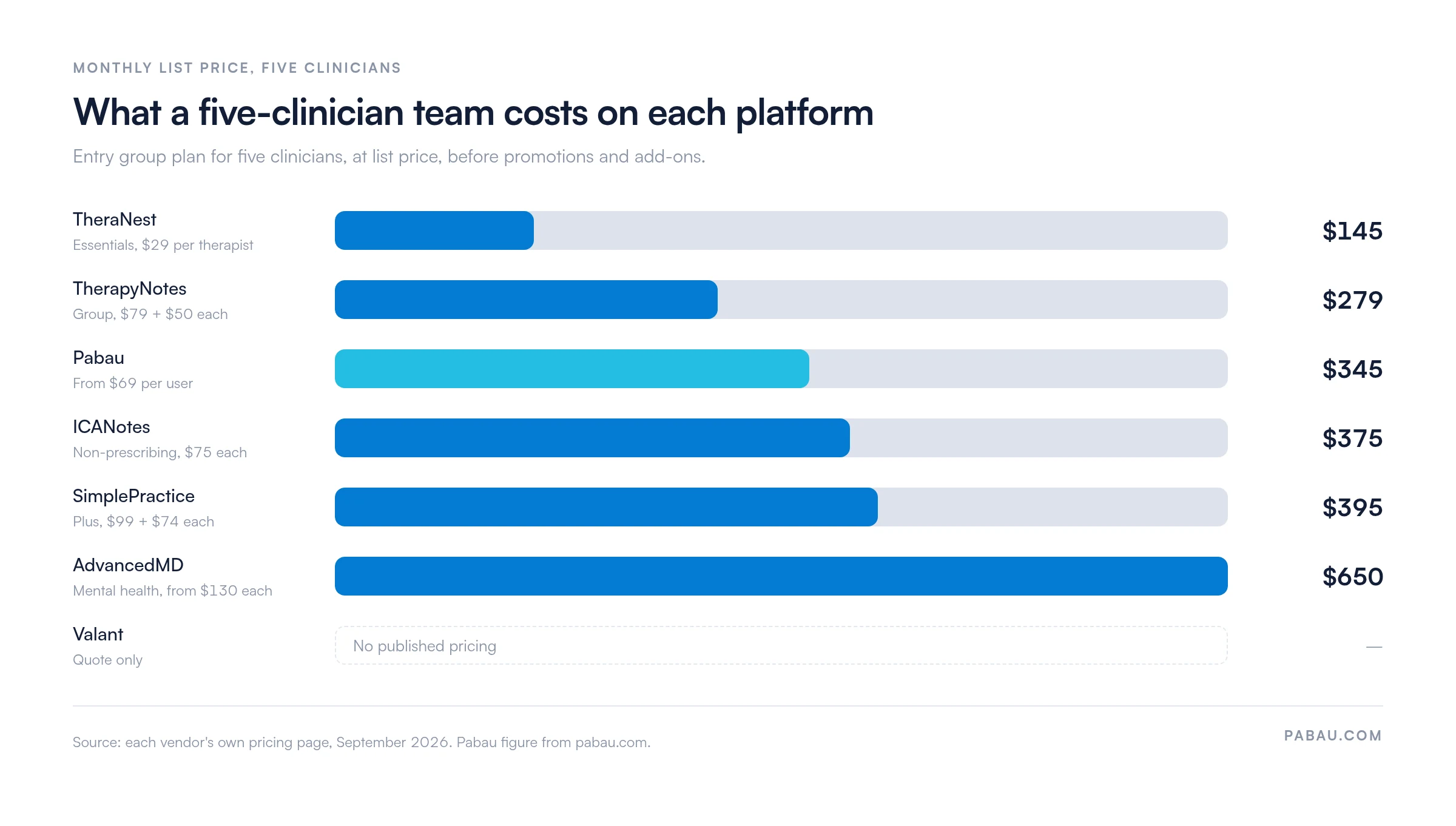
Criterion three deserves the arithmetic before you shortlist anyone. Entry prices here span $29 to $130 per clinician a month. At five clinicians, on each vendor’s own list pricing, that spread becomes a range from $145 to $650 a month.
A five-clinician team costs 4.5 times more on AdvancedMD than on TheraNest, on each vendor’s own list pricing for a comparable group plan.
Each figure uses the cheapest plan that gives five clinicians scheduling and billing, at list price, before discounts. ICANotes lands at $375 on its $75 Non-prescribing tier, because its $55 Notes Only plan covers clinical documentation alone.
Telehealth, e-prescribing, and AI notes cost extra on several of these platforms, so price the plan you will run day to day. Weigh the front desk as heavily as the charting too. Scheduling, reminders, deposits, and client communications create as much operational overhead as session notes do.
How Pabau handles mental health documentation and scheduling
In most mental health practices, the clinical record and the front desk live in different tools. Notes sit in the EHR, deposits and reminders sit in a booking system, and recall lists sit in a spreadsheet. Every handoff between them is a chance for a session to go unbilled or a form to arrive unsigned.
Pabau runs both sides from one client record. Intake forms, risk screens, and consent documents go out before the appointment and file themselves against the client. Pabau Scribe drafts the session note from voice or text, so documentation closes while the session is still fresh. Reminders, deposits, and rebooking prompts run on automations rather than on someone’s memory.
For a practice that also treats non-therapy clients, that matters more than any single feature. One calendar, one client record, and one subscription cover therapy alongside aesthetics, physical therapy, or wellness services. The practice adds a service line without adding another system to reconcile.
See how Pabau supports mental health and multi-disciplinary practices
AI-assisted clinical notes, built-in telehealth, automated client communications, and digital intake forms run from one platform. Mental health practices get the infrastructure to grow without adding admin complexity.
Pick the platform that matches how your practice is built, not the one with the longest feature list. TherapyNotes and SimplePractice lead for therapy-focused practices. ICANotes and AdvancedMD lead where prescribing drives the workflow. Pabau is the strongest foundation for practices that mix mental health with other services.
Whichever way you lean, run the five-clinician arithmetic before you sign. A platform that looks cheap for one therapist can become the most expensive line in your budget two hires later. Migration costs far more than the subscription you were trying to save on.
Pabau Scribe cuts post-session documentation time, and telehealth is available on every plan tier. The multi-industry design means a practice can add service lines without changing systems. Book a demo to walk through your own clinical scenarios with someone who knows mental health workflows.
Continue your research
Running a psychiatry practice and need structured evaluation templates?Psychiatric Evaluation Template provides a step-by-step guide for comprehensive mental health assessments that complement any EHR system.
Choosing an EHR for your therapy practice?Best EHR for therapists guide compares seven platforms on documentation, billing, and scheduling to help you avoid costly mismatches.
Managing a multi-disciplinary practice that includes therapy alongside other services?Pabau Mental Health EMR outlines how an all-in-one platform supports mixed-specialty mental health workflows.
Looking for a validated personality assessment tool?Dark core personality test gives practitioners a scored, standardized instrument for evaluating dark personality traits.
Frequently asked questions
What is the best EHR for mental health private practice?
For solo therapists and psychologists in private practice, SimplePractice and TherapyNotes are the two most widely used options. Their Capterra ratings are 4.6 and 4.7 respectively. SimplePractice suits practices that also want marketing and client acquisition tools. TherapyNotes suits practices where documentation quality and insurance billing come first. Multi-disciplinary private practices that combine therapy with other services should evaluate Pabau.
What features should a mental health EHR have?
At minimum: HIPAA-compliant data storage, behavioral health note templates, insurance billing with mental health CPT code support, scheduling with automated reminders, and a client portal. Psychiatry practices also need DEA-compliant e-prescribing and lab ordering. If you deliver telehealth, check whether video sessions are included in the base plan or charged as an add-on.
Which EHR is best for psychiatry specifically?
ICANotes is the strongest option for psychiatry, because it was designed by a practicing psychiatrist and supports DEA-compliant EPCS natively. AdvancedMD also supports EPCS and adds a full RCM suite for larger practices. For psychiatry practices that do not prescribe controlled substances, TherapyNotes and SimplePractice offer strong documentation and billing at a lower cost.
What is the difference between an EHR and practice management software for therapists?
An EHR focuses on clinical documentation: session notes, treatment plans, diagnoses, and medical history. Practice management software handles the operational side: scheduling, billing, invoicing, and staff management. Most platforms marketed as mental health EHRs now include both. Some, such as Pabau, add marketing automation, client acquisition tools, and multi-location management on top.
Is SimplePractice HIPAA compliant?
Yes. SimplePractice provides HIPAA-compliant infrastructure, including a Business Associate Agreement, encrypted data storage, and secure messaging. HIPAA compliance is a baseline requirement rather than a differentiator, since all seven platforms here provide HIPAA-aligned infrastructure. Verify that the specific plan tier you intend to buy includes the BAA, and that your third-party integrations are covered too.
Is there a free EHR for mental health?
No free EHR covers the documentation, billing, and telehealth a working practice needs. Some vendors offer limited free trials. The practical entry point is a low-cost tier such as TheraNest Essentials, at $29 per therapist per month. Free tools tend to lack HIPAA-grade infrastructure and mental health note templates, so they rarely hold up as a caseload grows.
What is the cheapest EHR for therapists?
TheraNest is the cheapest entry point here at $29 per therapist per month on its Essentials plan. SimplePractice starts at $49 a month and TherapyNotes at $69 a month for a single clinician. Watch the per-clinician rates, though: a cheap solo plan can become the most expensive option once you add a few therapists.