Professional development record
A professional development record is a structured log of a healthcare practition...

8
Last Updated: Oct 8, 2026

AI in healthcare compliance automates regulatory monitoring, documentation checks, and billing reviews, reducing manual burden for practice teams.
HIPAA, GDPR, and the EU AI Act each impose distinct obligations when deploying AI tools, and practices need a Business Associate Agreement with every AI vendor handling protected health information.
Algorithmic bias, black-box decision logic, and third-party data exposure are the three biggest compliance risks practices face when adopting AI tools.
Pabau’s AI-powered documentation and audit trail features keep clinical records within a single GDPR and HIPAA-aware environment, so compliance stays built into daily workflows.
AI in healthcare compliance — what many vendors now market simply as compliance AI — is already inside the documentation, billing, and scheduling workflows of thousands of practices, whether those practices intended it to be there or not. Medical spa compliance requirements alone have expanded significantly, and AI tools are arriving faster than most governance structures can absorb them.
This guide covers how AI is being used across clinical compliance functions, the regulatory frameworks that govern it, the risks that most practices underestimate, and the concrete steps practice owners can take to adopt AI compliantly.
AI does not approach compliance the way a human auditor does – it runs continuously, processes far more data, and flags inconsistencies the moment they occur rather than weeks later. For practice owners, that shift changes the economics of staying compliant.
Three areas are seeing the most immediate impact:
For a practice manager overseeing a five-clinician med spa, this means fewer missed documentation fields, fewer denied claims, and fewer compliance issues surfaced during an audit cycle.
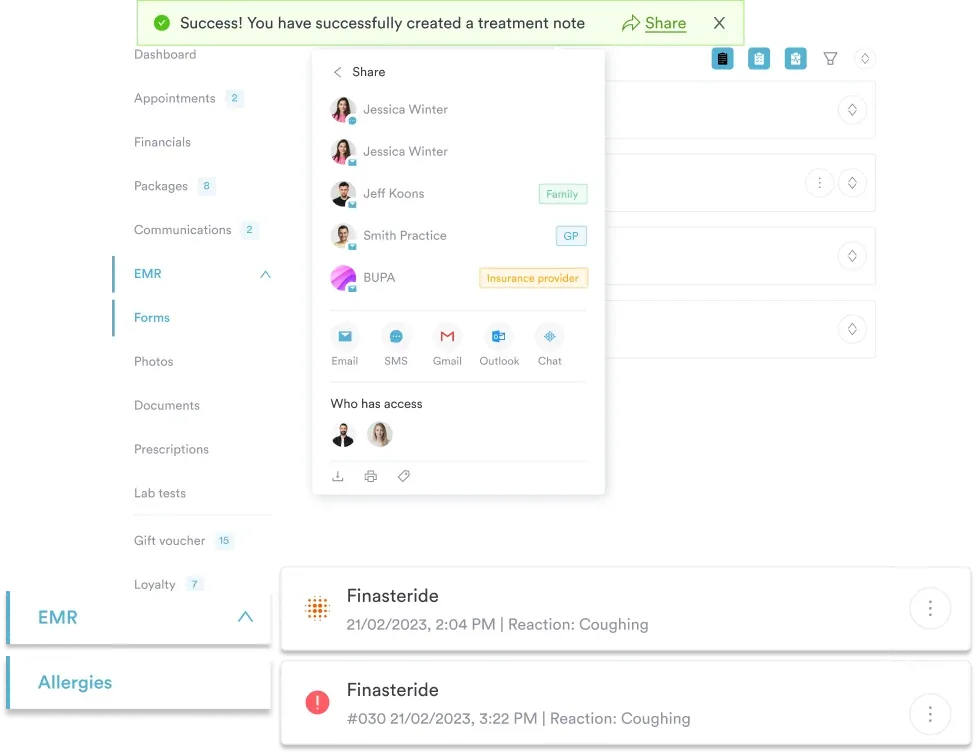
AI also improves audit trail integrity. Every interaction with an electronic health record (EHR) can be timestamped and logged automatically, creating the kind of granular evidence trail that regulators expect. Client record management systems with built-in audit logging make this far easier to maintain consistently across a full team. An AI EMR extends this audit trail further, logging every AI-generated entry alongside standard documentation automatically.
Understanding the regulatory landscape is where most practice-level AI compliance conversations break down. Three separate frameworks now intersect whenever AI tools touch patient data – and they impose meaningfully different obligations.
| Framework | Jurisdiction | Key AI obligation |
|---|---|---|
| HIPAA | United States | BAA required with any AI vendor processing protected health information (PHI); minimum necessary standard applies to data fed into AI models |
| GDPR | EU / UK | Lawful basis required for AI processing of special-category health data; data subject rights (access, erasure) must be preserved |
| EU AI Act | European Union | High-risk AI systems in healthcare must undergo pre-deployment compliance assessments and post-market monitoring, per PMC peer-reviewed analysis |
For US-based practices, HIPAA is the starting point. Any AI vendor that accesses, stores, or processes PHI is classified as a business associate under HIPAA. A signed Business Associate Agreement (BAA) is not optional. The relationship between AI and HIPAA comes down to that one document: a vendor without a signed BAA cannot legally touch PHI, no matter how strong its bias testing or explainability documentation looks. Practices considering whether med spas have to be HIPAA-compliant will find the answer is yes in almost every state, and AI tools do not create an exemption.
UK and EU practices face additional obligations under GDPR. Health data is special-category data under Article 9 of the UK and EU GDPR, which means processing it requires a specific legal basis beyond standard consent. When an AI tool processes patient notes or clinical histories, the practice is the data controller and bears full responsibility for ensuring the AI vendor’s processing is lawful.
The EU AI Act adds a third layer. According to a PMC peer-reviewed analysis of AI regulatory challenges in healthcare, high-risk AI systems used in medical contexts are obligated to undergo pre-deployment compliance assessments and post-market monitoring. Clinical decision support tools and AI note-generation systems that influence clinical outcomes may fall into the high-risk category, depending on their function.
State-level AI legislation is also emerging, and it moves faster than any single BAA can keep pace with. Illinois HB 1806 establishes restrictions on AI use in mental health therapy contexts, according to reporting by SimplePractice. Practices operating across multiple US states need jurisdiction-specific reviews of how AI in healthcare regulation applies locally, since a single BAA does not satisfy state-specific requirements.
AI does not automatically reduce compliance risk – deployed without governance, it creates new categories of exposure. NAVEX identified three specific risk vectors in their 2025 analysis of AI in healthcare compliance: bias amplification, disruption of internal controls, and regulatory exposure through insufficient oversight.
Healthcare AI governance structures matter here, and building them is the practice’s job, not the vendor’s. In September 2025, The Joint Commission and the Coalition for Health AI (CHAI) issued AI implementation recommendations, with the Harvard Gazette noting that the compliance burden falls primarily on individual facilities. Practices need oversight committees, documented testing protocols, and staff training that addresses AI-specific risks – not just generic data security training.
Audit every AI tool your practice uses against three questions: Does the vendor provide a BAA? Can you explain how the tool makes its determinations? Does the vendor’s data processing agreement explicitly restrict use of your patients’ data for model training? If any answer is no, escalate before the next contract renewal.

Pabau keeps your clinical documentation, audit trails, and patient records inside a single GDPR and HIPAA-aware platform, so compliance is built into how your team works, not bolted on afterward.

Practices that adopt AI tools reactively, without a structured framework, face the highest risk. The following steps reflect the approach recommended by legal and compliance professionals reviewing AI in healthcare compliance deployments at the practice level.
Maintaining HIPAA compliance with a growing AI stack means treating healthcare compliance auditing as an ongoing cycle rather than an annual event. Reviewing patient data security tools as part of that cycle ensures your AI vendor landscape stays current with evolving standards. Annual reviews are no longer sufficient for fast-moving AI deployments – quarterly checks are becoming the norm for practices with more than three AI-integrated systems.
Not every AI compliance tool sold to practices is built for healthcare. Plenty are general-purpose automation software with a compliance label attached, and the difference matters the moment PHI enters the system.
A common version of this question is “is OpenAI HIPAA compliant,” and the answer is the same for any generative AI vendor: it depends entirely on whether a signed BAA is in place, not on the vendor’s size or popularity. The same test applies to every AI tool a practice considers, from a scheduling assistant to a full clinical documentation platform.
Before signing with any HIPAA compliance solutions vendor, confirm three things in writing: a signed BAA that names AI processing specifically, a data processing agreement that restricts your patient data from being used to train the vendor’s models, and a documented explanation of how the tool reaches its outputs. A vendor that cannot produce all three isn’t ready for a healthcare practice, regardless of what its marketing promises.
Practice management software like Pabau is not a passive container for compliance – it is either part of your compliance infrastructure or a weakness in it. Healthcare compliance software works best as a property of the system a practice already uses for scheduling, billing, and clinical notes, rather than a separate app bolted on afterward. Pabau integrates AI-assisted clinical documentation directly within its platform, which means the AI operates inside the same GDPR and HIPAA-aware environment as the rest of the clinical record, rather than passing data to an external tool with separate governance obligations.
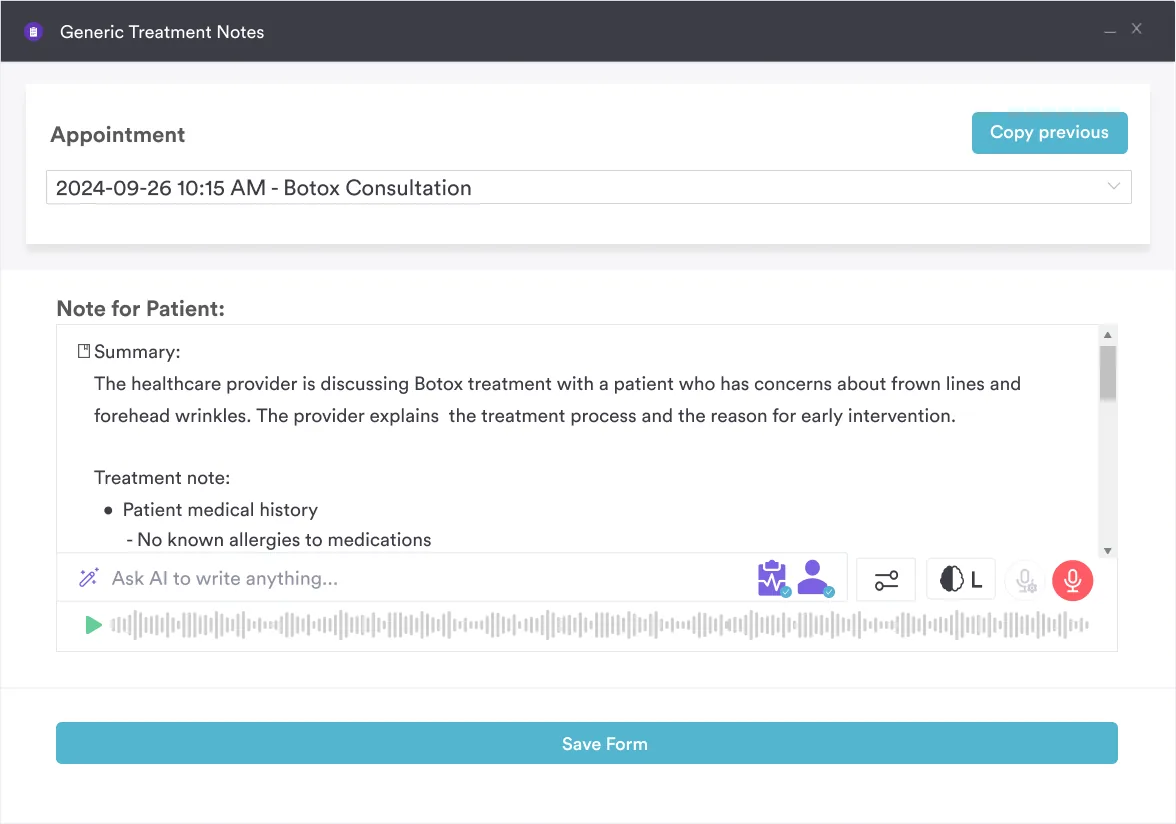
Pabau’s AI-powered clinical note generation, Pabau Scribe, captures structured clinical notes from practitioner input, reducing transcription time while keeping all note data inside the platform’s audit trail. Every clinical record interaction is logged automatically, creating the evidence chain that regulators expect. This matters specifically for practices subject to CQC inspections in England or ICO audits in the UK, where audit log completeness is a direct inspection criterion.
Because Pabau Scribe runs inside Pabau rather than as a separate app connected by an API key, there’s no second BAA to chase and no second vendor’s data-training policy to check – the governance is the same as the rest of the clinical record.
We introduced Pabau Scribe as a built-in feature so documentation and compliance would live in one environment.
Documentation is not the only compliance surface AI touches. For practices concerned about data privacy, digital intake and consent forms managed within Pabau keep the full patient consent record attached to the clinical file rather than fragmented across paper forms and external e-signature tools. This supports both GDPR accountability obligations and the HIPAA requirement to document patient authorizations.
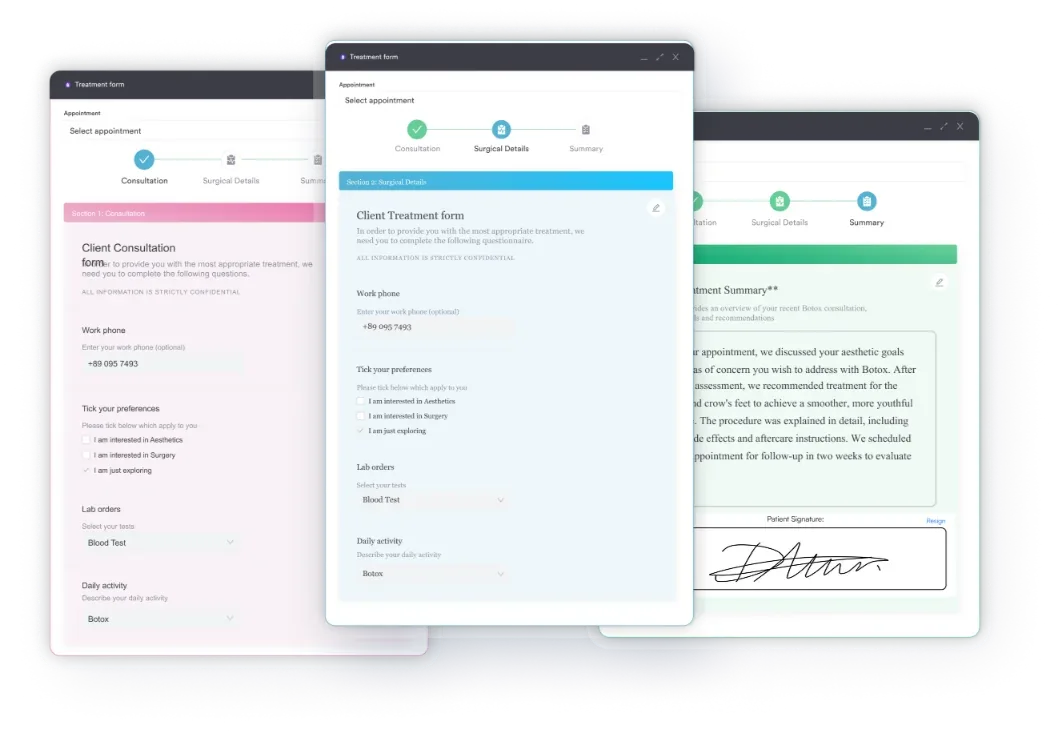
Practices operating in the aesthetic, wellness, and multi-disciplinary space often face compliance requirements that generic software does not address – specific treatment consent documentation, before-and-after photo governance, and prescription audit trails. A single platform that handles all of these inside one governance structure is materially different from stitching together five point solutions, each with its own data processing agreements.
Check whether your current practice management software provides a BAA as standard, covers AI feature data flows explicitly in its DPA, and maintains an audit log of all clinical record access. If any of these are missing, your compliance exposure extends beyond your AI tools to your core software platform.
AI in healthcare compliance has moved from an enterprise concern to a daily operational reality for individual practices. The tools are already inside documentation workflows, billing systems, and scheduling platforms. The question is no longer whether to engage with AI compliance obligations, but how to do it without creating new risk in the process.
Pabau’s built-in audit trail, GDPR and HIPAA-aware data architecture, and AI-assisted note generation give practices a compliance-first foundation that scales with their AI use. If you want to see how that works in practice book a live demo.

Curious how AI fits into your EMR? How an AI EMR works explains how artificial intelligence layered into an EMR helps create the record, not just store it.
Want to see how AI is changing the broader practice management picture? Best AI practice management tools reviews the current landscape of AI-integrated platforms for practices.
AI in healthcare compliance automates regulatory monitoring, documentation checks, billing code validation, and audit trail generation, reducing the manual effort required to stay aligned with HIPAA, GDPR, and CMS requirements. It catches errors in real time rather than in retrospective audits, which is particularly valuable for practices with small compliance teams.
AI tools can be HIPAA compliant when deployed correctly. The key requirement is a signed Business Associate Agreement (BAA) with any AI vendor that processes protected health information (PHI). HIPAA compliance is not an inherent property of an AI tool – it depends on how the tool is configured, what data it accesses, and whether the vendor’s data handling meets HIPAA standards.
The three most significant challenges are: demonstrating explainability when auditors ask how an AI system reached a decision, managing algorithmic bias in clinical or billing outputs, and maintaining compliant data flows when patient data passes through third-party AI vendors. State-level legislation, such as Illinois HB 1806 for mental health therapy contexts, adds a fourth layer of jurisdiction-specific risk.
Practices should inventory every AI tool in use, confirm BAA coverage for each US vendor handling PHI, apply HIPAA’s minimum necessary standard to AI data access, build explainability requirements into procurement contracts, and train staff on AI-specific compliance scenarios. Quarterly reviews are becoming standard for practices with more than three AI-integrated systems.
Yes, if the practice uses AI systems that qualify as high-risk under the Act and operates within or serves patients in the EU. The Act applies based on where AI systems are used and their risk classification, not the size of the organization. Clinical decision support tools and AI diagnostic aids may fall into the high-risk category, requiring pre-deployment assessments and ongoing post-market monitoring.