Facial skin treatment consent form template: Microneedling and phi-ion
A facial skin treatment consent form is the signed proof that a patient was scre...

2
Last Updated: Oct 21, 2026
An Obagi Blue Peel Radiance consent form records that your patient understood a salicylic acid peel before you applied it. Peel forms get copied between products, though, and a borrowed one can describe the wrong acid and the wrong recovery.
Blue Peel Radiance is a professional-only superficial peel. It pairs salicylic acid with small amounts of glycolic and lactic acid. Screening is the form’s biggest job. Recent isotretinoin, an active cold sore, pregnancy or a salicylate allergy all mean no peel that day.
Getting it right protects the patient’s skin and your indemnity. It also leaves a signed note that the patient expected flaking between days 2 and 5. Below are the screening questions, the prep window, a consent walkthrough and the aftercare to sign off.
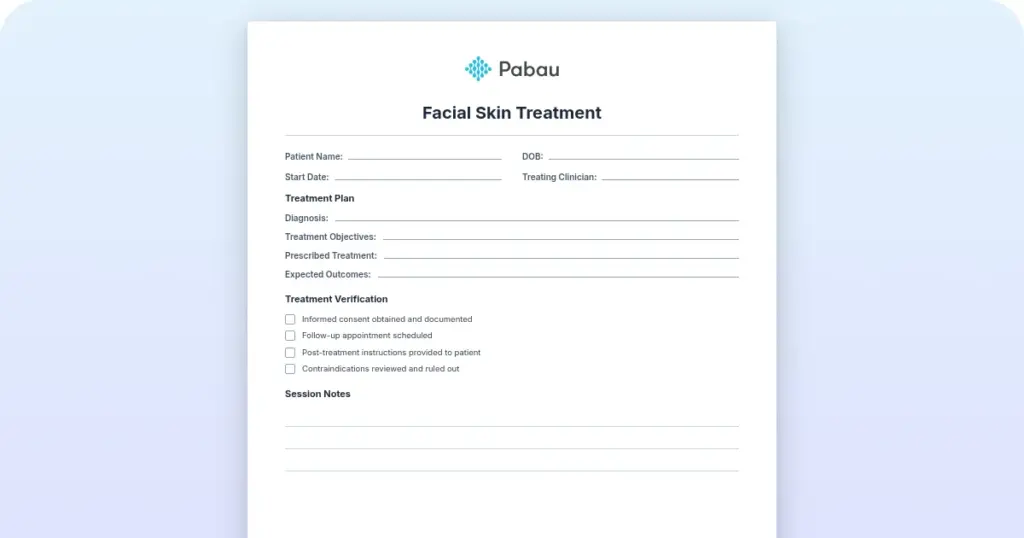
A three-page form covering patient details, yes/no screening questions, the prep window, and expected recovery and risks. It also has initialed aftercare commitments, photo consent, signatures and a treatment record for each session.
Download template
Blue Peel Radiance is a professional-only salicylic acid peel, so don’t borrow consent wording from TCA or enzyme peel forms.
Screen for isotretinoin in the past 12 months, active cold sores, pregnancy, salicylate allergy and radiation to the area.
Patients stop waxing and laser hair removal five to seven days before, and retinoids and acids three days before.
Flaking usually shows between days 2 and 5 and settles by day 7, so record that the patient heard this.
Re-check screening before every peel in a course, because one signature doesn’t cover a new prescription or pregnancy.
The form’s first job is to name the exact product, because Obagi sells several peels with near-identical names.
In September 2026, Obagi grouped them into a four-level Blue Peel Program. Blue Peel Radiance sits at Level 3. The original Blue Peel, a deeper TCA peel, sits at Level 4.
Each level carries different risks and a different recovery. A TCA form overstates what a Radiance patient should expect. An enzyme peel form may promise no visible peeling at all. Either way, the signature ends up attached to the wrong treatment.
Obagi also restricts Radiance to licensed medical professionals. That means a physician, or a nurse or esthetician working under a physician’s supervision. What counts as supervision depends on your state in the US, and on qualification in the UK.
Screening decides whether the peel happens at all, so it deserves the most space on the form. Ask every question out loud, even when the patient has already ticked the boxes online.
These don’t rule the patient out, but each one needs a note on the form. Record what you discussed and what you changed.
Send prep instructions when the patient books, because check-in is too late to fix them. A patient who waxed their upper lip two days ago can’t be peeled, however well the consultation went.
Five to seven days before, the patient stops laser hair removal, waxing, depilatory creams and electrolysis on the area.
Three days before, they stop topical retinoids and tretinoin. Retinol, AHAs, BHAs, exfoliating masks, hydroquinone and benzoyl peroxide stop too. Each of these can make the skin react harder to the acid.
On the day, you re-check the screening answers and make a small test application before the full peel. The timeline below puts both weeks on one page, which makes it easy to walk through with the patient.
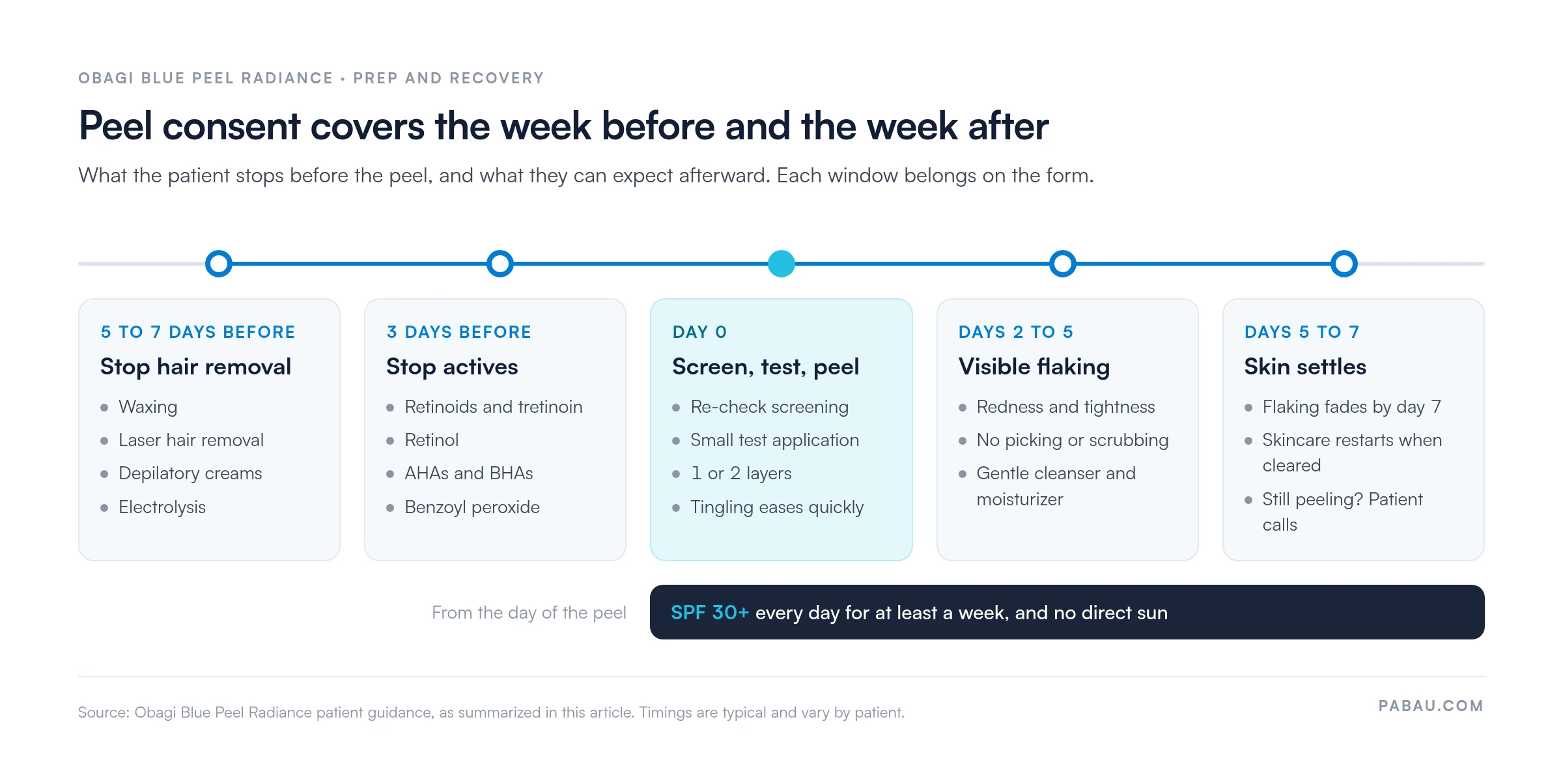
Good consent is a conversation spread across the booking, the consultation and the chair. This sequence holds up if a patient later questions what they were told.
Aftercare belongs on the consent form because the patient signs up to it. If they skip sunscreen and pigment changes follow, the initialed commitment shows the advice was given.
How long do they need sunscreen? Every day for at least a week, at SPF 30 or higher. They should also avoid direct sun and keep using SPF after that first week.
What if the skin starts flaking? Leave it alone. Picking or scrubbing can lead to scarring, so the dead skin should shed by itself.
When can they restart their usual skincare? Gentle cleanser and moisturizer only at first. Acids, retinoids, retinol and fragranced products wait until you clear them, usually after five to seven days.
What should they avoid for the first few days? Saunas, sunbathing, intense exercise and strong jets of water on the face.
When should they call you? For blistering, crusting, oozing, severe pain or a cold sore. They should also call if peeling hasn’t settled after seven days.
For a standalone sheet to send home, our chemical peel aftercare template works alongside this form.
Many practices still print a PDF, collect a wet signature, scan it and type aftercare emails by hand. Each step is a chance for a form to go missing before an audit.
Practice management software like Pabau, built as medical spa software, moves that onto the patient’s phone. You send the consent form with pre and post care instructions at booking. The patient signs on their own device before they arrive.
The signed form lands in the patient record, next to the treatment note and photos. After the peel, aftercare goes out on schedule, so nobody retypes the same email. You can rebuild this template as one of your own digital consent forms, screening questions included.
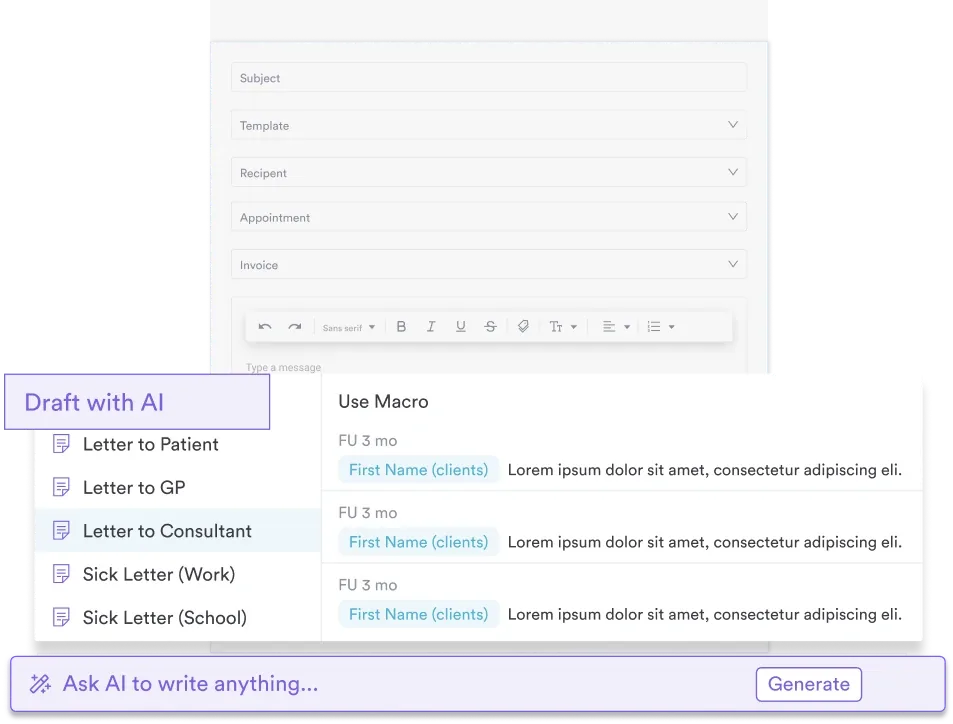

See how Pabau sends peel consent and prep instructions at booking. Signed forms go straight to the patient record, and aftercare follows on schedule.

Treat the form as the last safety check before acid touches skin. If a screening answer is yes, the peel waits, however full the diary looks.
The rest of its value shows up on day 3. A patient who signed for flaking between days 2 and 5 rarely mistakes it for a complication. So swap this Radiance-specific form in wherever a generic peel form still sits in your templates.
Book a demo to see how Pabau gets peel consent signed and filed before your patient reaches the chair.

Want a clean record of every peel in a course? Chemical peel treatment record gives you a session-by-session log for layers, timing and skin response.
Offering more than one type of peel? Chemical peel consent form covers the general consent points that apply across peel strengths.
Want a complete compliance checklist? The ultimate medical spa requirements checklist covers documentation, consent and record-keeping standards across aesthetic treatments.
Weighing up software for your practice? Best aesthetic clinic software compares platforms that handle digital consent, aftercare and patient records.
One peel can brighten the skin, but a series of four to six usually gives the best results. Sessions are often spaced two to three weeks apart.
It can be. Obagi’s guidance says it may help darker skin with pigment changes. Darker skin also carries a higher risk of lighter or darker patches. Start with a test application and a cautious first peel.
Up to 10 to 12 minutes after the first layer. If the skin tolerates that layer, the practitioner may add a second. The peel is then removed with a gentle cleanser and water.
Many practices allow makeup from the day after treatment. Gentle, fragrance-free products are the safer choice while the skin is still flaking.