Pabau Engage inbox

Pabau Engage is here: every patient conversation in one inbox.

Learn more
Book a demo Book a demo
☰
Aesthetic Clinic

Free model waiver form + what it is and when your practice needs one

Tanja Lepcheska
Last Updated: September 29, 2026

A model waiver form is a signed document that lets a healthcare practice use a patient’s image, name, or likeness for set purposes.

Those purposes include before-and-after photos, testimonials, social media posts, and staff training. It also protects the practice from claims that it used a patient’s image without permission.

It’s separate from an informed consent form, which covers the treatment itself. If the image carries health information, you’ll also need a HIPAA authorization. This guide covers what to include, when you need each form, the rules for minors, and how to collect e-signatures that hold up.

Found our content helpful?

Download your free model waiver form

A printable four-page form with patient details, photography permissions, and patient, clinician, and guardian signature lines. Patients can opt in or out of clinical photos and of anonymized use in teaching or marketing.

Download template
Key takeaways

Key takeaways

A model waiver form gives your practice written permission to use a patient’s image or likeness for the specific purposes listed on it.

It sits alongside informed consent, which covers the treatment, and HIPAA authorization, which covers health information, so many practices collect all three.

A complete waiver names both parties, lists each permitted use, states any compensation, explains revocation, and includes a guardian section for minors.

Full-face before-and-after photos count as identifiers under HIPAA, so a waiver alone rarely covers their use in marketing.

E-signatures collected through practice management software like Pabau and its digital forms are valid under the ESIGN Act when each signing is logged.

What is a model waiver form?

A model waiver form records a patient’s permission to use their image, name, or likeness in a defined context. It’s a contract between the practice and the patient. It lists exactly where the image may appear, such as before-and-after galleries, staff training, social media posts, or case studies. It also states what compensation, if any, the patient receives.

In aesthetics, “model” has a second meaning. A treatment model is a patient who gets a discounted or free treatment. In return, the practice can photograph them or let a trainee treat them under supervision. That trade is exactly what the waiver’s compensation clause should record.

Without a signed waiver, a patient can later object to how their image was used, and the practice has no written permission to point to. A signed form also shows auditors that your documentation is in order.

  • Model release: Grants permission to use the patient’s name, image, or likeness.
  • Liability waiver: Can also release the practice from claims related to capturing or using the image.
  • Commercial use authorization: Specifies whether images can be used for marketing, training, or both.
  • Medical record distinction: Doesn’t replace a HIPAA authorization or an informed consent form.

A model waiver is often confused with an informed consent form, but the two do different jobs. The waiver grants permission to use a patient’s image or likeness. The consent form confirms the patient understands a treatment and agrees to go ahead. Many practices need both.

Document Purpose Legal trigger Required with
Model waiver form Grants permission to use image or likeness for specified purposes Before taking or using patient photos or recordings HIPAA authorization, if images are in the medical record
Informed consent form Confirms the patient understands the treatment and agrees to proceed Before providing any clinical treatment Medical records and risk disclosure documentation
HIPAA authorization Permits use of protected health information (PHI) for purposes outside treatment or payment Before disclosing patient information to third parties or using it in marketing Model waiver, if images contain identifiable PHI

The key distinction: A model waiver answers “Can you use my image?” Informed consent answers “Do you understand the treatment and its risks?” HIPAA authorization answers “Can you share my health information?” Patients often sign all three during intake.

When your practice needs one

You need a model waiver whenever your practice captures or plans to use a patient’s image, likeness, or identifying details beyond their own treatment. Common scenarios include:

  • Before-and-after photography: Dermatology, aesthetic medicine, plastic surgery, and med spa practices routinely photograph patients to document results. Get the waiver signed before any before-and-after images are taken. If your dermatology EMR stores those photos, file the signed waiver in the same patient record.
  • Social media content: Publishing testimonials, results photos, or case studies on Instagram, TikTok, or your website needs explicit written consent. Our guide to before-and-after photo consent covers the med spa requirements in more detail.
  • Patient testimonials: If you quote a patient by name, or a photo reveals who they are, the waiver must cover testimonial use.
  • Clinical training and staff education: Presenting patient cases at team meetings, training sessions, or conferences needs a waiver that permits educational use.
  • Marketing materials: Brochures, email campaigns, and ads featuring patient stories or images need written release documentation.
  • Video or audio recording: Get a signed waiver covering recording and use before you record any consultation, procedure, or follow-up.

What to include in the form

A legally sound model waiver needs specific sections to protect both the practice and the patient. Building it as a digital capture form lets you mark each section as required, so none is left blank at intake.

  • Party identification: Full names of the practice and the patient, plus the date the form is signed.
  • Description of use: Specific detail of how images will be used, such as “before-and-after photos for our website and Instagram” or “staff training.” Vague wording like “promotional purposes” isn’t enough.
  • Commercial use clause: State whether the practice may use images for commercial purposes or only for education and training.
  • Compensation: Say whether the patient receives payment, free or discounted services, or no compensation. Spelling it out prevents disputes later.
  • Revocation rights: Explain that the patient can withdraw consent in writing at any time, and how to do it.
  • Right of publicity notice: A short statement that the practice won’t use images in a way that implies an endorsement the patient hasn’t agreed to.
  • Signature block: Patient signature or e-signature, date, and printed name.
  • Witness or notarization (optional): Some practices add a staff witness for high-risk uses. Notarization is rarely required, but a patient may ask for it.
  • Minor guardian section: For patients under 18, a parent or legal guardian signs, with an explicit statement of their authority.

HIPAA and privacy rules for patient images

The Health Insurance Portability and Accountability Act (HIPAA) overlaps with model waivers whenever an image carries health information. A model waiver doesn’t replace HIPAA compliance.

The key rule: If an image contains identifiable health information, you need both a model waiver and a HIPAA authorization. That includes a chart visible in the background or a photo filed in the medical record. If the image is fully de-identified, a model waiver alone may be enough, though legal review is still wise.

  • Marketing use of images: HIPAA allows marketing use of PHI only with a valid authorization. A model waiver alone doesn’t meet that requirement, so add HIPAA-specific language or pair the waiver with a separate authorization.
  • De-identified images: Full-face photos and comparable images count as identifiers under HIPAA’s de-identification standard. Most facial before-and-after shots therefore don’t qualify. A truly de-identified image needs no HIPAA authorization, but a model release still protects against right-of-publicity claims.
  • Testimonials and case studies: A patient’s name combined with clinical detail is PHI. A HIPAA authorization is required on top of the model waiver.
  • Audits: In a HIPAA investigation, you may need to show both the signed waiver and the authorization for any image used in marketing.

The matrix below maps the most common uses of a patient image to the documents each one needs.
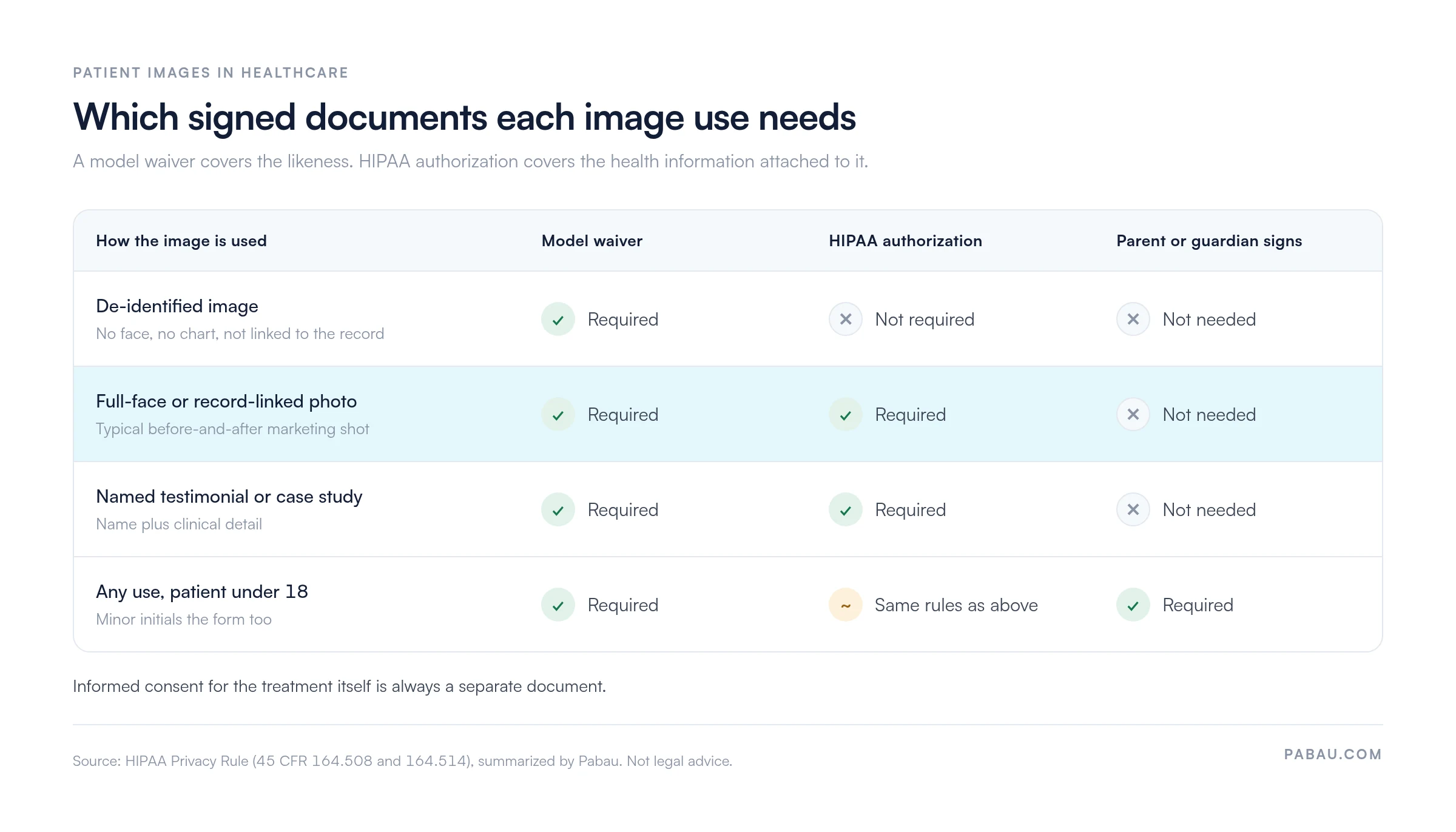
Decision matrix of signed documents by patient image use: de-identified image needs a model waiver only; full-face or record-linked photo and named testimonial need a model waiver plus HIPAA authorization; any use for a patient under 18 also needs a parent or guardian signature
Most before-and-after marketing photos show a full face, so they need a HIPAA authorization as well as the waiver. The requirements follow the HIPAA Privacy Rule, 45 CFR 164.508 and 164.514.

Best practice: Use a model waiver that includes HIPAA authorization language, or pair a simple release with a separate HIPAA form. Either way, send both in the same intake flow so the patient signs them together.

Special rules for minor patients

Minors can’t sign a binding contract, and that includes a model waiver. Every US state requires a parent or guardian to sign on a minor’s behalf, as do most jurisdictions worldwide. Your form needs a dedicated minor section with an explicit guardian acknowledgment.

  • Parental or guardian signature: The parent or legal guardian signs the waiver, not the minor. In joint-custody situations, getting both parents to sign is safest, depending on your state and risk tolerance.
  • Age threshold: Most states treat patients under 18 as minors for consent purposes. Some practices ask for guardian consent up to age 21 for high-risk image uses, such as facial aesthetic procedures.
  • Guardian authority statement: Include wording confirming the signer is the minor’s parent, legal guardian, or custodian, with authority to consent for them.
  • Minor’s assent (recommended): It isn’t legally required, but asking the minor to initial the form records their awareness and helps prevent later disputes.
  • Emancipated minors: If you treat an emancipated minor, confirm their status with legal documentation before going ahead without a guardian.

Collecting digital signatures that hold up

Digital signatures on model waivers are legally valid in the US under the ESIGN Act (15 U.S.C. § 7001). Most developed countries recognize e-signatures too. An electronic signature carries the same weight as a handwritten one, as long as the signer clearly intended to sign.

  • Intent: The patient must actively sign by typing, drawing, or clicking to sign. Pre-ticked boxes or passive consent don’t show intent.
  • Authentication: Capture the patient’s name, email, or patient ID, plus a timestamp and IP address, to prove who signed and when. Digital intake forms can log this metadata automatically.
  • Document retention: Store signed forms in a secure, tamper-proof format such as PDF in your patient record system. Avoid editable formats like Word.
  • Accessibility confirmation: Make sure the patient could review the form before signing and request a copy. Note this in your submission log.
  • State-specific rules: A few states once limited e-signatures in some medical contexts. ESIGN now gives broad federal coverage, but check your state’s current rules.

How to customize the template

The downloadable template covers patient details, photography permissions, and signature lines. Work through the steps below to turn it into a full model waiver for your practice and state.

  1. Update practice details: Replace the placeholder name, address, and contact details with your own. Include your legal entity name, such as an LLC, PC, or DBA.
  2. Define permitted uses: Be specific. Instead of “marketing purposes,” write “before-and-after photos on our website, Instagram, and in-office displays.” Specific wording protects both you and the patient.
  3. Specify geographic scope: State whether images stay in-office or appear online. Anything posted to social media or your website is effectively global, so say so in the form.
  4. Address compensation: If patients get a discount, a free follow-up, or payment for image use, record the exact terms. If there’s no compensation, state “No compensation will be provided.”
  5. Add HIPAA language, if applicable: Insert HIPAA authorization wording or reference a separate HIPAA form. You need it if images may be used in marketing or show health information.
  6. Include a minor section, if applicable: Name the guardian’s relationship to the patient and leave space for the guardian’s signature and the minor’s initials.
  7. Get a legal review: Have a healthcare attorney in your state review the finished form. Laws vary by state, and a brief $300 to $500 review costs far less than a lawsuit.
  8. Add it to your intake workflow: Send the waiver as a digital form so patients sign it before or at their first appointment.

How Pabau collects and files model waivers

Many practices still print a waiver PDF, get it signed at the front desk, then scan it into the patient file. Photos sit on a staff phone, and nobody can quickly confirm which images a patient agreed to share.

Practice management software like Pabau, built for med spas and aesthetic practices, keeps the waiver and the photos together. Patients sign the waiver as a digital form before their visit, and the signed copy files to their patient record with its timestamp. Before-and-after photos are captured in the same record, so you can check a patient’s permissions before a post goes live.

Every Pabau subscription includes digital forms and before-and-after photos, so there’s no extra module to buy. When a patient withdraws consent, you update one record instead of hunting through folders.

Collect model waivers before the first photo

Pabau sends model waivers and HIPAA authorizations as digital forms and stores each signed copy against the patient record. Before-and-after photos sit in the same record, so permissions are easy to check.

Pabau clinic management dashboard

Conclusion

If your practice photographs patients, a signed model waiver should come before the camera does. Pair it with a HIPAA authorization for any full-face or record-linked image, and add a guardian signature for anyone under 18.

The trade-off is a little more paperwork at intake, in exchange for images you can use without second-guessing. Customize the template, have an attorney check it, and send it as a digital form so it can’t get lost.

Book a demo to see how Pabau collects signed waivers and keeps them next to every before-and-after photo.

Continue your research

Continue your research

Running a med spa photo program? Before-and-after photo consent requirements sets out what a med spa consent form must cover before images are taken.

Want photos that sell your results? Med spa before-and-after photos covers lighting, angles, and consistency so your signed images are worth sharing.

How do you keep patient data secure? Patient data security tools explains how to protect signed forms and patient images during audits and reviews.

Frequently asked questions

What is a model waiver form used for?

It grants permission to use a patient’s image, likeness, or identifying details for set purposes. Those include before-and-after photos, social media, testimonials, and training. It also protects the practice from liability related to how the image is used.

Is a model waiver form legally binding?

Yes. A model waiver is a legal contract. It’s enforceable if it clearly lists permitted uses, is signed by the patient or a guardian for a minor, and doesn’t violate public policy. Electronic signatures are valid under the ESIGN Act.

Do I need a waiver for healthcare photography?

Yes. Get a signed model waiver before taking or using any patient photos, whether for before-and-after documentation, training, or marketing. Without one, the practice is exposed to liability claims and audit findings.

How does it differ from a HIPAA release form?

A model waiver grants permission to use a patient’s image or likeness. A HIPAA release permits use of protected health information, such as medical records, test results, and clinical notes. If an image contains identifiable health information, you need both.

Can a minor sign a model waiver form?

No. Minors lack contractual capacity, so a parent or legal guardian signs on their behalf. Some practices also ask the minor to initial the form to record their awareness.

Can patients sign it digitally?

Yes. Electronic signatures are legally valid under the ESIGN Act. The signer must clearly intend to sign, and the system should capture a timestamp, IP address, and signer identity to prove authenticity.
Found our content helpful?
×