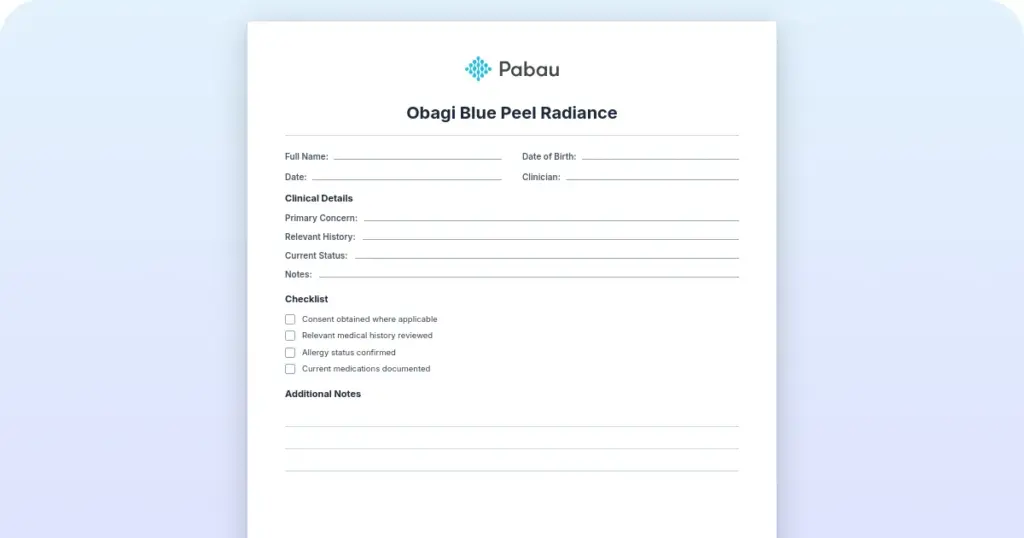
Obagi Blue Peel Radiance: Consent form and aftercare guide
An Obagi Blue Peel Radiance consent form records that your patient understood a ...

3
Last Updated: Sep 29, 2026

Aftercare guidelines are standardized post-treatment instructions that guide patient recovery and minimize complications.
Effective aftercare guidelines must cover wound care, activity restrictions, medication use, follow-up timing, and emergency warning signs.
CQC and professional bodies require documented aftercare protocols to ensure patient safety and regulatory compliance.
Pabau’s digital forms and automated messages deliver personalized aftercare instructions to patients immediately post-appointment.
A ready-to-use aftercare guidelines template covering post-treatment care instructions, activity restrictions, wound care protocols, medication guidance, follow-up appointment scheduling, and patient safety warnings for aesthetic and medical procedures.
Download templateAftercare guidelines form the foundation of safe post-treatment outcomes. They turn clinical expertise into clear, actionable instructions patients can follow during the critical healing window after aesthetic or medical procedures.
Whether your practice administers injectables, laser treatments, or surgical procedures, comprehensive aftercare guidelines reduce patient anxiety, improve healing compliance, and protect your practice from liability. This guide explains what effective aftercare guidelines contain, how to implement them across your practice.
An aftercare guidelines template is a standardized document that clinicians complete and provide to patients following a medical or aesthetic treatment. It outlines the specific care steps the patient must follow during the post-treatment recovery period, typically the first 24 to 72 hours. Some treatments need guidance for longer.
Aftercare guidelines differ from general patient information sheets. They are personalized to the specific procedure received, the patient’s individual health status, and any complications noted during treatment. They also address regulatory requirements. In the UK, CQC guidance requires practices to document post-procedure care instructions as part of safer care and treatment standards.
Clinical teams use templates to ensure consistency. A template ensures every patient receiving the same procedure receives the same evidence-based care instructions, reducing the risk of protocol drift and improving outcomes.
Most aftercare templates follow a five-step workflow: completion at appointment end, customization per patient, printing or digital delivery, patient review with staff, and storage in the patient record for legal protection.
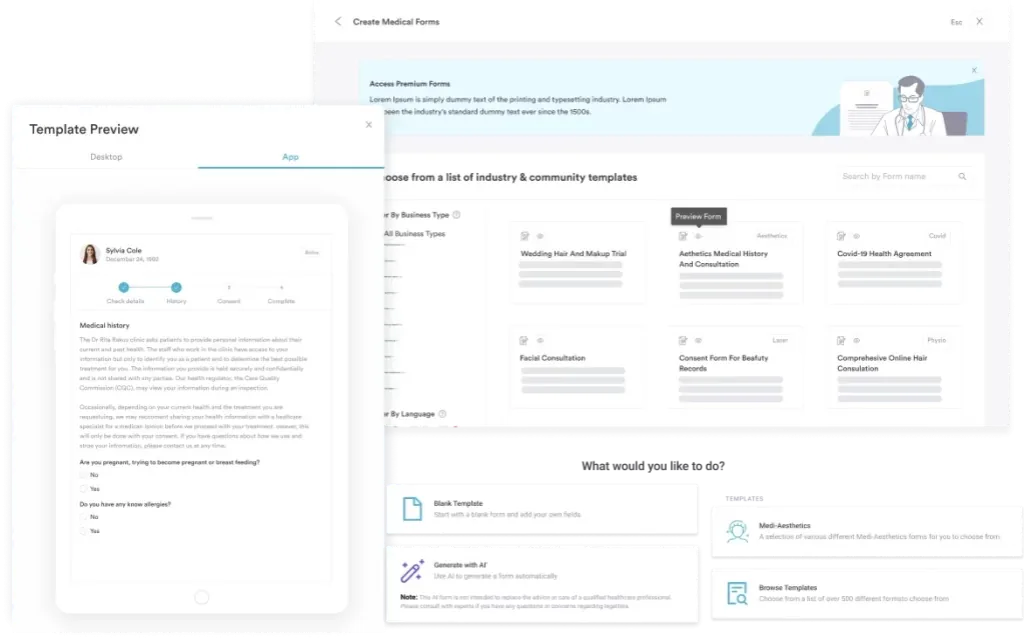
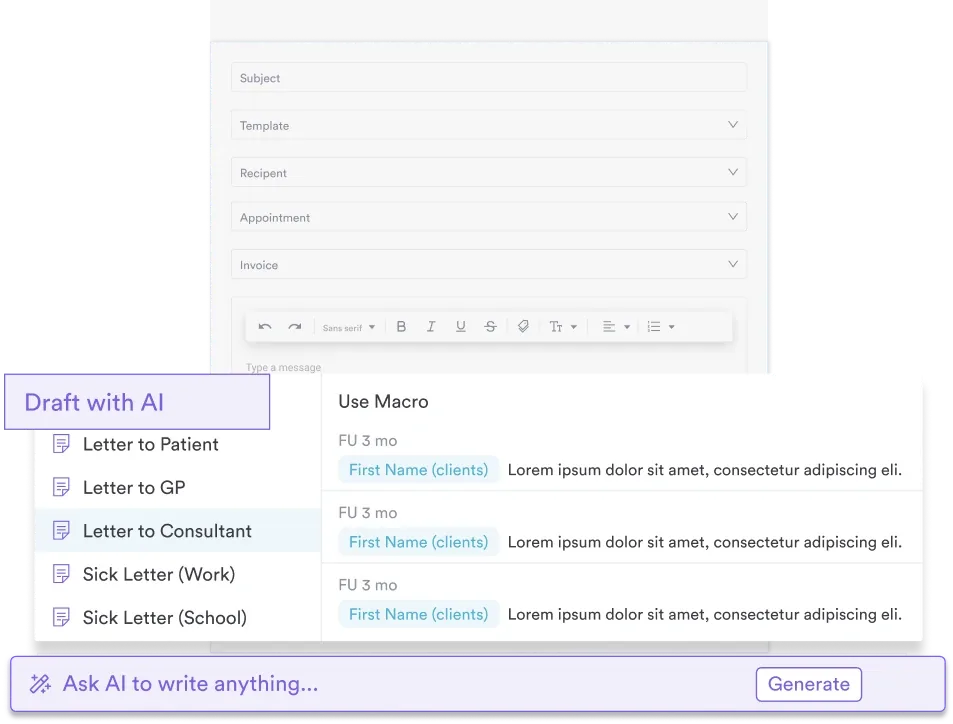
Digital practice management software like Pabau speeds this up. Digital forms capture the patient’s acknowledgment and feed structured records such as SOAP notes. Automated messages then send the personalized instructions the moment the appointment ends, so the patient has them before they leave.
Aftercare guidelines are essential for any practice delivering procedures with a post-treatment recovery period. Medical spas and aesthetic practices administer injectables (Botox, dermal fillers, Profhilo), laser treatments (hair removal, skin resurfacing), and chemical peels daily.
Private dermatology practices, surgical practices, and physiotherapy practices use aftercare guidelines for skin biopsies, minor surgery, and soft-tissue mobilization. For example, surgical teams issue procedure-specific instructions like areola reduction surgery aftercare.
Functional medicine and IV therapy practices provide aftercare guidance for infusions and injection protocols. Aftercare compliance directly affects client satisfaction and repeat bookings, since poor recovery care can cause visible complications like bruising or swelling that discourage future visits.
Teams managing multiple practitioners across multiple locations use templates to standardize care. The right medical spa software and patient portals ensure every practice location delivers identical aftercare messages regardless of which practitioner delivers the treatment.
Where care continues across shifts, the next team also needs to know which aftercare instructions the patient has already received. A structured shift handoff sheet keeps that verbal report consistent between nurses.
Software designed for GP practices can attach this form to the consultation record automatically.
Structured aftercare guidelines protect your practice, improve patient outcomes, and reduce operational burden. The benefits span safety, compliance, and patient experience.
Audit your current aftercare instructions once per quarter. Scan 10 random patient records to verify that: (1) aftercare guidelines were issued, (2) they matched the procedure type, and (3) any complication notes were captured. This simple check flags practice drift and ensures your team remains aligned on care standards.
Every treatment type demands specific post-care guidance. Injectables (Botox, fillers) require upright positioning and activity avoidance to prevent product migration. Laser treatments require strict sun protection and hydration to support skin barrier repair. Chemical peels need gentle cleansing and anti-inflammatory support during the peeling phase.
Effective aftercare guidelines address five core areas. The first three are wound care (cleansing, moisture barrier, topical treatments), activity restrictions (exercise, facial movement, sleeping position), and medication guidance (over-the-counter options, supplements to avoid).
The remaining two are follow-up scheduling (when to return and what to expect at review) and warning signs (swelling patterns that are normal versus signs of allergic reaction or infection).
The template should reference your practice’s treatment protocols specifically. A generic template stating “avoid strenuous exercise for 48 hours” is less effective than “avoid high-intensity cardio and heavy lifting for 2 days after filler treatment; light walking and stretching are safe.” Specificity builds patient confidence.
Documentation of post-treatment care is a regulatory expectation. The Care Quality Commission (CQC) Safe Care and Treatment fundamental standard (Regulation 12) requires providers to assess “the risks to the health and safety of service users of receiving the care or treatment” and to do “all that is reasonably practicable to mitigate any such risks.” This includes ensuring patients understand post-treatment recovery protocols.
Beyond CQC, professional bodies including the American Society of Plastic Surgeons (ASPS), the British Association of Aesthetic Plastic Surgeons (BAAPS), and the Joint Council for Cosmetic Practitioners (JCCP) publish patient care guidelines that emphasize written aftercare. Documenting that your practice followed evidence-based protocols demonstrates a commitment to patient safety and supports your defense if complaints arise.
Any aftercare guidelines you store digitally must be GDPR-compliant (UK/EU practices) or HIPAA-compliant (US practices). Store signed copies or digital acknowledgments in the patient record to prove the patient received and understood the guidance.
Clear, procedure-specific aftercare instructions make recovery more predictable. When patients know exactly how to care for a treatment site, they heal faster, complications drop, and satisfaction rises.
Start with a template built for your most common procedures, then adapt it with your own protocols, medication guidance, and follow-up timings. Deliver it the way each patient prefers: printed at checkout, emailed through automated patient engagement systems, or filed straight to their record.
See how Pabau’s digital forms and automated messaging deliver consistent, compliant aftercare automatically. Book a demo to see how other practices cut manual admin and raise patient safety standards.

Need a framework for documenting patient care workflows? Medical forms at your healthcare practice covers how to structure clinical documentation so every team member delivers consistent care.
Need consent forms for a cosmetic procedure? Porcelain veneer treatment forms provide ready-to-use consent forms and checklists for the veneer patient journey.
Ready to digitize your forms and patient communication? Clinical documentation software helps your practice collect, store, and audit patient records digitally.
Effective aftercare guidelines include: wound care instructions (cleansing, topical treatments), activity restrictions (exercise, sun exposure, makeup), medication guidance, follow-up appointment timing, and a list of warning signs (allergic reaction, infection indicators) that prompt immediate contact with the practice.
Write using plain language (avoid medical jargon), be specific to the procedure (not generic), organize by timeline (immediately after, 24 hours, 48-72 hours), and include at least one visual aid (diagram or checklist). Use active voice and action verbs: “Apply sunscreen SPF 50+ every 2 hours” rather than “Sun protection is recommended.”
Aftercare guidelines inform patients how to support healing, prevent complications, and recognize warning signs. They also serve a regulatory and legal function: documented aftercare protocols demonstrate that your practice followed evidence-based care standards and informed the patient of risks.
Practice management software like Pabau enables practices to create digital aftercare forms that populate automatically at appointment checkout. The system then triggers an email or SMS sending the personalized aftercare instructions to the patient’s phone immediately after the appointment, improving compliance and reducing manual printing.