GLP-1 usage by state: Who’s taking, searching and paying in 2026
GLP-1 usage by state peaks in West Virginia, America’s GLP-1 capital, with...

Last Updated: Oct 16, 2026
Case notes are the written record of each patient session. They capture what the patient told you, what you observed, what you did and what happens next. If it isn’t in the note, nobody can prove it happened. That includes your regulator, the patient’s insurer and the colleague who sees them next.
The habit that matters most is simple. Write the note on the same day, in the same structure, every time. Late or patchy notes are what inspectors and complaint panels pick apart first.
For a practice owner, that can decide whether an audit passes quietly or turns into a long review. Start with the free template below, then choose the format that suits your discipline.
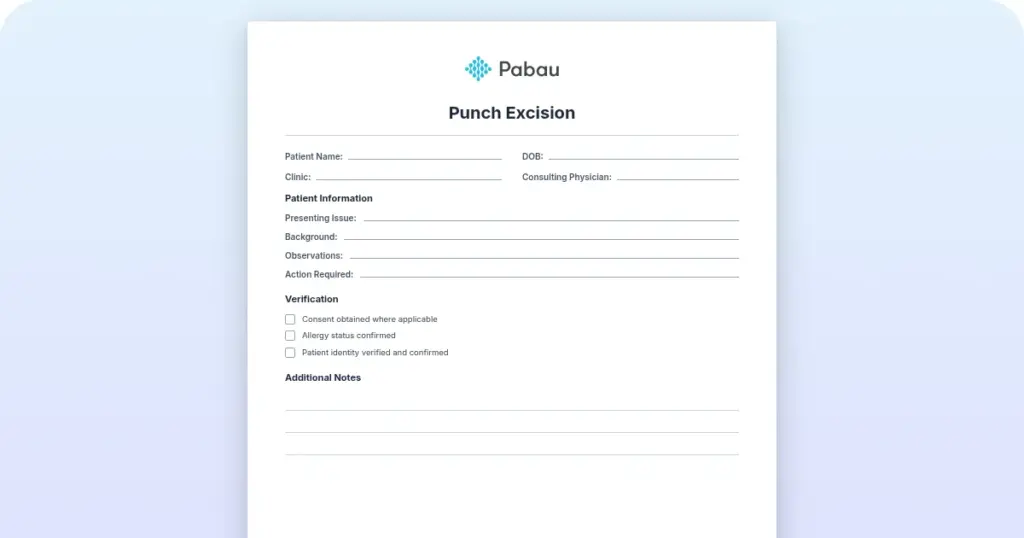
A one-page case notes form with a client ID field, a session number and a free-text notes box. A name line records who ran the session. Print it for quick session logs, and use the SOAP structure below to organize what goes in the notes box.
Download template
Case notes are the same-day record of each session, and regulators treat them as evidence of the care you gave.
SOAP, DAP, BIRP and GIRP all end in a plan, but each one divides the rest of the session differently.
DAP notes combine the patient’s report and your observations into one Data section, so neither one is dropped.
Write the note on the day of care, sign it, and add a dated amendment rather than overwriting an old entry.
In the UK, minimum retention periods come from the NHS Records Management Code of Practice, not the ICO.
A case note is the factual record of one healthcare encounter. It covers what the patient presented with, your findings, your assessment, the treatment you gave and the outcome.
In the UK, Care Quality Commission (CQC) standards require providers to keep clear, contemporaneous records. Colleagues rely on those notes to pick up care. Inspectors rely on them to judge it, and so do lawyers if a complaint goes further.
Progress notes are the smaller cousin. A progress note can be a quick update on one part of ongoing treatment, while a case note records the whole episode. Digital patient records keep both in one file, so any clinician on your team can pull them up.
Good notes protect three things at once: the patient’s care, your registration and your practice’s compliance record. Here’s how each one depends on what you write down.
Once you know what the note has to prove, the next decision is its shape.
Start with SOAP unless your discipline has a reason not to. It follows the order of clinical reasoning. The other three formats suit work where behavior, goals or a combined data section matter more, as the grid below shows.
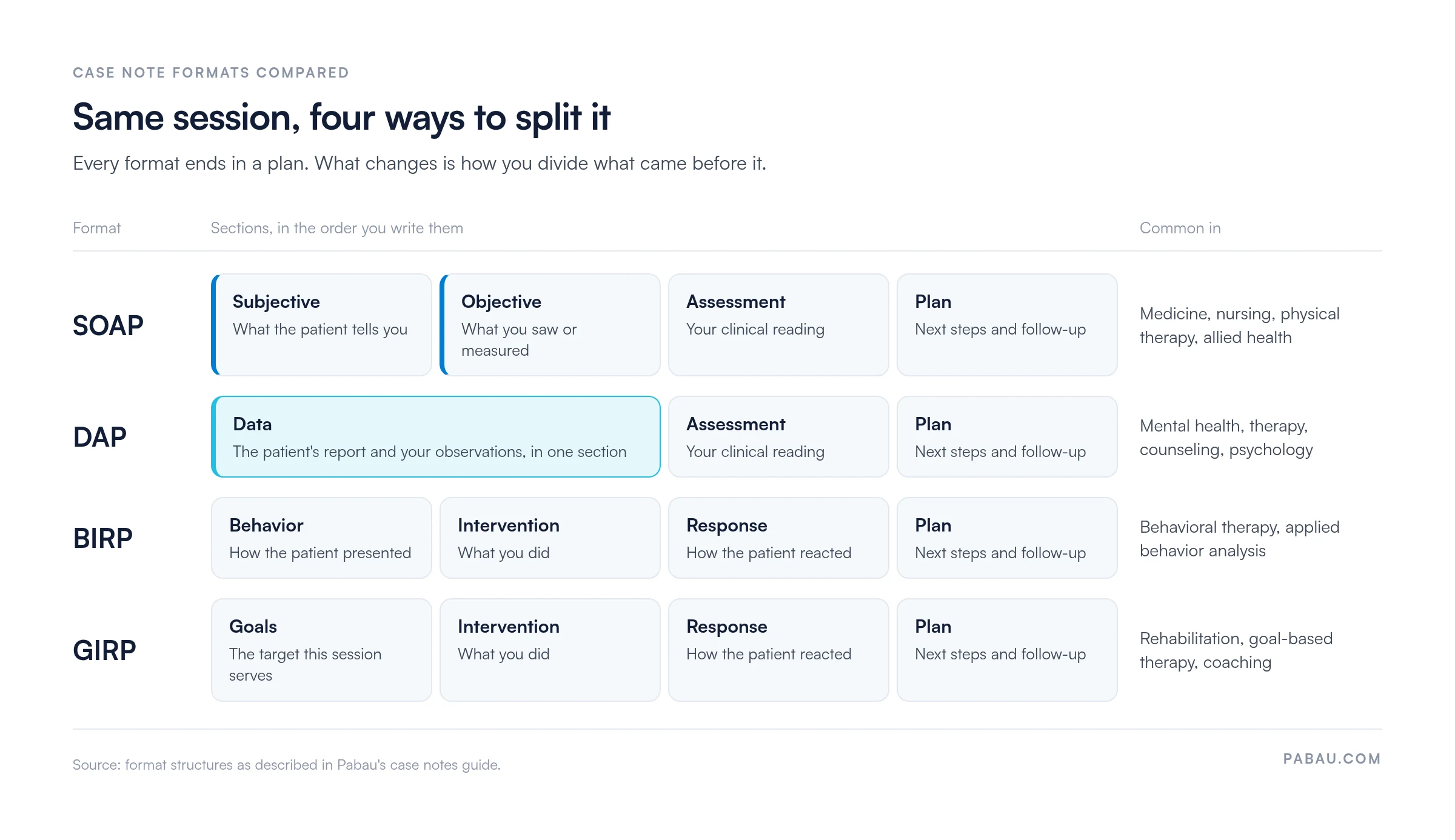
SOAP notes are the standard across medicine, nursing and most allied health. They move from what the patient reported to what you observed, what you concluded and what you’ll do next. For a ready-made layout, the SOAP progress notes template sets out each section.
DAP notes fold the patient’s own report and your observations into a single Data section. Neither one is dropped. Therapists often prefer it, because a session rarely splits neatly into what was said and what was seen.
BIRP notes center on the patient’s behavior and how they responded to your intervention, which suits behavioral work. GIRP notes anchor each entry to a treatment goal, so you’ll see them often in rehabilitation.
Here’s how one physical therapy follow-up might read in SOAP form:
Written as a DAP note, the first two lines become one Data entry. The assessment and plan stay the same.
Write the note on the day, in your chosen format, and sign it before you close the file. These six steps break that down.
That third step covers how the patient looks as well as what they say. Charting general appearance follows the same rule, so you record the fidgeting and the poor eye contact instead of the word anxious.
A complete note answers who, when, what and what next. Run through this checklist before your signature goes on it.
Most weak notes fail the same way. They record that care happened without showing what it was or how it went. These rewrites show the fix.
Three more problems don’t fit a before-and-after, but they trip up busy practices just as often.
A paper template is fine for a solo practitioner seeing a handful of patients a day. It starts to struggle once several clinicians share patients or work across sites.
Paper notes sit in one cabinet and are easy to misfile. They also leave no trace of who read or changed them. Digital systems add automatic timestamps and access logs. They also offer encrypted storage that supports HIPAA and GDPR compliance.
Before you switch, check that any clinical notes software you shortlist offers these five basics:
That list is also a fair test for any system you’re considering, ours included.
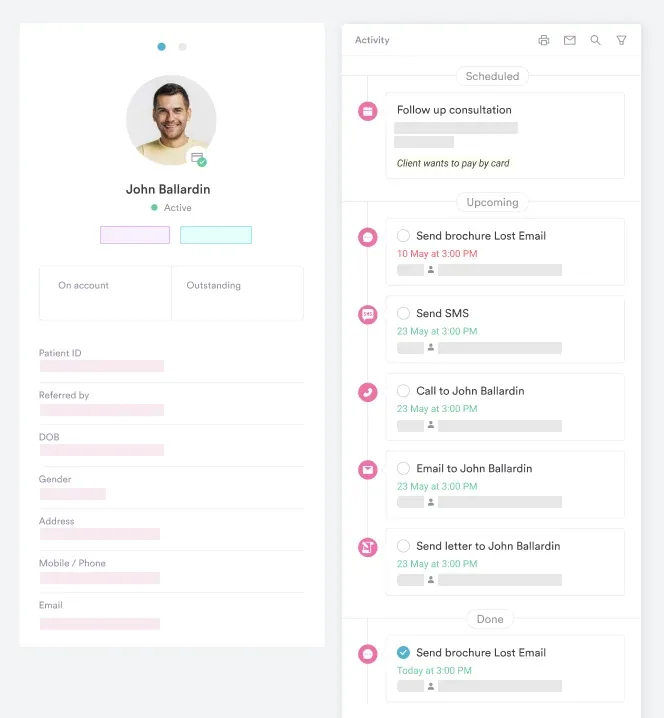
Many practices start with a PDF like the one above, then scan each completed form into a patient file. It works, but the note ends up apart from the booking, the consent form and the invoice.
Practice management software like Pabau keeps those together. You can rebuild this template in Pabau’s drag-and-drop form builder and link it to specific appointment types. Each completed note then lands in the patient’s record. Role-based access controls decide who can view or edit sensitive notes.
For the write-up itself, Pabau Scribe, our AI scribe, turns the consultation conversation into a structured draft note. You review it, edit it and save it against the appointment.
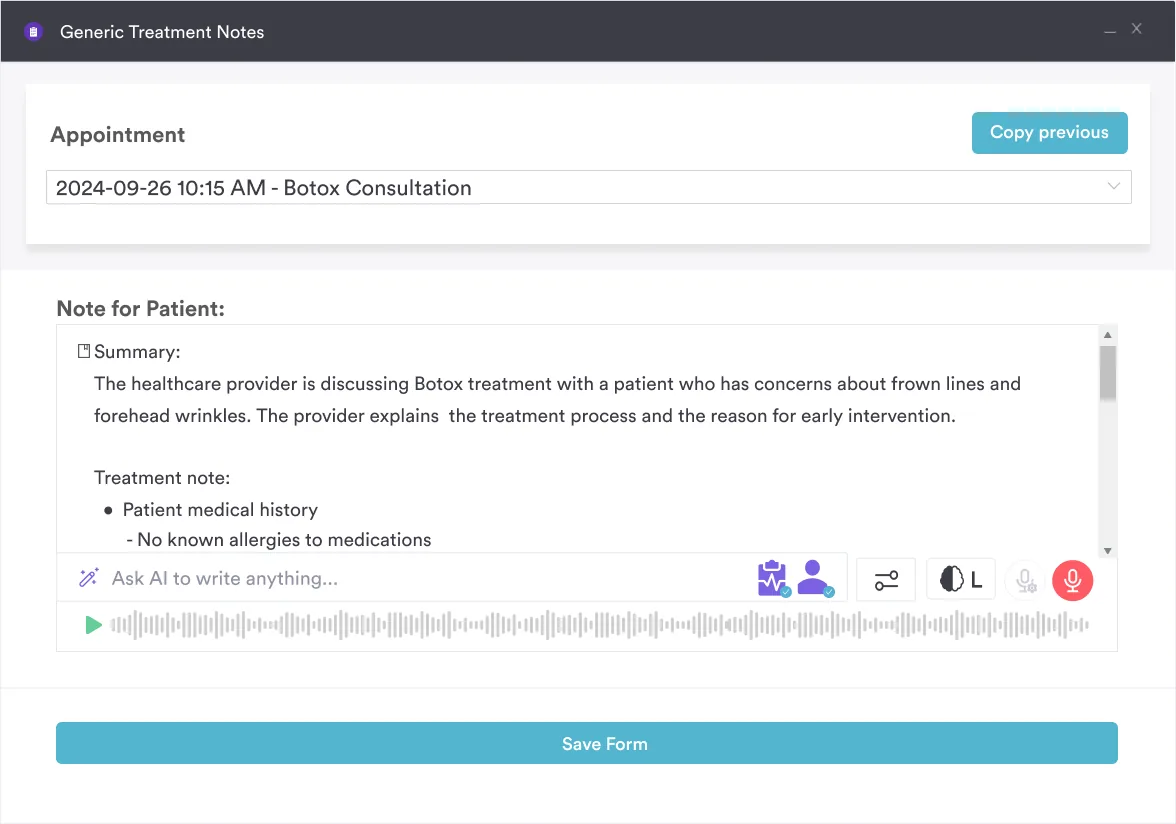

Build your case notes template in Pabau, link it to the right appointments, and let Pabau Scribe draft each note for your review.

A case note proves its value months later, when someone else reads it. Pick one format, write it the same day, and run the nine-field check before you sign.
If your team shares patients across clinicians or sites, paper will be the first thing to slow you down. The trade-off is setup time. You build a digital template once, and it saves time on every session after that.
Want to see this template as a digital form that files each note in the patient record? Book a demo and we’ll walk you through it.

Want more worked SOAP examples? SOAP notes examples walks through sample notes you can adapt for your own sessions.
Charting around one patient focus? DAR notes template explains the Data, Action and Response format with worked examples.
Need a note for ongoing treatment? Clinical progress notes template shows how to write the shorter updates that sit between full case notes.
Documenting care as a nurse? Nursing documentation guide covers the principles and legal requirements behind nursing records.
In the UK, the NHS Records Management Code of Practice sets the minimums. Most adult records are kept for 8 years after treatment ends. Children’s records are kept until their 25th birthday, or their 26th if they were 17 when treatment ended. In the US, HIPAA sets no retention period for medical records, so state law decides. Check your professional body too, since some expect longer.
Yes. In the UK, patients can make a subject access request under UK GDPR. You usually have one month to respond, and you normally can’t charge for it. In the US, HIPAA gives patients a right of access, with 30 days to respond and one possible 30-day extension. Write every note as if the patient will read it.
You can correct it, but never delete or overwrite the original. Add a dated, signed amendment that explains what changed and why. The original entry should stay readable, so anyone reviewing the record can see both versions.
In the US, yes. HIPAA defines psychotherapy notes as a therapist’s private notes analyzing a session, kept apart from the main record. They get extra privacy protection and fall outside the patient’s standard right of access. Session times, treatment and progress still belong in the regular case note.