Free model waiver form + what it is and when your practice needs one
A model waiver form is a signed document that lets a healthcare practice use a p...

5
Last Updated: Sep 29, 2026

A photo release form is written permission for a practice to photograph a patient and use those images for named purposes.
Treat clinical-record use, marketing use, and social media posting as three separate grants, because a patient can approve one and refuse another.
Patients under 18 need a parent or guardian signature, and children aged 13 and over should co-sign wherever the treatment makes that practical.
Withdrawal reaches unpublished images first, so a printed brochure or a reshared Instagram post can outlive a consent the patient has revoked.
Pabau captures photo permissions electronically at intake, links each one to the treatment record, and timestamps the audit trail.
A ready-to-use consent document with patient details, a six-box permitted-uses list, treatment linkage, parental signature blocks, retention terms, and revocation clauses. Written for HIPAA and GDPR record-keeping.
Download templateA photo release form is a signed document authorizing a practice to photograph a patient and use those images for named purposes. Those purposes are not interchangeable. A patient who agrees to a before-and-after photo in their chart has not agreed to see it on your Instagram grid.
Generic legal-forms sites hand you one signature line covering photographs and likeness. Clinical photography needs more than that. The free photo release form above splits permission by use. The form ties each image to a named procedure, and sets out how a patient withdraws consent later.
This guide covers what the form has to contain and when a signed one is required. It also shows how to adapt it for minors, social media, and staff photos. The last section covers how practice management software like Pabau captures digital consent at intake.

A photo release form is written patient consent letting a practice capture an image and use it only for the uses the patient approved. The form records informed consent and draws the boundary around where those images may travel.
A basic photo release form keeps only four parts. Those are who is being photographed, which uses are approved, how long images are kept, and a dated signature. The rest of a longer template exists to make one of those four harder to dispute.
In a healthcare setting the document does three jobs at once:
The same document goes by several names. You will see photo consent form, image release form, and consent form photo release used interchangeably. Three neighboring documents are not interchangeable, though:
You need signed photo consent before capturing any image in which a patient is recognizable, and again before using it outside the clinical record. The second trigger is the one practices trip over, because the photo was already taken lawfully for the chart.
Each use below carries its own signature requirement and its own extra condition. Read the table as a checklist against the form you currently hand out.
| Use case | What the consent must cover | Who signs | Extra requirement |
|---|---|---|---|
| Marketing photo | Website, print, paid ads, case studies | Patient, or guardian if under 18 | A named review or expiry date |
| Before-and-after clinical photo | Capture, chart storage, standardized retakes | Patient | The procedure named on the form |
| Social media post | Each platform by name, tagging, comments | Patient | A stated takedown process |
| Website testimonial with a photo | The quote and the image, granted together | Patient | Written sign-off on the final wording |
| Staff or employee photo | Website, ads, recruitment, internal use | The employee | What happens after the employee leaves |
One rule cuts through all five rows. If a colleague could identify the patient from the image, a tattoo, or a piece of jewelry, the image is identifiable and needs consent. Cropping out a face does not reliably make a photo anonymous.
Customize the photo release form template with your practice details, then have the patient complete it during the pre-treatment consultation, before any camera comes out. Signing afterwards turns a consent record into a retrospective request. A release of liability covering the treatment’s known risks is signed at the same consultation.
Use the download as a sample of photo release form wording, then swap in your practice name, retention period, and treatment list. The five sections below appear in that order on the template.
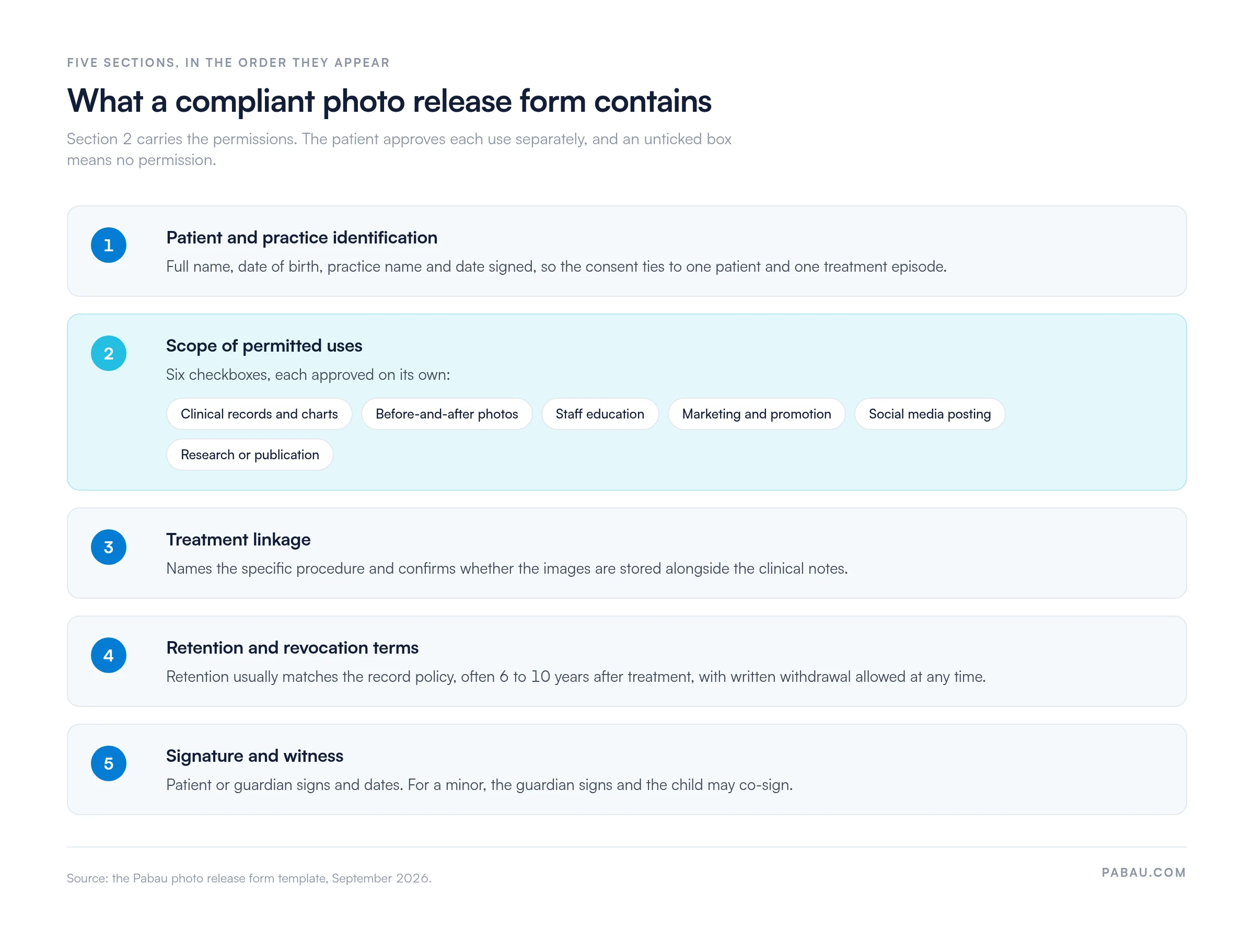
Practices that print the document sometimes label it a photo release waiver template. The wording on the header matters far less than the permitted-uses list underneath it. Once signed, the form belongs in the patient’s medical record rather than in a marketing folder.
Any practice that photographs a recognizable patient needs consent on file, which in aesthetics means almost every treatment room with a camera in it. The intensity of the requirement changes with what the images are for.
The core structure holds across every variant. What changes is who signs, which uses are on the list, and how long the permission runs before it needs refreshing.
A medical photo release covers photography for the chart, treatment documentation, and therapeutic review. HIPAA treats an identifiable patient photograph as protected health information, and UK GDPR treats it as health data. The confidentiality wording on the form has to be explicit about that.
Add a checkbox for disclosure to third parties. Referring physicians, insurers, and other members of the care team are separate recipients, and a patient may be comfortable with one and not the others. Practices working to HIPAA rules for med spas should record that choice on the form rather than in a note.
A before-and-after photo needs four separate permissions rather than one, because clinical storage, marketing, and social posting each carry different risk and different reversibility. We call that structure the Before/After Consent Layer.
The Before/After Consent Layer is what a generic release form leaves out. It starts with treatment linkage, moves through clinical-record use, then marketing use, then social media use. Each layer is granted on its own line, and withdrawing consent does not unwind them equally.
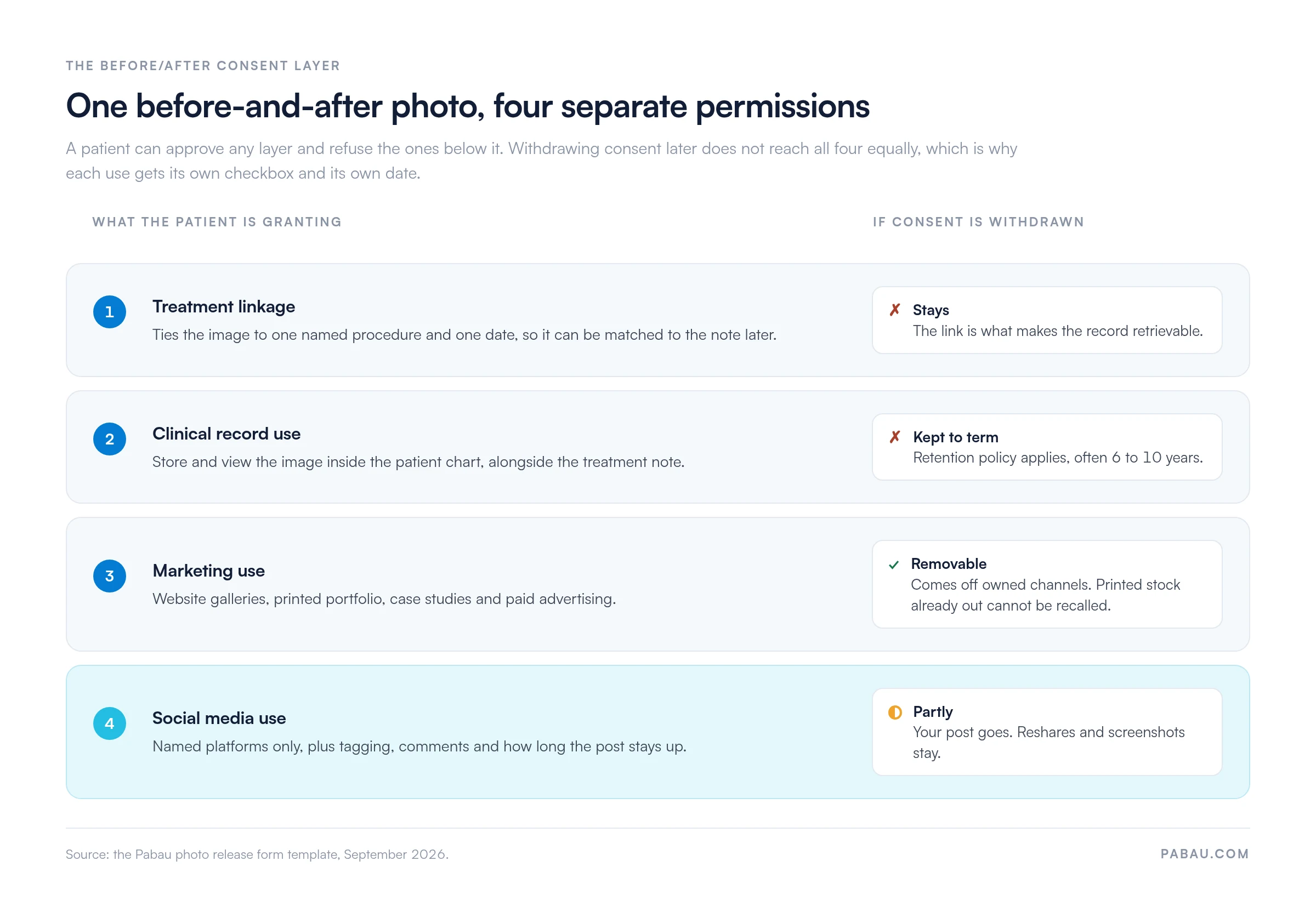
Revocation is the layer most templates handle badly. Write the process into the form itself. Name who a patient contacts, and state that the request should be in writing. Commit to a removal window, such as 14 days for your own website and social channels.
Then be honest about the limits. Images already printed in a brochure cannot be recalled, and a post that has been reshared or screenshotted survives deletion. Saying so on the form is better than discovering the argument during a complaint.
In practices we onboard, the recurring consent problem is rarely a missing signature. The usual culprit is an old signature that never mentioned social media, because the practice started posting results long after the form was written. Re-consent when a new channel opens.
One more layer sits on top of the four. US practices advertising before-and-after results are also subject to FTC guidance on health claims. That guidance expects comparative images to reflect typical results, not the best case in the folder.
A photo release form for minors needs a parent or legal guardian signature, because a patient under 18 cannot authorize image use alone. The form records the child’s name, the guardian’s name, and the relationship between them.
Have the child co-sign from around age 13 where the treatment makes that appropriate. Exact thresholds vary by jurisdiction, so check your local rule rather than the template’s default. Write the consent language plainly enough that a 10-year-old can follow what is being agreed.
Keep public use on a separate line for minors. Rules on children’s images online are tighter than for adults. A guardian who is fine with a chart photo will often decline a social post. The template carries signature lines for guardian, child, and witness.
A photo release form for social media must name the platforms, state whether the patient is tagged, and explain how a post gets removed. A blanket marketing tick does not cover any of those three.
Spell out the specifics. Decide which accounts may post and whether the practice location is tagged. Then decide whether comments stay open, and how long the image remains live. Each is a separate choice the patient is entitled to make.
Set expectations about what happens next. Once an image is public it can be screenshotted, reposted, or scraped, and the practice cannot control that secondary use. Patients who understand this up front complain far less when it happens.
Body-art studios face the same decisions on their own paperwork. A tattoo waiver template folds an optional photo checkbox into the session form, naming the studio portfolio, Instagram, or TikTok.
An employee photo release form covers staff headshots, team pages, and recruitment ads, and says what happens to those images after the employee leaves. Patient consent forms do not cover staff, and staff appear in team pages, treatment demos, and recruitment ads.
Keep it separate from the patient template. Consent given by an employee sits inside a working relationship, so the form should make refusal genuinely free of consequence and say so in writing.
The departure clause is the part worth arguing over. Agree in advance whether a headshot comes down on the last working day. Decide as well whether printed material already distributed stays in circulation, and who a former employee contacts to ask.
Evidence when someone asks. A signed form shows the patient agreed before the image was captured. If a regulator reviews your practice, the form is the audit trail that proves photographs were processed lawfully.
Patient trust. Presenting a form before photography tells a patient their privacy is being taken seriously. Patients who understand where an image will go tend to approve more uses, not fewer.
Faster decisions at the front desk. A written record of permitted uses tells staff which photos can go on the website and which stay in the chart. The rest needs a fresh conversation first. That removes the guesswork from every campaign.
A usable marketing library. Consent recorded properly turns treatment photos into assets you can publish without hesitating. A practice with clean permissions can build a results portfolio instead of sitting on images nobody is sure about.
Paper photo release forms work until you have to find one. Staff print, sign, scan, and file, and the signed page ends up somewhere other than the patient record. When a patient asks what they agreed to in 2024, the search takes longer than the treatment did.
Pabau, an all-in-one practice management system, captures photo permissions during paperless intake. The patient signs on their phone before arriving, each ticked use is stored against the treatment record, and Pabau timestamps the signature. Answering a regulator becomes a lookup rather than a filing-cabinet search.
Pabau’s before-and-after photo management then holds the images against the same record as the consent that authorized them. Staff can see which uses a patient approved at the moment they pick a photo for a campaign. A chart-only image never reaches the website by accident.
Revocation works the same way. A withdrawal is logged against the record, and the affected permissions flip off. The images stay in the chart for the retention period, out of reach of marketing. That is the Before/After Consent Layer enforced by the system rather than by memory.

Pabau collects photo permissions during online intake, links each approved use to the treatment record, and timestamps the signature. Your team can see what a patient agreed to before choosing an image for the website or a social post.

Download the template, then spend twenty minutes on the permitted-uses list before you print a single copy. That list is the only part of the document that changes what your practice can actually do with a photograph.
The trade-off worth remembering is that granular consent asks slightly more of the patient in the room and saves a great deal later. A patient who ticks four boxes has told you exactly where the line sits, and nobody has to guess in six months.
Once the wording is right, the remaining problem is retrieval. Book a demo to see how Pabau captures photo consent at intake and keeps each permission attached to the treatment record.

Need a structured patient intake workflow? Medical forms at your healthcare practice covers capturing consent, health history, and permissions in one check-in process.
Wondering how to store patient photographs safely? HIPAA compliance for clinic software explains which identifiable patient information must be protected and how images should be secured.
Building a before-and-after portfolio? Before-and-after photo management shows how Pabau stores, tags, and retrieves treatment images against the patient record.
A photo release form is a signed document giving a practice permission to photograph a patient. A parent or guardian signs for a minor. The form names the uses those images may be put to, such as clinical records, treatment documentation, marketing, or education.
Yes. In the US a recognizable patient image is protected health information, and in the UK it is health data under UK GDPR. A signed photo consent form is what makes using that image lawful, and without one there is no record of what the patient agreed to.
Yes. Start from a free photo release form such as the template above. Add your practice name, your retention period, and a separate checkbox for each intended use. Have a local legal advisor review the final wording before you hand it to a patient.
Consent to be photographed counts when the patient signs a dated form naming the specific uses, before any image is captured. A verbal agreement, a nod in the treatment room, or silence does not qualify under HIPAA or UK GDPR.
The core structure is universal, but customize it for your practice. Set your own name, treatment types, and data retention policy. Add parental signature lines for minors and platform-specific checkboxes for social media. Ask a legal advisor to confirm it fits your jurisdiction.
Respect the decision and do not photograph them. Some patients have privacy concerns or a history that makes photography difficult, and pressing the point damages trust. Document treatment progress through written notes and measurements instead.
Yes. E-signature law covers this, including the E-SIGN Act in the US and eIDAS in the UK and EU. An electronically signed form is binding when it carries a timestamp, an audit trail, and confirmation of consent. Pabau’s digital consent forms record all three.
Yes. A patient can withdraw future permission in writing and request deletion of unpublished images. Images already printed or already required for clinical and legal records may not be removable, and the form should say so plainly.