Patient follow up letter template
A patient follow up letter template lets your practice confirm a patient’s...

2
Last Updated: Oct 21, 2026
A cupping therapy color chart reads post-cupping marks, from light pink to dark purple, as diagnostic signals in traditional Chinese medicine (TCM). Each color points to a different level of blood circulation and stagnation. Light pink means little blockage, while dark purple or black signals severe stagnation that can take up to two weeks to fade.
Practitioners use the chart to explain marks to patients before treatment and to track how an area responds across sessions. The NCCIH overview of cupping confirms the marks are temporary. It also advises patients to explain them to other providers, so no one mistakes them for signs of abuse.
The chart covers light pink through black marks, stagnation severity levels, and location-based interpretation notes, plus fields for patient documentation. Print it, laminate it, or share it on screen during consultations.
Download template
Light pink or no marks indicate healthy circulation, while dark purple or black marks signal severe blood stagnation and poor qi flow in TCM.
Mark color reflects treatment depth and the patient’s underlying imbalance rather than bruising from trauma, and patients need to hear that distinction before treatment.
Mark location adds specificity, so a dark mark on the shoulder means something different from the same mark on the lower back.
Dark purple or black marks can take 7-14 days to fade, which is your cue to reduce suction and duration at the next session.
Recording color, location, session date, and patient feedback digitally lets you track progress and refine protocols for each patient.
Cupping creates a partial vacuum inside the cup, drawing blood and lymphatic fluid toward the skin surface. No impact trauma occurs, so these marks differ from bruises. The suction pulls red blood cells and fluid out of the capillaries and into the surrounding skin, a process called extravasation. Three factors set the depth and intensity of this response: Suction strength, how long the cup stays on, and the patient’s baseline circulation.
In TCM, mark color is a diagnostic window. The darker and more persistent the mark, the more stagnant the area was before treatment. That tells you whether to adjust technique, duration, or follow-up frequency.
Mark color can also be measured. A 2014 pilot study on cupping marks tracked skin color in digital color spaces for 72 hours after cupping. Color values shifted significantly after treatment and then followed a measurable recovery pattern.
Use this color-to-meaning guide during patient consultations. Print it, laminate it, or display it in your treatment room so patients can see what their marks say about circulation and stagnation.
A darker mark tells you more stagnation existed before treatment began. Your job is to read the color, reassure the patient that the mark shows movement, and match your protocol to their tolerance and recovery speed.
In TCM, stagnation is the blockage of qi (vital energy) and blood flow in a specific area. Western medicine measures poor circulation by flow rates. TCM stagnation is broader and covers both functional blockage and the patient’s subjective experience: Pain, tightness, heaviness, or cold sensation in the area.
Practitioners trained to International Cupping Therapy Association standards assess stagnation before treatment through palpation, patient history, and visual inspection. They then match cupping depth and duration to its severity. A light pink mark means the area had little blockage to release. A dark purple mark means significant stagnation was present, and that shapes how you explain marks and plan follow-ups.
Use your spa intake form template to document pain levels, movement limitations, and baseline symptoms before cupping. Then photograph or note the mark color 24 hours after treatment and again at the next session. Over 3-6 sessions, patterns emerge: Areas that consistently show dark marks may need lifestyle intervention (hydration, movement, nutrition) alongside cupping to speed up progress.
The location of cupping marks adds specificity to color interpretation. A dark purple mark between the shoulder blades suggests respiratory qi stagnation or postural strain. The same mark on the lower back suggests kidney qi or reproductive system stagnation. Reading location alongside color helps you explain more precisely what the patient’s body is showing.
Record mark location in your digital patient records alongside color and patient feedback. Location patterns then shape your treatment strategy: A patient with repeated dark marks in one spot may need posture and movement coaching alongside cupping.

The downloadable chart above supports three practitioner workflows:
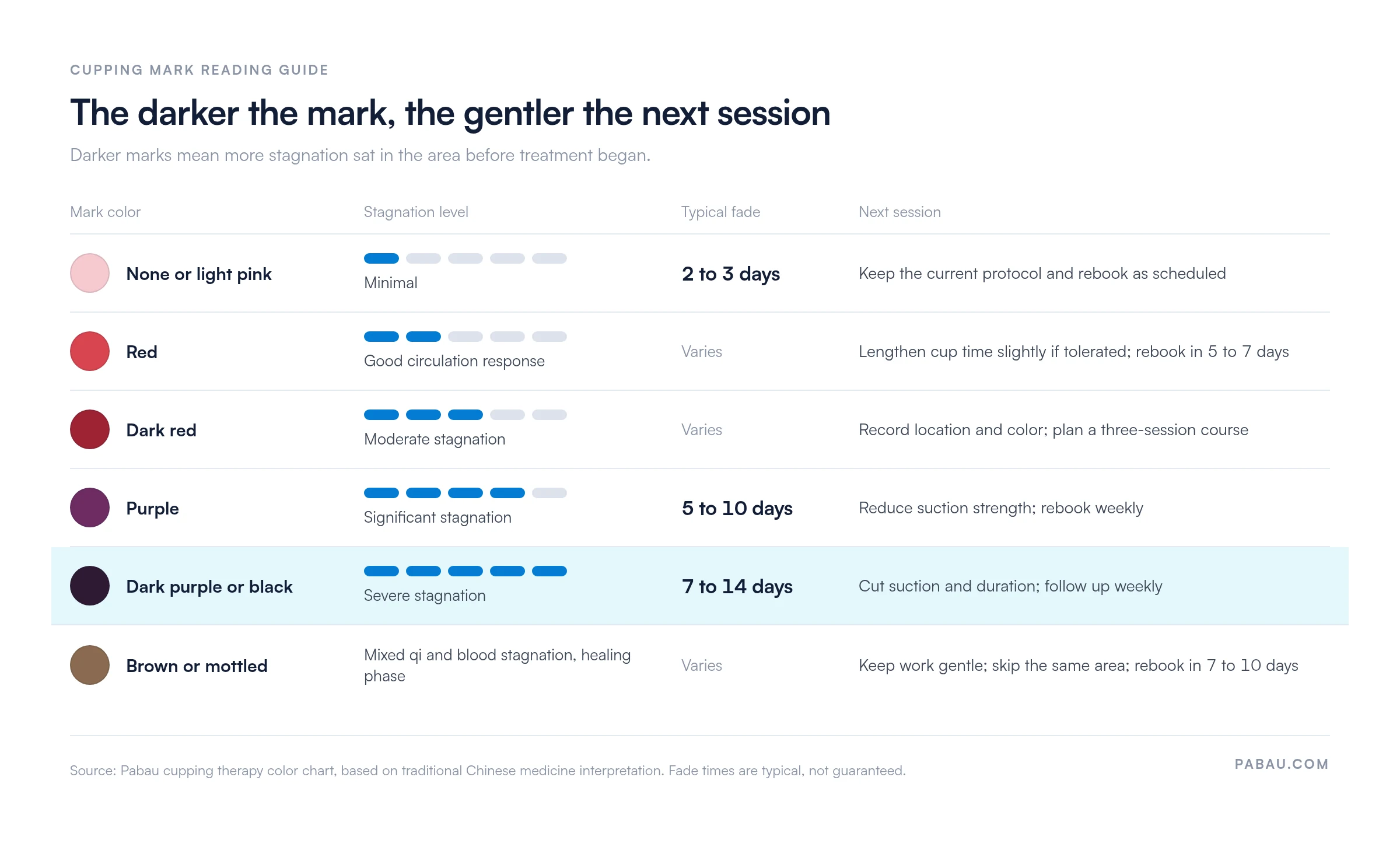
Add the chart to your outcome-tracking spa software as custom form fields for mark color, location, and patient feedback. This data builds a searchable history: Patients can see their own progress, and you can spot patterns across your practice. Tracking mark outcomes over 10-15 sessions gives patients visible evidence of change, which supports their commitment to ongoing treatment.
Beyond which cups were applied, wellness practices track mark color, patient sensation, and symptom shifts across sessions. This data informs clinical reasoning and gives patients objective evidence of progress.
Use your wellness clinic software to store:
When you document cupping outcomes in structured patient records, you create a clinical audit trail. If a patient asks, “Is cupping working?”, you can show them session 1 vs. session 6: Lighter marks, fewer movement restrictions, and improved self-reported wellness.
Pro tip: Add a note field for “mark color progression goal.” With chronic severe stagnation, the goal might be “move mark color from black (session 1) to purple (session 4) to red (session 7).” Setting that goal up front gives you and the patient a shared measure at each rebooking.
Many practitioners who track cupping marks split the job across a paper chart, a phone camera roll, and handwritten notes. By session six, comparing the upper back against session one means digging through three places.
Practice management software like Pabau keeps that history in the patient’s file instead. Build a custom form with fields for mark color, location, and patient feedback, and complete it at the end of each session. Before-and-after photos attach to the same Client records, so the session one mark sits next to session six on one screen.
The result is a progression record you can show a patient in seconds. It also gives you the evidence to adjust suction, duration, or rebooking intervals with confidence.

Pabau’s custom forms, before-and-after photos, and Client records keep every session’s mark color and location together. Show patients their progress and plan the next session from one screen.

Bring the chart into your next consultation, before the cups go on. Patients who see the color scale ahead of time can read a dark purple mark as a sign of progress. They also make fewer worried calls between sessions.
Mark location adds specificity: The same dark mark on the upper back reveals respiratory qi stagnation. On the lower back, it suggests kidney qi blockage.
The trade-off is discipline. The chart only pays off when every session’s color, location, and patient feedback land in the same record. A laminated copy in the treatment room is only a starting point. Book a demo to see how Pabau keeps cupping mark history, photos, and session notes together in one patient record.

Writing up each session? Massage therapy SOAP notes gives you a structure for recording what you did, how the patient responded, and the plan.
Screening before the first treatment? Massage intake form covers the health history to collect before any bodywork.
Building a longer care plan? Personal wellness plan helps patients set goals across seven dimensions of wellness.
Offering reflexology alongside cupping? Foot reflexology charts map the reflex points you can walk patients through during a session.
Keeping patients on track between visits? Health and wellness planner gives them a printable place to log habits and goals.
Severe stagnation is deep, chronic blockage of blood and qi in a specific area. Cupping releases it as dark purple or black marks that may persist 7-14 days. The darkness shows significant movement of blocked blood toward the surface, which TCM practitioners read as a positive treatment sign. Reduce suction intensity at the next session, and explain that mark color reflects the stagnation level rather than treatment aggression.
No, cupping marks are temporary in most cases. They typically fade within 5-10 days, depending on mark darkness and recovery factors such as age, hydration, nutrition, and baseline circulation. Light pink marks resolve in 2-3 days and purple marks in 5-10 days. Dark purple or black marks can take up to two weeks. NCCIH does list persistent skin discoloration and scarring as possible side effects, so cover them during consent.
Marks fade naturally as the body reabsorbs the extravasated blood. Practitioners can recommend three patient actions: Drinking 2-3 liters of water daily, light movement, and gentle self-massage away from the marked area. Avoid vigorous massage directly on fresh marks. Before a patient’s important event, reduce suction at the prior session or cup covered areas such as the lower back and legs.
Refer the patient to a dermatologist if a mark persists beyond three weeks or the discoloration stays after the rest has faded. The discoloration is extravasated blood in the skin, which normally reabsorbs over days to weeks. Correctly applied cupping rarely leaves lasting skin changes, so a mark that lingers points to an unusual reaction.
“Bad” marks are typically dark purple or black, and they signal severe stagnation rather than a treatment problem. They often show that cupping mobilized a deep blockage. Pain, blistering, or skin breakdown after cupping is different, because it points to excessive suction or prolonged application. In that case, reduce suction strength and duration at the next session.
Moderate stagnation is a mid-level blockage: The area has qi and blood movement that is slower than normal, but not completely stuck. Dark red marks indicate moderate stagnation. These areas typically improve over two or three sessions. Session 1 leaves a dark red mark, session 2 a lighter one, and session 3 may show light pink or no mark at all. Rebook these patients weekly until the marks lighten consistently.