Free model waiver form + what it is and when your practice needs one
A model waiver form is a signed document that lets a healthcare practice use a p...

7
Last Updated: Sep 29, 2026

An indemnity waiver form holds up only when it names the procedure, lists the risks you disclosed, and records the patient’s initials beside each one.
A release waives the patient’s right to sue, while the indemnity shifts your defense costs, and most clinical forms carry both.
No waiver covers gross negligence, willful misconduct, or unlicensed practice, so keep the exclusion clause in the signed form.
Our free template runs to 10 numbered sections, including photography permissions and a filing panel for your team.
Practice management software like Pabau sends the waiver before the visit and files the signed copy with its timestamp and version.
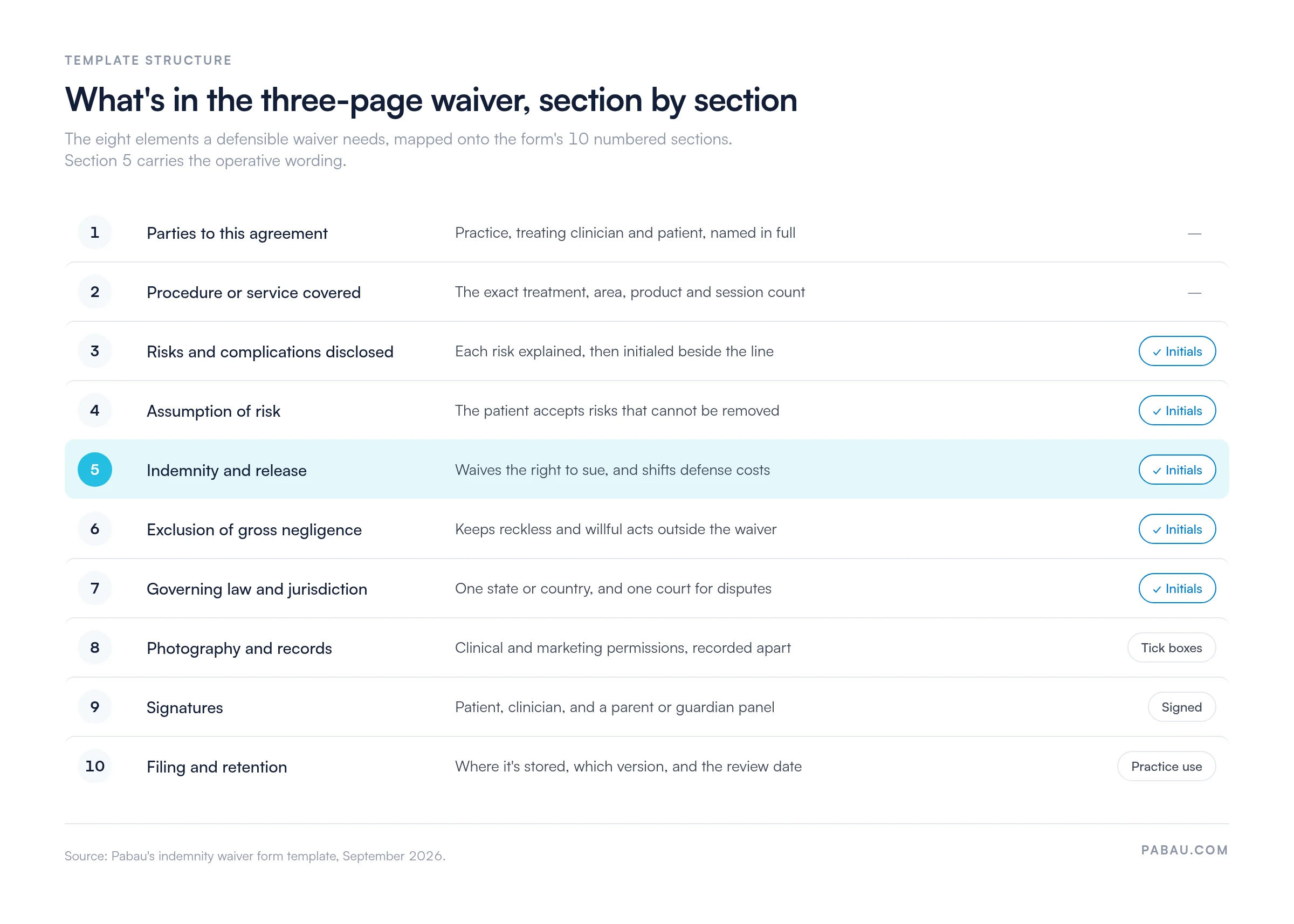
A three-page waiver in 10 numbered sections. It names the parties and the procedure, then lists each disclosed risk with a box for the patient’s initials. The indemnity wording, the gross negligence exclusion, governing law, photography permissions and signature panels follow.
Download templateAn indemnity waiver form records that a patient understands the risks of a named procedure and agrees not to sue over them. A line like “the patient accepts all risks” gives a court very little to work with, so your form has to name the procedure, list the complications you disclosed, and capture the patient’s initials beside each one.
Below, you’ll find every element the form needs, where each one sits in our free template, and how to get it signed before the appointment.
The form does two jobs at once. It records that the patient was told what could go wrong, and it limits what they can claim if one of those complications happens.
In a medical or aesthetic setting, that breaks down into three functions:
That third point carries the most weight where outcomes vary. Aesthetic work is the obvious case, because a patient’s idea of a good result and yours may not line up. Body art runs into the same mismatch, so a tattoo studio waiver records the approved design and placement next to the risks you disclosed.
A release waives the patient’s right to sue. An indemnity makes them cover your costs if they sue anyway. Most clinical forms combine both, which is why the two words keep appearing together. Outside patient care, a standalone letter of indemnity makes the same promise for one business deal, such as releasing cargo or a payment.
Our template combines them in section 5. Section 6 sits directly underneath and keeps gross negligence outside both, which is what stops a court throwing out the whole page.
Any procedure with a known complication rate should have a signed waiver in the record before it starts. That covers more of the appointment book than most schedules suggest.
The risk conversation only works if you know what you are screening for. Pair the waiver with medical intake forms that capture contraindications, allergies and current medications.
Consent to treat is a separate matter, and a waiver does not replace it. Where you need that recorded on its own, a medical consent form does the job for adult patients.
Eight elements make a waiver defensible. Leave one out and the whole document gets easier to challenge.
Our template carries all eight, although the numbering does not run neatly from one to eight. Sections 1 and 2 name the parties and the procedure. Section 3 lists the disclosed risks, with a box for the patient’s initials beside each line.
Sections 4 to 7 hold the assumption of risk, the indemnity and release wording, the gross negligence exclusion, and governing law. Photography and records sit in section 8. Section 9 is the signature block, with a panel for a parent or guardian, and section 10 is for your team. Reading down the form, the running order looks like this.
Broad language is the most common weakness. A line saying the patient accepts all risks covers less ground than a short list of named complications. Name them, and a court can see exactly what was explained.
A signed waiver is protected health information, so it sits under the same rules as the rest of the chart. Store it inside the patient record rather than a shared drive or a folder behind reception.
Limit access to the staff who need it, and check that your breach response plan covers wherever the signed copies live. A stack of waivers in an unlocked cabinet is a reportable problem waiting to happen.
Build the audit trail as you go. Record when the waiver was signed, who reviewed it with the patient, and which version of the form was used.
Then keep it for as long as your state’s statute of limitations runs, which is typically two to six years. Some practices hold waivers for seven to ten years to be safe, and your malpractice insurer may set its own floor.
Sharing that record with another provider takes a different document. A HIPAA authorization form is what gives you permission to release it.
Document the date and time each waiver was signed, the clinician who reviewed it, and any questions the patient raised during the consent conversation. That trail is your strongest medico-legal defense if a dispute arises. Keep the signed form at least as long as your state’s statute of limitations, and longer where your insurer asks for it.
Check who is allowed to sign it off. The clinician performing the procedure, or the supervising medical director, should review and approve the risk disclosures. For aesthetic treatments, that usually means a nurse practitioner, physician assistant or medical director, depending on your state.
Injectables, lasers and body contouring each carry their own complication list. One generic risk paragraph will not do the work for all of them, so write the disclosures per treatment.
Photography is a separate permission, and it splits in two. Clinical photographs kept in the medical record serve the chart, while marketing use is a separate ask. Section 8 of the template records each one on its own line, so agreeing to the first is never read as agreeing to the second.
When the photograph is for marketing rather than the chart, a model waiver form is the fuller document. It names each permitted use and records any compensation the patient receives.
Paper waivers are slow to file and easy to lose. Sending the form ahead of the appointment fixes both problems, and it gives the patient time to read something they are being asked to sign.
Five questions catch most of the problems that surface later. Run them once, on the version you are about to send out.
Two mistakes come up more often than the rest. The first is leaving the expiry date empty, which lets one signature drift across treatments it was never meant to cover. The second is letting practitioners keep their own edited copies, so no two patients sign the same wording.
Sometimes, and the wording usually decides it. Courts read waivers narrowly, because signing one means giving up the right to bring a claim.
What strengthens a waiver:
What a waiver will not do:
A well-drafted waiver holds against claims of ordinary negligence. It will not travel further than that, so have an attorney in your state read the wording before it goes into routine use.
Most practices still collect waivers on paper at the front desk. The signed sheet gets scanned days later and filed under a name only one person remembers. When a complaint arrives, nobody can say which version of the wording the patient saw.
Practice management software like Pabau sends the waiver to the patient before their appointment and files the signed copy in their record. The signature, the timestamp and the form version are stored together, so the audit trail builds itself. No one has to scan or rename a document afterward.
Your front desk can see who has signed and who has not. A missing waiver gets caught before the patient is in the chair, rather than after the procedure. Reception spends less time chasing paperwork, and you can produce the signed form on demand.

Pabau sends the waiver ahead of the visit and files the signed copy in the patient record. The timestamp, the reviewer and the form version are stored with it, so your audit trail is ready if a claim arrives.

A waiver earns its keep in the months after a complaint, not on the day it is signed. What decides the outcome is whether the risks were named, whether the patient initialed them, and whether you can produce the version they signed.
Download the template and replace the generic risk lines with the complications you disclose for each procedure. Have an attorney in your state check the wording first. Then keep one version in circulation, because a waiver whose wording varies between practitioners is the one that fails when it is tested.
A signed waiver you cannot find will not help you. Book a demo to see how Pabau collects waiver signatures before the appointment and keeps every signed copy in the patient record.

Need the wording for a straight release? Our medical release form template covers the release side on its own, without the indemnity clause.
Treating a patient under 18? The consent to treat a minor template sets out who can sign and what a guardian has to confirm.
Something went wrong after treatment? An adverse reaction form records what happened and when, which is the other half of your medico-legal file.
Moving your forms off paper? Our guide to patient intake software compares how these platforms collect, sign and store clinical paperwork.
In most cases, no. A witness signature is worth adding where the patient has limited capacity, needs an interpreter, or where a guardian signs. Notarization is rarely required for clinical waivers, so check your state rules before you add the step.
Yes, at any point before the procedure begins, and it must not affect their future care. Note the withdrawal in the record with the date and the reason given. A signed waiver does not oblige anyone to go ahead with treatment.
Only for the procedure and dates it names. Our template has an expiry field for exactly that reason. Set it to the end of the treatment course, then take a fresh signature for the next one.
Do not treat, and do not press them. Record the refusal, the date, and what was explained. Offer to answer questions or rebook once they have read the form. Proceeding without a signature leaves you with no record of the risk conversation.
Give them one as standard practice, even where your state does not require it. A patient who holds the signed form can see what they agreed to, which makes a later dispute about the wording much less likely.