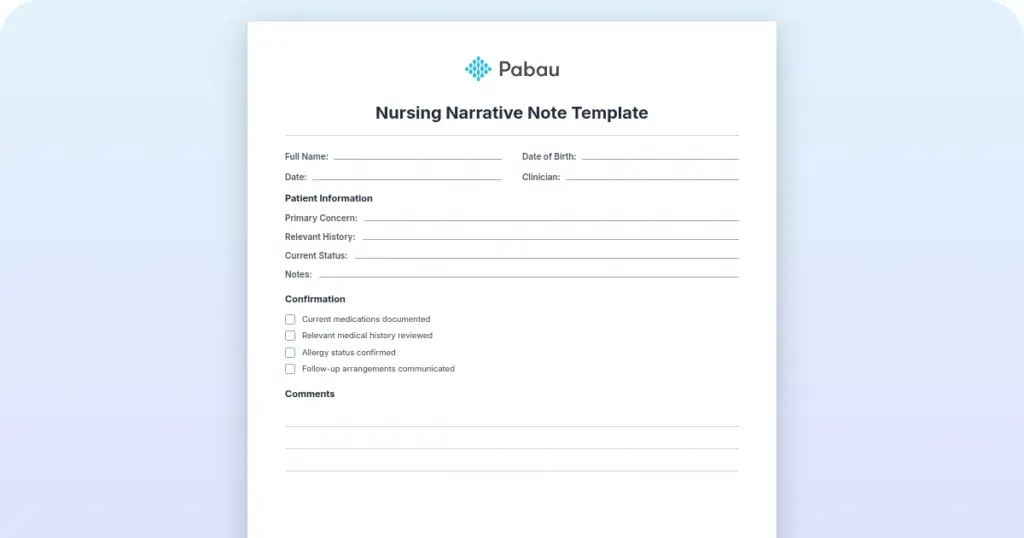
Nursing narrative note template
A nursing narrative note template is a structured PDF that guides you through re...

3
Last Updated: Oct 21, 2026

A nutrition care plan is a written clinical document recording a patient’s nutrition assessment, diagnosis, treatment goals, and monitoring schedule.
The Nutrition Care Process runs in four steps: assessment, diagnosis, intervention, and monitoring or evaluation.
A nutrition diagnosis is written as a PES statement, naming the problem, its etiology, and the signs that evidence it.
A complete plan carries assessment data, a PES statement, SMART goals, a dietary prescription, and a dated re-evaluation.
Practice management software like Pabau holds the same workflow digitally, so follow-ups and audit trails stop depending on a Word document.
A print-ready form with sections for assessment data, the PES nutrition diagnosis, SMART goals, the dietary prescription, the monitoring plan, and a dated re-evaluation.
Download templateA nutrition care plan is the clinical document that turns assessment data into a treatment you can measure. Registered dietitians write them, nurses contribute to them, and payers ask to see them.
This guide covers the four-step framework behind the plan, the fields each section needs, and a worked example you can copy. It also shows how the same workflow runs digitally, without a folder of Word documents.
A nutrition care plan is a written document setting out one patient’s personalized nutritional strategy. It records their nutritional status, names specific nutrition-related problems, sets measurable treatment goals, and prescribes the interventions that address those problems.
A registered dietitian or qualified nutrition professional writes it. That makes it a clinical document rather than general dietary advice, because it rests on measured data instead of preference.
The data behind it is specific: patient history, dietary intake, laboratory values, and anthropometric measurements. The plan then organizes that data using a standardized framework called the Nutrition Care Process (NCP).
So who writes one? Registered Dietitian Nutritionists (RDNs) are the credentialed professionals authorized to diagnose nutrition problems and build these plans in clinical settings. Nurses also document nutrition-focused nursing diagnoses, such as imbalanced nutrition, but that scope differs from a dietitian-authored plan.
Practices that run this on paper usually end up holding three versions of the same document. Keeping it in patient intake software means every team member reads the same plan and records their own contributions as they go.
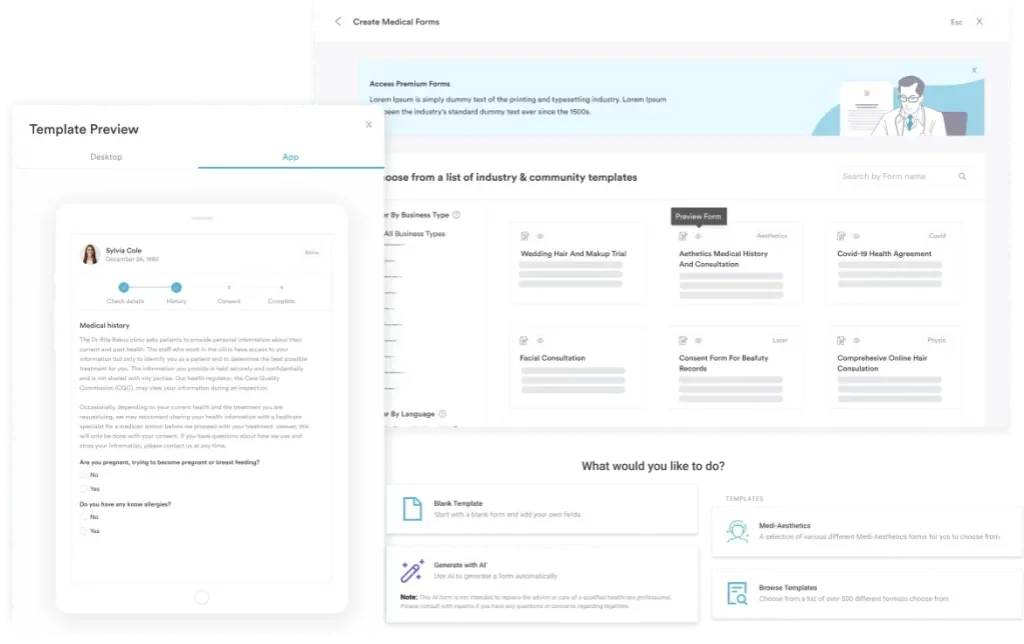
Every nutrition care plan follows the Nutrition Care Process (NCP). It is a systematic, evidence-based framework adopted by the Academy of Nutrition and Dietetics, and its four steps run in sequence. Practitioners remember them by the acronym ADIME:
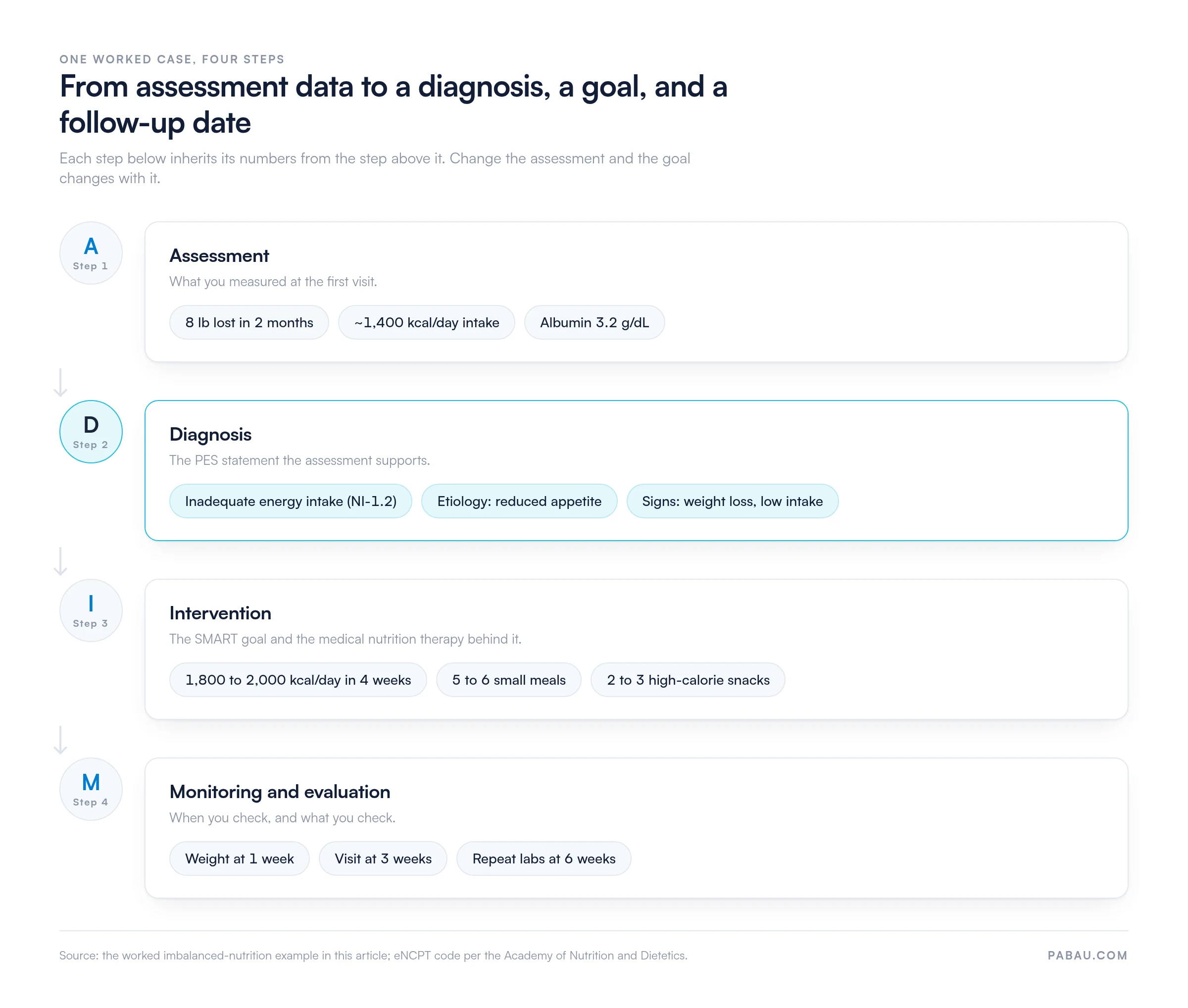
The steps only earn their keep when you can watch one patient’s numbers move through all four. The chain below follows the worked example later in this article, from a first weight reading to a booked follow-up.
Assessment is where you collect objective and subjective information. That covers dietary history from a 24-hour recall or a food frequency questionnaire, plus current medications, supplements, and medical history.
Then come the measurements. Labs cover glucose, lipids, albumin, prealbumin, and micronutrients. Anthropometrics cover height, weight, and BMI. Social and economic factors count too, including food access, cooking ability, and cultural preferences.
Capture all of it systematically, through structured intake forms and dedicated record sections. A partial assessment weakens the diagnosis that follows and leaves you nothing to show an auditor. Joint Commission and CMS both require documented nutritional screening in clinical settings.
A nutrition diagnosis names one specific problem the patient has. The standard format is a PES statement, built from the problem, its etiology, and its signs and symptoms.
Take a patient losing weight after a change in appetite. Their PES statement reads:
Common nutrition diagnoses include inadequate energy intake, excessive carbohydrate intake, imbalanced nutrition, food and nutrition-related knowledge deficit, and altered nutrition-related laboratory values. Each one drives the intervention and the goals that follow it.
Interventions are the actions you take against the diagnosed problem. Most combine Medical Nutrition Therapy (MNT), meaning evidence-based dietary modifications, with nutrition education and counseling.
Goals must be SMART: Specific, measurable, achievable, relevant, and time-bound. A goal that qualifies reads like this: “Patient will achieve a sodium intake below 2,300 mg/day within 4 weeks, measured via 24-hour urine sodium.”
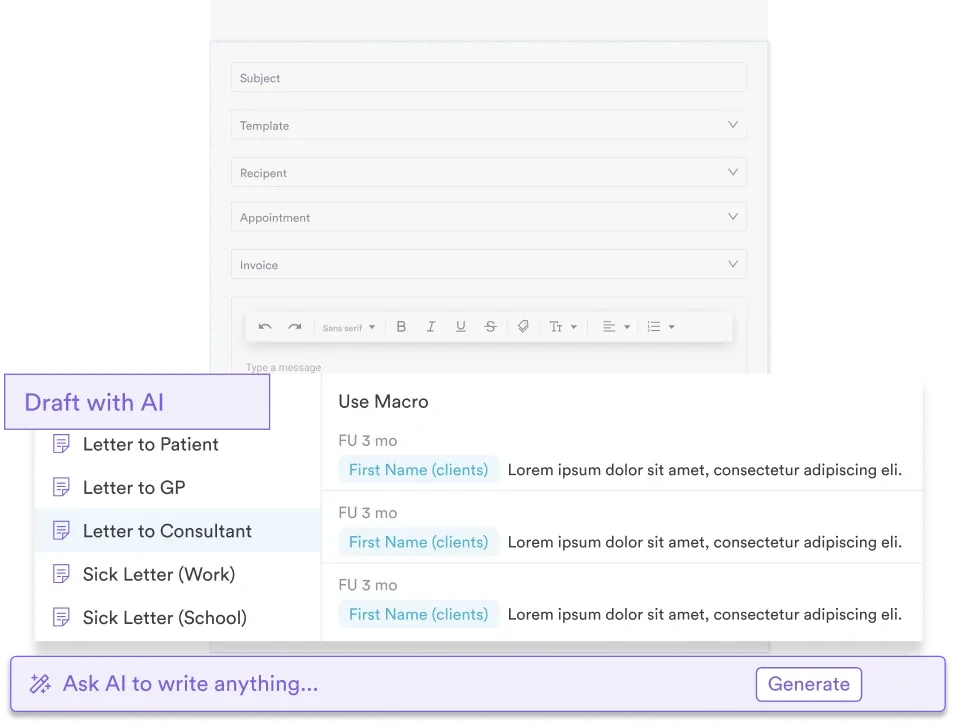
The patient leaves with the plan in writing, and the referring physician usually needs a copy of it. Drafting both from stored templates with letters and dictation tools keeps the wording consistent with what you charted. A nutrition education handout can go out alongside both, covering the general dietary guidance behind the counseling.
Monitoring and evaluation is continuous. At each follow-up you reassess the relevant data, then compare it against the baseline and the SMART goals. Three questions decide what happens next. Is the plan working, should the goals change, and are new problems emerging?
Common indicators include weight, lab values such as HbA1c and a lipid panel, dietary intake patterns, symptom resolution, and patient-reported quality of life. Record each reassessment as a dated note. SOAP progress notes suit this well, because the same four headings repeat at every visit and make the trend easy to read.
Set the interval from the patient’s acuity. Acute problems usually need reassessment every 2 to 4 weeks. Stable chronic disease is often quarterly. Booking that visit before the patient leaves the room is what keeps the plan alive, and it demonstrates ongoing care for reimbursement.
A complete document includes these elements:
Some practices go further than this. Functional and integrative medicine services often add microbiome data, organic acids panels, or genetic markers to the assessment. Tailor the template to your scope, and document only what your credentials authorize.
Imbalanced nutrition, less than body requirements is one of the most common nutrition diagnoses. It turns up constantly in clinical nutrition, weight loss practices, and acute care settings.
Here is how the documentation reads for a patient with the less-than-requirements form:
Read the table downward and the logic holds: assessment data supports the diagnosis, and the diagnosis sets both the goals and the interventions. Bringing the patient into the goal-setting is what turns that documentation into adherence.
A nutrition care plan and a nursing care plan for nutrition are not the same document. The first comes from a dietitian working the NCP. The second addresses a nursing diagnosis such as imbalanced nutrition, drawn from the NANDA-I taxonomy.
The difference is scope. A nursing plan documents nursing interventions and nursing outcomes, so it covers feeding assistance, monitoring for complications, and patient teaching. A nutrition care plan documents dietitian interventions and nutrition outcomes, so it covers MNT and dietary prescriptions.
Both often coexist. A hospitalized patient may carry a dietitian-authored plan for inadequate energy intake alongside a nursing plan for aspiration risk related to swallowing difficulty. Each profession documents its own scope, and both work toward the same recovery.
So pick the template that matches your credentials. A nurse documenting feeding, oral hygiene, or nutritional monitoring should start from an imbalanced nutrition care plan instead. A dietitian diagnosing and treating nutrition problems needs the NCP-based template above.
Assessment too brief. Skipping dietary history or lab work shortcuts the diagnosis. A sound diagnosis rests on complete data.
Goals that are not SMART. “Eat healthier” is not measurable. Include numbers: A target weight, a calorie intake, a nutrient level, or an adherence rate.
Missing follow-up dates. A plan without a reassessment schedule is incomplete. Document when the patient returns and which metrics you will measure.
Forgetting the patient’s voice. Patients who do not understand or agree with the plan will not follow it. Record their preferences, their barriers, and their readiness to change.
Templates stored as Word documents or PDFs cause the same four problems in every practice. Versions get lost, follow-ups slip, handwritten notes cannot be searched, and coordination between the dietitian and the nursing team happens by email.
Practice management software like Pabau holds the whole NCP workflow in one place instead. Intake assessments arrive through digital forms before the visit. The diagnosis and the goals go into the notes on structured client records, and the follow-up gets booked from the same screen.
Automated messaging carries the rest. Clients get a pre-visit questionnaire for dietary history and symptom updates, then a copy of the plan afterward, then a reminder for the follow-up. Your team stops entering the same data twice, and the audit trail builds itself for CMS MNT documentation.
The outcome is a plan that changes when the patient does. Every dietitian, nurse, and front-desk coordinator sees the same assessment, diagnosis, and goals, and each records their own contribution as it happens.

Pabau’s digital forms and client records hold nutrition assessments, SMART goals, and patient follow-ups in one place. Your team documents once, and the reassessment date never depends on someone remembering it.

The framework is what makes a nutrition care plan defensible. Assessment data supports the diagnosis, the diagnosis sets the goals, and the goals decide what you measure at the next visit. Break that chain anywhere and the plan becomes dietary advice with a signature on it.
So start from the template, and commit to the re-evaluation date before the patient leaves the room. A plan nobody revisits fails the audit and the patient at the same time.
Download the template above to work on paper for now. Book a demo to see how Pabau keeps nutrition assessments, SMART goals, and follow-ups moving without a second filing system.

Need a structured assessment form? Medical forms at your healthcare practice covers how to design intake and assessment forms that capture complete patient data.
Working on the reassessment step? Evaluation nursing care plan shows how to document outcomes against the goals you set at the first visit.
Assessing a patient with GI symptoms? Gastrointestinal assessment walks through the examination findings that often explain a drop in oral intake.
Planning care around a family member? Caregiver care plan covers the documentation when someone else prepares the meals and tracks the intake.
A nutrition care plan is a written clinical document created by a registered dietitian. It sets out one patient’s personalized nutritional strategy, covering their assessment data, identified nutrition problems, treatment goals, and planned interventions. All of it is structured using the standardized Nutrition Care Process (NCP) framework.
A complete plan includes patient identification, dietary and medical history, and assessment data covering anthropometric and lab values. It then carries the nutrition diagnosis as a PES statement, SMART-formatted goals, the dietary prescription and MNT interventions, and a monitoring plan with scheduled follow-ups. The practitioner’s signature and credentials close it.
Follow the four steps of the Nutrition Care Process. Collect comprehensive data at assessment. Identify and name the nutrition problems using a PES statement. Set SMART goals and plan evidence-based MNT for the intervention. Then monitor progress and adjust the plan. Document each step in a standardized template or your EHR.
The Nutrition Care Process is the framework: assessment, diagnosis, intervention, and monitoring or evaluation. The nutrition care plan is the written document that results from applying that framework. It captures one patient’s specific assessment, diagnosis, goals, and interventions.
The schedule depends on the patient’s acuity and progress. Acute or unstable conditions typically need reassessment every 2 to 4 weeks, while stable chronic conditions may be reviewed quarterly. Always document a specific re-evaluation date in the original plan, then adjust it based on the patient’s response to the interventions.
Registered Dietitian Nutritionists (RDNs) are the credentialed professionals authorized to diagnose nutrition problems and create evidence-based nutrition care plans in clinical settings. Nurses may document nutrition-related nursing diagnoses and interventions, but those follow a different standardized language, NANDA-I, and a different scope.
Thorough documentation serves several purposes at once. It keeps care continuous across your team, and it creates the audit trail that CMS, the Joint Commission, and insurers ask for. It also protects your practice legally, and it lets you track outcomes so you can adjust the interventions on evidence rather than impression.