Treatment summary
A treatment summary is a written record of what care was delivered during an epi...

1
Last Updated: Oct 16, 2026
A normal physical exam is a structured head-to-toe assessment in which every body system is checked and falls within expected ranges, with no acute findings. According to the American Medical Association, complete documentation of that exam is a core requirement for evaluation and management (E/M) billing.
Normal findings still need precise charting. A note that reads “WNL” system after system invites audit questions and leaves the next clinician no usable baseline. This guide covers normal findings by body system, ready-to-use documentation phrases, a SOAP note example, and when to code Z00.00 or Z00.01.

A normal physical exam documents findings within expected ranges across every major body system, from vital signs through neurological function.
‘Within normal limits’ (WNL) is accepted shorthand, but system-specific language gives stronger audit protection and a better clinical baseline.
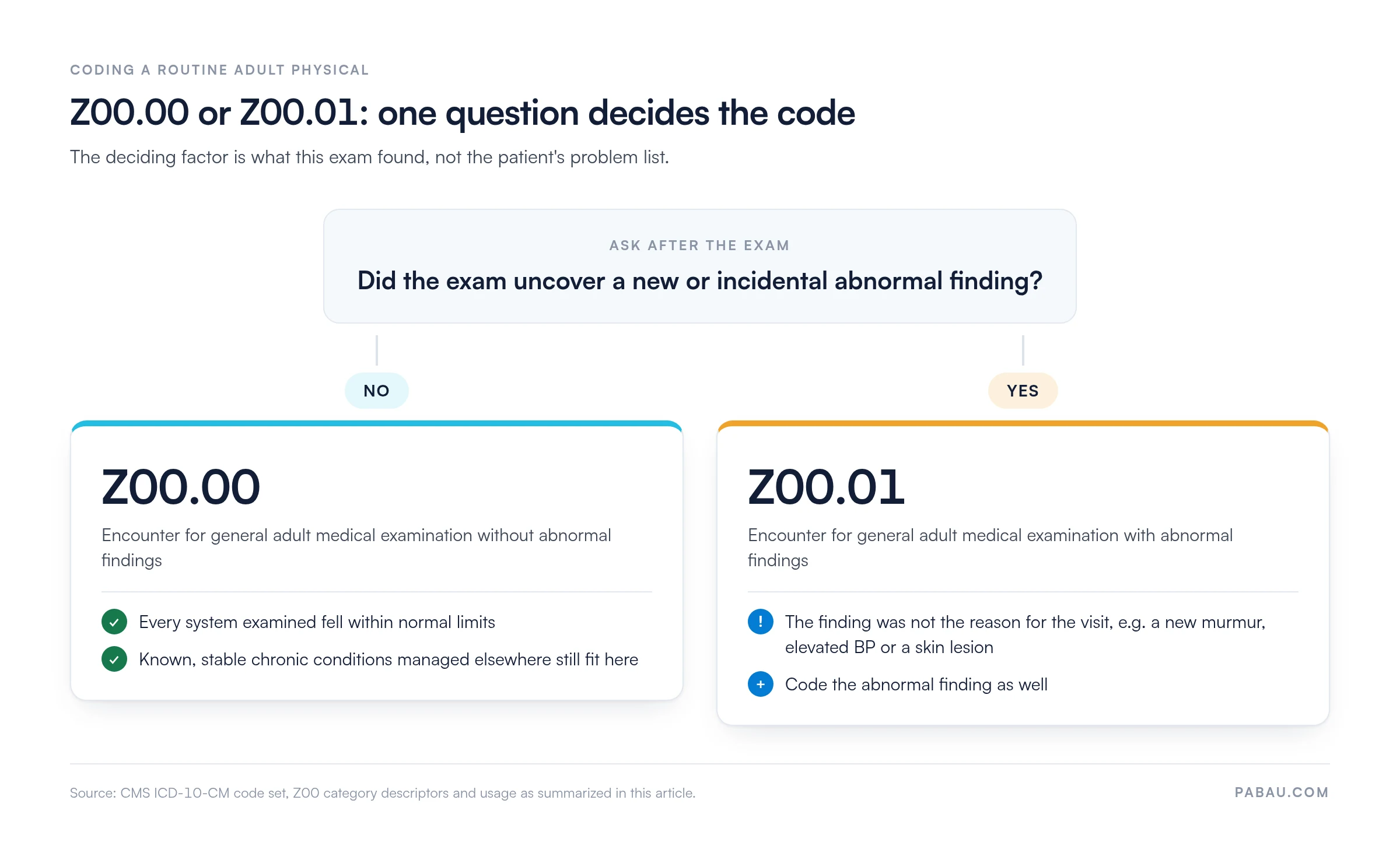
ICD-10 code Z00.00 applies when the exam finds no abnormalities. Z00.01 applies when incidental abnormal findings turn up that weren’t the reason for the visit.
Practice management software like Pabau lets practitioners pre-fill normal findings in customizable templates, so charting time goes to what’s abnormal.
A normal physical exam is a structured, multi-system assessment with three jobs. It establishes the patient’s baseline, screens for undetected disease, and meets the documentation requirements of a preventive or E/M encounter.
“Normal” describes the findings, not the effort. Each system was assessed by inspection, palpation, auscultation, or percussion, and the findings fell within accepted limits for the patient’s age and sex. In primary care, a thorough normal exam is the foundation of the longitudinal patient record.
The four assessment techniques underpin every body system:
Most adult physical exams cover at least eight organ systems to satisfy AMA/CMS multi-system exam criteria for E/M coding. Documenting each system individually, even when findings are normal, is what distinguishes a billable comprehensive exam from a focused visit.
Each body system has accepted normal-finding language that clinicians can adapt in their EHR or SOAP notes. The table below summarizes normal findings and gives a ready-to-use documentation phrase for each system.
Vital signs are the opening data set of every physical exam. According to the American Heart Association, normal adult blood pressure is below 120/80 mmHg. Elevated readings (120-129 systolic) are now a separate category from Stage 1 hypertension. The ranges below are widely cited adult norms from clinical references, including the AHA and standard medical education texts.
HEENT phrases are among the most frequently templated in outpatient practice, because the system is assessed at nearly every encounter. These are the key terms for each part of the exam.
A normal physical exam template gives practitioners a structured starting point to modify for each encounter. The most efficient approach is to pre-populate a full “normal” template in your EHR, then edit only the systems with abnormal findings.
That is faster than free-texting from scratch, cuts omissions, and keeps notes consistent for audits. Clinicians building standardized templates can save medical forms at your practice as reusable digital documents. If you’d rather adapt a ready-made layout, start from our free history and physical form.
The Objective section of a SOAP note is where physical exam findings live. Below is a full example for an adult attending a routine wellness exam with no abnormal findings. Adapt it for any primary care or outpatient setting.
Practices using time-saving digital intake forms collect the subjective history before the appointment. The clinician’s charting then starts at the Objective section rather than a blank screen.
Documenting a normal physical exam correctly protects the practice in an audit and gives the next clinician a usable record. The three habits below apply in primary care, physical therapy, and most outpatient specialties.
“WNL” (within normal limits) is an accepted clinical abbreviation. Used as a catch-all for whole systems, though, it leaves an auditor unable to tell whether a system was assessed at all. Clinicians joke that WNL stands for “we never looked,” and a payer reviewing the note may read it the same way.
Best practice is to use WNL only when the system was explicitly examined. Pair it with at least one specific finding, such as “CTAB, WNL” rather than “Resp: WNL” alone. For higher-level E/M codes, system-specific language is always the safer choice.
When documenting a normal physical exam, avoid using ‘WNL’ for multiple systems in a row without any specific findings. Payers auditing E/M claims look for evidence that each system was actively assessed, not just checked as normal. One specific finding per system (e.g. ‘CTAB’ for lungs, ‘S1/S2 RRR’ for heart) is far more defensible than a column of WNL abbreviations.
CMS E/M documentation guidelines require evidence that each billed system was reviewed. A system left out of the note, even if examined, was not documented, which means it was not billable. For a comprehensive multi-system exam, list each of the eight required systems even if all findings are normal.
A consistent template also lightens the load on practitioners who document 20 or more encounters a day, because its structure prompts every system in order.
A normal physical exam is most valuable when it creates a dated baseline. Record specific values, such as BP 116/72, rather than “normal BP,” so a later reviewer can spot trends. A BP that climbs from 110/68 to 128/80 over four years matters clinically, even though no single reading looked alarming on its own.
The ICD-10 codes for routine physical examinations sit in the Z00 category (Encounter for general examination). According to the CMS ICD-10-CM code set, the two codes most commonly used are Z00.00 and Z00.01. The choice hinges on whether the exam identified incidental abnormal findings, not on whether the patient arrived with a complaint.
A common coding error is defaulting to Z00.01 out of caution when a patient has known chronic conditions managed elsewhere. Known, stable chronic conditions in the medical record don’t automatically make the preventive exam “with abnormal findings.” Z00.00 is appropriate if the exam itself yielded no new abnormal results, even when the patient carries chronic diagnoses.
The whole decision comes down to one question about what this exam found, as the diagram below shows.
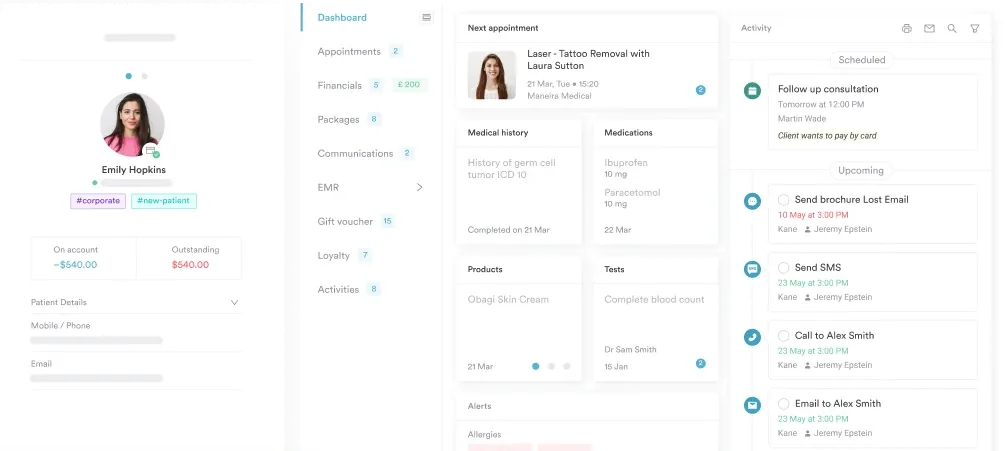
Charting a complete normal exam 20 or more times a day adds hours to a clinician’s week. Practice management software like Pabau lets you build customizable normal-finding templates that pre-fill each system’s standard language. Practitioners then edit only the findings that differ from normal.
Pabau’s client record management stores every encounter in date order, so you can compare today’s findings with last year’s baseline. Pabau Scribe, our AI scribe, transcribes a clinician’s spoken exam narrative in real time. It turns that narrative into structured note language, which the practitioner then reviews and approves.
The result is an audit-ready note for every routine physical, without the evening spent finishing charts. Independent and multi-location practices get this template-driven charting on a single subscription.

Pabau’s customizable clinical note templates and AI-powered documentation tools help your practice capture complete, audit-ready physical exam notes without the repetitive typing. See it in a live demo.

Treat the normal exam as the note you’ll lean on later. It’s the chart an auditor reads, the justification behind the claim, and the baseline the next clinician compares against.
The practical move is to build one full normal template, with a specific finding for every system, and edit only what changes on the day. It takes a few hours once and retires the WNL shortcut from every note that follows. The trade-off is discipline. A pre-filled template only protects you if the clinician checks each line against the exam they performed.
Book a demo to see how Pabau’s note templates and Pabau Scribe cut charting time on every routine physical.

Want more worked SOAP notes? SOAP notes examples walks through completed notes across specialties, so you can see the Objective section in context.
Documenting the review of systems too? 12-point review of systems gives you a ready-made ROS checklist to pair with the physical exam.
Tracking vitals across visits? Vital signs record is a free template for logging the baseline values this guide recommends recording.
Need a faster neuro exam? Neuro exam cheat sheet summarizes cranial nerve, reflex, and coordination checks on a single page.
Normal physical exam findings fall within accepted ranges for the patient’s age and sex in every system examined. Typical vital signs are BP below 120/80 mmHg, HR 60-100 bpm, and RR 12-20 breaths per minute. Other normal findings include clear lungs, a regular heart rhythm with no murmurs, a soft non-tender abdomen, intact cranial nerves, and 2+ reflexes. Each system is documented in standard clinical language such as “CTAB,” “RRR,” and “A&Ox3.”
Z00.00 is the ICD-10 code for an encounter for general adult medical examination without abnormal findings. Use it when the physical exam reveals no new or incidental abnormalities. Z00.01 applies when the exam uncovers incidental abnormal findings that were not the reason for the visit. Known chronic conditions don’t require Z00.01 if the physical exam itself was normal.
In SOAP format, normal physical exam findings are documented in the Objective section. List each body system examined followed by its key normal findings (e.g. “Resp: CTAB, no wheezes, rales, or rhonchi”). Include all systems examined, even when normal, to satisfy CMS multi-system exam criteria. The Assessment section then lists the relevant Z00.00 or Z00.01 ICD-10 code.
HEENT normal findings means the exam of the head, eyes, ears, nose, and throat revealed no abnormalities. Typical documentation reads “NC/AT” (normocephalic/atraumatic) and “PERRL, EOMI” (pupils equal and reactive, extraocular movements intact). It also notes “TMs clear bilaterally,” patent nares, and a clear oropharynx with no erythema or exudate.
Deep tendon reflexes (DTRs) are the standard reflexes assessed during a physical exam, graded on a 0-4 scale where 2+ is normal. Commonly tested reflexes include the biceps (C5-C6), brachioradialis (C5-C6), triceps (C6-C7), patellar (L3-L4), and Achilles (S1) reflexes. The Babinski reflex is also checked. A normal (negative) result in adults is plantar flexion of the toes.
Using “WNL” for all systems without any specific supporting findings is an audit risk. Payers and compliance reviewers may read an exam note made entirely of WNL abbreviations as potentially unperformed. Best practice is to pair WNL with at least one specific finding per system, such as “CTAB, WNL” or “S1/S2 RRR, WNL.” That shows the system was actively assessed.