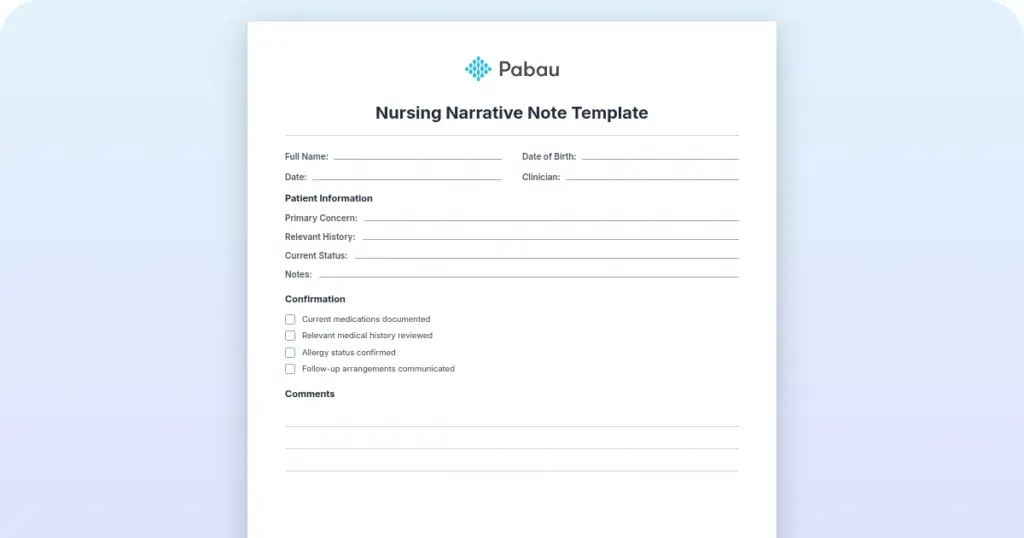
Nursing narrative note template
A nursing narrative note template is a structured PDF that guides you through re...

3
Last Updated: Oct 21, 2026

Evaluation is step five of ADPIE, where you measure whether a patient goal was met, partially met, or not met.
You evaluate by comparing the patient’s status today against the expected outcome written during planning.
Goal status decides what happens next, so a goal that falls short triggers a documented plan revision.
Write evaluation statements with numbers and observed behavior, never with judgments like “patient is doing better”.
Practice management software like Pabau stores each evaluation against the patient record, so progress stays visible across visits.
A ready-to-use evaluation sheet for the final step of the nursing process. It carries columns for the expected outcome, the actual outcome, goal status, the reason behind that status, and the revised plan.
Download templateAn evaluation nursing care plan section records whether the patient reached the goals you set during planning. It is the fifth step of the nursing process, known as ADPIE.
Evaluation answers three questions. Did the interventions work? Did the patient meet the goal? And what happens to the plan next?
This guide shows how to structure that section and how to score each goal. The worked examples cover ambulation, pain, and patient-education goals, plus the wording that holds up in a chart.
A nursing care plan evaluation is the systematic review of patient progress against the expected outcomes. The nurse steps back from daily care and asks one question. Did the patient achieve the goal?
Assessment and evaluation are easy to confuse. Assessment gathers data about the problem. Evaluation measures whether the solution worked. You compare what you observe now against what you planned, then record the result.
The evaluation section of a care plan usually carries five elements.
Evaluation does two jobs. It documents accountability, proving the plan was monitored rather than simply written. It also drives improvement, showing which interventions earned their place in the next revision.
Regulators expect that record. The American Nurses Association, The Joint Commission, and state nursing boards all look for evaluation in the chart. When a goal is missed, the notes must show reassessment and a revised plan.
Work through these five steps to finish the evaluation section of a care plan.
The focused assessment in step two changes with the goal’s domain. A nursing skin assessment supplies a Braden or Norton score, so a skin integrity goal has a number to be judged against.
The template gives you columns for nursing diagnosis, expected outcome, actual outcome, goal status, reason, and revised plan. Keeping it inside a structured clinical record means the whole team reads the same version at handoff.
The template suits nursing staff and interdisciplinary teams in almost any setting. Occupational and speech therapy teams record functional improvements the same way.
Primary care, acute care, long-term care, home health, and community health teams all follow the same logic. In long-term care, the goals you score start in the comprehensive care plan that a resident admission checklist tracks to day 21.
Nursing students learning ADPIE get the most out of the reason column, because it forces the clinical thinking behind the score. Practice managers use that same column to spot interventions that keep failing.
A structured format removes guesswork. Instead of “patient is doing better”, you record a measurable comparison against a stated goal. The next clinician then knows what was achieved and what still needs work.
Accreditation bodies and payers want to see clinical reasoning, not boxes ticked. A structured format keeps goals explicit, outcomes measurable, and revisions justified. Running a periodic medical chart audit on those entries shows where documentation drifts before an inspector finds it. Consent forms captured at booking give that same audit trail a clean starting point.
A missed goal with a recorded reason prompts a different approach next time. Common reasons include interventions applied inconsistently, low patient engagement, or a timeline that was never achievable. Without that reason, teams repeat the same plan that already failed.
Paper evaluation is slow, and it depends on someone remembering the date. Far fewer evaluations then get missed.

The three-status framework is the backbone of evaluation documentation. Each status points to a different next step. The same judgment goes into the daily shift note, not only the care plan. A PIE note format pairs each intervention with the patient’s response to it.
The patient reached the expected outcome. Goal: Patient will report pain of 3 or less out of 10. Actual: Pain 2 at rest and 4 with activity. Status: Met.
Record why it worked, such as consistent analgesia and good therapy attendance. That note tells the next shift which interventions to keep. Then move to ongoing monitoring or discharge planning.
The patient reached part of the goal. Goal: Patient will ambulate 200 feet without assistance. Actual: 100 feet independently, then standby assist for balance. Status: Partially Met.
Record the distance achieved, then judge the cause. Was the target unrealistic for this patient, or was the timeline simply too short? Extend the window or intensify the interventions, and say in the note which one you chose.
The patient made no progress toward the goal. Goal: Patient will verbalize understanding of medication adherence strategies. Actual: Unable to recall three key points when asked. Status: Not Met.
Treat that result as diagnostic information. Name the barrier, whether it is language, cognitive impairment, low motivation, or too little teaching time. Then change the method. Clearer patient communication, family involvement, or a simpler goal all belong in the revision.
Most evaluation notes fail on wording rather than on clinical judgment. The test is simple. Could another clinician act on your sentence without asking you a question?
| Weak statement | Chartable statement |
|---|---|
| Patient is doing better. | Pain 2/10 at rest, down from 7/10 on admission. Goal met. |
| Tolerated ambulation well. | Ambulated 150 feet with a walker, no shortness of breath. Goal met. |
| Education given. | Patient repeated all three insulin storage steps unprompted. Goal met. |
| Goal ongoing. | Ambulated 100 of 200 feet with standby assist. Goal partially met, timeline extended to week four. |
Every chartable version carries a number, an observation, and a status. That is exactly what an auditor and the next clinician both look for.
Archived evaluations also become a dataset. Patient management software lets you see whether a whole cohort keeps missing mobility goals, which points to a planning problem.
Most practices still track evaluation dates in someone’s head or on a paper worksheet. The goal gets written, the reassessment date passes, and the evaluation is reconstructed from memory a week later.
Practice management software like Pabau keeps the goal, the interventions, and the evaluation in one patient record.
A manager can see which goals are overdue for evaluation and which patients have missed the same outcome twice.
So the care plan gets reviewed on time, with a documented reason behind every status. An audit then becomes a search rather than a hunt through paper files.

Pabau stores each evaluation against the patient record and flags the goals due for review. Your team documents outcomes at the bedside instead of from memory.

Evaluation is what turns a care plan from a filed document into a working one. The score matters less than the reason you record beside it, because the reason changes the next intervention.
So set a date for every goal you write, and evaluate on that date even when the answer is uncomfortable. A partially met goal caught in week two costs far less than one discovered at discharge.
Book a demo to see how Pabau keeps care plan evaluations, goal statuses, and revisions in one patient record.

Want to see a finished care plan end to end? Constipation nursing care plan shows how goals, interventions, and evaluation lines sit together on one page.
How do you evaluate goals that run for months? CVA nursing care plan works through long-horizon mobility and communication outcomes after a stroke.
Need short-timeline outcomes to practice on? Fever nursing care plan sets goals that get evaluated within hours rather than weeks.
Need clear terms with your clients? client agreement template covers service scope, payment terms, cancellation policies, and confidentiality obligations for healthcare practices.
Want the baseline data your evaluation compares against? Emergency nursing assessment covers the findings you will measure later progress from.
Evaluation is the fifth phase of ADPIE. You measure whether the patient reached the outcomes set during planning. You compare actual status to the goal, record met, partially met, or not met, and revise the plan.
State the expected outcome, then describe the patient’s actual status from your focused assessment. Score the goal as met, partially met, or not met. Explain why that happened, and say what changes next. Use measurable data rather than opinions.
Evaluation criteria are the measurable benchmarks inside the expected outcome statement. Examples include ambulating 50 feet without shortness of breath, reporting pain of 3 or less, and an incision staying free of infection signs. Those criteria are what you measure actual status against.
A partially met goal means the patient achieved some of the expected outcome but not all of it. Independent ambulation that still needs minimal assist is the classic example. The status calls for a revision, so intensify the interventions, extend the timeline, or reset the target.
Assessment is the first phase, gathering data about the patient’s problem. Evaluation is the last phase, measuring whether your plan solved that problem. Assessment asks what the patient needs. Evaluation asks whether you met that need.
Record why it was missed, such as an unrealistic timeline, inconsistent interventions, or low patient engagement. Then revise the plan by changing interventions, resetting the goal or timeline, or adding new strategies. Re-evaluate at the next scheduled assessment. A missed goal is diagnostic information that guides better planning.