Treatment summary
A treatment summary is a written record of what care was delivered during an epi...

1
Last Updated: Oct 16, 2026
A pharmacology drug card template is a one-drug-per-card layout that holds the facts you need before giving a medication. It covers the drug’s names and class, how it works, its dose and route, side effects, interactions, and nursing considerations.
Build one card per drug, sort your deck by drug class rather than alphabetically, and start with 50 to 100 core medications. Expand to about 150 as the NCLEX approaches. The free printable template below gives you the layout, so you only fill in the drug-specific details.
A two-page printable PDF with fields for generic and brand name, class and action, dose, frequency, a high-alert flag, and special instructions. It also covers indications, contraindications, side effects, nursing considerations, patient education, and a page for notes.
Download template
A pharmacology drug card template holds one medication’s names, class, mechanism of action, indications, dosage, side effects, interactions, and nursing considerations on a single card.
Every card needs the same core fields in the same order. That way you can find the side effects or the dose on any card at a glance.
Organize your deck by therapeutic drug class, such as beta-blockers or anticoagulants, rather than alphabetically. That mirrors how you choose a drug at the bedside.
For NCLEX prep, focus on 100 to 150 high-yield medications and review them with spaced repetition over several weeks.
A pharmacology drug card is a compact reference that holds the most clinically important facts about a single medication. It distills a prescribing label or a textbook chapter into one scannable page. You use it during study, at the point of care, and before giving a dose.
Drug cards work because they follow the same structure every time. The generic name sits in the same spot on every card, and so do the side effects and nursing considerations. That consistency trains your eye to find information fast.
A drug card also differs from a flashcard. A flashcard has a question on one side and an answer on the other, such as “What does dopamine do?” A drug card is a reference data sheet instead. You read it to refresh your knowledge, verify a dose, or check contraindications before giving a medication.
Nursing school teaches pharmacology across several courses, including med-surg, pediatrics, psych, and critical care. By graduation, you’re expected to know hundreds of drugs. Drug cards keep that knowledge organized and easy to retrieve. They matter most for NCLEX prep, because the exam tests quick recall of drug-specific facts under pressure.
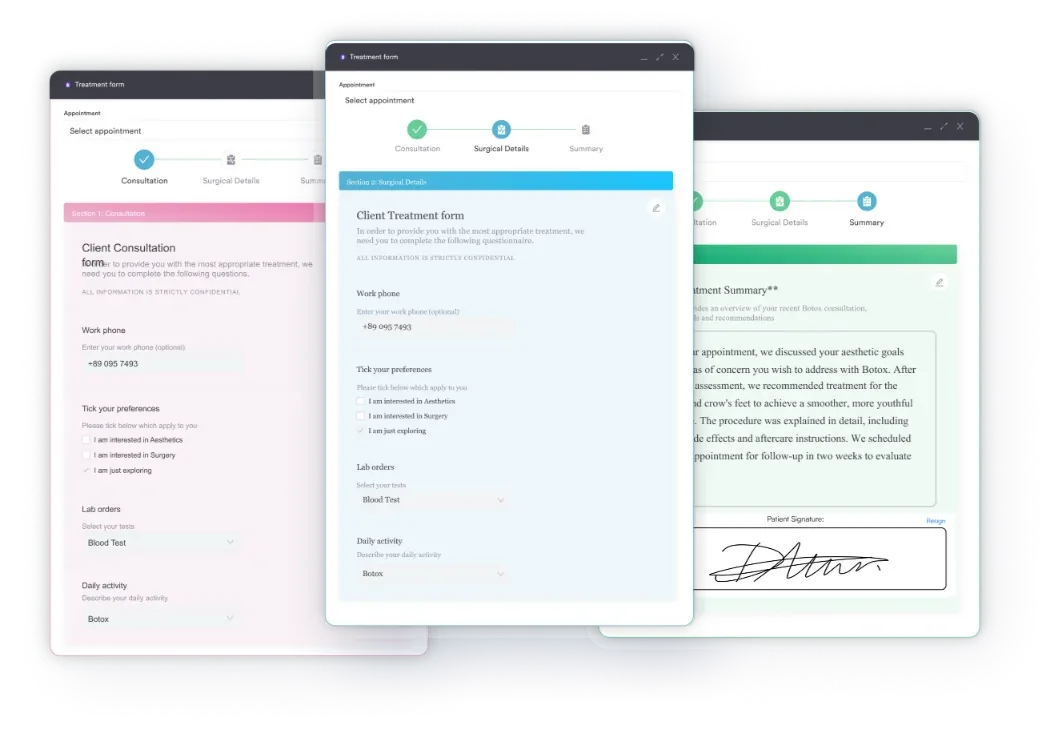
The most useful card balances completeness with scannability. Make it too sparse, with just a name and an indication, and you end up back in the textbook. Make it too detailed, and the card takes as long to review as the label.
Grouped by the question each one answers, those ten fields fall into five zones on the card.
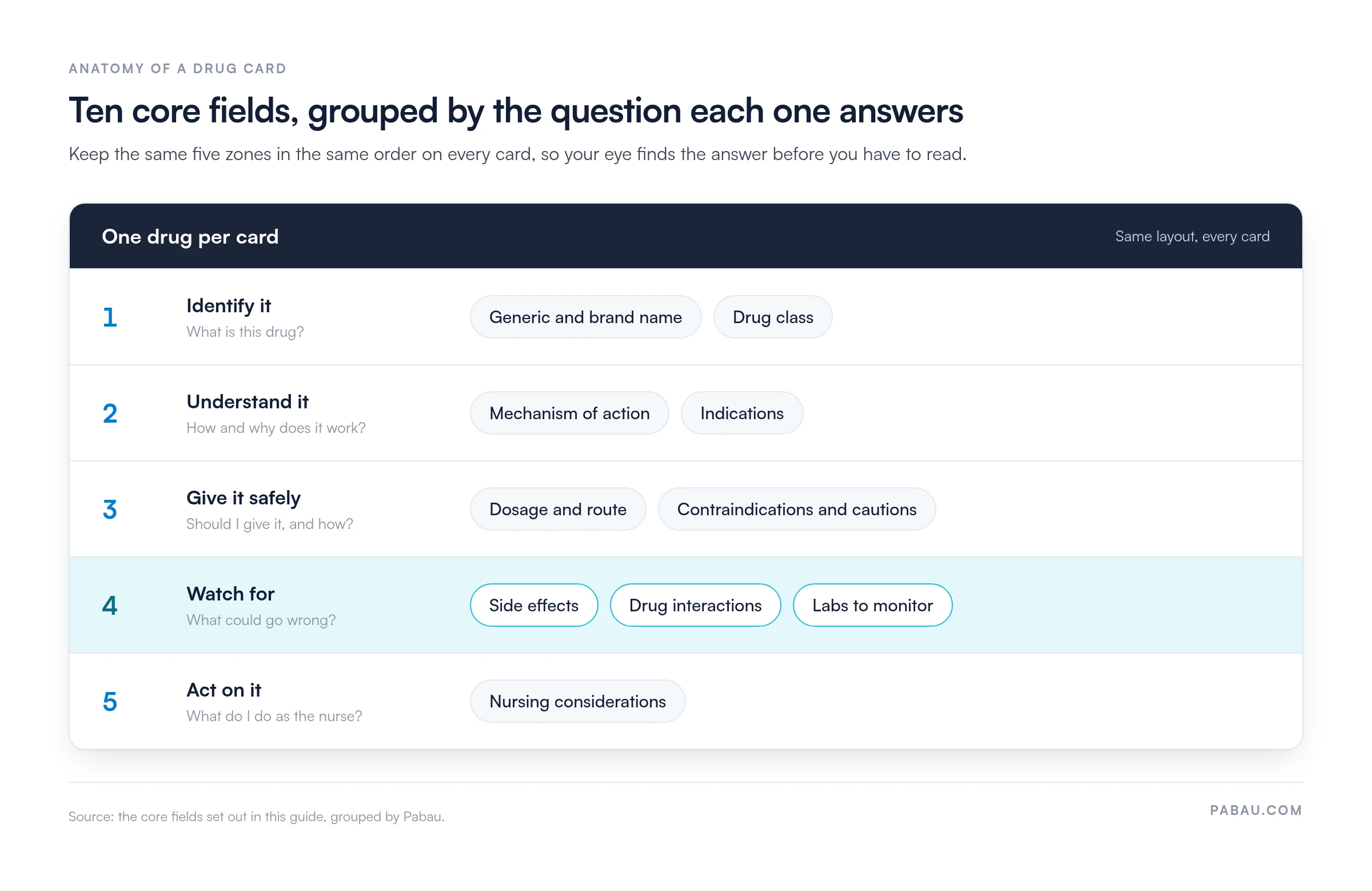
A card that skips any of these fields sends you back to your textbook or a drug reference app when you need a quick answer. A complete template saves you that detour.
Most nursing students file their cards alphabetically at first. That works for a dictionary, but not for learning pharmacology. At the bedside, you don’t search by first letter. You reach for something that treats high blood pressure, or this patient’s infection.
Sort your cards by drug class instead, with a divider or a color for each therapeutic category. Typical groupings for a core nursing deck include:
This grouping mirrors clinical thinking. When a patient presents with high blood pressure, you ask which antihypertensive fits. You never ask which drug name starts with a given letter. Sorting by class strengthens that link, so recall gets faster in exams and on shift.
Some conditions sit across two of those groups. Pulmonary hypertension is treated with drugs that a PAH medication list sorts by biological pathway rather than by organ system. File those cards behind one divider and the pathway logic stays visible.
Many generic names carry a stem that signals the drug class, so one divider can teach you a whole family of drugs. Write the stem on the divider for each class:
Stems have exceptions, so confirm the class on the label before you lean on the pattern. Aripiprazole, for example, ends in -prazole but is an antipsychotic.
Start with 50 to 100 core medications, then build to about 150 if you’re preparing for the NCLEX.
The NCSBN, which develops the NCLEX, tests pharmacological and parenteral therapies as a category of their own. Cardiovascular agents, antibiotics, analgesics, anticoagulants, insulin, and a handful of psychiatric drugs come up again and again in NCLEX prep.
You don’t need 500 cards. You need deep knowledge of the 50 to 150 drugs you’re most likely to meet on the exam and in your first years of practice.
Many nursing programs suggest starting with a “top 100” list and adding cards as you meet unfamiliar drugs in clinicals. Once you’re in practice, the medication administration record becomes your working document. Many nurses still keep a smaller deck for rare or high-risk drugs.
Drug cards double as an NCLEX strategy. The exam tests whether you can recognize side effects, spot contraindications and interactions, and calculate doses under time pressure.
You can’t consult a drug reference during the NCLEX, so you need facts you can recall in seconds. Drug cards reviewed with spaced repetition build that recall. A simple schedule is every three days for two weeks, then weekly.
The format of your cards matters as much as the content. A cluttered, hard-to-read card defeats the point of a quick reference.
Should you use a digital tool like Quizlet or Anki, or print your cards? The answer depends on your learning style and schedule.
Many nursing students take a hybrid approach. They print 50 to 100 core cards for focused study and keep digital flashcards on their phone for short sessions during breaks. You get the tactile memory boost of paper plus a digital backup.
Whichever format you choose, keep the same structure on every card so your brain learns where each fact lives. The free template above works either way: print it, or fill it in on screen.
If you’re building your first deck and don’t know where to start, here’s a 46-card starter set. These drugs appear across most nursing curricula and come up often in NCLEX prep:
Metoprolol, lisinopril, amlodipine, furosemide, spironolactone, digoxin, warfarin, heparin, clopidogrel, nitroglycerin.
Morphine, oxycodone, fentanyl, naloxone, ibuprofen.
Amoxicillin, cephalexin, ciprofloxacin, gentamicin, vancomycin, metronidazole, azithromycin, trimethoprim-sulfamethoxazole.
Insulin glargine, insulin lispro, metformin, glipizide, levothyroxine, prednisone.
Sertraline, fluoxetine, amitriptyline, haloperidol, risperidone, lorazepam, diazepam, lithium.
Omeprazole, famotidine, metoclopramide, ondansetron.
Albuterol, fluticasone, diphenhydramine.
Phenytoin, valproic acid.
Older decks often carried a ranitidine card, but the FDA requested that all ranitidine products be withdrawn from the US market in April 2020. Famotidine now fills that H2 blocker slot.
Once you’ve mastered these 46 cards, add cards for drugs you meet in clinical rotations or that your instructors emphasize.
Designing a drug card layout from scratch costs study time you could spend on the drugs themselves. A ready-made template fixes the fields and their order, so you fill in the drug-specific data and start studying.
The free template above is a two-page printable PDF. Page one covers names, class and action, dose, frequency, a high-alert flag, special instructions, indications, contraindications, side effects, nursing considerations, and patient education. Page two leaves room for notes, which is where interactions and labs to monitor fit.
Pair your cards with FDA drug labeling for verification, and your study system rests on official sources. Add NCSBN resources to keep your deck aligned with the NCLEX.
A drug card deck pays off early in clinicals, where you verify medications faster. It keeps paying off through finals, the NCLEX, and your first years as a nurse.
Once you’re in practice, a patient’s medication picture is often spread across a paper intake form, a prescribing tool, and your own reference cards. Cross-checking those by hand before every dose takes time and invites transcription errors.
Practice management software like Pabau pulls that picture into one patient record. Medications reported through patient intake software land in the record before the visit. Your structured clinical notes sit right alongside them.
When you prescribe, Pabau’s e-prescribing software checks each new drug against the patient’s current medications, allergies, and conditions. You apply the pharmacology on your cards with the full history in front of you.
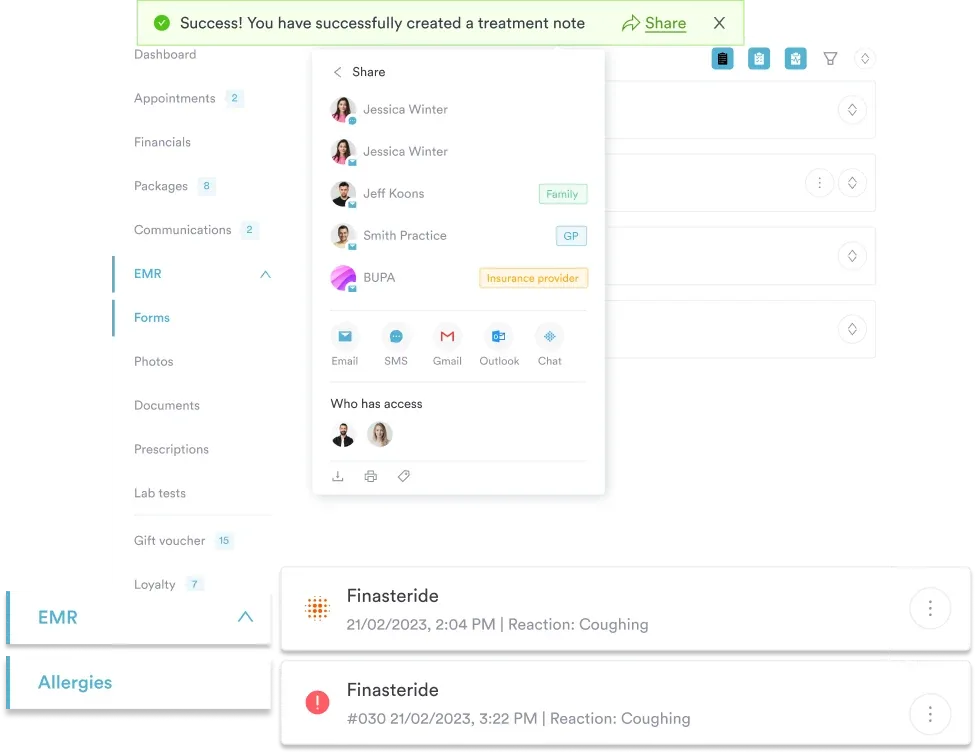

Pabau brings intake forms, clinical notes, and e-prescribing with interaction checks into one patient record. Your team verifies each medication against the full history in seconds.

A drug card deck earns its keep when every card follows one layout and the deck is sorted by class. Start with the 46-card starter set, not a 300-card list you’ll never get through.
The trade-off is time up front. Writing your own cards after each lecture is slower than buying a printed deck, but the writing is what makes the facts stick. Download the template, make your first 10 cards this week, and review them every three days.
In practice, the same habit of checking one drug at a time carries over to the patient record. Book a demo to see how Pabau keeps medication history, notes, and prescribing checks in one place for your clinical team.

Tracking a patient’s daily, weekly, or PRN medications? Medication log template keeps doses and times on one printable sheet.
Still building your clinical vocabulary? Medical terminology PDF is a free glossary of 30 clinical terms to study alongside your drug cards.
Want to see where medication details fit in your charting? Nursing documentation explains why accurate records matter for patient care.
Practicing head-to-toe assessments too? Nursing assessments template gives you a structured form for recording what you find.
A pharmacology drug card should include generic and brand names, drug class, mechanism of action, indications, and dosage and route. It also needs side effects (common and serious), contraindications, drug interactions, nursing considerations, and labs to monitor. Optional fields include pregnancy information, DEA schedule (if controlled), and reversal agents.
Use a consistent template, with one card per drug. Fill in the core fields from your textbook, class notes, and FDA drug labeling. Keep it brief, and summarize rather than copy the full label. Color-code by drug class. Make each card after you’ve learned the drug in class, so you’re synthesizing information rather than transcribing it.
Yes. The NCLEX tests how quickly you recall side effects, contraindications, doses, and interactions. A deck of 100 to 150 core medications, reviewed with spaced repetition, builds that recall. Pair your cards with practice questions to link knowledge to clinical reasoning.
Start with 50 to 100 core medications, and build to about 150 if you’re preparing for the NCLEX. Focus on high-yield categories such as cardiovascular drugs, antibiotics, pain management, and psychiatric medications. Knowing 100 drugs inside and out beats knowing 300 superficially.
Both work. Printable cards are tactile and distraction-free, while digital apps have built-in spaced repetition and are searchable. A hybrid approach gives you both: print 50 core cards and keep another 100 digital.