Scapular assistance test: Procedure, interpretation and free template
The scapular assistance test is a manual examination in which the clinician supp...

1
Last Updated: Oct 19, 2026

Health assessment in nursing is a systematic collection of subjective and objective patient data used to identify problems and plan care.
The nursing process follows ADPIE, and assessment comes first. Everything after it depends on the data you gather.
Comprehensive assessments cover every body system. Focused assessments target one concern, and emergency assessments deal with life threats first.
Knowing the normal range for each system is what lets you spot the finding that needs escalating.
Practice management software like Pabau turns the assessment form into a digital record that links straight to the care plan.
A printable form covering patient details, chief complaint, medical and social history, medications, allergies, and vital signs. It also has space for a head-to-toe physical exam, a functional assessment, and diagnostic test results.
Download templateHealth assessment in nursing is a systematic evaluation that gathers both subjective and objective patient data. Subjective data is what the patient tells you about symptoms, history, and concerns. Objective data is what you measure and observe, from vital signs to physical exam findings.
That data feeds the nursing process, known as ADPIE. You assess, diagnose, plan, implement, and evaluate. Everything downstream rests on what you collect first, from the nursing diagnosis to the nursing care plan.
This guide walks through the assessment one system at a time. It covers the four exam techniques, the normal findings, the results worth escalating, and how to write it all down.
Nurses run different assessment types depending on context, urgency, and how much information they need. A comprehensive assessment is standard on admission and at new-patient visits, which is why primary care practices build one into intake. A focused assessment covers most of what comes after that.
A complete assessment moves from subjective to objective. You start with the history and the interview, then work through the physical exam. Each component narrows what you are looking for in the next one.
Most of the subjective half can be collected before the patient arrives. Digital intake forms let patients fill in history, medications, and allergies at home, so the visit starts on the exam.
Physical examination uses four techniques, often shortened to IPPA. Each has a distinct purpose, and the order you use them in matters.
A systematic head-to-toe examination stops you skipping a system. Keeping the same order every time makes you faster and cuts assessment error.
Newborns are examined head to toe as well, on a form of their own. A newborn assessment checklist carries neonatal vital ranges, APGAR scoring, and primitive reflex testing.
Knowing what normal looks like is what makes an abnormal finding jump out at you. Below is the baseline for each system, and the findings that warrant escalation.
Pain and mental status both need validated tools. Without them, two nurses can look at the same patient and record different things.
Pick a scale that matches the patient. The Numeric Rating Scale and the Visual Analog Scale both work for verbal adults, scored 0 to 10. The FLACC scale and the Wong-Baker FACES scale suit non-verbal and pediatric patients.
Whichever scale you use, record location, quality, onset, and duration alongside the number. Note what relieves the pain and what makes it worse, because that is what the next clinician acts on.
Assess orientation to person, place, time, and situation. Use the Glasgow Coma Scale when consciousness is altered. It runs from 3 to 15, and a score of 8 or below indicates severe impairment.
Mini-Cog and the Montreal Cognitive Assessment screen for dementia and cognitive decline. For psychiatric presentations, use standardized mood and anxiety tools such as PHQ-9 and GAD-7. Mental health practices usually score these in the record, so trends are visible across visits.
Standardized tools improve consistency, communication, and clinical outcomes. Most healthcare settings mandate at least one.
A score on its own changes little until it reaches the care plan. Where fall risk is high, the risk for injury care plan supplies the NANDA-I diagnosis, goals, and prevention interventions.
Documentation is a legal record, a safety control, and the handoff the next shift relies on. Vague charting creates liability and fragments care.
Documented findings only help if the rest of the team can see them. Joined-up patient care management means the next clinician opens the record and sees exactly what you saw.
Most practices still run the assessment on paper, or in a form that lives apart from the patient record. Someone types the findings in later, or scans the sheet and attaches it. Either way the data arrives late, and the re-typing introduces error.
Practice management software like Pabau removes that step. The assessment is a digital form tied to the appointment, so what the nurse records lands straight in the client record. Patients can complete the history section themselves before they arrive.
From there, automated workflows can flag an abnormal result, trigger a follow-up, or push the finding into the care plan. Going paperless also fixes the audit trail, since every entry is timestamped and attributed.
Patients can read their own documented findings through the patient portal, which cuts the calls asking what the nurse wrote down.
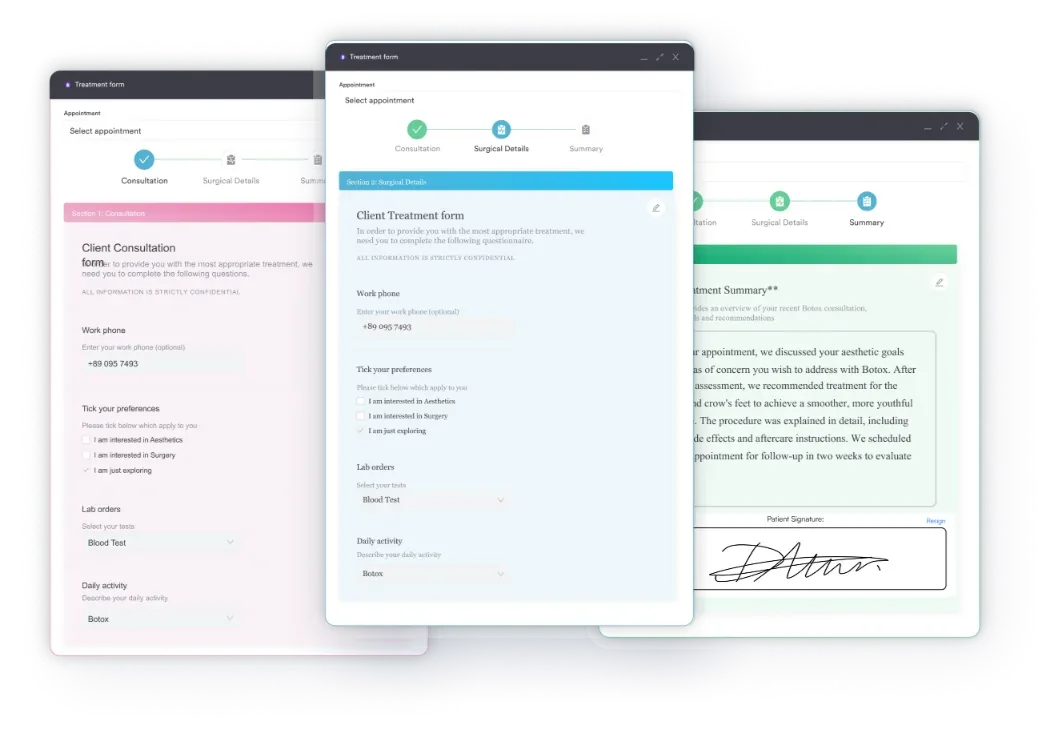

Pabau’s digital forms let nurses record a full head-to-toe assessment on the device in front of them. Findings save to the client record and feed the care plan, with no re-typing.

An assessment is only as good as the baseline you carry in your head. Learn what normal looks like for each system, and the abnormal finding announces itself, whether you have five minutes or fifty.
The trade-off worth remembering is speed against completeness. A focused assessment is quicker, but it only works when a comprehensive one has already set the baseline you compare against.
Print the template above and use it on your next admission. Book a demo to see how Pabau moves that form into the patient record, so nothing gets re-typed.

Caring for a patient with meningitis? Meningitis nursing care plan template gives nurses a clinical framework for rapid assessment and coordinated intervention.
Running a multidisciplinary team meeting? Multidisciplinary review template structures a timed meeting agenda with the follow-up detail auditors expect.
Examining a pediatric patient’s nervous system? Pediatric neurological exam checklist structures mental status, cranial nerve, motor, and reflex testing with red-flag recognition.
Documenting a full pediatric assessment? Pediatric review of systems template offers present or absent prompts across 13 sections for a full pediatric assessment.
Interpreting a patient’s pulmonary function test? PFT interpretation chart walks through reading PFTs in order, from the FEV1/FVC ratio to severity grading.
Health assessment in nursing is a systematic collection of subjective and objective patient data. Subjective data covers history, symptoms, and concerns. Objective data covers physical examination findings and vital signs. Together they form the foundation of the nursing process, so nurses can identify problems, plan interventions, and evaluate outcomes.
The four techniques are inspection, palpation, percussion, and auscultation. Inspection is visual observation, palpation is feeling with the hands, and percussion is tapping to assess underlying structures. Auscultation is listening with a stethoscope. Nurses apply them in that sequence, ending with auscultation so nothing disrupts the normal sounds.
A comprehensive assessment evaluates all body systems and includes a complete health history. It is used at admission or for a routine physical. A focused assessment targets one complaint or system, and it is used at follow-up visits or for patients with a known condition.
Assessment findings inform the nursing diagnoses, usually labeled with the NANDA taxonomy, and those diagnoses drive the care plan. Specific data such as pain level, mobility status, and cognitive function determine which interventions are appropriate. The same data sets how often outcomes should be evaluated.
Commonly used tools include SBAR for handoff communication and SOAP notes for documentation. NANDA supplies standardized diagnosis labels, and NEWS2 scores early warning signs in UK acute care. Morse and Braden scales cover fall and pressure ulcer risk. The tools you use depend on the setting and the patient population.
The nursing process is ADPIE: assess, diagnose, plan, implement, evaluate. Assessment is the first step, and every step after it depends on accurate data. Without a thorough assessment, nursing diagnoses are incomplete, care plans are ineffective, and outcomes suffer.