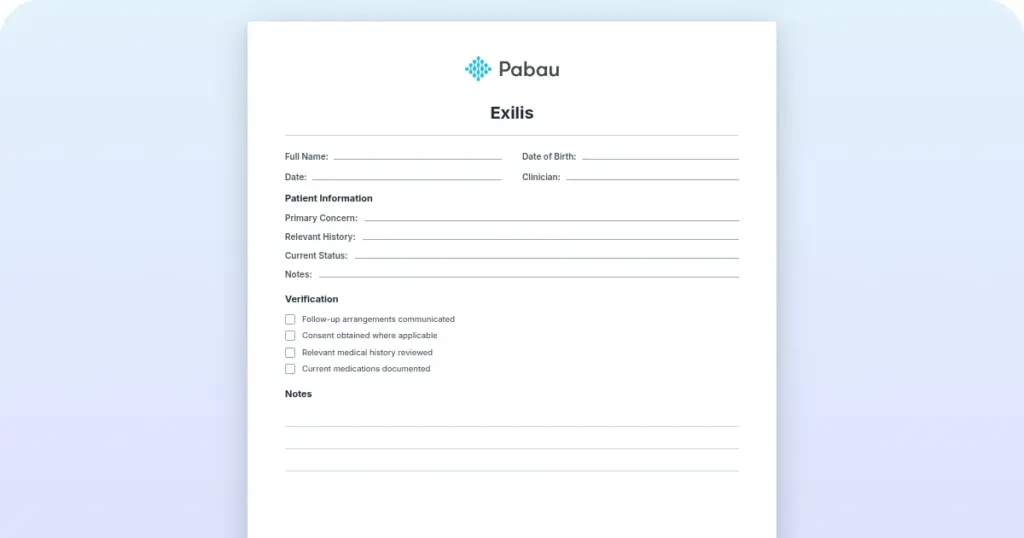
Exilis patient treatment record: Free PDF for RF sessions
An Exilis patient treatment record is the session log for BTL’s radiofrequ...

1
Last Updated: Oct 23, 2026

An FUE consent form records that the patient understood the surgery, its risks, and the limits of their donor area before the first incision.
The ISHRS renamed FUE follicular unit excision in 2018, so the form should read like surgical consent rather than a salon waiver.
Name the surgeon who makes the incisions, and say in writing what assistants are and are not doing.
The free template covers the procedure, ten named risks, medical screening, aftercare, and a photography clause.
It carries no signature block, so add dated lines for the patient and the operating surgeon before you print it.
Digital consent goes out before the appointment and files itself in the patient record with a timestamp.
A consent form for follicular unit excision covering the procedure, ten named risks, pre-treatment disclosure, and aftercare. It closes with a medical screening questionnaire and free-text questions on the patient’s goals and concerns.
Download templateAn FUE hair transplant is surgery. A punch cuts around each follicular unit in the donor area, and the grafts come out one by one. Thousands of small incisions then go into the recipient site.
Patients rarely hear it described that way. They book something the marketing calls minimally invasive, walk in without a referral, and walk out the same afternoon.
The consent form is where that distance gets closed. Here is what belongs on the page for FUE specifically, what the free template already covers, and the two things it leaves you to add.
A signed form has one job. It shows that the patient made an informed decision before anyone touched their scalp.
For FUE, that decision has four parts:
The last one is where hair restoration differs from most aesthetic paperwork. Complaints in this field are often less about a bad outcome and more about who did the work.
The other three matter because hair loss carries on after surgery. A patient who was told that at the start reads a thinning crown as biology. A patient who was not reads it as a failed transplant.
Most consent forms in circulation, including the free template on this page, spell FUE out as follicular unit extraction. That is not what the term means anymore.
In 2018 the International Society of Hair Restoration Surgery, or ISHRS, renamed the procedure follicular unit excision. An excision is an incision followed by a removal, so the new name describes what the punch does.
The society was blunt about why it made the change. “Extraction” made the procedure sound like tweezing, and that impression helped non-physicians sell and perform it.
Two minutes of editing brings your form up to date. Write “follicular unit excision (FUE)” at the top, then use FUE for the rest of the page.
The ISHRS warns patients that some practices hand the surgical steps to technicians hired by the day. Graft removal, hairline design, and recipient incisions are the steps it names.
Your form is the cheapest way to show you do not work like that. Add three lines to it:
Delegation rules differ by state in the US and by registration in the UK. Write down what your team does, then check it against the rule where you practice.
A form that holds up covers eight areas. The template supplies most of them.
The procedure overview sits at the top of the page. The template explains that follicles are removed individually from the back or sides of the scalp, then placed into the thinning area.
Two details are worth adding by hand. Say roughly how many hours the session runs, and confirm the surgery happens under local anesthetic while the patient is awake.
If you quote a graft count at consultation, write it on the form as a range. A patient who was promised 3,000 grafts and received 2,400 has a grievance you could have avoided in one line.
The template asks the patient to confirm they have disclosed their medications, allergies, and existing conditions. It then runs a yes or no questionnaire covering:
Three scalp-specific questions are missing, and they change the plan rather than the paperwork. Ask about a keloid history, about blood thinners, and about the type of hair loss being treated.
Alopecia areata is the answer that most often stops a booking. So is a donor area too sparse to supply the coverage the patient wants.
Where a patient lists several prescriptions, collect the detail before the surgery date. A hair transplant intake form gives you room to do that properly.
Write the risks the way you would say them across a desk. The template names ten:
Two more belong on an FUE form. The donor area is finite, so every session spends a resource the patient cannot get back.
And FUE leaves scars, whatever the marketing says. They are small round dots rather than a line, but they show on a closely shaved head.
Shock loss is the reason this section exists. Transplanted hairs shed within weeks, and a patient who was not warned believes the surgery failed.
The template tells patients that results vary and may take six to 12 months to become fully visible. It also states plainly that density, coverage, and growth are not guaranteed.
Add the milestones you use in follow-up. Shedding in the first weeks, early regrowth around three to six months, and final density later still.
Then add one sentence about existing hair. Male pattern loss continues after surgery, so a second session may be needed for reasons that have nothing to do with the first.
The template bundles photography into the consent statement. The patient authorizes clinical photographs and videos, which are kept with their medical records.
That covers clinical use and nothing else. Marketing use needs its own opt-in, with one box to agree and one to decline.
Say where the images will appear, whether that is your website, social media, or an in-house portfolio. Never make the surgery conditional on a yes.
The template carries one financial line. Deposits and booking fees are non-refundable unless the practitioner agrees otherwise.
Hair restoration needs more than that, because a second session is common rather than exceptional. State whether the quote covers one session or a plan, and what a further session costs.
Say what happens if graft yield disappoints. A patient who knows the answer in advance rarely argues about it a year later.
The printable template has no signature block at all. That is the single biggest thing to fix before you use it on paper.
Add four lines at the foot of the page:
Sign it before the day where you can. Consent taken in a gown, minutes before shaving starts, is the version that gets challenged.
Here is the honest inventory, so you know what you are printing before a patient sees it.
Every field you add is a field somebody has to complete. Add the ones you will use, and leave the rest off.
If you also offer strip surgery, the wording changes with the technique. Our general hair transplant consent template covers the donor scar and sutures that FUE does not involve.
No single authority writes hair transplant consent wording. Two different systems decide what your form has to say.
Informed consent is state law, and the test differs. Some states ask what a reasonable physician would disclose, others what a reasonable patient would want to know.
Supervision and delegation are also state matters, and they decide who may make an incision. Check both with your medical board before you finalize the form.
The medical answers on the page are protected health information under the Health Insurance Portability and Accountability Act, or HIPAA. A HIPAA compliance checklist is a sensible cross-check on how you store them. Sending those records to another provider needs separate paperwork, so keep a disclosure authorization on hand. An aesthetic clinic offering several treatment types needs each one documented to its own standard.
Providers carrying out hair transplant surgery in England register the regulated activity of surgical procedures with the Care Quality Commission, or CQC. Inspectors read consent records as evidence of how decisions were made.
General Medical Council guidance puts responsibility for consent on the doctor providing the treatment. It can be delegated only to someone suitably trained and qualified for that conversation.
Health answers count as special category data under UK GDPR. Run a GDPR checklist over your storage and retention rules while you are updating the form.
Both carry the same legal weight. Electronic signatures are valid in the US under the federal ESIGN Act, short for the Electronic Signatures in Global and National Commerce Act. The UK equivalent is the Electronic Communications Act 2000.
The difference shows up afterwards. A paper form gets filed, and then somebody has to find it again. A digital form lands in the patient record with a date and time attached.
That timestamp is worth more in hair restoration than in most fields. It proves consent was taken at the consultation rather than in the chair.
Most hair transplant clinic software will already store a signed PDF against the patient profile. So will a plastic surgery EMR, which is built for consent that has to be retrievable years later. Check what yours does before you buy anything new.
Run through this once, and the version you print will fit your practice rather than a generic one:
Two mistakes are worth calling out. A form signed after sedation or shaving proves little about what the patient knew beforehand.
And a form last reviewed three years ago will not match how you work today. Set a date to read it again.
The usual setup is to email a PDF and then chase it. The patient forgets, arrives on the day, and signs on a clipboard while the room is prepared. Signed copies end up in a folder, or as a photo on somebody’s phone.
Practice management software like Pabau moves that work forward in the timeline. When a patient books an FUE session, the consent form goes out automatically by email or text.
They complete it on their phone, sign with a finger, and the signed version files itself in their record with a timestamp. You can see the answers before the surgery date, so a keloid history or a blood thinner changes the plan rather than the morning.
Because hair restoration runs over months, the record matters as much as the signature. A hair clinic CRM keeps consultation notes, consent, photos, and every follow-up in one patient file. Month-nine questions then get answered in one search.
Digital intake forms work the same way for consultations and medical clearance, so one workflow covers the whole patient journey. London Face and Skin replaced its fragmented systems with Pabau to cut paperwork.


Pabau sends consent forms ahead of every appointment and stores the signed copy in the patient record with a timestamp. Your team reviews the medical answers days before surgery, not minutes before.

An FUE consent form is cheap protection, and easy to leave half-finished. The template on this page gives you a working base for the procedure, the risks, and the screening.
What makes it hold up is the part you add. Name the surgeon, add the signature lines, call the procedure an excision, and get it signed before the day.
Do that and the form stops being a formality. It becomes the record that settles a disagreement in one search, a year after the grafts went in.
Chasing signatures should not eat your morning. Book a demo to see how Pabau sends FUE consent forms ahead of surgery and files them automatically.

Setting up the paperwork for the whole procedure? The hair transplant template covers assessment, pre-procedure checks, and post-operative care in one document.
Need the detail before the consultation? The hair transplant intake form collects the medical history a consent form deliberately keeps short.
Offering strip surgery as well as FUE? The hair transplant consent template covers the donor scar and sutures that FUE avoids.
Opening a hair restoration practice? Our guide to hair transplant compliance sets out the registrations and records you need in place first.
Comparing systems to store all of this? Our roundup of hair transplant software covers consent, photos, and follow-up in one record.
Before the day of surgery wherever possible. Signing at the consultation gives the patient time to read the risks and ask questions. A form signed once shaving has started is the version most likely to be challenged.
Responsibility sits with the practitioner carrying out the surgery. UK guidance allows delegation only to someone suitably trained and qualified, and US delegation rules vary by state. Check your state board or registration before anyone else takes the conversation.
Write it as a range rather than a promise. Final counts depend on donor density and what you find on the day. A range that was agreed in writing prevents an argument about the number quoted at consultation.
Take fresh consent for each session. Donor supply, the treatment area, and the graft plan all change between visits, and the patient’s health may have changed too. Keep the earlier form on file alongside the new one.
No, and the form should not imply it. FUE avoids the linear scar left by strip surgery, but each punch leaves a small round mark in the donor area. Those dots can show on closely shaved hair.
Retention is set locally, so there is no single answer. Ask your state board or your indemnity provider, then apply one policy to every patient file rather than deciding case by case.