Head to toe assessment cheat sheet: Printable nursing guide
A head to toe assessment cheat sheet gives you one fixed order at the bedside, s...

2
Last Updated: Oct 23, 2026

A NICU report sheet, or brain sheet, is the structured tool neonatal nurses use to hand a patient over at shift change.
It carries neonatal-specific fields: gestational and corrected age, vent settings, feeds in mL/kg/day, weight trend, lines, and lab values.
The SBAR sequence gives the handoff its script, and then each step reads from a different section of the sheet.
An adult ICU template misreads a neonate, because its reference ranges and its feeding and weight fields do not fit.
Practice management software like Pabau moves the same fields into a shared record, so both shifts read one live version.
A printable one-page sheet with fields for demographics, gestational and corrected age, vital signs, respiratory support, feeding, medications, labs, IV access, and assessment notes. Then print it for the bedside, or adapt the fields to your unit’s protocols.
Download templateNICU nurses look after the most fragile patients in the hospital. Also, each one needs constant monitoring, exact medication tracking, and a clean handover at every shift change. A structured report sheet turns that load into one organized page, so the critical details do not live only in someone’s head.
This page covers what belongs on the sheet and how the handoff runs, step by step. It also shows where a neonatal sheet parts company with an adult one.
A NICU report sheet is a one- or two-page document a neonatal nurse fills in across the shift. It also doubles as a live reference on the floor and as the script for the handoff conversation.
Nurses call it a brain sheet because it works as external memory. It holds the vent settings, the feed volumes, and the last blood gas. So the nurse stops hunting through three screens and a paper chart mid-shift.
That is where it parts company with a general nursing shift report built for adult ICU or med-surg. Instead, a neonatal sheet needs gestational age, corrected age, birth weight, neonatal vent parameters, and enteral feed volumes in mL/kg/day. Those fields are what make it a NICU sheet rather than an adult template with the title changed.
A complete sheet covers five groups of fields, each one readable at a glance without turning the page.
Most sheets carry a grid for tracking vitals hour by hour across the shift:
A NICU handoff runs on SBAR: situation, background, assessment, and recommendation. So the sequence covers the same ground every time, whoever is holding the sheet. Our SBAR report template shows the general wording. Here is how it plays out at a neonatal bedside.
The sheet’s layout should mirror that order. So each step of the report reads off a different block of fields, which is why field order on the page is not cosmetic.
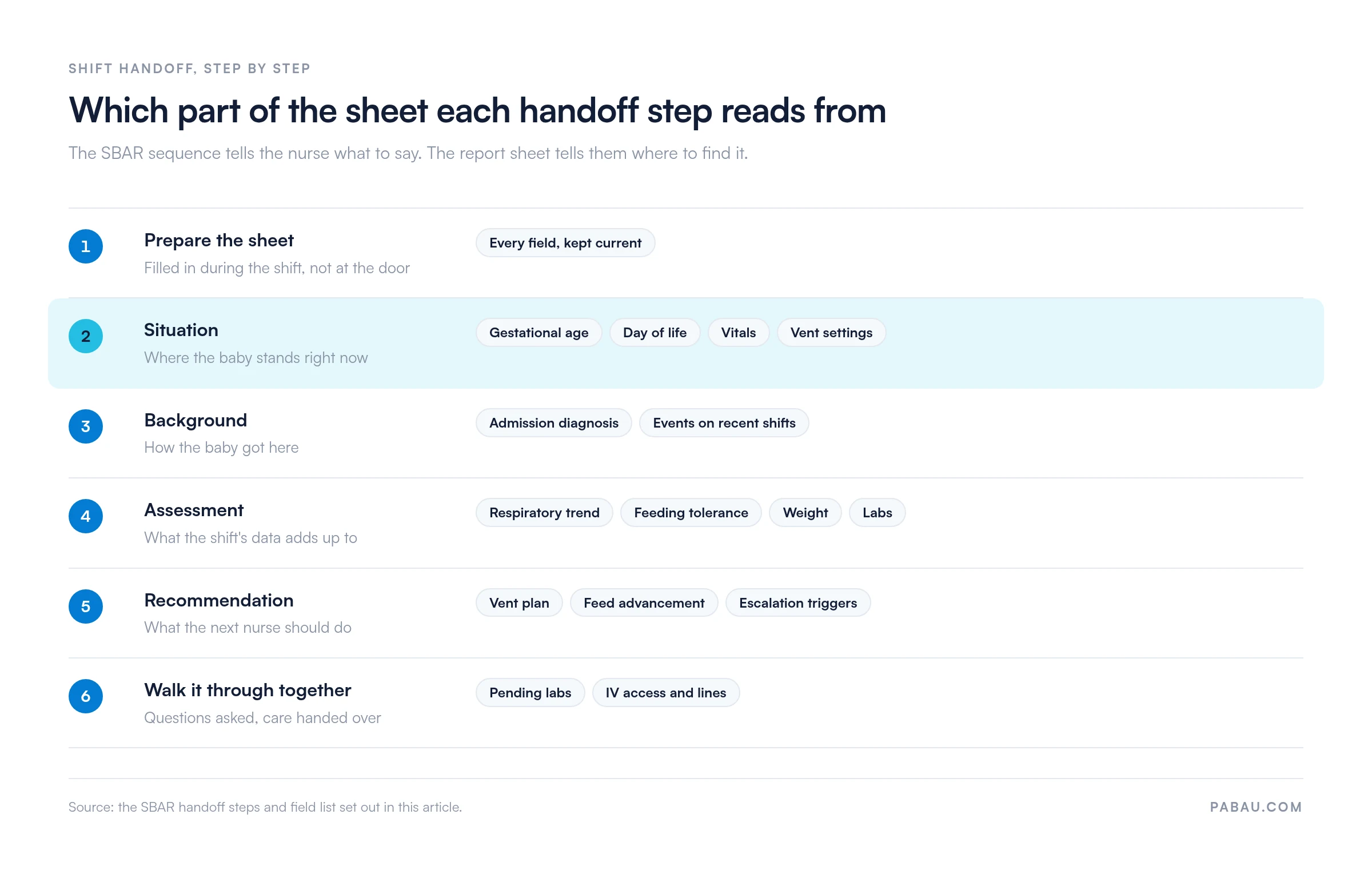
Why this matters: handoff is where information gets dropped. AHRQ’s patient safety network treats handoffs and sign-outs as a recognized source of communication failure and, as a result, recommends a standardized format for them.
The Joint Commission makes the same point from the accreditation side, naming hand-off communication as a patient safety priority. So a standardized sheet is what keeps that format holding on a busy unit.
An adult ICU report sheet or med-surg sheet will mislead a NICU team, because its reference ranges belong to a different patient. These are the fields where the two diverge:
Reach for an adult template and you inherit its ranges along with its blank spaces. Still, the same structure does adapt to other critical care units, and our CVICU report sheet is the cardiac version of it.
A paper sheet works right up to the moment two people need it at once. It lives in one pocket, it gets rewritten every shift, and it leaves no trace once the shift ends.
Practice management software like Pabau keeps the same fields in the patient record instead. Its patient intake forms let you build each section of the sheet as reusable fields, so the layout matches the way your unit reports.
Because the record is shared, the incoming nurse opens the same version the outgoing nurse just saved. Also, Medical records management keeps an audit trail of who changed what and when, which paper cannot do.
The handoff conversation itself does not change. The SBAR sequence, the field order, and the walk-through all survive the move. Instead, what changes is who can see the record, and how far back it goes.
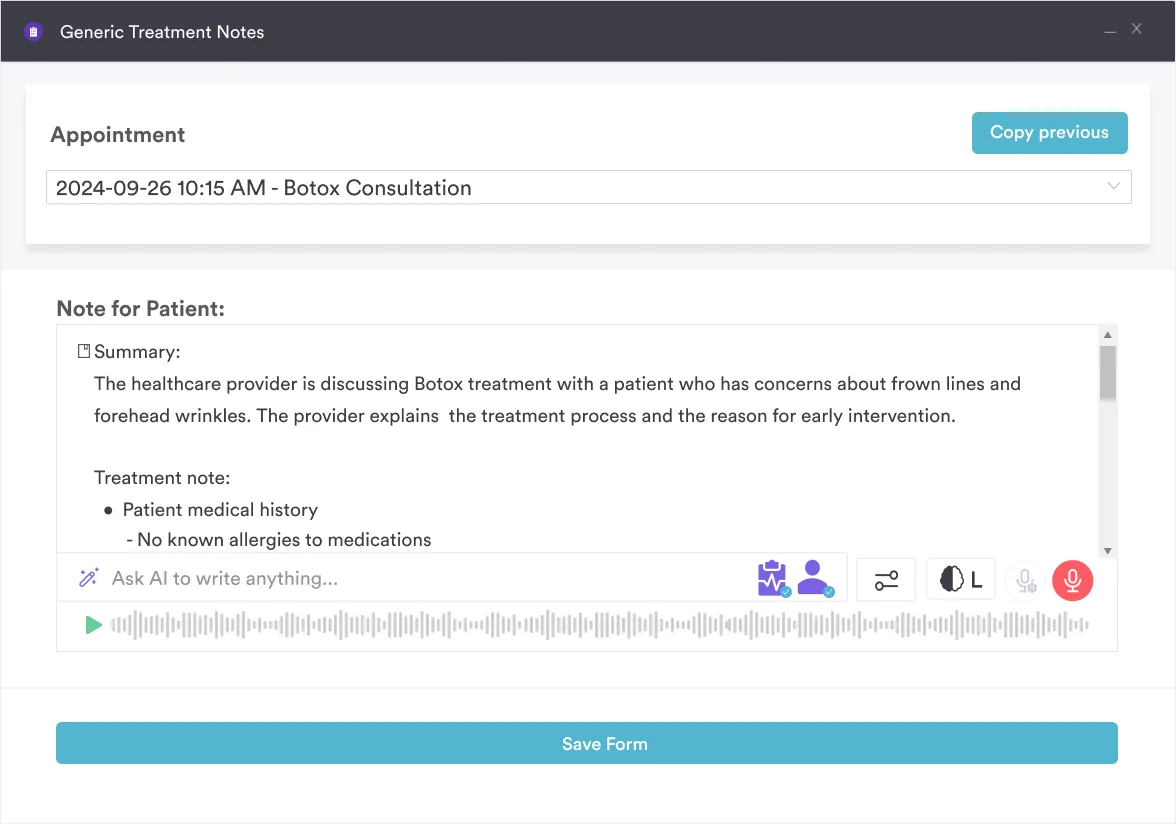

See how Pabau keeps vitals, vent settings, feeds and labs in one shared patient record that both shifts can read.

The sheet is only as good as the discipline behind it. A team that fills it in as the shift runs will hand over in five minutes. In contrast, a team that fills it in at the door will miss something.
Start with the printable template, then change it until it matches your unit’s protocols. Keep the field order aligned with the way you actually give report, and the handoff writes itself.
The decision worth making early is whether the sheet stays on paper. Paper is quick to start, but it is impossible to audit. Book a demo to see how Pabau holds the same handoff fields in a shared patient record.

Handing over at the bedside instead of the station? Bedside shift report covers what changes when the patient and the family are in the room.
Prefer a different handoff mnemonic? I-PASS handoff template structures the same information around illness severity and contingency planning.
Want the documentation rules behind the sheet? Nursing documentation explains what has to be recorded, when, and in whose words.
Working in an emergency department instead? Emergency nursing assessment applies the same field discipline to triage and rapid assessment.
Brain sheet and report sheet mean the same thing in NICU nursing. Both name the one- or two-page tool that organizes a patient’s data for handoff. The brain sheet label stresses its role as external memory during the shift. Still, some units use the terms interchangeably, and others reserve report sheet for the formal handoff document.
You can download a free NICU report sheet PDF from the card at the top of this page. It carries the standard fields: demographics, vital signs, respiratory support, feeding, medications, labs, and IV access. Then print it as it is, or adapt it to your unit’s workflow.
Start with the free template and change the fields to match your protocols. Common changes include adding your facility logo, adjusting vital sign ranges to your unit’s targets, and adding standing orders or care bundles. Many units print it and handwrite updates through the shift, then move to a digital version later.
Prioritize demographics, vital signs, respiratory settings, active medications, the feeding plan, and recent labs. Those are the fields the incoming nurse needs before touching the baby. Weight trend, IV access notes, and pending labs can go in the margin, or stay in the electronic record if your unit has one.
The template itself is a blank form with no patient data on it. Once you fill it in, treat the printout like any paper chart. Store it securely, shred it after use, and never leave it unattended at the bedside. If you print in a clinical area, follow your facility’s data security and paper handling rules.