Despina Petrushevska

Emotional eating worksheets
What are emotional eating worksheets? Emotional eating worksheets are structured...

1
Last Updated: Nov 10, 2026
Free PDF 3 pages, print-ready Clinician-reviewed
My changing family worksheet is a free, three-page clinical form that helps healthcare professionals understand a patient's family dynamics and recent transitions. After a short client information block, it walks through seven sections. These cover family structure, family history, life transitions, communication and support, emotional well-being, cultural considerations, and resources and interventions. Each section holds two open questions, and a blank conclusion box closes the form for the clinician's summary. Use it as a guided conversation during a consultation, rather than a scored assessment. This guide explains what each section asks, who uses the form, and how to turn the answers into a care plan.
A three-page PDF with client information fields, 14 open questions across seven family-dynamics sections, and a blank conclusion box for the clinician's summary.
Start from scratch, or upload this PDF or any form you already use, and Pabau's AI Form rebuilds it with tick boxes, text fields and a signature. Attach it to the treatment once, and every patient gets it on time.
AI Form rebuilds the consent, history and aftercare forms you already use. You review each one, then publish.
Patients complete forms on their phone before they arrive, so the front desk stops retyping paper.
Every signed form is versioned and attached to the treatment record, ready when you need it.
Set how long a consent stays valid. Returning patients skip forms they have already signed.
Supports HIPAA and GDPR compliance AES-256 encryption 4.8 on G2 4.7 on Capterra Trusted by 4,000+ practices worldwide

My changing family worksheet is a three-page clinical form for exploring a patient’s family dynamics and recent transitions
Seven sections cover family structure, family history, life transitions, communication and support, emotional well-being, culture, and resources
Each section holds two open questions, written for the patient to answer about their own family
Use it as a guided conversation during a consultation, never as a diagnostic or scored tool
The clinician writes the blank conclusion box, turning the patient’s answers into agreed next steps
My changing family worksheet is a clinical form template that helps healthcare professionals understand how a patient’s family is organized and how it is changing. The form describes itself as a guide for open and empathetic discussion, so it works best when you fill it in together.
It opens with client information fields for name, date of birth, address, contact number, email and the date. Seven numbered sections follow, each with two open questions. A blank conclusion box closes the form.
The questions are written for the patient to answer about their own family. They ask about divorce, remarriage and adoption, and also about moving, job changes and retirement. That range makes the form useful well beyond relationship breakdown.
The instructions also ask you to stay sensitive to cultural and social considerations throughout. A full section is given over to culture for that reason.
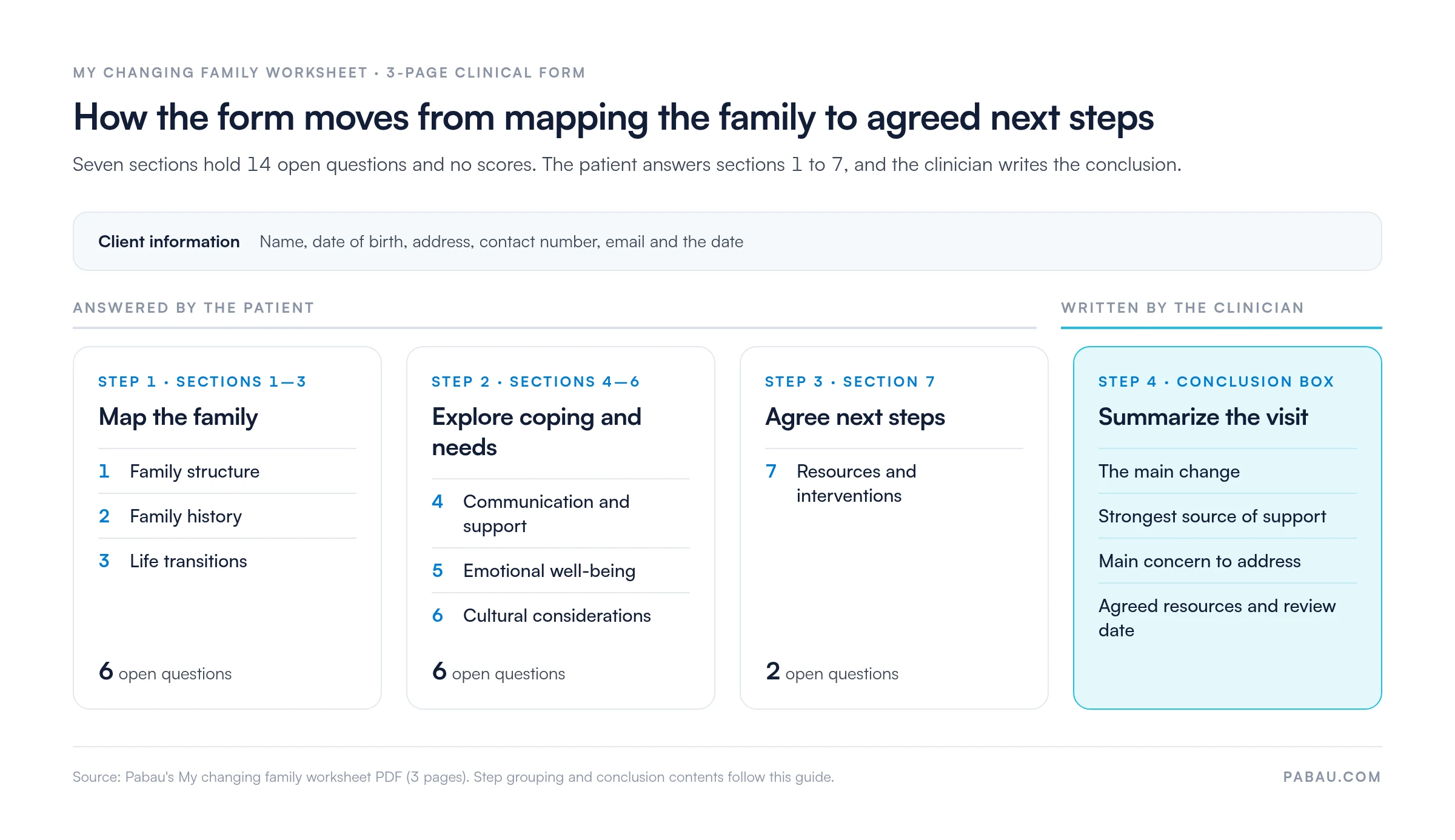
The table lists each section, the two questions it asks, and what the answers give you as a clinician.
Seven sections with two prompts each come to 14 questions. The form has no scoring, checkboxes or rating scales, so every answer is free text.
The form is written for healthcare professionals who need family context to plan care. Typical users include the following roles.
Every prompt assumes a patient who can reflect on their family in conversation. The form has no child-friendly wording or activities, so a younger patient needs a tool built for their age.
Family therapists can find practice guidance from the American Association for Marriage and Family Therapy (AAMFT) before adding family-focused tools to their work.
Plan for a conversation across one or two appointments, rather than a form handed over in the waiting room.
Sections 1 and 2 go faster with a drawn map of the family beside you. A family genogram template records structure and history across generations. For roles, boundaries and conflict in more depth, the family dynamics worksheet gives a longer assessment.
If the patient discloses abuse, neglect or a risk of harm, pause the form and follow your safeguarding and mandatory reporting procedures. Refer on promptly when the emotional well-being answers point to depression, anxiety or a crisis. If you assess further yourself, a psychiatric evaluation template gives that follow-up a structure.
The conclusion box is the only part of the form the patient does not answer. It is where 14 open answers become a short clinical summary.
A useful conclusion names the main change, the patient’s strongest source of support, and the concern they most want addressed. It then records the agreed resources and the next review date. Keep it to a few lines so the next clinician can read it at a glance.
Because the form carries no scores, add a published measure when you want a number to track. The Holmes and Rahe stress scale scores life events such as divorce, moving and retirement. The social support scale puts a figure on the support that section 4 asks about.
Repeat the worksheet after a planned transition such as a move or a retirement. Comparing the two conclusion boxes shows whether support and communication have improved. That trend is hard to spot in session notes alone.
A fixed set of questions means every patient is asked about culture, support and coping, not only the topic that prompted the visit. Answers recorded in the same order are also easier to compare over time.
For a practice, one shared form gives clinicians, nurses and social workers a common starting point. Each of them can see what has already been asked before asking again.
The form also keeps the conversation balanced. Its sections move from mapping the family to coping and cultural needs, then to agreed next steps, as the flow below shows.
Paper versions of this form tend to end up as a scanned file that nobody rereads. Pabau, the practice management platform we build, keeps the answers in the patient’s record instead, next to the notes from the same visit.
Pabau’s digital forms let you rebuild the worksheet’s questions and send them before an appointment, or complete them together on screen. Completed forms save to Client records alongside the clinician’s notes.
Scheduling then books the review appointment you set in the conclusion box. Counselors and family therapists can see the whole workflow in Pabau’s therapy practice management software.
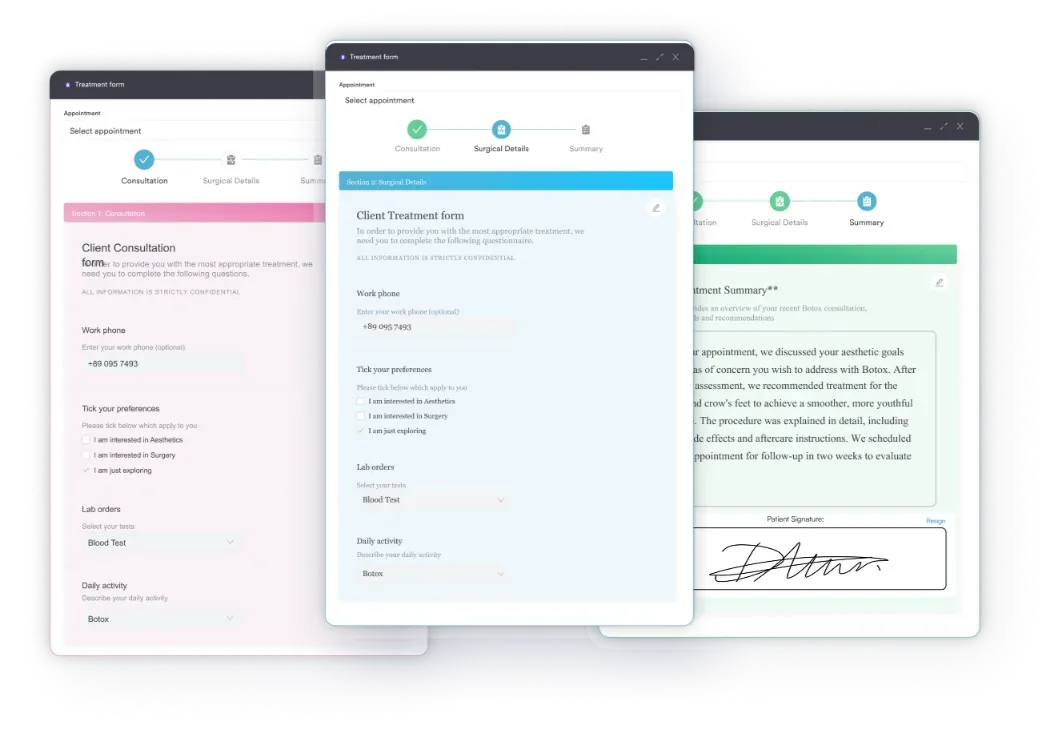

Pabau’s digital forms and Client records keep worksheets, session notes and follow-up appointments together. Book a demo to see how it fits your practice’s workflow.

Family change shapes how patients cope, follow care plans and use support, yet it seldom gets a structured place in the record. My changing family worksheet gives it one, in 14 questions and a summary box.
Use it as a conversation, write the conclusion yourself, and repeat it after the next major transition. The value comes from comparing those summaries over time.
Book a demo to see how Pabau keeps family history, forms and follow-ups on one patient record.

Supporting parents after a separation? Co-parenting agreement sets out parenting time, decisions and communication in writing.
Want the whole household talking? Family meeting agenda gives families a timed structure for regular check-ins.
New to drawing family maps? Genogram example explains the symbols, types and clinical uses of a genogram.
Is stress the main theme in the answers? Managing stress worksheet helps patients name stressors and plan how to respond.
Did culture shape the family’s response? Vancouver Index of Acculturation measures identification with heritage and mainstream culture.
My changing family worksheet is a free, three-page clinical form for understanding a patient’s family dynamics and transitions. It holds client information fields, 14 open questions across seven sections, and a blank conclusion box. Healthcare professionals complete it with the patient as a guided discussion.
A healthcare professional completes it with the patient during a consultation. Primary care clinicians, behavioral health clinicians, family therapists, nurses and social workers can all use it. The patient answers the questions, and the clinician writes the conclusion.
It is not written for children. The questions address the patient directly about family structure, work, retirement and cultural needs. For a child coping with divorce or a new stepfamily, choose a tool designed for their age.
No. The form has no scores, cut-offs or rating scales, so it cannot diagnose a condition. Use it to gather family context, then refer on or use a validated screening tool if the answers raise a clinical concern.
It asks about changes in family structure such as divorce, remarriage and adoption. It also covers wider life transitions, including moving, job changes and retirement, and how each one affected family relationships.