Maja Popovska

Nursing care plan for aggressive behavior
A nursing care plan for aggressive behavior is a structured clinical document fo...

2
Last Updated: Oct 26, 2026
Free PDF 12 pages, print-ready Clinician-reviewed
The Vancouver Index of Acculturation (VIA) is a 20-item self-report questionnaire measuring how strongly a person identifies with their heritage culture and with mainstream culture. Each statement is rated from 1 to 9, and the answers produce two separate subscores rather than one total.
Psychologists, therapists and researchers use it when cultural adjustment may be shaping stress, family roles or help-seeking. This guide covers what the VIA measures, how to score it and how to read the two results, with the free PDF just below.
All 20 VIA statements on a 1 to 9 agreement scale, with fields for the patient’s name, age and heritage culture. It also includes heritage and mainstream subscore boxes and notes on reading both scores.
Upload this PDF, or any form you already use, and Pabau's AI Form rebuilds it with tick boxes, text fields and a signature. Attach it to the treatment once, and every patient gets it on time.
AI Form rebuilds the consent, history and aftercare forms you already use. You review each one, then publish.
Patients complete forms on their phone before they arrive, so the front desk stops retyping paper.
Every signed form is versioned and attached to the treatment record, ready when you need it.
Set how long a consent stays valid. Returning patients skip forms they have already signed.
Supports HIPAA and GDPR compliance AES-256 encryption 4.8 on G2 4.7 on Capterra Trusted by 4,000+ practices worldwide

The VIA scores heritage and mainstream culture orientation separately, so a patient gets two subscores rather than one.
It has 20 statements rated from 1 to 9, and each subscore is the average of 10 items.
Scores describe cultural orientation patterns, and the VIA has no published clinical cut-offs, so it never stands in for a diagnosis.
Score by item content, and check items 13 and 14 on this form, where the usual odd and even order is reversed.
Pabau, the practice software we build, can send the questionnaire before a first session and file the answers in the patient record.
The Vancouver Index of Acculturation is a psychometric instrument developed by Andrew Ryder, Lynn Alden and Delroy Paulhus, first published in 2000. It treats acculturation as two separate dimensions rather than a single scale running from “old culture” to “new culture”.
Practitioners often use it when a patient has moved between cultures and the clinical question is how they balance two sets of norms. Researchers use it in studies of immigrant and multicultural populations.
The VIA draws on Berry’s bidimensional model of acculturation. Berry’s framework describes four strategies a person may adopt, depending on how strongly they hold heritage and mainstream orientations.
Because the two dimensions are measured separately, the VIA can show where a person sits on each one. A single overall score would hide that detail.
The questionnaire contains 20 statements split into two subscales: Heritage culture and mainstream culture. The items alternate between the two, and the patient rates how strongly they agree with each one on a scale of 1 to 9.
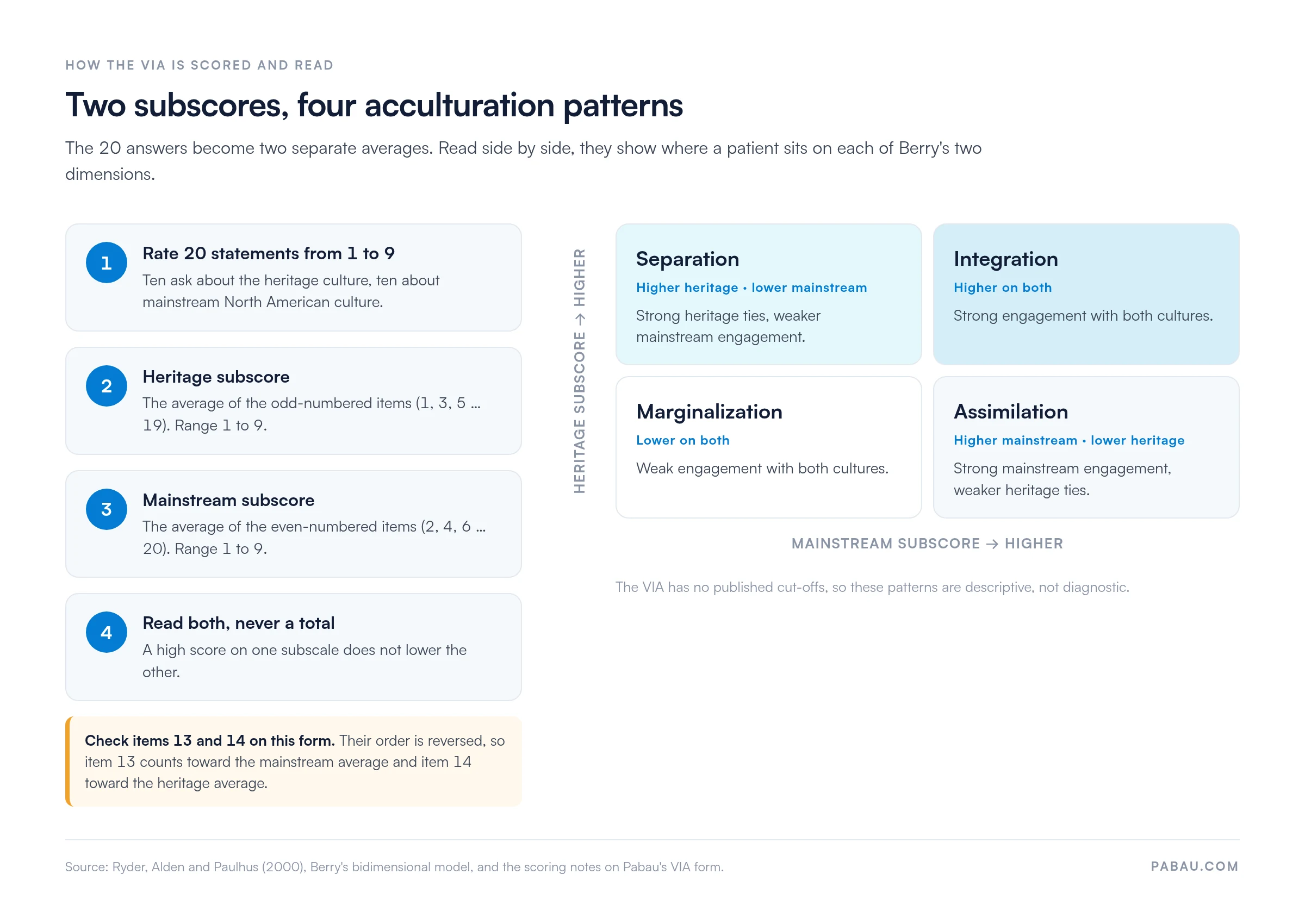
Each subscale is scored on its own. The heritage subscore is the average of the odd-numbered items, and the mainstream subscore is the average of the even-numbered items. Both subscores therefore run from 1 to 9.
Score by content as well as position. On this form, items 13 and 14 reverse the usual order. Item 13 asks about North American cultural practices, so it belongs in the mainstream average, and item 14 belongs in the heritage average.
Read the two subscores together rather than adding them up. The diagram below shows how each pair of results maps onto Berry’s four patterns.
Each heritage item asks about participation in the culture of origin. The ten statements cover traditions, marriage, social activities, working relationships, entertainment, everyday behavior, cultural practices, values, humor and friendships.
Use the item wording from the PDF so that your administered version matches the published instrument.
The mainstream items mirror the same ten areas, asking about North American culture instead. Keep the response options identical to the source instrument when you compare results across groups.
Ryder, Alden and Paulhus reported the instrument’s reliability and validity in their original development samples. Quote those figures from the source paper rather than from secondary summaries.
Later studies have tested the two-factor structure with other immigrant groups, including older Chinese-Canadian adults, and model fit has varied by sample. Any claim that an adapted version is validated should point to the specific published adaptation study.
Use the PDF as the source of truth for item wording and scoring. Work through these steps in a clinical or research setting.
Store the completed form with the patient record, and note the language version or any adaptation in your intake note.
Send the questionnaire before the first appointment so the clinician can review responses during the session. Record the language version used, and flag any item the patient found hard to understand so the result is read in context.
Mental health and psychology practices working with migrant and multicultural patients are the most common users. Private practices use it during intake and treatment planning.
Clinicians use the VIA as part of an intake or psychosocial assessment, particularly where migration, displacement or cultural conflict is part of the presenting picture. It gives a structured prompt for a conversation the clinician might otherwise skip.
Keep interpretation descriptive. The VIA describes orientation patterns, and scores should sit alongside clinical judgment and other assessment information.
A standard instrument makes cultural orientation discussable in a consistent way. Two team members can compare notes on the same measure rather than on impressions.
Two results instead of one: A patient who holds both cultures strongly scores high on both subscales, a pattern that a single-scale measure would flatten.
Short enough for intake: Twenty statements on one rating scale fit into a pre-session form without adding a long assessment.
Repeatable over time: Giving the same form later in treatment shows whether either subscore has shifted.
Documentation clarity: A completed, dated questionnaire records how the patient described their cultural orientation at that point in care.
Researchers have adapted the VIA for other language and cultural contexts, including Turkish and Arabic versions and work with Chinese-Canadian older adults. Each adaptation needs its own translation and validation steps.
The items name “North American” culture as the mainstream reference. The form’s scoring notes suggest another descriptor, such as “American” in the US or “British” in Great Britain, when you study a different mainstream context.
If you adapt the questionnaire, document the translation process, pilot the items with the target group, and report reliability in your own sample. Describe your version as adapted, not as the original instrument.
Several instruments measure acculturation, and they differ in theory, length and intended population. The VIA works with any heritage culture, while some older scales were built for one population. Confirm details against each instrument’s own documentation.
Cultural framing matters. Present heritage and mainstream orientation as two valid ways of living rather than as a ladder to climb.
The APA’s ethical guidance asks practitioners to consider whether a test suits the person being assessed, and the APA Ethics Code sets out those expectations. If a patient wants to keep exploring who they are, an identity worksheet can carry the conversation into later sessions.
On paper, the VIA is usually handed over in the waiting room. Someone then keys the two subscores into the notes later, and the language version used often goes unrecorded.
Pabau, our software for therapy practices, moves that step ahead of the appointment. Its digital forms send the questionnaire to the patient before the first session. Completed answers file straight into the patient record, so the clinician can review them before the patient walks in.
Keeping responses inside the patient record also makes them easier to protect. Access follows the record, rather than a shared inbox or a paper file in a drawer.
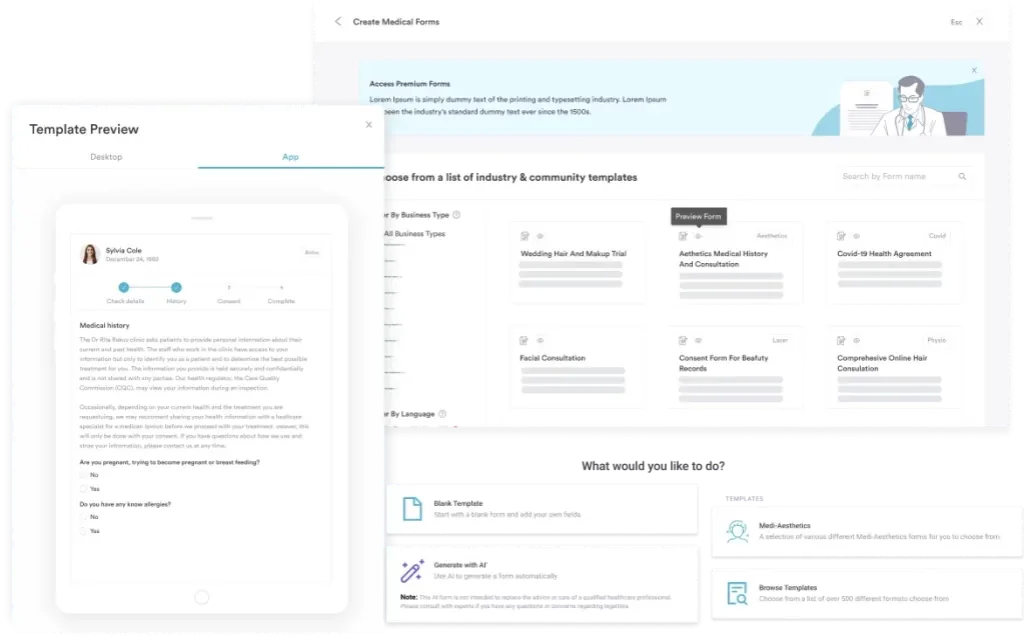

See how Pabau sends digital forms ahead of appointments and keeps completed responses in each patient record.

The VIA earns its place in an intake pack because it asks two questions instead of one. A patient can hold both cultures strongly, and a single score would erase that.
Use the two subscores to open a conversation with the patient, then record them alongside your clinical judgment. Note the wording and language version you used, and repeat the form later if cultural adjustment is a treatment goal.
If you want the questionnaire to reach patients before the first session, book a demo to see how Pabau sends it and files the answers.

Running a full psychosocial assessment? Psychosocial assessment template gives you a structured way to capture the wider history the VIA sits within.
Need a broader intake for new adult patients? Adult biopsychosocial intake covers biological, psychological and social history in one form.
Exploring identity with a patient in session? Identity worksheet helps patients reflect on the roles and values that shape who they are.
Writing up the first session? Intake note template structures the notes you record after an initial assessment.
Measuring connection rather than culture? Sense of belonging scale helps you assess how connected a patient feels to the people and groups around them.
The Vancouver Index of Acculturation is a psychometric questionnaire that measures heritage and mainstream culture orientation as two separate dimensions.
The downloadable PDF is available free from this page. Confirm the terms of use in the original publication before reproducing or adapting it in a publication.
Berry’s framework describes integration, assimilation, separation and marginalization. The VIA measures the two underlying dimensions that produce these strategies.
Yes, and several adaptations have been published. Describe any version as adapted and report its reliability in your own sample.
Yes. The scoring notes suggest using another descriptor, such as “American” or “British”, when you study a different mainstream culture. Record the wording you used.
Andrew Ryder, Lynn Alden and Delroy Paulhus developed the VIA. They published it in 2000 in the Journal of Personality and Social Psychology.
The VIA has 20 items, with 10 on heritage culture and 10 on mainstream culture. Patients rate each statement from 1 to 9 to show how strongly they agree.
Score each subscale separately. The heritage subscore is the average of the odd-numbered items, and the mainstream subscore is the average of the even-numbered items. The result is two scores, not one total.
Yes. The two subscales are independent, so a high heritage score does not lower the mainstream score. High scores on both suggest the patient draws on both cultures.
No. The VIA describes cultural orientation and has no clinical cut-offs. Read the scores alongside clinical judgment and other assessment information.