Miracle question worksheet
A miracle question worksheet is a solution-focused tool that asks patients to im...

1
Last Updated: Oct 15, 2026

A social support scale scores how supported a patient feels by the people around them. It screens for isolation risk rather than diagnosing it.
The template on this page is the ISEL-12, the 12-item short form of Cohen and Hoberman’s Interpersonal Support Evaluation List.
Patients answer each statement definitely false, probably false, probably true, or definitely true. There is no neutral middle option.
Score each answer 0 to 3, reverse the six negatively worded items, then sum all 12 for a total out of 36.
The ISEL-12 has no diagnostic cut-off. Compare the total with the normative mean of 28.8 and with the patient’s earlier scores.
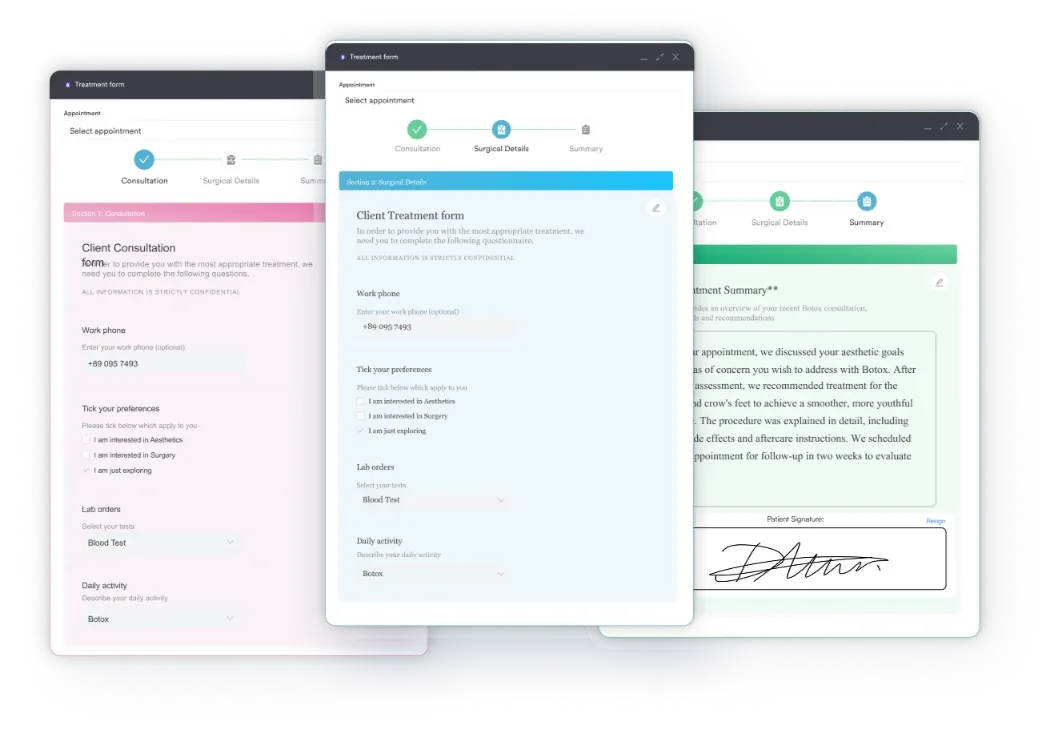
A digital form collects the 12 answers, and practice management software like Pabau scores the total into the patient record.
A one-page clinical form built on the ISEL-12, with the four-point definitely false to definitely true response format. It carries all 12 statements, a name and date header, and an assessor’s notes box.
Download templateA social support scale turns a hunch that a patient is isolated into a number you can chart. The form on this page is the ISEL-12, Cohen and Hoberman’s 12-item short version. Patients rate 12 statements, you score each one 0 to 3, and the total runs 0 to 36.
One detail decides whether that total is worth reading. Six items are worded negatively, so you reverse them before adding. Skip that step and a well-supported patient reads as isolated. Below you get the scoring key, the three subscales, and the norm to read the total against.
A social support scale measures how adequately a patient perceives the support around them. It covers emotional, informational, practical, and companionship support from family, friends, partners, and the wider community.
Diagnosis is not its job. The score quantifies a feeling, then flags the patients who need psychosocial resources or care coordination.
The reason to screen is that perceived support predicts outcomes. Strong support tracks with better mental health, steadier treatment adherence, and faster recovery from illness.
Low perceived support runs the other way. It is a documented social determinant of health, linked to depression, anxiety, and heavier healthcare use.
The answers can arrive through digital intake forms instead of on paper at the front desk. Run the scale at first assessment, at treatment milestones, and at follow-up to see how support shifts.
Four validated instruments dominate mental health and primary care settings. Each suits a different patient group, assessment context, and time budget.
The ISEL-12 is the short form of the Interpersonal Support Evaluation List, published by Sheldon Cohen and Harry Hoberman in 1983. Its full version runs 40 items across four subscales.
The short form keeps appraisal, belonging, and tangible support, and drops the self-esteem subscale. Cohen’s own lab states that omission at the top of its ISEL-12 scoring notes.
The Multidimensional Scale of Perceived Social Support, or MSPSS, is the closest alternative at the same length. It also asks 12 questions, but sorts support by relationship rather than by function.
The MOS Social Support Survey, developed by RAND, is longer and aimed at patients with chronic illness. Its four functional dimensions show which type of support a patient finds adequate.
That difference decides your next move. A source-based scale tells you who is missing from a patient’s life. The function-based version tells you what kind of help is missing.
A related question is how connected a patient feels, rather than what help they can call on. The social connectedness scale measures that sense of belonging instead.
Score each answer 0 to 3, flip the six reverse items, then add all 12 for a total out of 36. The ISEL-12 asks for a true or false judgment on each statement, not a rating of agreement.
Steps three and four are where hand-scoring goes wrong, so the map below holds both in one place.
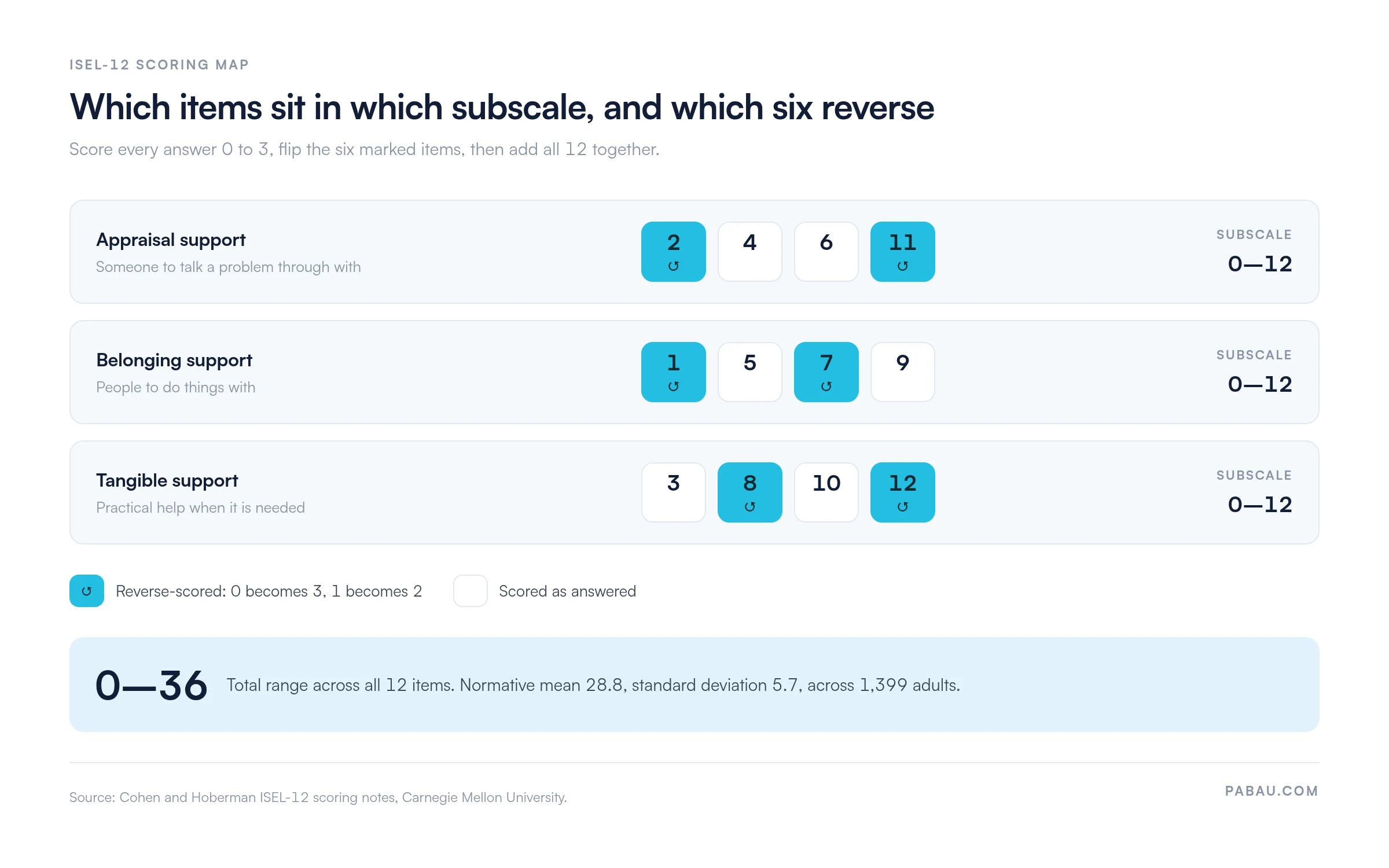
That normative mean comes from Cohen’s lab. Across 1,399 adults in four Pittsburgh Mind-Body Center studies, the mean total was 28.8. The standard deviation was 5.7.
So a total near 29 is ordinary, and a total near 23 sits a full standard deviation below it. Treat that distance as a reason to ask more questions, never as a diagnosis.
Each subscale names a different job that other people do for a patient. That is what turns one number into a specific next step.
Here is how that plays out in a session. A patient scores 11 on tangible, 9 on belonging, and 4 on appraisal, for a total of 24. Neighbors help with the practical work, but nobody hears the worry.
One warning goes with that reading. Four items each is thin, and the largest validation of the ISEL-12 found the subscale scores less reliable than the total.
Merz and colleagues tested the scale on 5,313 adults for Psychological Assessment in 2014. One-factor and three-factor models fit the data equally well, so they recommended reporting the total.
So treat the total as the measure and the subscales as texture. A thin belonging score suggests group activity, while a thin appraisal score points toward counseling or peer support.
The ISEL-12 carries solid psychometric evidence. Cohen’s lab reports a Cronbach’s alpha of 0.86 across the combined sample of 1,399 adults. Study-level alphas run from 0.75 to 0.90.
Merz and colleagues then validated the scores in 5,313 English-speaking and Spanish-speaking Hispanic and Latino adults. Internal consistency for the total held up in every language and ancestry group tested.
The convergent evidence sits in the correlations. Totals fall as perceived stress and depressive symptoms rise, and climb alongside life satisfaction and marital adjustment.
Neither source publishes a clinical threshold, and the literature reports means rather than cut-offs. That is why you read the score against a comparison group, or against the same patient’s history.
None of that weakens the case for screening. Perceived support still predicts depression severity, treatment adherence, and quality of life.
It fits inside a visit you already have. Hand out the scale during a psychiatric or psychological assessment, a family medicine appointment, or a therapy intake.
The workflow matters more than the form. Slot the scale into the intake pack your therapy practice management system already sends, and the score arrives before the patient does.
Treat a low score as a question rather than a conclusion. Is the patient isolated by circumstance, such as living alone or a recent move? Or is it conflict at home?
Ask also whether the low score reflects the situation or depressive thinking that distorts it. Clear isolation risk warrants safety planning, a medication review, and named referrals to community or peer support.
Then write it down where the next clinician will find it. A mental health EMR keeps the score, the date, and the action in one chart entry.
That specificity is what quality and accreditation bodies want in social determinants of health documentation. A repeated score also shows movement, which reads better to a payer than a single reading.
Flag any patient whose score drops after a bereavement or a separation, so outreach happens before the next review.
The download is the ISEL-12 laid out as a one-page clinical form. It carries all 12 statements in Cohen’s published order, with the four response options printed under each one.
A header takes the patient’s name and the date. An assessor’s notes box sits at the foot of the page.
The scoring key stays in this article on purpose. A form that prints the reversals next to the statements tells the patient which answers look good.
Print it for a paper chart, or upload it to your portal for electronic completion. Mental health, primary care, and wellness practices use it to catch isolation early.
A paper scale creates a second job after the questionnaire, which is transcribing the score into the chart. Practice management software like Pabau removes that step.
Add the ISEL-12 as a digital form and patients complete it on the portal before arrival. Pabau’s measurements tracking software then scores the questionnaire, so the total lands in the record without manual entry.
Reverse-scored items are where hand-totaled scores go wrong most often. Automatic scoring applies the reversals the same way every time, so the number in the chart holds up.
Repeat the scale through treatment and the record shows how perceived support moves. Where a score drops, an automated message can point the patient at a support group or a community service.
When the next step is a referral, Pabau’s AI-powered patient letters draft it from the record you already completed.
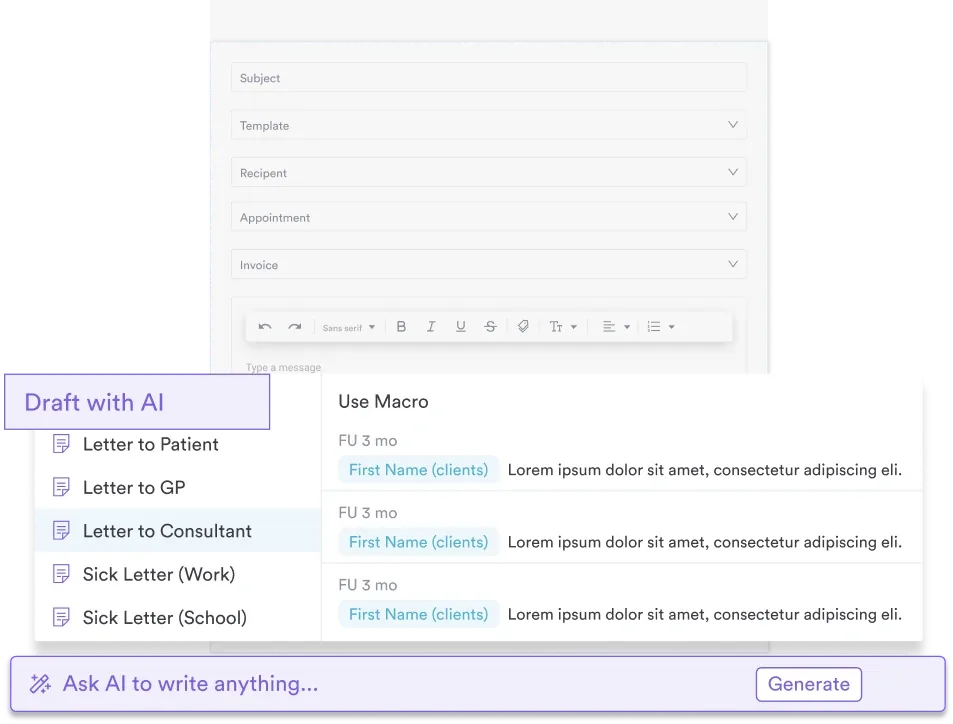

Pabau collects the 12 answers on your portal, scores the total, and keeps the history in the patient record. Your team stops transcribing and starts acting on the number.

The ISEL-12 earns its two minutes because it converts an impression into a figure you can compare. Its scoring key is what makes that figure trustworthy.
Get the six reversals and the three groupings right, and a below-average total points at a specific referral. Reverse the wrong items and the score argues the opposite case.
Download the form above and start screening on paper this week. Book a demo to see how Pabau collects the 12 answers, scores the total, and keeps the trend in the patient record.

Need a full mental health assessment framework? Psychiatric evaluation template walks through history, risk, and mental status in the order a first appointment follows.
Setting up a new therapy intake? Mental health intake form gathers the history and consent that a support score sits alongside.
Screening body image as well? Body appreciation scale is another short self-report measure with a published scoring key.
Comparing software for a therapy practice? Top 7 mental health software in the US reviews the platforms that handle scored questionnaires.
Cohen’s lab publishes the ISEL scales on its own website and asks users to share resulting papers. Confirm usage rights with your institution before any commercial use.
Any trained staff member can give it out, because the scale is self-report. Interpreting the total and deciding the next step belongs to the clinician.
Ask them to fill it in before you total the form. A sum missing an item cannot be compared with the 0 to 36 range or the 28.8 mean.
Yes. Send it through your patient portal before the video visit, then review the total on screen with the patient.
Sharing the total often helps, because it makes a vague worry concrete and gives you something to set a goal against. Frame it as a snapshot, not a verdict.
Most patients finish the 12 statements in about two minutes. Scoring by hand adds a minute or two, mostly spent on the reversals.
No. Low perceived support raises the risk of depression, but this scale measures support alone. Screen for mood with a separate instrument.