Trauma response test: Free template for clinicians
A trauma response test is a structured screening questionnaire that helps clinic...

1
Last Updated: Oct 15, 2026
A co-parenting agreement is a written plan that separated or divorced parents use to set out how they will raise their children together. It covers parenting time, decision-making, money, communication, and how disagreements get resolved.
The agreement isn’t legally binding on its own, but a judge can approve it and make it enforceable. Many families draft one with a mediator or family therapist, then file it with the court if their state requires it. The free template below gives you each section to fill in.
A three-page template with sections for the parenting schedule, decisions on education and health, money, communication, and dispute resolution. It closes with signature and date lines for both parents.
Download template
A co-parenting agreement records parenting time, decisions, and money in one place.
An agreement is not automatically binding until a judge approves it.
Specific schedules, handover times, and expense rules prevent most everyday disputes.
Include a written dispute process so disagreements are resolved before court.
A co-parenting agreement is a private, written record of the arrangements parents have agreed for their children. It fills in the day-to-day detail that a general custody order often leaves open, such as who handles school drop-off or how holiday weeks rotate.
In most cases a court order takes priority, and the agreement works within it. Parents often write a co-parenting agreement after separation, before a hearing, or when an existing schedule stops working. Most agreements address:
The main difference is whether a court has approved the document, because the two terms overlap in many states. A parenting plan is often the term courts use for an agreement that has been filed or approved.
Use the term your court or family law office uses. The substance of the document matters more than the label. Where every exchange turns into an argument, a parallel parenting plan keeps direct contact to a minimum and puts more of the detail in writing.
A strong agreement covers six areas: schedule, holidays, decisions, money, communication, and disputes. Write each section in plain language and include the dates, times, and locations. The comparison below shows how much a few specifics change a clause.
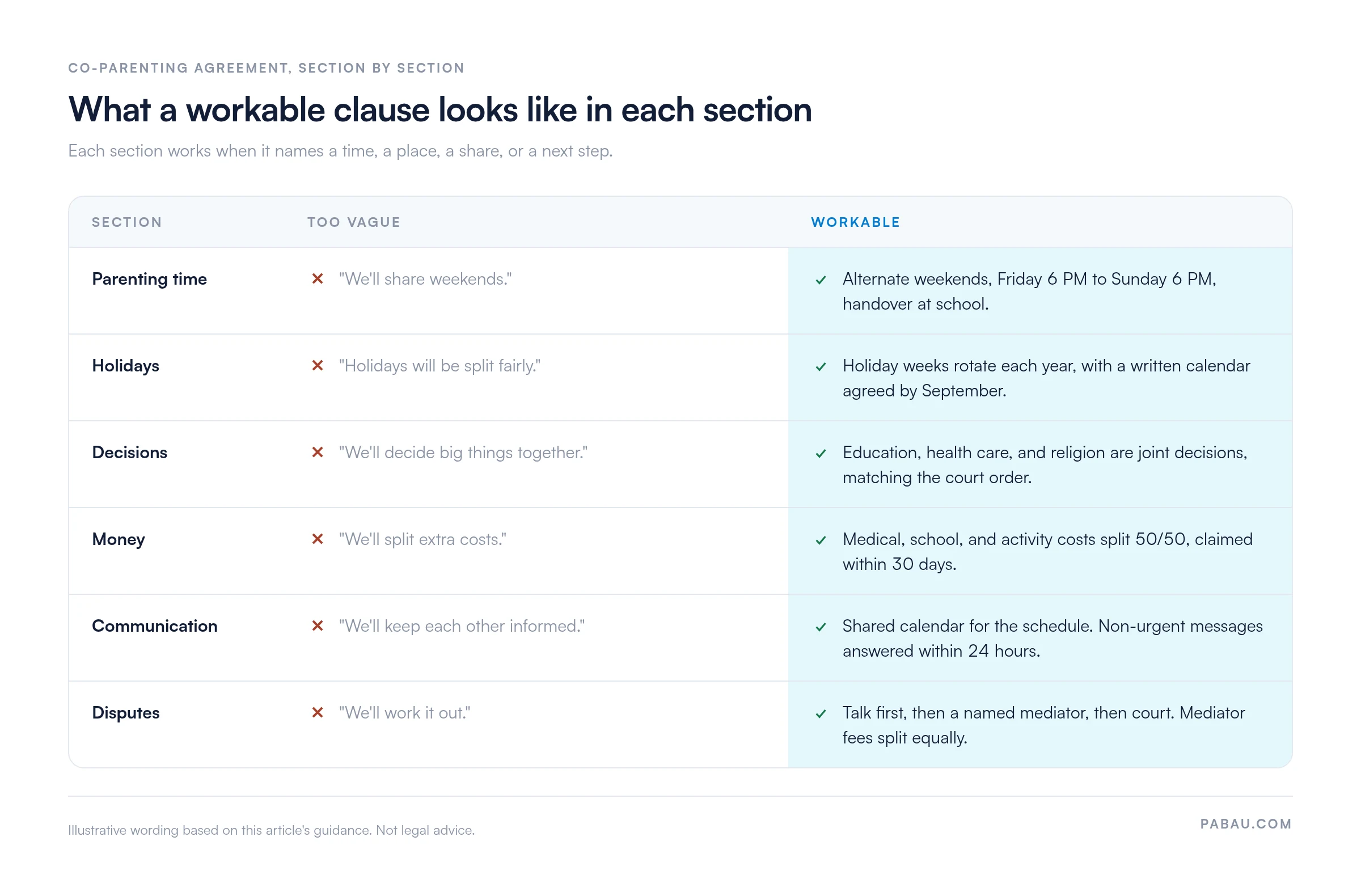
Set the weekday and weekend split, handover times, and exchange location. A 50/50 arrangement often alternates weeks or splits each week, but the handover details decide whether it runs smoothly.
State who makes major decisions on education, health care, and religion, and whether those decisions are joint or made by one parent. Match the wording to the legal custody designation in your court order, because an agreement cannot give a parent authority the court has not granted.
List how medical, school, and activity costs are shared, and set a deadline for reimbursement requests. Child support amounts are set by state guidelines, so keep this section focused on how other costs are split. Federal guidance is published by the Office of Child Support Enforcement.
Agree on how you will communicate, such as a shared calendar or messaging app, and how quickly non-urgent messages get a reply. Add household rules, including how each parent speaks about the other in front of the children.
Name the steps in order: a direct conversation first, then a mediator, then court if needed. Many agreements name the mediator and note how fees are shared.
No, a co-parenting agreement is not automatically legally binding, but a judge can make it enforceable by approving it. Courts generally ask whether the terms serve the child’s best interests and whether both parents signed voluntarily.
Requirements differ by state, so the same wording may carry weight in one place and only guide behavior in another. Interstate moves add another layer, because the Uniform Child Custody Jurisdiction and Enforcement Act determines which state decides custody. Most states have adopted it.
Involve a family law attorney before signing if:
A court can generally modify an approved agreement if circumstances change substantially, so keep your version current.
Start with the decisions you already agree on, then draft the disputed points around them. Work through these steps in order.
Review the agreement once a year and after any major change, such as a move, a new school, or a shift in work hours. Begin with the schedule and money sections, because they cause most day-to-day friction. Date every version and keep the previous copy, so both parents can see what changed and when. Store a copy where both parents can reach it quickly.
Family therapists and mediators who help parents with this document often email it as a PDF, then chase two signatures. Each new version means another round of printing, scanning, and filing by hand.
Pabau, the therapy practice management software we build, moves that into one digital workflow. With Pabau’s digital forms, you send the agreement to both parents, collect their signatures online, and keep the signed copy on the patient record.
Through the Client Portal, parents can complete the forms you send before a session. When the agreement changes, you send the updated form. The earlier signed version stays on file, so you can show which copy applied and when.
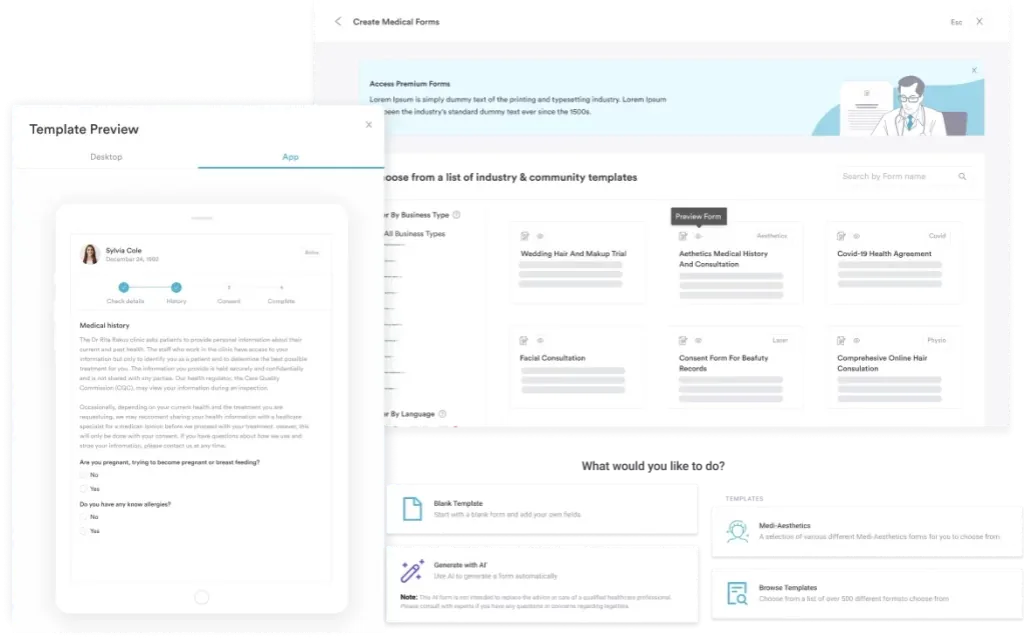

Send co-parenting agreements as digital forms, collect both parents’ signatures online, and keep every signed version on the patient record.

The agreement that holds up is the one with specifics in it. A clause naming a handover time or a reimbursement deadline gives both parents something to point to when a disagreement starts.
Fill in the points you already agree on first, and mark the contested ones for a mediator. A family law review before signing costs time now. It costs far less than a hearing over a clause neither parent can interpret.
If your practice helps families draft and sign these agreements, book a demo to see how Pabau keeps each signed version on the patient record.

Filing a plan in Washington? Washington State parenting plan walks through the state’s own parenting plan format.
Co-parenting with a narcissistic ex? Sample parenting plan with a narcissist shows how to tighten boundaries and handover rules.
Supporting a client through divorce? Divorce worksheet helps therapists structure sessions on separation and its fallout.
Considering time apart first? Trial separation checklist covers the terms couples agree before living apart.
A co-parenting agreement is a written record of how separated parents will share parenting time, decisions, and costs. Some states and courts call the same document a parenting plan, so check the term your court uses.
Yes, parents can draft their own agreement. A family law attorney or mediator can review it before signing, which helps catch missing terms and unclear wording.
Review it at least once a year and after any major change, such as a move, a new school, or a shift in work hours. Date each version so both parents know which copy applies.
Yes. A 50/50 schedule divides parenting time evenly, usually by alternating weeks or splitting each week. The agreement should also state handover times, school responsibilities, and how holidays are shared.