Nursing narrative note template
A nursing narrative note template is a structured PDF that guides you through re...

3
Last Updated: Oct 21, 2026

Ineffective breathing pattern is a NANDA-I nursing diagnosis for inspiration or expiration that fails to provide adequate ventilation. It sits in Domain 4: Activity/Rest, Class 4: Cardiovascular/Pulmonary Responses.
Common related factors include COPD, asthma, neuromuscular dysfunction, anxiety, pain, and post-operative complications. Defining characteristics include tachypnea, use of accessory muscles, and abnormal oxygen saturation.
Nursing assessment must evaluate respiratory rate, depth, rhythm, SpO2, ABG values, and work of breathing. SMART goals then specify measurable outcomes, such as reaching a respiratory rate of 12-20 breaths per minute within four hours.
Evidence-based interventions include airway positioning, oxygen therapy, pursed-lip breathing, diaphragmatic breathing techniques, and patient education. Digital forms in practice management software like Pabau keep care plan completion and tracking in one record.
A two-page fillable form for documenting a breathing pattern care plan at the bedside. It covers patient details, five assessment prompts, the nursing diagnosis statement, short- and long-term goals, a standard nursing interventions checklist, and evaluation and sign-off.
Download templateIneffective breathing pattern is one of the most common respiratory nursing diagnoses, and one of the easiest to document badly. In essence, it describes breathing mechanics that fail to move enough air, whatever the underlying cause.
This guide covers the NANDA-I definition, the related factors behind the diagnosis, and the defining characteristics you chart. It then works through SMART goals, interventions with rationale, patient teaching, and documentation. For example, sample care plans for COPD, asthma, and anxiety show how the same diagnosis changes shape with the etiology.
Overall, the form above is the blank structure you fill in at the bedside. The clinical detail behind each section stays here in the article, so use the two together.
Specifically, NANDA International, known as NANDA-I, defines ineffective breathing pattern as inspiration and/or expiration that does not provide adequate ventilation. Additionally, the diagnosis is classified under Domain 4: Activity/Rest, Class 4: Cardiovascular/Pulmonary Responses. Use it when a patient’s breathing mechanics fail to maintain sufficient gas exchange for metabolic needs. Ultimately, every care plan that follows is built on that definition.
Generally, nurses document this diagnosis using the three-part PES format. That is Problem (ineffective breathing pattern), Etiology (related factors such as pain or anxiety), and Signs/Symptoms (tachypnea, accessory muscle use, and similar findings). In effect, understanding the NANDA taxonomy ensures consistent communication across healthcare teams and proper alignment with clinical documentation standards.
The etiology decides the plan, because the same diagnosis behaves differently depending on what caused it. Accordingly, related factors fall into the categories below, and each one calls for a different assessment and intervention priority.
Accurate etiology identification also shapes the nursing health assessment that follows. As a result, it keeps interventions aimed at the root cause rather than the symptom alone.

Defining characteristics are the subjective and objective signs nurses observe and document. In particular, they differentiate ineffective breathing pattern from other respiratory diagnoses and form the evidenced-by clause in the PES diagnosis statement.
In short, note these characteristics with specificity. For instance, “RR 28, shallow depth, use of intercostal muscles, SpO2 88% on RA” strengthens the nursing diagnosis and guides outcome measurement. Age matters too, since the thresholds above are adult values and pediatric vital signs shift with age.
Assessment data identify the problem, quantify its severity, and set the baseline every goal is later measured against. Consequently, work through the seven steps below in order, and record a number wherever one exists.
Overall, document findings systematically. An AI medical scribe speeds up the write-up, so assessment data reach the record in the same shape every shift. Likewise, a reusable progress note template does the same job for the reassessments that follow.
SMART goals are Specific, Measurable, Achievable, Relevant, and Time-bound. In effect, they translate the nursing diagnosis into objective targets that guide interventions and evaluation. The six goals below come due at different points, from the first two hours through to discharge.
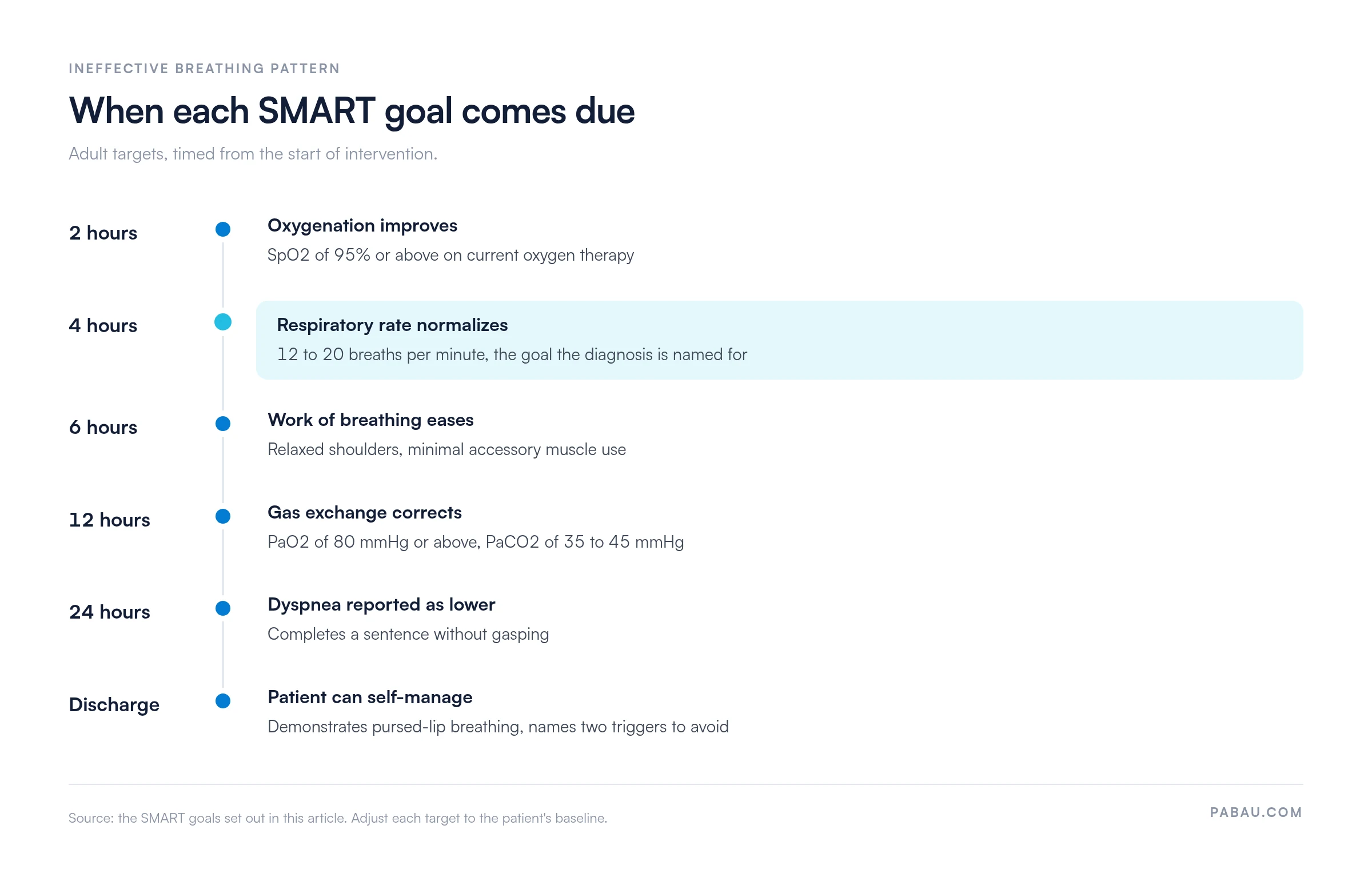
In particular, tie each outcome to a measurable vital sign or an observable patient behavior. Revise the target when the patient’s status changes, and record what prompted the revision.
Generally, interventions are the nursing actions taken to help the patient achieve the established goals. Consequently, each intervention requires an evidence-based rationale explaining why it is expected to improve the patient’s breathing pattern.
Of course, customize interventions based on the identified etiology. For instance, a patient with COPD exacerbation requires different priorities than a post-operative patient with pain-induced splinting.
Indeed, the patient manages their own breathing between visits, so teaching decides whether the improvement holds. Pitch each session to the patient’s literacy level, physical capacity, and readiness to learn, and keep patient education short enough to repeat.
In addition, document all teaching delivered, patient understanding, and any barriers to learning. Likewise, a secure patient portal lets the patient reread the breathing instructions at home, which is where most of the practice happens.
Overall, accurate documentation ensures continuity of care, provides legal protection, and fulfills regulatory and accreditation standards. Conversely, poor charting can undermine even excellent clinical care.
Clear charting protects both patient safety and clinician accountability. In fact, it is also the record any later review of a respiratory deterioration starts from.
The following care plan examples demonstrate how to adapt the framework to common clinical presentations. Specifically, each scenario highlights specific etiology, defining characteristics, goals, and interventions tailored to the patient context.
One diagnosis label, three different sets of priorities. Work from the same framework for a COPD care plan or an asthma care plan, then change the targets to match the cause. Ultimately, if the patient keeps deteriorating on maximal therapy, the plan escalates to a respiratory failure plan.
Evaluation determines whether nursing interventions are achieving the desired outcomes. Thus, systematic reassessment at regular intervals allows timely modification of the care plan when progress stalls or status changes.
Evaluate each goal explicitly. Then compare current vital signs, SpO2, ABG values, and patient report against the baseline and the goal statement. Finally, document whether each goal is met, partially met, or not met, along with the reason.
A worked example: “Goal met, RR decreased from 26 to 20 breaths/min within 2 hours of positioning and oxygen therapy”. Then, if a goal is not met, name the barrier. Usually, inadequate pain control, poor medication adherence, and disease progression are the three that show up most often.
Then modify the intervention rather than restating the goal. A patient management system carries goal status across the care episode, so the next nurse sees what was already tried.
On the ward and in primary care practices alike, respiratory care plans still get built on paper or in a file outside the patient record. Usually, the assessment gets written once, the goals get copied into the progress note, and the evaluation lands somewhere else again. Every hand-off then costs someone a search.
Practice management software like Pabau keeps the whole cycle in one chart. Specifically, build the care plan as a medical form, and the assessment values, goals, and interventions save against the patient record. Then, Pabau Scribe, our AI scribe, drafts the narrative note from what you dictated at the bedside.
Reassessment then becomes a repeat of the same form rather than a blank page. Meanwhile, goal status carries forward, and respiratory rate and SpO2 readings trend next to each other. Ultimately, every nurse on the team opens the current version of the plan.

Build the care plan as a digital form in Pabau, then reassess against that same form. Assessment values, goals, interventions, and sign-off stay on the patient record, so the next nurse picks it up without a search.

The value of this care plan sits in the specificity, not the length. Indeed, a diagnosis statement naming a measured respiratory rate and an actual SpO2 gives the next nurse something to work against. “Rapid breathing” gives them nothing.
The downloadable form above gives you the blank structure to complete at the bedside. Then fill it in against your patient’s own etiology, setting, and clinical context, using the guidance in this article. Ultimately, a COPD exacerbation and a panic attack share a diagnosis label and almost nothing else.
Whatever you chart in, keep the assessment, the goals, and the evaluation in the same record. Accordingly, Book a demo to see how Pabau holds care plan documentation in one place. Your team then spends more of the shift on direct patient care.

Sending the patient home with a plan? Asthma action plan gives the patient a written zone-by-zone guide for what to do when breathing worsens.
Need thresholds at a glance? Abnormal vital signs chart sets out the ranges that should prompt escalation, respiratory rate included.
Breathlessness with a cardiac cause? Congestive heart failure nursing care plan covers the fluid-overload picture that mimics a primary breathing problem.
Planning care for a pneumonia patient? Pneumonia nursing care plan template gives a structured framework for evidence-based care from assessment through recovery.
Caring for a patient with a tracheostomy? Tracheostomy nursing care plan structures respiratory assessment, tube management, and complication prevention.
Ineffective breathing pattern is a NANDA-I nursing diagnosis that describes inspiration and/or expiration that does not provide adequate ventilation. It occurs when a patient’s breathing mechanics fail to maintain sufficient gas exchange for metabolic needs. Common causes include pulmonary disease, neuromuscular weakness, pain, anxiety, and post-operative complications.
Use the three-part PES format: Problem (ineffective breathing pattern) + Etiology (related to specific factors) + Signs/Symptoms (as evidenced by objective findings). Example: “Ineffective breathing pattern related to post-operative pain as evidenced by RR 28, shallow depth, intercostal muscle use, and SpO2 88% on room air.”
Defining characteristics include tachypnea (RR > 20), bradypnea (RR < 12), irregular breathing rhythm, and shallow depth. Others include use of accessory muscles, nasal flaring, dyspnea, cyanosis, abnormal ABG values, and SpO2 below 95%.
Dyspnea is the clinical term for the subjective sensation of difficult or labored breathing; shortness of breath is the patient’s description of that sensation. They are synonymous in clinical use. Both refer to the patient’s subjective complaint, whereas tachypnea and shallow breathing are objective observations of respiratory mechanics.
Ineffective breathing pattern refers to the mechanics of inspiration and expiration not providing adequate ventilation (often due to pain, anxiety, or neuromuscular weakness). Ineffective airway clearance refers to an inability to clear secretions or keep the airways open. Causes include excessive mucus production, a weak cough reflex, or airway obstruction. Both can occur together, but their underlying causes and interventions differ.
The normal adult respiratory rate is 12-20 breaths per minute at rest. Tachypnea is defined as RR > 20; bradypnea is RR < 12. However, context matters: athletes, pregnant patients, and those with anxiety may normally breathe faster. Always assess RR alongside other vital signs and clinical presentation.