Maja Popovska
Nutrition intake form
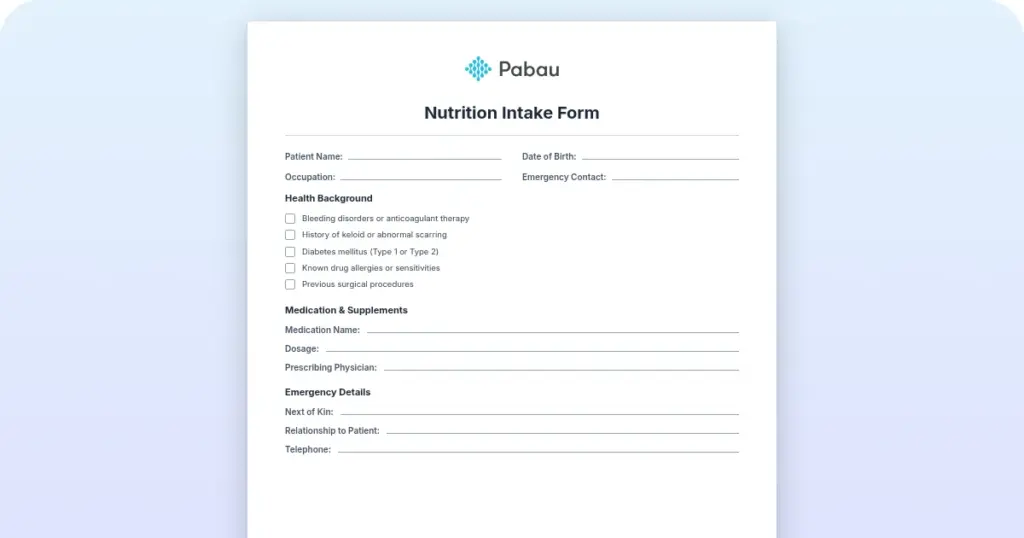
A nutrition intake form is a structured questionnaire that records a patientR...

3
Last Updated: Oct 22, 2026
Free PDF 1 page, print-ready Clinician-reviewed
An abnormal vital signs chart provides a structured clinical reference for identifying, documenting, and responding to vital sign abnormalities across different patient age groups. Whether you’re running a busy primary care clinic, a sports medicine practice, or a physical therapy facility, a reliable vital signs chart keeps your team aligned on which measurements signal patient deterioration and when to escalate care. This guide covers what the chart is, the normal and abnormal ranges by age, how to implement it in your clinic workflow, and why it matters for patient safety.
Upload this PDF, or any form you already use, and Pabau's AI Form rebuilds it with tick boxes, text fields and a signature. Attach it to the treatment once, and every patient gets it on time.
AI Form rebuilds the consent, history and aftercare forms you already use. You review each one, then publish.
Patients complete forms on their phone before they arrive, so the front desk stops retyping paper.
Every signed form is versioned and attached to the treatment record, ready when you need it.
Set how long a consent stays valid. Returning patients skip forms they have already signed.
Supports HIPAA and GDPR compliance AES-256 encryption 4.8 on G2 4.7 on Capterra Trusted by 4,000+ practices worldwide

An abnormal vital signs chart documents heart rate, respiratory rate, blood pressure, temperature, and oxygen saturation thresholds that signal clinical concern.
Normal ranges differ significantly by age-pediatric vital signs vary more than adults, requiring age-stratified reference tables for accurate assessment.
Abnormal vital signs often cluster (e.g., fever + tachycardia + hypotension = possible sepsis), so clinicians must interpret them in context, not in isolation.
Early Warning Score (EWS) tools use vital sign abnormalities to predict patient deterioration and guide clinical response protocols.
An abnormal vital signs chart is a clinical documentation tool that defines the thresholds at which heart rate, respiratory rate, blood pressure, body temperature, and oxygen saturation (SpO2) fall outside normal range and require clinical attention. Unlike a static reference table, a structured abnormal vital signs chart guides clinicians and clinic staff on which readings represent mild abnormality, moderate concern, or emergency thresholds-and what action each level demands.
The chart organizes data by age group because normal ranges vary significantly across pediatric patients, adults, and elderly patients. A respiratory rate of 25 breaths/minute might be normal for a toddler but abnormal for an adult. The five primary vital signs tracked are:
This framework helps clinic staff at all levels-medical assistants, nurses, physical therapists.
Normal ranges shift with age, so the same reading can be reassuring in one patient and a red flag in another. A respiratory rate of 30 breaths per minute is expected in an infant but signals distress in an adult. Set the normal baseline for the patient’s age first, then treat any reading outside that band as abnormal and worth a second look.
| Age group | Heart rate (bpm) | Respiratory rate (breaths/min) | Systolic BP (mmHg) |
|---|---|---|---|
| Newborn (0-1 month) | 100-160 | 30-60 | 60-90 |
| Infant (1-12 months) | 100-150 | 30-53 | 72-104 |
| Toddler (1-3 years) | 90-140 | 22-37 | 86-106 |
| Preschool (3-5 years) | 80-120 | 20-28 | 89-112 |
| School age (6-12 years) | 70-120 | 18-25 | 97-115 |
| Adolescent (13-18 years) | 60-100 | 12-20 | 110-131 |
| Adult (18+ years) | 60-100 | 12-20 | 90-120 |
For normal vital signs for adults, the targets are stable: a heart rate of 60-100 bpm, a respiratory rate of 12-20 breaths per minute, and blood pressure under 120/80 mmHg. Elderly patients often sit at the edges of these ranges, and a sudden blood pressure drop when they stand (orthostatic hypotension) is a common fall risk worth checking at each visit.
A pediatric vital signs chart matters most because children’s heart and respiratory rates run far higher than adults and settle downward as they grow. Reading a toddler against adult thresholds produces false alarms, while reading an adolescent against infant ranges hides real problems. Anchor every pediatric assessment to the child’s age band, then pair the number with how the child looks (color, alertness, and work of breathing) before you act.
Infant visits pair vitals with neurological screening. An infant reflexes chart logs the Moro, rooting, and Babinski responses alongside the age each one should integrate.
Implementing the chart in your clinic workflow requires five operational steps: standardize measurement technique, document baseline and current readings, compare against the chart thresholds, assess context and interconnectedness, and trigger the appropriate clinical response.
In software built for occupational therapy practices, scores from scales like this feed straight into progress notes.
Any clinical practice that measures vital signs regularly benefits from a standardized abnormal vital signs chart. The chart is most valuable in settings where multiple staff members measure vitals and must communicate abnormal findings consistently.
A structured abnormal vital signs chart delivers operational and clinical benefits. It standardizes interpretation across staff, reduces the risk of missed abnormalities, accelerates clinical decision-making, and supports compliance with quality standards.

Pabau’s client record system captures vital sign measurements, flags abnormal readings against age-stratified thresholds, and alerts your team to deteriorating patients-all in one integrated workflow.

Vital signs rarely stand alone. When two or more abnormalities occur together, they point toward specific clinical syndromes that require immediate recognition and response.
A comprehensive chart includes a clinical interpretation column that guides clinicians through this logic. Implementing automated vital sign alerts in your clinic software allows the system to flag high-risk combinations automatically, ensuring no patient deterioration goes unnoticed.

Early Warning Score (EWS) systems convert vital sign abnormalities into a numeric risk score that predicts which patients are most likely to suffer cardiac arrest or death within 48 hours. The UK’s National Early Warning Score (NEWS2) and US-based EWS tools assign points to each vital sign based on severity, then sum the points to generate a total score. In NEWS2, an aggregate score of 0-4 indicates low risk (routine ward-based monitoring), a score of 5-6 (or a score of 3 in any single vital sign) indicates medium risk that triggers urgent clinician review, and a score of 7 or more indicates high risk requiring emergency assessment and critical care consideration.
Research shows respiratory rate >35/min carries the highest risk signal (odds ratio 31.1 for life-threatening adverse event). Temperature abnormalities, oxygen saturation <90%, and systolic blood pressure <90 mmHg or >200 mmHg also drive elevated EWS scores. Clinics that adopt EWS-guided protocols-measuring vital signs at each visit, calculating the score, and acting on the threshold-reduce in-hospital cardiac arrests by alerting teams to high-risk patients before deterioration becomes critical.
Integrate the chart with coordinated staff response protocols so that when a patient’s EWS crosses a threshold, all team members know exactly what escalation step to take next.
Laminate your abnormal vital signs chart and post it at every vital sign measurement station (front desk, exam rooms, triage area). Train all staff quarterly on the chart’s use and your clinic’s response protocols. Include the chart in new-hire onboarding so every team member recognizes abnormal thresholds on day one.
An abnormal vital signs chart is a foundational safety tool that translates vital sign measurements into clear, actionable clinical guidance. By standardizing thresholds across age groups and defining response protocols, your clinic team catches early warning signs of patient deterioration before critical events unfold. Whether you’re operating a small primary care practice or a multi-location medical spa, implementing a structured chart-and training all staff to use it consistently-protects patient safety and strengthens your clinic’s compliance posture. Download the template above, customize it to your clinic’s protocols.

Documenting vital sign trends more efficiently? GP’s guide to safer notes shows how AI tools speed note-taking while keeping records HIPAA and GDPR compliant.
Assessing vital signs in a newborn? Newborn exam checklist covers vital signs, APGAR scoring, and screening procedures for the first days of life.
Screening a child for sleep problems? Pediatric sleep questionnaire screens snoring, apneas, daytime sleepiness, and behavior in children ages 2 to 18.
An abnormal vital signs chart is a clinical reference tool that defines the heart rate, respiratory rate, blood pressure, temperature, and oxygen saturation thresholds at which readings are considered abnormal and require clinical action. It is organized by age group (pediatric, adult, elderly) because normal ranges differ significantly across ages.
For adults: heart rate <60 or >100 bpm is abnormal; respiratory rate <12 or >20 breaths/min is abnormal; blood pressure <90/60 mmHg (hypotension) or ≥130/80 mmHg (hypertension) is abnormal; temperature <95°F or >100.4°F is abnormal; oxygen saturation <95% on room air is abnormal.
Pediatric vital signs vary widely by age because children’s cardiovascular and respiratory physiology differs from adults. Heart rates, respiratory rates, and blood pressure ranges are higher in infants and young children and gradually normalize as the child grows. Using the correct age-stratified normal range is essential to avoid false alarms or missed abnormalities.
A respiratory rate above 35 breaths/minute in an adult is a critical abnormality. Research shows it carries the highest risk for life-threatening adverse events and is used in Early Warning Score systems to trigger immediate clinical escalation and emergency protocols.
Respiratory rate is often the earliest and most predictive warning sign, which is why Early Warning Score systems weight a rate above 35 breaths per minute so heavily. In practice, though, the most concerning finding is usually several readings turning abnormal together, such as a rising heart rate alongside a falling blood pressure.
Measure the patient’s vital signs using standardized technique, record the readings in your clinic system, compare each against the age-stratified thresholds on your abnormal vital signs chart, assess context (is the patient symptomatic? do multiple vitals cluster?), and execute your clinic’s response protocol (reassess, escalate, or activate emergency procedures).
An Early Warning Score is a numeric risk system that converts abnormal vital signs into points and sums them to predict patient deterioration risk. Higher scores (≥5) trigger escalation to critical care review. EWS systems help clinics identify high-risk patients before cardiac arrest or death occurs.