Kate Tarrant
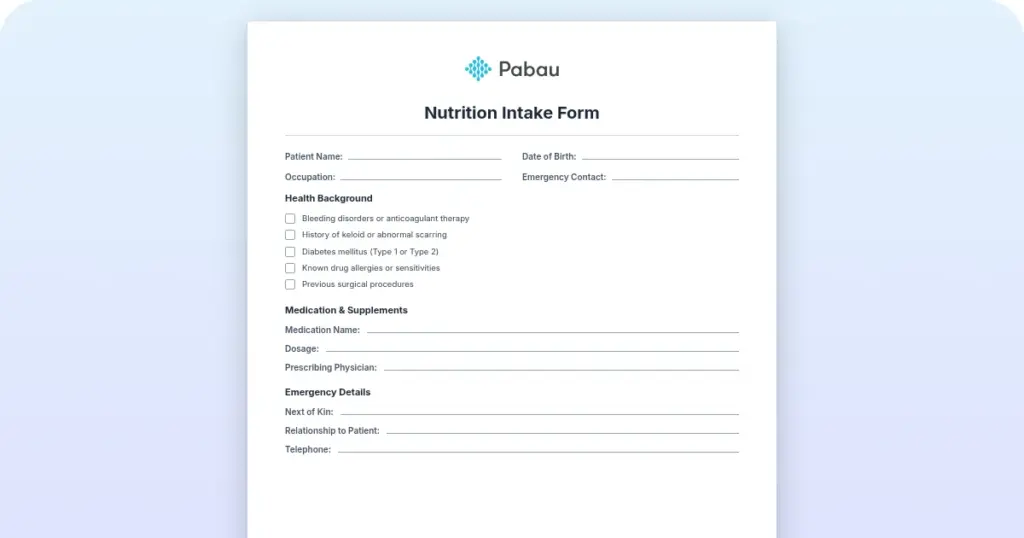
Nutrition intake form
A nutrition intake form is a structured questionnaire that records a patientR...

4
Last Updated: Oct 22, 2026
Free PDF 2 pages, print-ready Clinician-reviewed
What is a Tracheostomy Nursing Care Plan Template? A tracheostomy nursing care plan template is a standardised clinical documentation tool that nurses and multidisciplinary teams use to deliver safe, evidence-based care for patients with tracheostomies. The template provides a structured framework for assessing respiratory status, managing the tracheostomy tube, preventing complications, and supporting patient communication […]
A comprehensive care plan covering patient assessment, NANDA-aligned nursing diagnoses, evidence-based interventions, outcome goals, airway management protocols, infection prevention strategies, and caregiver education frameworks for acute, post-acute, and community nursing settings.
Upload this PDF, or any form you already use, and Pabau's AI Form rebuilds it with tick boxes, text fields and a signature. Attach it to the treatment once, and every patient gets it on time.
AI Form rebuilds the consent, history and aftercare forms you already use. You review each one, then publish.
Patients complete forms on their phone before they arrive, so the front desk stops retyping paper.
Every signed form is versioned and attached to the treatment record, ready when you need it.
Set how long a consent stays valid. Returning patients skip forms they have already signed.
Supports HIPAA and GDPR compliance AES-256 encryption 4.8 on G2 4.7 on Capterra Trusted by 4,000+ practices worldwide

A tracheostomy nursing care plan template is a structured documentation framework that guides nurses through comprehensive assessment, NANDA-aligned diagnosis, intervention planning, and patient outcome monitoring for clients with tracheostomies.
The template includes airway management protocols, suctioning procedures, stoma site care, infection prevention strategies, and communication techniques tailored to non-verbal patients.
Effective care plans address three primary nursing diagnoses: Ineffective Airway Clearance, Risk for Infection, and Impaired Verbal Communication.
Pabau’s digital forms feature converts paper care plans into searchable, automated workflows that reduce documentation time and improve care coordination across acute, post-acute, and community settings.
A tracheostomy nursing care plan template is a standardised clinical documentation tool that nurses and multidisciplinary teams use to deliver safe, evidence-based care for patients with tracheostomies. The template provides a structured framework for assessing respiratory status, managing the tracheostomy tube, preventing complications, and supporting patient communication and swallowing.
Tracheostomy care requires precision and coordination across multiple clinical domains. The template serves as both a legal record and an operational guide, ensuring consistency across shifts and care settings. It documents the patient’s baseline respiratory status, tube specifications (inner/outer cannula, cuff pressure), suctioning protocols, and risk factors such as infection vulnerability or cognitive impairment. Because many tracheostomies are placed when a patient cannot be weaned from ventilation, this plan frequently runs alongside a respiratory failure care plan template that tracks the underlying hypoxaemia or hypercapnia driving the airway support.
From a regulatory perspective, nursing care plans align with standards set by the Nursing and Midwifery Council (NMC) in the UK and the American Nurses Association (ANA) in the US. These bodies mandate comprehensive documentation that demonstrates professional judgment, patient-centred planning, and adherence to current clinical guidelines. A well-designed template bridges compliance requirements with practical workflow efficiency.
Using a tracheostomy nursing care plan template involves five operational steps that integrate digital forms for streamlined documentation with evidence-based clinical assessment.
Nurses using AI-assisted clinical documentation can accelerate care plan completion while maintaining documentation accuracy. Digital platforms reduce transcription errors and enable real-time access across care settings.
This template serves multiple healthcare settings and professional roles. Acute care nurses in intensive care units and post-operative wards use it to manage newly placed tracheostomies and monitor for post-surgical complications. Step-down and intermediate care units transition patients toward independence, making the template essential for documenting readiness milestones.
Community health nurses delivering home-based care rely on detailed care plans to coordinate with visiting therapists, family caregivers, and district nurse colleagues who may rotate shifts. The template ensures continuity when multiple team members provide care across days or weeks.
Rehabilitation teams (speech and language pathologists, physiotherapists, occupational therapists) reference nursing care plans to align their interventions with the patient’s overall care goals. Educators in nursing schools and healthcare provider training programmes use templates to teach students standardised documentation practices and clinical reasoning.
Completed forms belong in structured medical records management, not a filing cabinet.
Compliance and Legal Protection: Comprehensive, dated documentation demonstrates that care met professional standards at the time it was delivered. This is critical during Care Quality Commission (CQC) inspections, complaints investigations, or clinical negligence reviews. A care plan showing individualised assessment and evidence-based interventions strengthens the organisation’s defence.
Workflow Efficiency: Standardised templates eliminate duplicate data entry and reduce the cognitive load of remembering what information is essential. Nurses complete documentation faster, freeing time for direct patient care. Digital versions with auto-populated fields (e.g. date, time, patient name) further streamline the process.
Documentation Clarity: Patients and families understand the care plan more easily when it follows a familiar structure with clear goals. This transparency builds trust and supports informed consent for invasive procedures like suctioning or tube changes.
Patient Safety: Care plans that explicitly document baseline respiratory status, suctioning protocols, and emergency procedures reduce the risk of adverse events. When a new nurse joins the shift, a complete care plan communicates critical parameters without verbal handover delays.
Audit Readiness: Templates pre-structure the information auditors review. Organisations using standardised care plans pass clinical audits more consistently because documentation is comprehensive and consistent across patient records.
Effective care planning begins with comprehensive nursing assessment. The template guides nurses to evaluate respiratory status (breath sounds, work of breathing, SpO2, cyanosis), tracheostomy tube integrity (placement, cuff seal, tie security), stoma condition (erythema, drainage, granulation tissue), and patient’s mental status and communication capacity.
From this assessment data, nurses derive NANDA International diagnoses that guide intervention selection. Ineffective Airway Clearance applies when secretions, tube obstruction, or weak cough impairs gas exchange; interventions focus on suctioning frequency, humidification, and cough assistance techniques. Risk for Infection is present due to bypass of upper airway defences; prevention includes sterile suctioning, stoma site care with appropriate cleansing solutions, and cuff pressure monitoring to prevent aspiration. Impaired Verbal Communication requires alternative communication methods: letter boards, picture charts, speaking valves (Passy-Muir), or low-pressure cuff deflation trials. A GP practice managing chronic conditions needs the trend, not the latest reading alone.
Secondary diagnoses often include Anxiety (related to airway dependence), Impaired Swallowing (if applicable), and Risk for Self-Care Deficit (when the patient has limited mobility or cognitive impairment). Where memory loss is the cognitive barrier, a dedicated impaired memory nursing care plan template documents the orientation, safety, and communication strategies these patients need. The care plan template provides space to document these diagnoses and their associated assessment frameworks for each.
Limited mobility is the other branch of that self-care deficit, and it carries pressure injury risk. A Braden Scale score flags that risk before any skin damage develops. The scale may underestimate risk in sedated, mechanically ventilated patients, which matters in the intensive care units this template serves.
Tracheostomy care encompasses routine maintenance and emergency preparedness. Routine suctioning removes mucous secretions that obstruct airflow; the template documents patient-specific frequency (time-based vs. as-needed), catheter size, and technique (clean vs. sterile). Inner cannula cleaning (typically every 4-8 hours or daily) removes dried secretions that reduce tube patency; the procedure uses sterile saline, appropriate cleaning brushes, and careful reassembly to prevent damage.
Stoma site care involves gentle cleaning with sterile normal saline and assessment for signs of infection (purulent drainage, foul odour, surrounding erythema, granulation tissue). Cuff pressure monitoring ensures the balloon seal is firm enough to prevent aspiration but not so tight that it damages the tracheal wall (target 20-30 cm H2O). Tracheostomy tie or holder changes maintain secure positioning; the care plan specifies how often ties are changed and what signs indicate a loose tube (visible tube movement, air leak around the cuff).
A tracheostomy nursing care plan template transforms complex clinical management into a structured, reproducible process. By integrating assessment, NANDA diagnoses, evidence-based interventions, and caregiver education into one document, nurses deliver safer, more consistent care across all settings. Book a demo to see how Pabau’s digital forms can automate your care plan workflows and improve documentation compliance.
Update the care plan at least daily in acute care settings, weekly in post-acute/community care, and immediately after any significant change in patient status (e.g. respiratory decline, new infection signs, tube replacement). Document the date and reason for each update so changes in care direction are transparent.
Temporary tracheostomies (typically <30 days) may include weaning protocols and decannulation readiness checklists within the care plan. Permanent tracheostomies emphasise long-term coping strategies, adaptation support, and caregiver burden reduction. Both require identical safety protocols, but goals and education timelines differ significantly.
Paediatric tracheostomy care requires age-specific modifications: smaller tube sizes, different suctioning frequencies (often more frequent due to smaller airways), adapted communication methods for developmental stage, and family-centred rather than patient-centred consent processes. While the template structure applies, clinical parameters and interventions must be individualised by a paediatric specialist.
Immediate action: attempt gentle suctioning with appropriate catheter, assess breath sounds and oxygen saturation, inflate cuff fully to assess for seal leak, deflate cuff and attempt manual removal if life-threatening, and notify medical staff immediately. The care plan should document this emergency protocol in writing and ensure all staff have practised it.