Free model waiver form + what it is and when your practice needs one
A model waiver form is a signed document that lets a healthcare practice use a p...

4
Last Updated: Sep 29, 2026
An ultrasound facial uses high-intensity focused ultrasound, or HIFU, to heat the deep support layer of the face so the skin tightens without surgery. Energy converges at 4.5mm, the depth of the SMAS layer a surgeon tightens in a facelift. The patient sees no change on the day, and the lift builds over three to six months.
That delay is where practices get into trouble. A patient who expected a facelift result by Friday will be back at reception on Monday. The record you made beforehand is what settles it.
Screening, risks, timelines and photo permissions all belong on the form. The template below gives you one, and the rest of this page covers how to use it.
A ready-to-use form covering patient details, medical history screening, a contraindication checklist and risk disclosures. It also carries a plain-English explanation of HIFU, expected outcomes, and photography and record-retention permissions.
Download template
An ultrasound facial heats the SMAS layer at 4.5mm, which is why the lift reads as structural rather than superficial.
Screen every patient for implants, pregnancy, active infection and recent isotretinoin before you take a deposit.
Results build over three to six months, so put the timeline in writing before the first session.
Record screening, risks, photo consent and device settings on the form, because that note is what protects the practice.
Practice management software like Pabau keeps the signed form, the photos and the recall on one patient record.
An ultrasound facial is a non-invasive skin-tightening treatment that uses focused ultrasound to stimulate collagen.
The energy passes through the epidermis and concentrates in the dermis and the SMAS layer beneath it. SMAS stands for superficial musculoaponeurotic system, the sheet of tissue a surgeon lifts in a facelift.
Ultherapy is the device most practices recognize, and it has been FDA-cleared for the face since 2009. It delivers microfocused ultrasound in precise thermal zones.
Sofwave is the newer option, running several parallel beams at once. Both rely on the same principle. Heat the deep tissue, and the body rebuilds it.
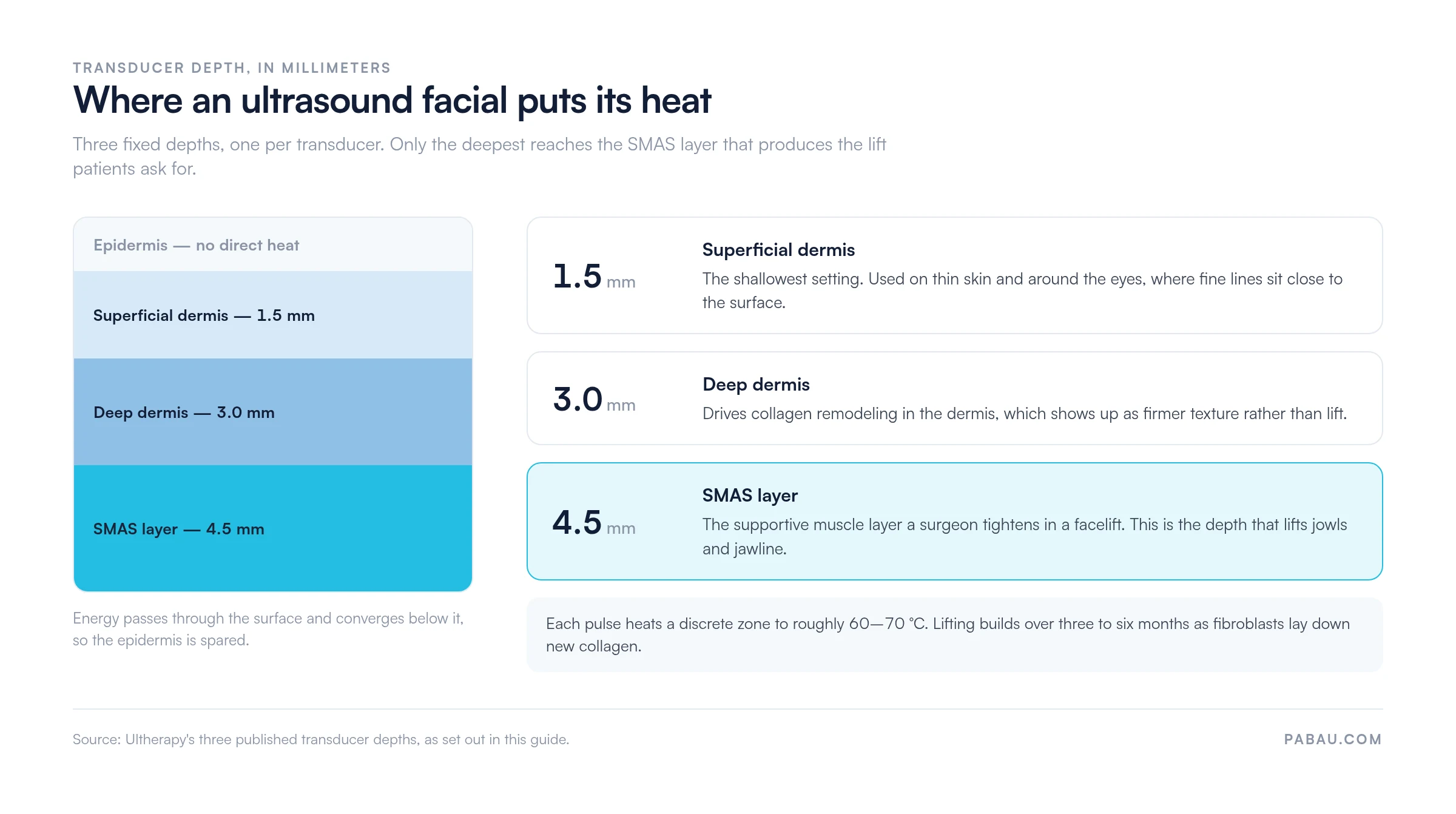
The energy reaches the SMAS layer because the transducer focuses it at a fixed depth, the way a magnifying glass concentrates sunlight.
The surface stays cool, and heat appears only where the beams converge. Each zone reaches roughly 60 to 70°C, which is hot enough to contract collagen on the spot.
Ultherapy runs three transducer depths, and the one you pick decides what the patient notices. The diagram below maps each depth to the layer it heats.
Every area with loose skin responds, but not at the same speed. The brow tends to move first, often inside six to twelve weeks, while the jawline keeps sharpening for six months. Name the area you are treating at consultation, and give the patient the timeline that goes with it.
Patients choose this treatment because they can go back to work the same afternoon. There is no general anesthetic, no dressing and no scar. The trade-off is scale. A tightening is what the device delivers, and heavy sagging still needs a surgeon.
Some patients should never be treated, and others need a conversation before you book them. Screen for both at consultation rather than on the day, because a deposit already taken makes the answer harder to hear. Write the answers on the form.
Absolute contraindications (do not treat):
Relative contraindications (discuss and document carefully):
The American Institute of Ultrasound in Medicine (AIUM) publishes a safety statement on cosmetic ultrasound. Cite it in your training file and your consent wording, so the position you are relying on is on record.
A consent form earns its place by proving the patient understood what they agreed to. Nine sections do that work. The one you leave out is usually the one a complaint turns on.
Medical history is the section most practices under-build. If you are starting from a blank page, a med spa consultation form gives you screening questions you can lift straight across.
The same section list works for other facial treatments. Our galvanic facial consent form carries the contraindication screen, the risk disclosure and the photo permission.
A written protocol keeps six practitioners delivering the same treatment. Walk the patient through it at consultation, so the day itself holds no surprises.
Hand the aftercare sheet over before the patient leaves, rather than emailing it that evening. If you do not have one yet, these HIFU aftercare instructions cover the same 24-hour window.
Promise a gradual change over three to six months, and no dramatic shift in the first two weeks. Patients who hear that at consultation rate the same result more highly than patients who were sold a lift by the weekend.
The timeline below is the one to read out:
Ultherapy carries the longer clinical record and the larger patient base. Sofwave is faster in the chair and, by most reports, more comfortable. Treatment volume and patient tolerance usually settle the decision.
Both devices are FDA-cleared for non-invasive lifting and tightening, so throughput and capital budget usually decide it. Medical spa software like Pabau tracks how often each handpiece is used and what it earns per hour. That second number is the one that answers the lease question.
Most practices run this workflow across three places. The signed consent form sits in a filing cabinet or a shared drive. The before-and-after photos live on somebody’s phone. The six-month recall depends on a person remembering.
Pabau keeps all three against the same patient record. You send the form before the appointment, the patient signs on their own phone, and the signed copy attaches itself to their file. Digital intake forms mean nobody is scanning paper at 7pm.
Photos work the same way. Before-and-after photo tools store each set against the treatment, so the six-month comparison takes two clicks instead of a hunt through a camera roll. Recalls then go out automatically at the interval you set.
That last part is where the repeat revenue on this treatment sits. A patient treated in March is due back the following spring. The system should be the one remembering that, not your front desk.

Pabau sends the ultrasound facial consent form before the appointment and files the signed copy against the patient. Every before-and-after set is stored with the treatment note. Six-month recalls then go out on their own.

The device does the easy part. Whether an ultrasound facial works for your practice is decided in the three months afterward. That is when the patient waits, and wonders whether it was worth the money.
So customize the form to your jurisdiction, put the timeline in writing, and photograph every case against the same background and the same light. Patients who can see the change at six months are the ones who rebook.
Keeping those three records together is where software earns its place. Book a demo to see how Pabau handles consent, photos and recalls for an ultrasound facial list.

Storing before-and-after photos properly? Before-and-after photos for med spas covers consent, storage and the rules on using treatment results in marketing.
Not sure where consent fits in your wider compliance file? Med spa compliance walks through the records an inspector asks for and how long to keep them.
Running other collagen-induction treatments? Skin needling consent form gives you a second template built on the same screening and risk-disclosure structure.
Most patients report brief heat and prickling as each line is delivered, strongest over the jaw and brow. It stops the moment the transducer lifts. Offer an over-the-counter painkiller beforehand, and drop the energy if a patient cannot hold still.
One session is the standard course. Some practices add a touch-up at six months for patients with heavier laxity. After that, plan a maintenance treatment every 12 to 18 months.
Yes, though most practices book them on separate days and record the interval in the notes. Ask about recent injectables during screening, since the treated area and the timing both affect your plan.
Patients with mild to moderate laxity and reasonable skin quality see the clearest change. Heavy sagging still needs surgery, and saying so at consultation prevents a refund conversation six months later.
That depends on where you practice. In the US the rules vary by state. In the UK they turn on qualification and on the device manufacturer’s training requirements. Check both before you add it to a menu.
See them in person, photograph the area, and write a dated note covering the settings used and the advice given. Most nerve irritation settles within weeks. A case that does not goes to your insurer and the device supplier.