Lip threading covers two different cosmetic treatments. Hair-removal threading pulls fine upper lip hair out with twisted cotton thread. A lip thread lift places dissolvable threads under the skin to lift and define the lips. This free template gives your practice one consent form for both, plus a pre-treatment screening checklist and aftercare instructions for patients to take home.
Download your free lip threading consent form template
A ready-to-use consent form covering patient details, contraindication screening, risk disclosures, consent declarations, and signature blocks for lip threading procedures.
Lip threading can mean hair-removal threading or a thread lift with biocompatible threads, so the consent form must state which one the patient is having.
Informed consent documents the method, the risks (infection, irritation, asymmetry), the contraindications, and realistic expectations about results.
Screen for absolute and relative contraindications before the appointment, and treat pregnancy as a reason to defer a thread lift.
Clear aftercare reduces complications, and thread lift results keep improving for 4-6 weeks as new collagen forms.
Practice management software like Pabau sends consent forms before the visit, stores signed copies, and automates aftercare reminders.
Found our content helpful?
What is lip threading?
Lip threading refers to two distinct cosmetic procedures: hair-removal threading and a thread lift. Hair-removal threading uses twisted cotton thread to remove fine upper lip hair.
A lip thread lift inserts biocompatible threads, typically polydioxanone (PDO) or poly-L-lactic acid (PLLA), beneath the skin for mechanical lift and collagen stimulation. Both are non-surgical. Threading is an alternative to waxing, and a thread lift is an alternative to dermal fillers.
Hair-removal threading: Twisted thread removes hair at the follicle. There’s no downtime, and results last 3-6 weeks.
Thread lift: A fine cannula or needle places dissolvable threads under the skin. Results show immediately, improve over 4-6 weeks as collagen forms, and last 12-18 months.
Hybrid approach: Some practitioners combine hair removal and a subtle lift in a single appointment.
What the consent form covers
The template gives you one document that covers the full consent conversation, from screening to signature. Each section maps to a step in your consultation, so nothing is left to memory.
Patient details: Name, date of birth, contact information, and the treatment date.
Contraindication screening: Questions on infection, medication, retinoid use, pregnancy, and scarring history.
Risk disclosures: Plain-language descriptions of the side effects the patient must understand before treatment.
Consent declarations: Statements the patient initials to confirm they understand the procedure, risks, and aftercare.
Signature blocks: Space for the patient and practitioner to sign and date the form.
How the procedure works, step by step
Your consent form should describe what the patient will feel and see on the day. These five steps give staff the language to answer procedural questions.
Consultation and marking: Assess lip anatomy and discuss goals. Mark the Cupid’s bow and lateral corners, and confirm the patient is comfortable with the planned lift or hair removal area.
Topical anesthetic: Apply numbing cream for 10-15 minutes to reduce discomfort. Some practitioners add ice or vibration for extra comfort.
Thread insertion (thread lift only): Insert biocompatible threads through a fine cannula or needle at a 30-45° angle. Place them toward the center of the lip and along the vermilion border. Depth is typically 3-5 mm below the skin surface.
Hair removal (threading only): Twist cotton thread into a loop and roll it across the upper lip. The thread catches each hair and lifts it out at the follicle.
Post-procedure soothing: Apply antibiotic ointment and a cooling mask. Go over aftercare and book a follow-up at 2 weeks.
Benefits to explain to patients
Patients choose between threading, waxing, and fillers based on comfort, downtime, and how long results last. These are the points to cover in the consultation.
Precision: Threading targets only unwanted hair, with less irritation than waxing on sensitive skin.
Longevity: Hair removal lasts 3-6 weeks. Thread lift results improve over 4-6 weeks and last up to 18 months.
Natural appearance: A thread lift gives subtle, gradual enhancement, without an “overdone” look when an experienced practitioner performs it.
Minimal downtime: There’s no surgery, general anesthesia, or incision, so patients return to normal activities the same day.
Skin-friendly: Threading doesn’t traumatize the skin the way waxing or laser can, so it suits sensitive or thin skin.
Collagen stimulation: Thread material triggers a mild inflammatory response that encourages collagen production and gradual improvement.
Risks, side effects and contraindications
Every risk below belongs on the consent form in plain language, and every contraindication belongs on the screening checklist. How strictly you apply each one depends on practitioner qualifications and local regulations.
Risk or side effect
Description
Mitigation
Swelling and redness
Mild inflammation lasting 24-48 hours that usually resolves with topical care.
Apply ice after treatment and recommend soothing aftercare products.
Bruising
Possible with a thread lift, rare with hair-removal threading.
Avoid NSAIDs before treatment where appropriate, and never stop anticoagulants without the prescriber’s advice. Book 5-7 days before any event.
Infection
Rare when proper hygiene and sterile technique are used.
Use sterilized instruments and apply antibiotic ointment. Watch for increasing warmth, pus, or fever.
Asymmetry
Uneven lift or hair removal if marking or insertion angle is inconsistent.
Mark both sides symmetrically, take before-and-after photos, and plan a follow-up adjustment if needed.
Dimpling or puckering
Possible if threads sit too superficially or the patient over-manipulates the area.
Use the correct insertion depth (3-5 mm). Tell the patient not to touch, press, or massage the area for 2 weeks.
Allergic reaction
Rare with FDA-cleared thread materials, but possible with topical anesthetic or aftercare products.
Take an allergy history before treatment and offer alternative topical products.
Pain and discomfort
Mild to moderate during the procedure, depending on pain tolerance and how well the topical anesthetic works.
Use an effective topical anesthetic, allow extra time, and advise on pain relief afterward.
Absolute contraindications (do not perform):
Active infection or inflammation in the treatment area.
Severe bleeding disorders or anticoagulant therapy (depending on practitioner qualifications).
Immunosuppression.
Relative contraindications (use caution and document counseling):
Recent retinoid use, which may increase skin sensitivity.
Active acne or cystic breakouts.
A history of keloids.
Thin or fragile skin.
Unrealistic expectations or reluctance to follow aftercare instructions.
Aftercare instructions to give patients
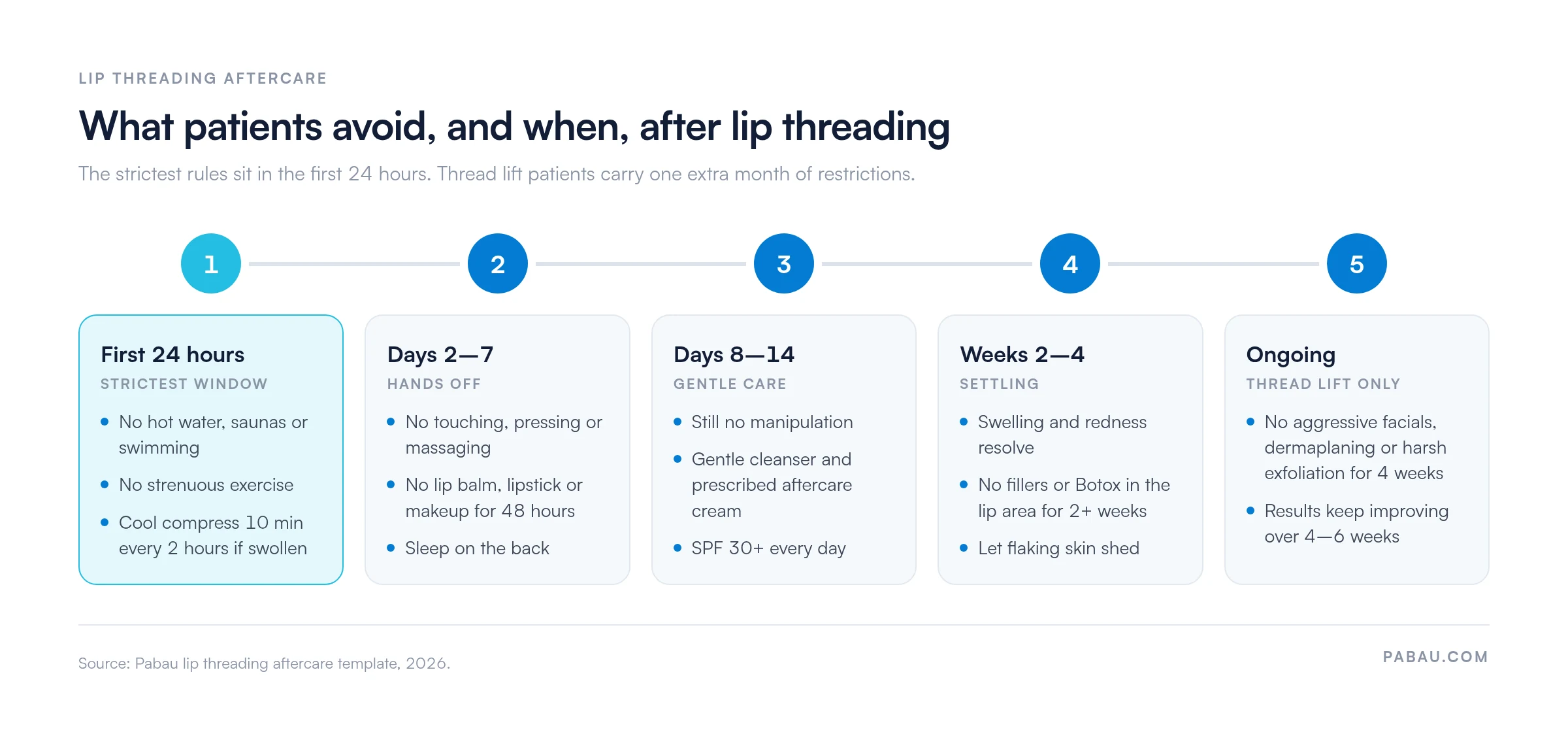
Clear aftercare reduces complications and follow-up calls. Deliver these instructions through the Client Portal or as a printed handout before the patient leaves the practice. The restrictions ease in five stages, and the strictest ones apply in the first 24 hours.
Aftercare restrictions ease in five stages, and thread lift patients carry an extra month of limits. Stages are taken from this template’s aftercare instructions.
First 24 hours: Avoid hot water, saunas, swimming, and strenuous exercise. Keep the lip area clean and dry. Apply ice or a cool compress for 10 minutes every 2 hours if swelling occurs.
Days 2-7: Don’t touch, press, squeeze, or massage the treated area. Avoid lip balms, lipstick, or makeup for 48 hours. Sleep on your back if possible to keep pressure off the lips.
Days 8-14: Keep avoiding manipulation. Use a gentle cleanser and apply the prescribed aftercare cream, typically an antibiotic ointment or soothing balm. Wear SPF 30+ sunscreen every day.
Weeks 2-4: Swelling and redness should resolve. Avoid fillers, Botox, or other cosmetic procedures in the lip area for at least 2 weeks. Let flaking skin shed naturally rather than picking at it.
Ongoing (thread lift): Avoid aggressive facial treatments, dermaplaning, or harsh exfoliation for 4 weeks. Results continue to improve over 4-6 weeks as collagen builds.
Pre-treatment screening checklist
Use this checklist during the consultation to identify contraindications and document informed consent before treatment.
Patient confirms no active lip infection, herpes, or cold sore.
Patient confirms no injectable treatments (fillers, Botox) in the lip area within the last 2 weeks.
Patient confirms no anticoagulant or antiplatelet medication, or the practitioner documents the exception.
Patient confirms no history of keloids or hypertrophic scarring.
Patient confirms no active retinoid use (tretinoin, adapalene, retinol), or has paused it for 5-7 days.
Patient confirms no pregnancy or breastfeeding (thread lift). Hair-removal threading is generally safe during pregnancy if the patient is comfortable.
Patient confirms realistic expectations about the results timeline, duration, and natural appearance.
Patient confirms they understand the aftercare requirements and agree to follow them.
Practitioner confirms appropriate qualifications and insurance coverage for the procedure type.
Practitioner confirms sterile instruments, FDA-cleared threads (if thread lift), and sterile technique will be used.
Lip threading vs waxing: What to tell patients
Patients ask this more than any other question. The table gives your team one consistent answer.
Factor
Lip threading
Waxing
Precision
High. Targets individual hairs and fine detail.
Moderate. It’s harder to avoid removing fine hairs outside the intended area.
Skin irritation
Minimal, with no heat or chemical irritant applied.
Higher, since heat and wax can irritate or damage sensitive skin.
Duration of results
3-6 weeks. Hair grows back fine, with no stubble.
3-6 weeks. Same duration, but regrowth can feel coarser at first.
Ideal for sensitive skin
Yes. The preferred option for thin, reactive, or rosacea-prone skin.
Not ideal, as it can worsen redness or rosacea.
Cost
Typically £8-15 per visit in the UK for professional threading.
Typically £5-12 per visit in the UK. At-home wax kits cost less.
At-home option
Possible but requires skill, so it’s not recommended for beginners.
Yes. At-home wax kits are widely available and easier to self-apply.
Thread lift enhancement
Can combine hair removal and a subtle lift in one appointment.
No lifting effect. Hair removal only.
How to use the template in your practice
Build the consent form and aftercare instructions into your workflow so every patient gets the same information at the same point. Medical spa software like Pabau can send both through digital intake forms and track who has signed.
Import and customize: Download the template and add your practice name, logo, and local regulatory references, such as CQC registration, practitioner qualifications, and insurance details. Match the wording to your jurisdiction, such as CQC requirements in England or FDA guidance on thread materials in the US.
Pre-appointment delivery: Send the consent form with the booking confirmation or through the Client Portal 2-3 days before the appointment. Ask patients to review it, note any questions, and initial each risk section.
In-appointment review: Go through the form verbally during the consultation. Answer questions, document any concerns or changes, and collect final signatures before treatment begins. A structured cosmetic consultation is the right moment to confirm realistic expectations and the outcome timeline.
Post-procedure delivery: Hand over printed aftercare instructions before the patient leaves, or send them through the Client Portal right after treatment. Highlight the 24-hour restrictions and follow-up contact details.
Follow-up communication: Use automated SMS or email reminders through Pabau’s email and SMS campaigns to reinforce aftercare on days 1, 7, and 14. Track acknowledgment and catch complications early.
Compliance audit: Keep a secure log of every signed consent form, and store scanned forms electronically for audits and insurance purposes. Make sure your storage method meets GDPR or HIPAA requirements, depending on where you practice.
Pro Tip
Before adding lip threading to your service menu, check that your practitioner qualifications meet local regulations. In England, whether you need CQC registration depends on who performs the treatment and what other services you offer. In the US, scope of practice varies by state and licensing body. Confirm your insurance covers the specific procedure, since hair-removal threading and thread lifts carry very different liability.
How Pabau automates threading consent and aftercare
Many practices still hand patients a paper consent form at the front desk. Staff then scan it, file it, and print aftercare sheets by hand. Forms go missing, and patients arrive with questions they could have asked earlier.
Pabau sends the consent form with the booking confirmation, so patients review and sign it before they arrive. Signed forms attach to the patient record automatically, and aftercare instructions go out by email or SMS once treatment ends.
The result is a shorter consultation, a complete audit trail for every treatment, and fewer aftercare calls in the two weeks after a thread lift.
Collect lip threading consent before patients arrive
Pabau sends your consent form ahead of the appointment, captures e-signatures, and delivers aftercare automatically. Every signed form is stored on the patient record, ready for audits.
Treat hair-removal threading and a thread lift as two separate consent conversations, even when one form covers both. The thread lift carries the longer risk list, the pregnancy deferral, and a month of aftercare restrictions.
Customize the template for your jurisdiction, run the screening checklist before the appointment, and send aftercare the moment treatment ends. That way the signed form matches what the patient was told, which is what protects you in an audit or complaint.
Book a demo to see how Pabau handles lip threading consent, reminders, and aftercare delivery in one place.
Lip threading is a minimally invasive cosmetic treatment for either hair removal or lip enhancement. Hair-removal threading uses twisted cotton thread to remove fine upper lip hair. A thread lift places biocompatible threads beneath the skin for subtle lift and volume.
Does lip threading hurt?
Most patients feel mild to moderate discomfort, depending on their pain tolerance and how well the topical anesthetic works. Numbing cream applied 10-15 minutes beforehand reduces discomfort significantly. Any soreness afterward is usually mild and resolves within 24-48 hours.
What side effects should patients expect?
Common side effects are temporary swelling, redness, and mild bruising, which usually resolve within 48 hours. Infection, asymmetry, and allergic reactions are rare when the practitioner uses sterile technique and appropriate materials. Following the aftercare instructions lowers the risk further.
How long do the results last?
Hair-removal threading lasts 3-6 weeks. Thread lift results show immediately and keep improving over 4-6 weeks as collagen builds. They last 12-18 months, depending on individual metabolism and the thread material.
How does threading compare with waxing?
Threading is more precise, causes less irritation, and can be combined with a subtle lift. Waxing is faster and cheaper but more likely to irritate sensitive skin. Both last 3-6 weeks. Threading suits sensitive or thin skin, while waxing suits at-home or budget-conscious patients.
Can patients have lip threading while pregnant?
Hair-removal threading is generally safe during pregnancy if the patient is comfortable, though many practitioners defer elective cosmetic procedures out of caution. Thread lifts are usually postponed until after pregnancy and breastfeeding because the thread material triggers an inflammatory response. Patients should check with their practitioner and healthcare provider.