Free model waiver form + what it is and when your practice needs one
A model waiver form is a signed document that lets a healthcare practice use a p...

6
Last Updated: Sep 29, 2026
A release of liability document is a signed form in which a patient accepts a treatment’s known risks. The patient also agrees not to sue the practice over complications from those risks. It works alongside informed consent rather than replacing it. It also can’t shield a practice from gross negligence or intentional harm.
Practices use it most for elective, cosmetic, and physical therapy treatments where outcomes vary. The free template below covers the clauses courts look for. This guide explains how to tailor it to each treatment and collect signatures before the visit.
A fill-in release covering practice and patient details, the treatment description, assumption of risk, indemnification and governing law clauses, and signature blocks. Tailor it to each treatment, then have your attorney review it before use.
Download template
A release of liability and an informed consent form do different legal jobs, so most elective and cosmetic treatments call for both.
An enforceable release names the specific treatment, states the assumed risks, includes an indemnification clause, and is signed voluntarily.
No release can waive liability for gross negligence, intentional harm, or violations of law, so have a healthcare attorney review yours.
Electronic signatures carry the same legal weight as wet signatures under the ESIGN Act in the US and eIDAS in the EU.
Practice management software like Pabau collects e-signed releases before the appointment and saves them to the patient record.
A release of liability document is a contract between a patient (the releasor) and a provider or practice (the releasee). The patient agrees not to bring legal claims against the releasee.
It covers injuries, complications, or unfavorable outcomes from a specific treatment. The patient acknowledges the risks involved and accepts them as a condition of receiving care.
It’s one of the foundational medical forms a practice collects at intake, alongside the medical history questionnaire and consent forms. These are the core terms you’ll see in any version:
Use a release of liability for any treatment that carries inherent risk, or where a rare complication could injure or disappoint the patient. The most common cases are:
Have patients sign a release specific to their treatment at intake, ideally before the appointment. They can then read and accept the risk disclosures at home, without time pressure on the day of treatment.
The two documents do different legal jobs, and most practices use them together. An informed consent form records that the patient was told about a treatment’s risks, benefits, and alternatives. A release of liability records that the patient gives up the right to sue over complications from those disclosed risks.
Pair this template with an adult medical consent form so each treatment file carries both signatures. Informed consent is the ethical baseline for care, and the release adds legal protection for the practice.
Some businesses combine both jobs in one form. A piercing consent and waiver sets out the risks of the procedure and the release language in the same document.
Courts look for specific elements before they enforce a release. A missing clause weakens it, while a complete template shows deliberate risk management. Include the following:
Store each executed release in your medical records management system. Your team can then pull it up in seconds if a dispute arises.
Yes, in most US states and UK jurisdictions, provided it meets specific legal requirements. Enforceability isn’t automatic. Courts check that the release was signed voluntarily, clearly written, and supported by consideration (an exchange of value). They also check that it doesn’t try to waive liability for gross negligence.
That last point is a hard limit in nearly all jurisdictions. A release can’t protect a provider against gross negligence, intentional harm, or violations of law. If a patient is injured through reckless disregard for safety, a signed release won’t shield the practice from a lawsuit. The panel below sets out which claims a release can bar and which it never can.
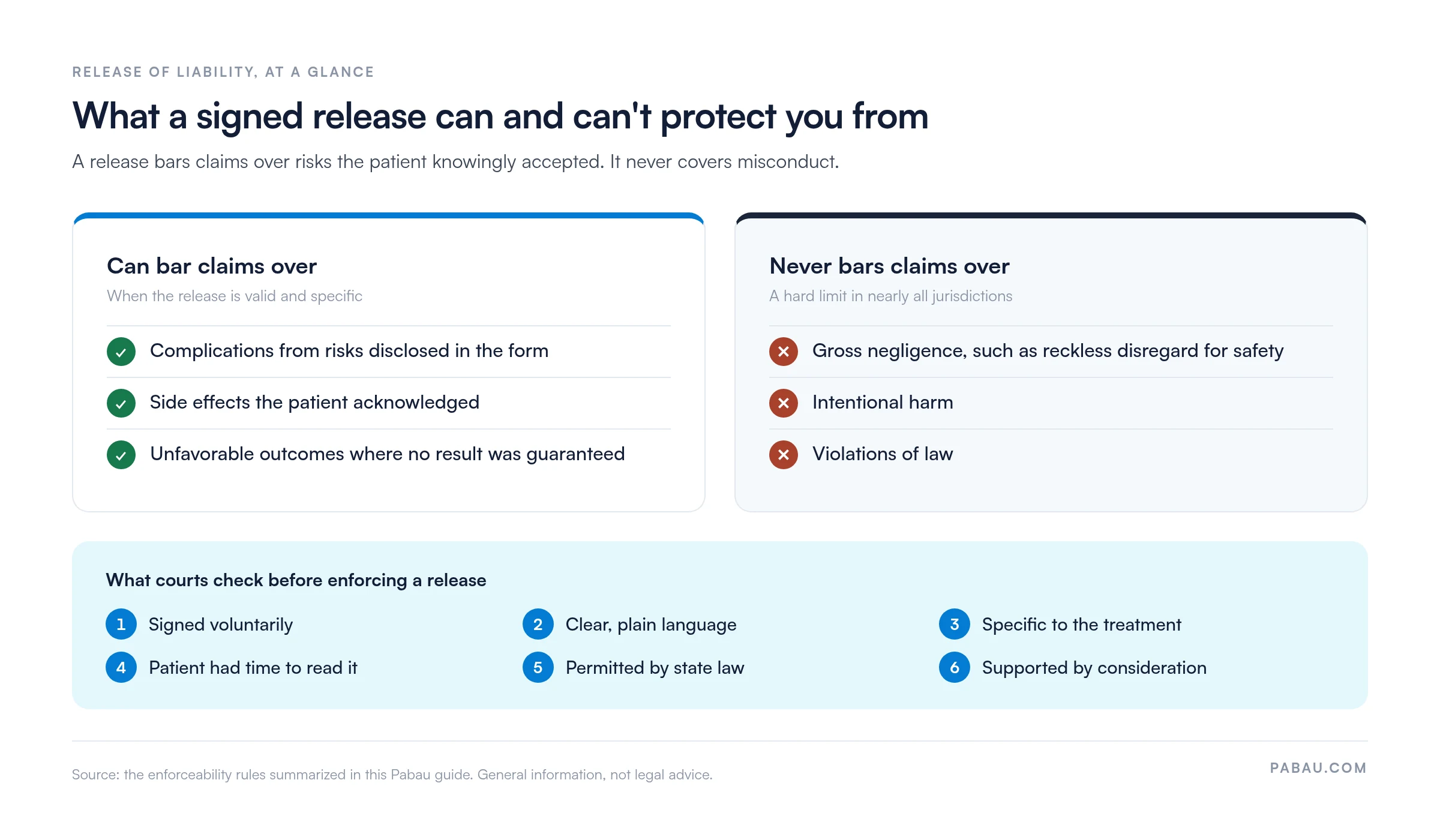
Courts typically test a release against these conditions:
Have a healthcare attorney in your jurisdiction review the template before you use it. A professionally reviewed form is inexpensive insurance against enforceability challenges later.
Electronic signatures on liability waivers are legally valid in the US under the ESIGN Act (15 U.S.C. § 7001) and across the EU under the eIDAS Regulation. A patient can sign a release digitally through DocuSign, Pabau’s digital forms, or a similar platform. That signature carries the same legal weight as a wet signature on paper.
With time-saving digital intake, patients complete and sign forms before they arrive, so nobody fills in paperwork in the waiting room. Signed documents land in the patient record with timestamps and an audit trail. For busy practices, that removes a daily round of scanning and filing.

The patient must intentionally agree to sign electronically, be able to access and keep the signed document, and consent to electronic delivery. Your e-signature platform should keep an audit trail showing who signed, when, and from which device or location.
The template is a starting point, not legal advice. Tailor it to your treatments, jurisdiction, and risk profile, then work through these five steps.
A HIPAA-covered practice needs a release of liability and a separate HIPAA privacy authorization, and patients must sign both. You’re covered if you accept insurance, bill Medicare or Medicaid, or transmit patient health information electronically.
A HIPAA authorization permits the practice to use and disclose a patient’s protected health information for specific purposes. Sharing treatment photos with a skin care brand, with the patient’s consent, is one example. A release of liability waives the patient’s right to sue over treatment-related complications.
Keep the two forms separate so patients understand each one’s purpose. A dedicated HIPAA authorization form handles the disclosure side. For the release itself:
Some patients ask a relative or caregiver to handle their records and insurance paperwork. Record that authority on an authorized representative form and file it with the release.
Many practices still print a release from a template site, have the patient sign it at the front desk, then scan and upload it. Staff end up chasing unsigned forms on treatment day, and the paper copy is hard to find when a dispute comes in.
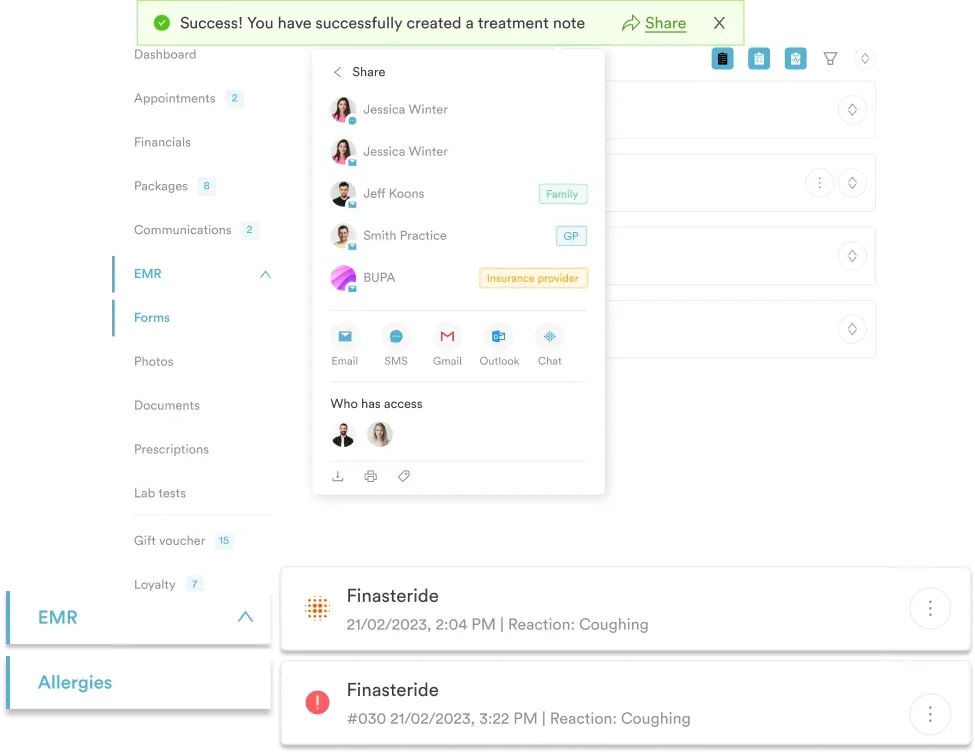
With Pabau, the release goes out automatically with the booking confirmation. The patient reads it at home and e-signs it alongside their medical history and consent forms. The signed copy is saved to their patient record with a timestamp. At check-in, staff can see which forms are complete, so no treatment starts without a signature on file.
Your front desk stops handing out clipboards, and a signed release is ready in seconds if a patient questions an outcome. Every Pabau subscription includes digital forms and e-signatures, so there’s no add-on to buy.

Pabau sends a treatment-specific release with each booking, captures the patient’s e-signature, and saves the signed copy to their record. Your team stops chasing paperwork on treatment day.

A release of liability earns its place when it’s specific. Write one version per treatment and name the risks in plain language. Then have an attorney check it against your state’s law before the first patient signs.
Treat it as one layer of protection rather than a shield. It won’t cover negligence, and it doesn’t replace informed consent or a HIPAA authorization. What it does is show a court that the patient knew the risks and chose to go ahead.
Getting it signed before the visit matters as much as the wording. Book a demo to see how Pabau collects and stores signed releases for every treatment you offer.

Photographing patients for before-and-after records? Photo release form separates clinical-record photo consent from marketing and social media use.
Patient declining a recommended treatment? Against medical advice form records the refusal formally so your file shows what was advised.
Treating patients under 18? Consent to treat minor form captures parent or guardian authorization and the scope of treatment allowed.
Need a parent to authorize records and treatment? Medical release form covers guardian treatment authorization and release of a child’s records.
It’s a legal contract in which a patient agrees not to sue a healthcare provider over complications from a specific treatment. The patient signs it after acknowledging and accepting that treatment’s known risks.
No. An informed consent form records that the patient was told about the risks and alternatives. A release of liability waives the patient’s right to sue over those risks. Practices often need both.
Only partly. A release covers complications from known, disclosed risks. It can’t protect against gross negligence, intentional harm, or violations of professional standards, so have an attorney review your form.
You may decline to provide the service. Record the refusal in the patient record and escalate it to your supervising physician or practice manager. Treating without a signed release increases your practice’s liability exposure.
Yes. Under the ESIGN Act in the US and the eIDAS Regulation in the EU, e-signed waivers are legally equivalent to wet signatures. That holds when the patient consented to sign electronically and the platform keeps an audit trail of who signed and when.
Not to draft it, since a template is an acceptable starting point. Having a healthcare attorney review and tailor it to your jurisdiction and risk profile is strongly recommended. A brief consultation is inexpensive.