Bear hug test: Procedure, interpretation and free template
The bear hug test is a quick shoulder special test that screens for subscapulari...

3
Last Updated: Oct 23, 2026

The hexagon agility test measures rapid directional changes, dynamic balance, and neuromuscular control using a 24-inch hexagonal course and three clockwise and counterclockwise revolutions.
A change greater than 1.015 seconds (95% confidence) indicates true improvement; this minimal detectable change threshold supports reliable clinical interpretation.
Normative data varies by age and gender, so compare athlete results against published benchmarks to interpret performance accurately.
Practice management software like Pabau helps sports medicine practices document, track, and compare hexagon agility test results over time for evidence-based progression planning.
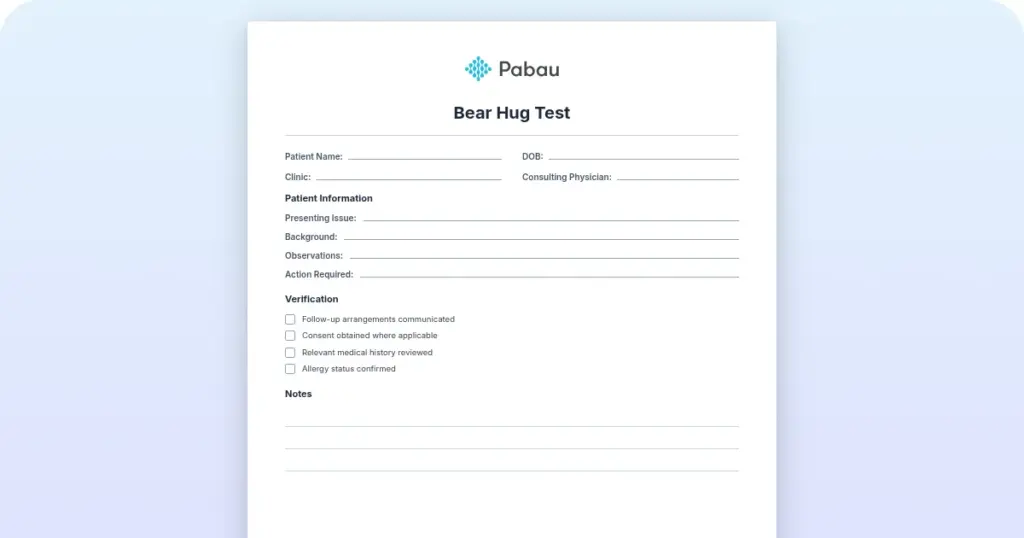
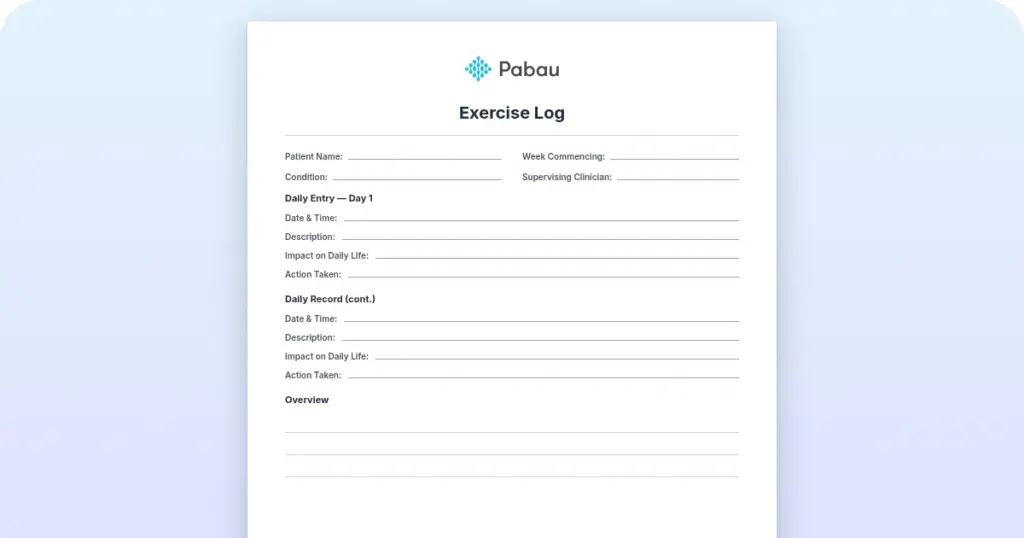
Hexagon Agility Test recording sheet
A standardized recording sheet and protocol guide for documenting athlete performance, with space for raw times, direction trials (clockwise and counterclockwise), and the best score for reliable baseline tracking.
Download templateThe hexagon agility test is one of the most reliable assessments for measuring an athlete’s ability to change direction rapidly while keeping balance and control. Unlike linear sprint tests, this protocol challenges multiple movement planes at once, a demand that translates directly to sport-specific performance.
Research supports the hexagon agility test across sports medicine, physical therapy, and athletic training, and reports its consistency: a minimal detectable change of 1.015 seconds at 95% confidence, which makes it useful for detecting true performance improvement in rehabilitation and training cycles.
This guide covers the complete protocol, how to score it, normative benchmarks, and a clinical interpretation framework, plus a printable recording sheet your practice can use right away.
The hexagon agility test is a standardized field assessment that measures multidirectional agility, dynamic balance, foot speed, and lower-body coordination. Agility is the skill-related fitness component it targets most directly. The athlete starts in the center of a hexagonal course (each side 24 inches / 60 cm, with 120-degree angles) and jumps over the boundary lines in rapid succession.
The test quantifies how quickly and accurately an athlete can execute directional changes, a core demand in soccer, tennis, basketball, lacrosse, and other court and field sports. It is also used in rehabilitation to assess neuromuscular control and readiness to return to sport.
Unlike unidirectional sprints, the hexagon test forces the athlete to decelerate, plant the foot, and accelerate in new directions within a confined space. That makes it sensitive to changes in proprioception, muscle activation patterns, and injury risk factors.
Sports medicine practitioners and physical therapists use the hexagon agility test for three main reasons:
The test also works well with digital assessment forms for consistent data capture across multiple athletes or repeated assessments over time.

Administering the hexagon agility test takes careful setup and a standardized protocol to keep results valid and reliable. These five steps mirror the format in the printable recording sheet:
When documenting athlete assessment results in your clinical system, record both trial times separately before determining the best score. This lets you identify directional asymmetries. An athlete who performs better counterclockwise, for example, may have subtle neuromuscular imbalances worth addressing.
Storing completed assessments in patient management software keeps every score searchable within the patient’s record.

Store hexagon agility test results, track progress, and compare to normative benchmarks, all in one integrated platform. Schedule a demo to see how sports medicine practices use Pabau to document, analyze, and present athlete performance data.

The hexagon agility test applies across a broad range of healthcare and sports settings. Sports medicine practices use it to evaluate athlete readiness, screen for injury risk, and document return-to-sport progression. Personal trainers and strength coaches use it to monitor conditioning during seasonal training cycles.
The test is equally valuable in occupational therapy and orthopedic settings where clients need to show dynamic balance before resuming occupational or recreational activities. It has also been validated in tennis players and other sport-specific populations, which makes it relevant to any practice serving competitive athletes.
Practical administration: The test needs only tape, a stopwatch, and 6-8 feet of floor space. Setup takes under 5 minutes and costs nothing, which makes it accessible to practices of all sizes, from solo practitioners to multi-location groups.
High reliability and validity: Published research reports strong test-retest reliability. A change greater than 1.015 seconds is needed to be 95% certain the change reflects true improvement rather than measurement error, and that precision lets clinicians confidently detect meaningful progress in rehabilitation and training.
Sport-specific relevance: Unlike general fitness tests, the hexagon agility test mimics the rapid multidirectional movements athletes perform in competition. That ecological validity means results correlate more strongly with on-field performance than single-plane sprints.
Objective documentation: Every test can be timed to 0.1 seconds and stored in a client record. That objective data helps keep athletes engaged by showing quantified progress over time and justifying progression to higher-intensity training.
Document athlete directional preference during warm-ups. If an athlete consistently performs better in one direction (clockwise versus counterclockwise), note the pattern. Over multiple sessions, watch for convergence: as neuromuscular balance improves, the directional difference should narrow, signaling better overall stability and reduced asymmetry risk.
Raw times mean little without context. Established published norms for the hexagon test, most commonly traced to Arnot (1984) and reproduced by resources such as BrianMac and TopEndSports, classify performance into five rating tiers by gender. The published sample is drawn from roughly 16- to 19-year-olds, and times across the excellent-to-poor tiers span roughly 11-22 seconds.
Males tend to post faster raw times than females at every rating tier. More important than absolute time, though, is the athlete’s improvement trajectory. An athlete who cuts their hexagon agility test time by 1.1 seconds over a 6-week rehabilitation cycle has made a clinically meaningful gain.
These benchmarks come from a published sample and individual results will vary, so use them as a reference point rather than an absolute standard, particularly for athletes well outside the late-teens age range they were normed on. What matters clinically is whether an athlete’s performance is moving in the right direction, which for this test means downward, as faster times indicate improvement.
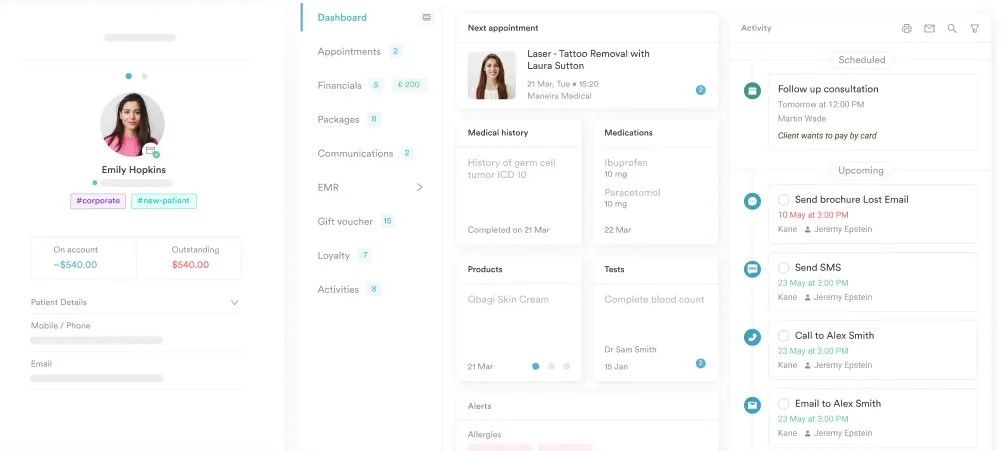
Store hexagon agility test baseline values and follow-up results in structured athlete client records so you can pull historical data and calculate change scores at a glance.
Sports practices often ask whether to use the hexagon agility test, the 505 test, the Illinois agility test, the T-test, or the pro agility shuttle. Each measures agility from a slightly different angle. The hexagon test emphasizes multidirectional changes in a confined space, the 505 test isolates a single 180-degree turn, the T-test captures forward, lateral, and backpedal movement, and the pro agility shuttle measures acceleration and deceleration across longer distances.
Choose the hexagon agility test when you want to assess rapid, complex directional changes, the kind that matter in soccer, basketball, racquet sports, and field sports. Its low cost and space efficiency make it ideal for practices with limited assessment areas. The test also pairs well with published tennis performance research, so if your practice serves competitive players, it has strong validity evidence.
When tracking athlete performance outcomes over time, consistency matters more than which single test you choose. Document which test you use, keep the same tester for future retests where possible, and hold baseline data for each athlete in one centralized system.
The hexagon agility test is a reliable, practical measure of multidirectional athletic ability that works across sports medicine, physical therapy, and athletic training. Its evidence base (validated reliability, published norms, a documented minimal detectable change) means you can confidently use it to measure rehabilitation progress and return-to-sport readiness.
The free recording sheet above gives you a printable protocol to use right away. To cut manual data entry and reduce no-show appointments for testing sessions, pair your hexagon agility testing program with a practice management system that stores results in athlete records, flags follow-up assessments, and shows progress graphs. Pabau helps sports medicine practices streamline exactly this kind of assessment tracking, so book a demo to see it in action.

Checking for carpal tunnel symptoms? Phalen’s test guide shows how to perform it and confirm results with nerve conduction studies.
What software integrates sports testing? Sports medicine platforms coordinate testing schedules, automate result entry, and flag athletes due for reassessment, which keeps follow-up intervals consistent.
Planning to open your own practice? Physical therapy business plan guide covers the financial model, payer mix, and operations plan lenders expect.
The hexagon agility test measures multidirectional agility, dynamic balance, and neuromuscular coordination by having athletes rapidly change direction around a 24-inch hexagonal course. Agility is the main skill-related fitness component it assesses.
Record the time for three clockwise revolutions and three counterclockwise revolutions, then take the faster (lower) of the two as the score. Lower times indicate better agility, and the gap between directions flags asymmetry.
An excellent score is under 11.2 seconds for males and under 12.2 seconds for females. Average performers typically fall between 13.4-15.5 seconds (male) and 15.4-18.5 seconds (female). Compare an athlete’s time against the rating table for their gender.
The test has strong test-retest reliability. A change greater than 1.015 seconds (95% confidence) indicates true improvement beyond measurement error.
The two directions reveal rotational asymmetries in leg strength and proprioception. Differences between trial times can identify neuromuscular imbalances worth targeting in training.
Yes. Record a baseline before injury, then retest during recovery. Reaching or exceeding baseline performance supports return-to-sport clearance decisions.
Each of the six sides measures 24 inches (about 60 cm), and the internal angles are 120 degrees. Mark it accurately with tape or chalk, because small variations in hexagon size affect comparability to published norms.
Time the three clockwise revolutions and the three counterclockwise revolutions separately, then record the faster (lower) of the two as the score. No calculator is needed, and recording each direction on its own also lets you spot left-right asymmetries.