Anja Dodevska
Exercise worksheet to download: What it is and what to record on the worksheet
An exercise worksheet is a structured document that records a patient’s ex...

1
Last Updated: Oct 27, 2026
Free PDF 1 page, print-ready Clinician-reviewed
The cervical rotation lateral flexion test is a passive screen for first rib hypomobility. You rotate the neck away from the side you are testing. Then you bring the head toward the opposite shoulder and watch what the movement does.
It is usually shortened to the CRLF test.
Plenty of sites quote sensitivity and specificity figures for this test. Those numbers do not exist in the literature. This guide covers the procedure, how to read the result, what the two relevant studies measured, and a free form for documenting it.
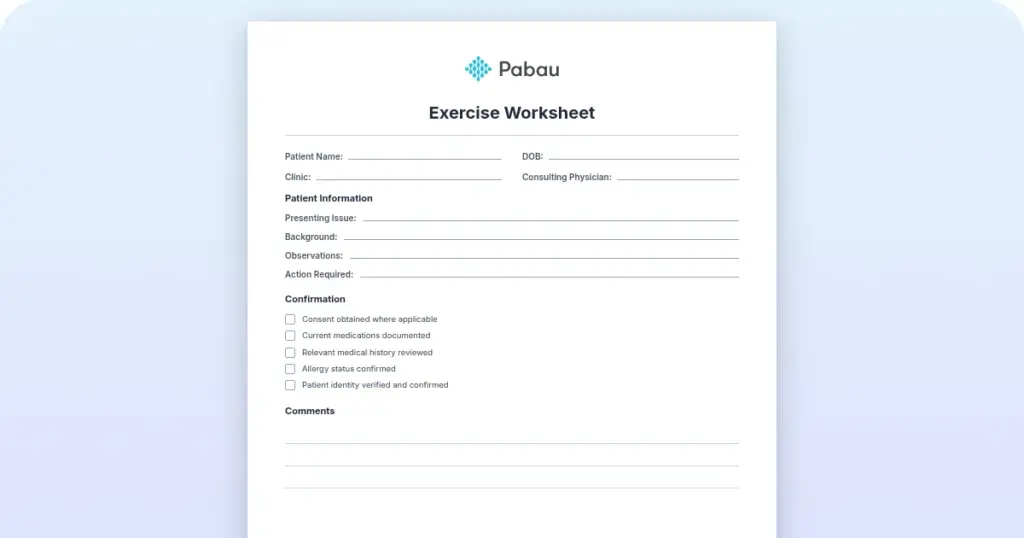
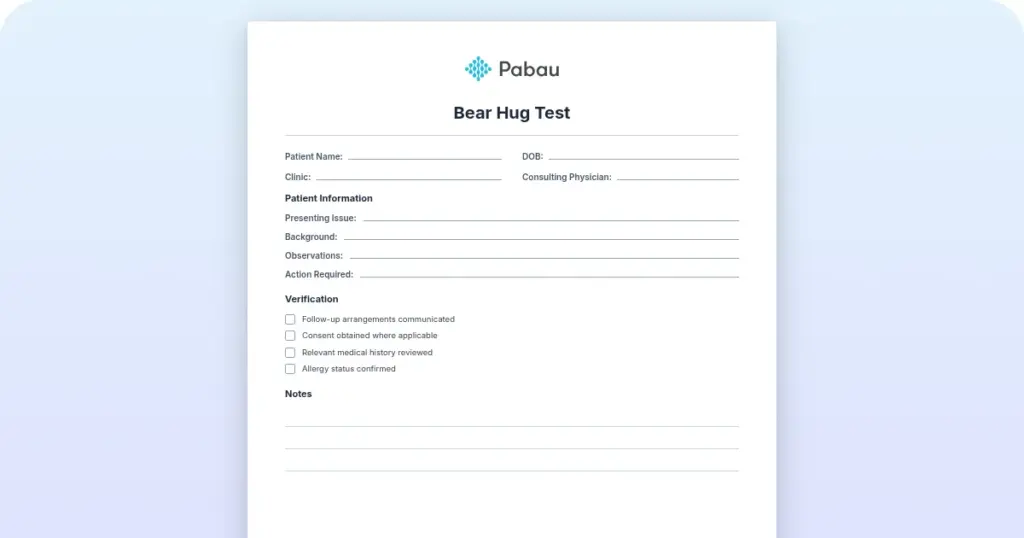
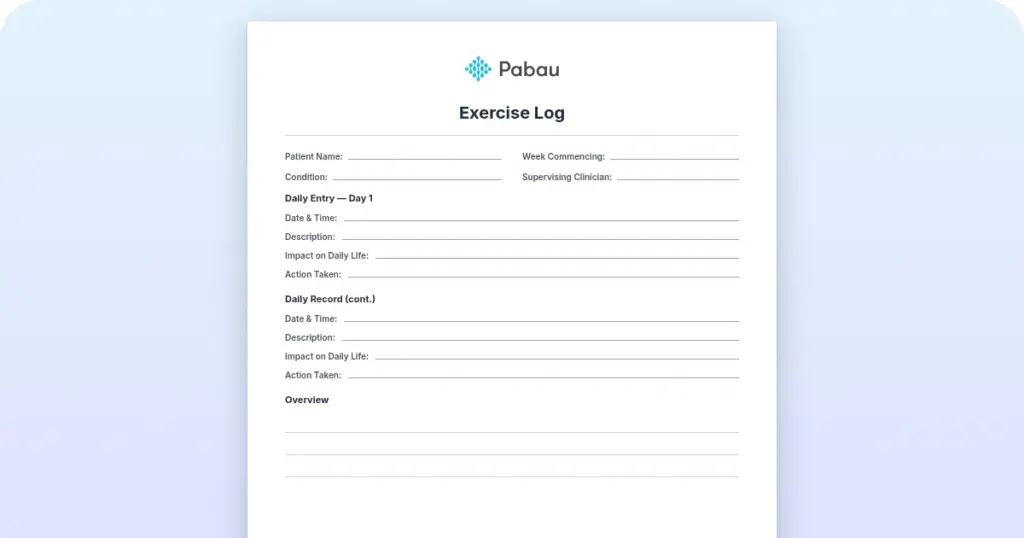
This CRLF test PDF gives you positioning prompts, side-by-side range-of-motion fields, end-feel and symptom boxes, and space for your interpretation and follow-up plan.
Start from scratch, or upload this PDF or any form you already use, and Pabau's AI Form rebuilds it with tick boxes, text fields and a signature. Attach it to the treatment once, and every patient gets it on time.
AI Form rebuilds the consent, history and aftercare forms you already use. You review each one, then publish.
Patients complete forms on their phone before they arrive, so the front desk stops retyping paper.
Every signed form is versioned and attached to the treatment record, ready when you need it.
Set how long a consent stays valid. Returning patients skip forms they have already signed.
Supports HIPAA and GDPR compliance AES-256 encryption 4.8 on G2 4.7 on Capterra Trusted by 4,000+ practices worldwide

The cervical rotation lateral flexion test (CRLF test) is a passive screen for first rib hypomobility in patients with neck or arm symptoms.
A positive test means lateral flexion toward the shoulder is restricted after full cervical rotation, usually alongside the patient’s familiar arm or neck pain.
No validated sensitivity or specificity figures exist for the CRLF test. Lindgren et al. (1992) established near-perfect agreement between examiners, which is reliability rather than diagnostic accuracy.
The only study to test CRLF accuracy directly (Koppenhaver et al. 2022) found it did not predict who benefited from first and second rib manipulation.
Practice management software like Pabau keeps positioning, range-of-motion figures, and reproduced symptoms in one structured note you can compare at follow-up.
The CRLF test is an orthopedic assessment that combines cervical rotation with passive lateral flexion to judge first rib mobility. A restricted result points to first rib hypomobility, meaning the rib is not gliding freely as the neck moves. That restriction is one possible contributor to thoracic outlet syndrome (TOS), brachialgia, or cervical radiculopathy. A rehab practice reporting outcomes to a payer needs consistent measures, not narrative summaries.
Isolated range-of-motion testing does not load the first rib in the same way. Rotating first takes the cervical spine to end range. The lateral flexion that follows has to come from the rib and the soft tissue around it. That is why the finding tells you something a plain lateral flexion measurement cannot.
Do not confuse it with the cervical flexion-rotation test (CFRT). The CFRT assesses upper cervical rotation at C1-C2 in patients with cervicogenic headache. Different structure, different question, different evidence base.
The craniocervical flexion test is a third test again, and it measures deep neck flexor endurance. Names this similar get mixed up often, and their numbers get swapped along with them. More on that further down the page.
Whatever the result, it needs to reach the patient record in a form the next clinician can use. Degrees, end-feel, and the exact symptom reproduced all matter later.
Practice management software like Pabau can capture them while the patient is still in the room. The downloadable form above gives you the same fields on paper.
Knowing what the test loads makes the result easier to read. The cervical spine has seven vertebrae, and each contributes some rotation and some lateral flexion. The brachial plexus, subclavian artery, and subclavian vein all run through the thoracic outlet. That space is narrow, bounded by the clavicle, the first rib, and the scalenes.
The first rib forms the floor of that space. It should elevate and glide as the neck moves. When it stops doing that, the neurovascular bundle above it has less room, and the patient may report arm pain, numbness, or weakness. That picture is what clinicians label thoracic outlet syndrome.
So the CRLF test asks a simple mechanical question. Can the first rib move while the cervical spine is already at end-range rotation? Restriction suggests it cannot, and familiar arm pain during the movement raises the chance that the thoracic outlet is involved.
Run the test with the patient seated or supine. Seated suits most practices, because it is easier to stabilize the shoulders and watch for compensation. These five steps keep the technique consistent between clinicians and between visits.
Always repeat the test on the other side. Asymmetry is more informative than a single measurement. The unaffected side gives you that patient’s own baseline to compare against.
Capturing both sides while the patient is still in front of you saves rework.

Clinical form capture tools let staff complete assessments like this on a tablet during the session itself.
Read the result from three things: how far lateral flexion travels, how it feels at the end, and whether the patient’s familiar symptoms return. A positive test does not diagnose thoracic outlet syndrome. It flags first rib hypomobility as a plausible contributor to what the patient is describing.
Resist reading more into a positive test than it can carry. TOS has neurogenic, arterial, and venous forms, and each presents differently. The CRLF test contributes one mechanical finding to a fuller cervical and upper extremity examination.
Only two studies matter here, and neither one gives you a sensitivity figure. Lindgren, Leino and Manninen (1992), writing in Archives of Physical Medicine and Rehabilitation, looked at whether two examiners reach the same CRLF result. They did, in all 23 patients, giving a kappa of 1.0.
The authors also checked their findings against cineradiography of first rib movement in a handful of those patients, and the results lined up. That is reliability plus a mechanical check. It is not diagnostic accuracy, and the study reports no sensitivity, specificity, or likelihood ratios at all.
Diagnostic performance was tested once, three decades later. Koppenhaver et al. (2022) examined 50 patients with neck pain, then treated all of them with first and second rib manipulation. The CRLF result did not predict who improved. Age and sex were more useful predictors than the test itself.
Where do the quoted numbers come from, then? They belong to a different test. The cervical flexion-rotation test has published figures around 91% sensitivity and 90% specificity for upper cervical dysfunction in cervicogenic headache. Similar initials, similar body region, and the values drift across into CRLF articles.
Once you know that, the numbers are easy to spot. A CRLF figure with no study attached, or one credited to Lindgren, has been borrowed from the CFRT literature. Quoting it in a note or a referral letter puts a claim in the record that no paper supports.
None of this makes the test useless. It is quick, it needs no equipment, and two clinicians will agree on the answer. Use it to describe mobility and reproduce symptoms. Then let the treatment response, rather than a borrowed statistic, tell you whether the first rib was the problem.
Arm and neck pain has several plausible sources, and more than one can be present at once. Work through the alternatives before you settle on thoracic outlet involvement.
The CRLF test earns its place inside a broader assessment. Combine it with the history, a neurological screen, imaging where indicated, and the response to your first few treatments.
Good documentation protects continuity of care, supports your reasoning, and holds up under insurance or medico-legal review. If your practice writes in SOAP note format, the test belongs in the objective section. Six elements cover it.
The downloadable form above captures all six in the same order, which makes handovers between clinicians much less work. Whoever sees the patient next can find the earlier figures without reading the whole file.
Record both sides every time, even when only one shoulder hurts. A right CRLF of 38 degrees means little on its own. Put it next to a left value of 43 degrees and you have an asymmetry you can re-measure at the next visit.
In most practices the CRLF result lands in a free-text note or on a paper chart. Degrees get written for one side only. End-feel gets skipped when the room is running late. Six weeks later, nobody can say whether the restriction improved.
Pabau replaces that with a form the clinician completes during the appointment. Fixed fields for left and right degrees, end-feel, and reproduced symptoms mean the same data is captured every time. Pabau Scribe can write the narrative part from what you said out loud while testing.
Because it all sits on one patient timeline, the reassessment starts with the earlier numbers already on screen. You can see 38 degrees become 42, and so can the patient. That comparison is also what a referral form needs, so writing one stops being a retyping job.
For practices with several clinicians, the win is consistency. Everyone documents the test the same way, whoever runs it. Audits, handovers, and insurance queries stop depending on one person’s note-taking habits.

Pabau helps physical therapy, chiropractic, and osteopathy practices capture assessment findings, manage patient records, and track outcomes from intake through discharge.

The CRLF test is worth keeping in your examination. It takes seconds, needs no equipment, and two trained clinicians will read it the same way. What it cannot give you is a diagnostic probability, because nobody has ever measured one for it.
So use it for what it does. Describe the mobility you found, record the symptom you reproduced, treat, and re-measure. Let the change between visits carry the clinical argument instead of a statistic borrowed from another test.
Download the free form above to standardize how your team records the test. If you would like to see how Pabau handles assessment forms, patient records, and outcome tracking in one place, book a demo.

Wondering how other special tests hold up to scrutiny? Passive lumbar extension test sets out the procedure and the accuracy figures behind it.
Assessing knee laxity in the same caseload? Reverse pivot shift test covers the technique, what a positive means, and how reliable it is.
Need a recording sheet for a passive knee test? Quadriceps active test gives you the positioning prompts and a printable form.
Grading muscle response in a neurological caseload? Tardieu Scale explains the grades and gives you a form for recording them.
The cervical rotation lateral flexion test is a passive orthopedic assessment of first rib mobility. You rotate the cervical spine away from the side being tested, then guide the head toward the opposite shoulder. Restricted movement suggests first rib hypomobility, which may contribute to thoracic outlet syndrome, brachialgia, or cervical radiculopathy.
A positive CRLF test points to first rib hypomobility, which is one possible contributor to thoracic outlet syndrome. TOS itself is a clinical syndrome with neurogenic, arterial, and venous forms. Confirming it needs the history, a neurological examination, and imaging such as CT angiography or MRA. The CRLF test screens, it does not diagnose.
No validated sensitivity or specificity figures exist for the CRLF test as a stand-alone screen. Lindgren et al. (1992) reported complete agreement between two examiners (kappa 1.0, n=23), corroborated against cineradiography, which is reliability rather than diagnostic accuracy. Koppenhaver et al. (2022, n=50) found the test did not predict who benefited from first and second rib manipulation. Figures near 91% sensitivity and 90% specificity belong to the cervical flexion-rotation test, a different test used for cervicogenic headache.
The CRLF test screens first rib mobility, combining cervical rotation with lateral flexion from that rotated position. The CFRT assesses upper cervical rotation at C1-C2 in patients with cervicogenic headache, using flexion followed by rotation. Different structures, different clinical questions, and separate evidence bases. Keep their accuracy figures apart as well.
Take a detailed history of the neck and arm symptoms. Then add other tests, such as the upper limb tension test, Adson’s maneuver, and a neurological screen. Consider imaging if TOS is suspected. First rib mobilization, scalene stretching, and postural work are common next steps. Refer on if symptoms are severe or neurologically progressive.
Yes. Seated is more common, because it is easier to stabilize the shoulders and spot trunk compensation. Supine works well if the patient is more comfortable lying down, and the procedure and interpretation stay the same. Either way, make sure the patient is relaxed and not guarding before you begin.