ICD-10 Code Y76.0: Diagnostic obstetric and gynecological devices
ICD-10 Code Y76.0: Definition and billable status ICD-10 Code Y76.0 is a valid, ...

Last Updated: Oct 23, 2026
Billable Code Specific Code
S52.033J is the billable ICD-10-CM code for displaced fracture of olecranon process with intraarticular extension of unspecified ulna, subsequent encounter for open fracture type IIIA, IIIB, or IIIC with delayed healing.
The description matches the FY2025 code set on the CMS code list, effective October 1, 2024. The olecranon is the bony point of the elbow, at the upper end of the ulna. Intraarticular extension means the fracture line runs into the elbow joint surface.
Pair that with a severe open wound and slow healing, and you get one of the most detail-hungry codes in the forearm range. Four separate facts have to line up. They are the site, the displacement, the Gustilo grade, and the healing status at this visit.
Two things trip coders up here. J gets read as nonunion, and the code gets filed under the radius. This page walks each character, then shows what the record must say before the claim goes out. Practice management software like Pabau builds claims management into the record, so orthopedic and physical therapy practices can flag missing detail before submission.
Let Pabau's smart automation suggest the right codes, reduce claim denials, and keep your practice compliant—effortlessly.
Automate repetitive tasks and focus on what matters most—your patients.
Reduce coding errors and ensure compliance with the latest regulations.
Clean claims, fewer denials, and faster reimbursements.
Powerful insights and reporting to help your practice thrive.
HIPAA compliant SOC 2 certified GDPR-compliant Trusted by 4,000+ clinics worldwide

ICD-10 code S52.033J reports a displaced fracture of the olecranon process with intraarticular extension of the unspecified ulna.
The injury sits in the ulna at the elbow, not the radius, so the code lives in the S52.0- block.
The 7th character J means a subsequent encounter for an open type IIIA, IIIB, or IIIC fracture with delayed healing.
J never means nonunion in the S52 family. Nonunion uses K, M, or N, depending on the wound grade.
S52.033 is the unspecified-side code. Document right or left and bill S52.031J or S52.032J instead wherever the record supports it.
Practice management software like Pabau links each fracture follow-up note to the claim, so encounter type and healing status reach billing intact.
The table below summarizes the administrative attributes of ICD-10 code S52.033J as recorded in the CDC/NCHS ICD-10-CM web tool.
Every character in a fracture code carries a specific clinical meaning. Misreading one character produces a different code, and often a denial. The AAPC ICD-10-CM code lookup is a useful reference for verifying each component.
One structural point explains most errors on this code. In the S52 range, the open or closed status of the wound lives entirely in the 7th character. The 6th character carries displacement and laterality instead.
So a coder cannot look at S52.033 alone and tell whether the fracture was open. That answer only appears once the extension is attached.
The 7th character extension is required on every fracture code in ICD-10-CM. In the S52 range it does triple duty. It records the encounter type, the wound status, and the healing outcome, all in one letter.
Per ICD-10-CM Official Guidelines Section I.C.19, the character must reflect the stage of care at this visit, not the original injury date. The same encounter logic runs across the injury chapter.
Read the table in columns and the logic falls out. The letters run in threes, and each triple covers one healing outcome. Within a triple, the first letter is closed, the second is open type I or II, and the third is type IIIA to IIIC.
J is the third letter of the delayed-healing triple, which is why it belongs to the severe wound grades. That also settles the most common misreading of this code. J never means nonunion in the S52 family.
Nonunion is K for a closed fracture, M for open type I or II, and N for open type IIIA to IIIC. If the record says the bone has stopped healing on a type III open fracture, the code is S52.033N.
Keep a one-line crib sheet on the billing screen. The letters run ABC for initial, DEF for routine healing, GHJ for delayed healing, KMN for nonunion, PQR for malunion, and S for sequela. Within each group, the first letter is closed, the second is open type I or II, and the third is type IIIA to IIIC.
Delayed healing means the fracture is still healing, but slower than expected for the injury and the patient. Callus formation is present yet sparse on imaging, and the fracture line is still visible past the point where it should have faded. Healing is slow, not stalled. That is what separates the J extension from nonunion.
Nonunion, by contrast, means healing has arrested altogether. There is no bridging callus, and the fracture edges may look sclerotic. The site stays painful or unstable, typically past four to six months.
The clinical difference decides the 7th character, so N replaces J once healing has stopped. Other forearm codes follow the same rule.
Factors that slow healing in an open, intraarticular olecranon fracture include:
The note supporting S52.033J needs a statement that healing is behind schedule, ideally tied to imaging. Something as plain as “X-ray at 14 weeks shows minimal callus and a persistent fracture line” does the job. That habit is part of writing safer clinical notes, and without the line the claim is exposed at audit.
The olecranon is the hook-shaped end of the ulna that forms the point of the elbow. It articulates with the trochlea of the humerus, and the triceps tendon inserts on its tip.
A blow to the flexed elbow or a fall directly onto it is the usual mechanism. Because the bone sits under thin skin, olecranon fractures open through the wound far more often than fractures buried in muscle.
Intraarticular extension means the fracture crosses the articular surface of the semilunar notch. That changes both the clinical stakes and the code. An articular fracture threatens elbow congruity and long-term motion, so it earns its own 5th character. ICD-10-CM splits olecranon fractures into S52.02- without joint extension and S52.03- with it.
The same split carries through to later encounters. A nondisplaced, closed right-ulna nonunion without joint extension is reported with ICD-10 code S52.024K.
Displacement matters too. The triceps pulls the proximal fragment away from the shaft, so a displaced olecranon fracture rarely reduces itself. Surgeons usually fix these with tension-band wiring or a plate. Sports medicine software and orthopedic systems with structured coding support help clinicians capture displacement and joint involvement at the point of care. Revenue cycle management treats coding, submission and collection as one process rather than three handoffs.
ICD-10-CM uses the Gustilo-Anderson classification to grade open fracture severity. Gustilo and Anderson published the system in 1976, and trauma orthopedics has used it ever since.
For S52.033J, the graded wound has to fall in the type III band. The table below maps each grade to the 7th character you would use at a subsequent encounter with delayed healing.
S52.033J is only correct when the original wound was graded IIIA, IIIB, or IIIC. Delayed healing on a type I or II open wound takes H instead, and a closed fracture takes G as its extension. The table never touches the 6th character, because in S52 codes the extension carries the wound grade alone.
The S52.033 family spans every encounter type and healing outcome, and the neighboring codes change the site or the side. Picking the wrong one is the most frequent source of claim edits in fracture coding. Review the comparison below before you assign, and cross-check every description against the current CMS code list. A medical coding cheat sheet with CPT, ICD-10-CM, and HCPCS ranges makes that code lookup faster.
S52.033J does not say which arm was injured. The 6th character 3 is the unspecified-ulna option, sitting alongside 1 for right and 2 for left. That makes this code a legitimate billable choice and a documentation warning at the same time.
ICD-10-CM offers an unspecified-side code for cases where the record genuinely does not establish laterality. That happens with transferred trauma patients or incomplete outside records. It is not meant as a default.
A subsequent encounter is the weakest possible excuse for not knowing the side. The patient is sitting in front of the clinician with a healing elbow. Most injury codes force the choice anyway.
The rule is simple. If the note, the imaging report, or the original operative record names a side, bill S52.031J or S52.032J.
Reserve S52.033J for the rare encounter where nothing in the chart establishes laterality. Many payers apply extra scrutiny to unspecified codes, and repeated use on follow-up visits is the kind of pattern that draws a records request.
ICD-10 code S52.033J is a diagnosis code, not a procedure code. Whatever happens at the visit is reported separately in CPT.
Which fee schedule pays also depends on the code type. CPT services reported with S52.033J price from the Medicare Physician Fee Schedule. HCPCS Level II supply codes do not, and HCPCS code V2305 prices from the DMEPOS fee schedule under a CMS-enrolled supplier number.
Most subsequent encounters for delayed healing are evaluation and imaging visits rather than surgery.
Two cautions on this table. CPT codes in the 255xx and 256xx ranges cover radial shaft and distal radius fracture treatment, so they do not belong with an olecranon diagnosis. Billing a nonunion repair alongside a delayed-healing diagnosis is a contradiction a payer will notice. Always confirm the descriptor against the operative report before pairing.
Wound care can add codes of its own. Repeat debridement of the fracture site is 11012.
ICD-10-CM Official Guidelines Section I.C.20 does not make external cause reporting mandatory. There is no national requirement, and the guideline draws no line between inpatient and outpatient claims. Reporting becomes mandatory only where a state law, a payer contract, or another external agency requires it.
The guidelines still encourage external cause codes on every injury claim, because they document how the injury happened. Capturing the mechanism in intake and follow-up templates keeps the detail available at every encounter.
S52.033J is a highly specific code, and every element of its description has to be supported in the record. Physical therapy practices already work this way in staged rehab plans such as return to running protocols.
Miss any one of these and the code is only partly supported. Accurate patient record management that ties the original injury documentation to every follow-up note is the foundation of defensible fracture coding.
Audit your open fracture follow-ups once a quarter. Check four things in each note. Look for the original Gustilo grade, laterality, displacement with joint involvement, and the current healing status. All four have to appear before a J-suffix code will survive payer review.
Clinicians rarely write the code descriptor word for word. The terms below are accepted clinical synonyms for the diagnosis behind S52.033J. Recognizing them in a note helps the right code reach the claim.
When you review a note, look for imaging language about the pace of healing. Phrases such as “sparse bridging callus” or “union progressing slowly” support the delayed-healing extension. Phrases such as “no callus” or “sclerotic margins” point at nonunion, which moves the code to S52.033N.
Fracture codes with 7th character extensions generate some of the highest denial rates in orthopedic billing, and S52.033J is no exception. These are the error patterns that produce denials on this code, plus the documentation checks that catch them.
Errors on codes like S52.033J usually start in the handoff between the clinical note and the billing screen. The Gustilo grade sits in an operative report from four months ago. The healing status sits in today’s X-ray comment. A coder working from a summary sees neither, so the extension becomes a guess.
Pabau keeps the whole episode in one patient record. A clinician finishes the follow-up note, and the encounter type, imaging findings, and treatment plan land on the billing screen without anyone retyping them. The original injury note stays one click away, so the wound grade and the side are there when the coder needs them.
That means fewer claims going out with an unspecified-side code the chart could have resolved. It also means fewer denials from a mismatch between the diagnosis and the procedure.
The same setup runs across specialties, which matters for practices juggling a wide ICD-10-CM code set. Every subscription includes every feature, so this is not something a smaller practice has to upgrade into.
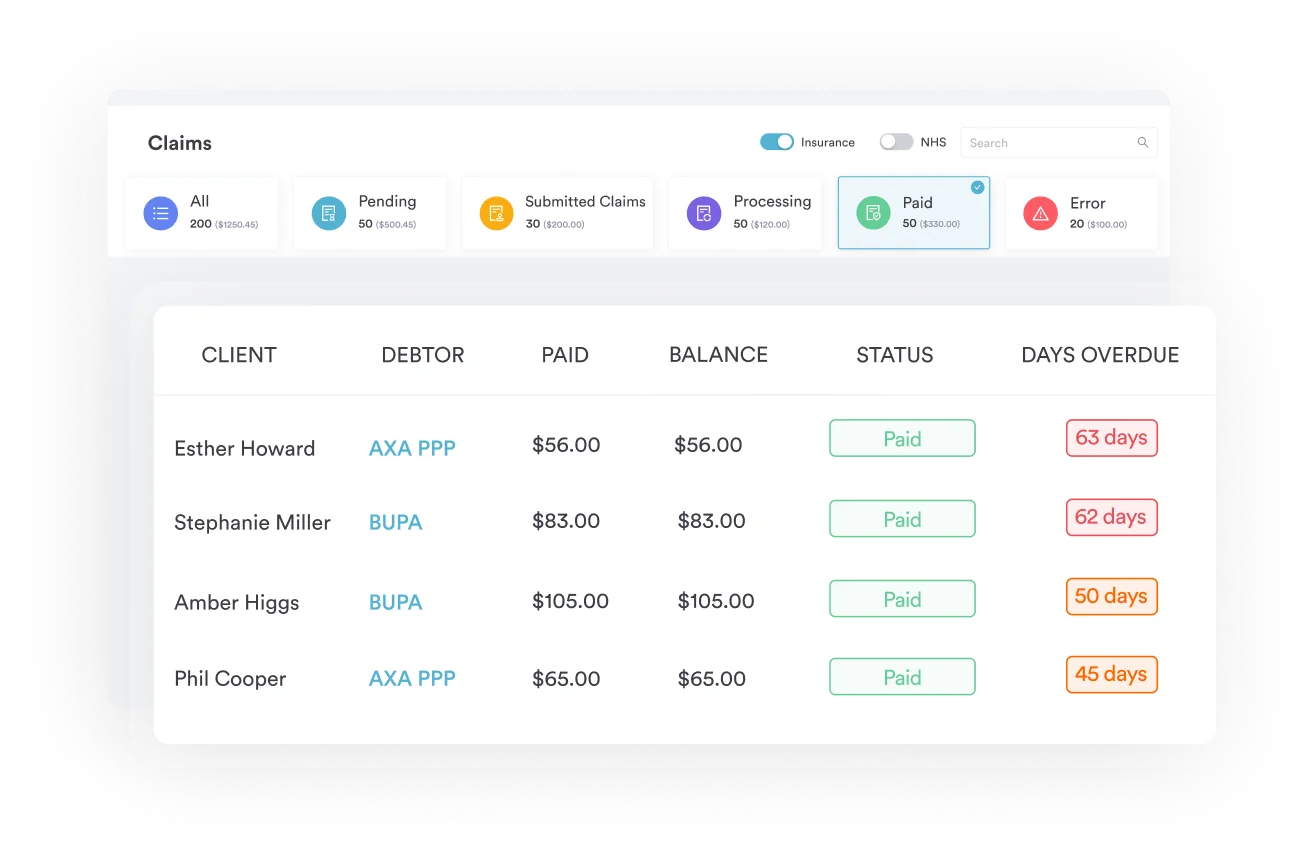

Pabau helps orthopedic and physical therapy practices track encounter sequences, manage clinical documentation, and submit cleaner claims. See how structured follow-up workflows keep 7th character coding accurate.

S52.033J describes one narrow clinical picture. The fracture is displaced, runs into the elbow joint, came through a severe open wound, and is still healing slowly. Get the bone right and the letter right, and the rest follows. It is the ulna, not the radius, and J means delayed healing rather than nonunion.
The unspecified side is the last thing to check. If the chart names right or left anywhere, S52.031J or S52.032J is the better claim. Reaching for the unspecified code out of habit is what draws payer attention.
Fracture coding fails at the seams between encounters, rarely inside any single note. Fix the handoff and the 7th character stops being a guess. Book a demo to see how Pabau keeps fracture documentation and claims in step across a multi-provider practice.

Working the same injury chapter at an initial visit? S41.021A shows how the 7th character A works on an open wound code, side included.
Coding another subsequent encounter? S37.893D applies the same subsequent-encounter logic outside the fracture chapters.
Billing wound care on a type III open fracture? 15005 covers the add-on for preparing a wound bed before coverage.
Following a joint injury into long-term degeneration? M17.5 covers secondary osteoarthritis once the original trauma has healed.
Billing a larger adjacent tissue transfer? CPT code 14021 covers adjacent tissue transfer on the scalp, arms, or legs for defects of 10.1 to 30.0 square centimeters.
S52.033J is a billable diagnosis code for a displaced fracture of the olecranon process with intraarticular extension of the unspecified ulna. It is reported at a subsequent encounter, where the fracture was open Gustilo type IIIA, IIIB, or IIIC and healing is delayed. Five elements must be documented: the olecranon site, joint extension, displacement, the type III open wound, and delayed healing at this visit.
No. J means delayed healing, which is slow but continuing union. Nonunion has its own letters in the S52 family. A closed fracture uses K, an open type I or II fracture uses M, and N covers a type IIIA to IIIC wound. If imaging shows healing has stopped on a type III open olecranon fracture, the correct code is S52.033N.
It is an ulna fracture. The olecranon process is the point of the elbow at the upper end of the ulna. S52.033J sits in the S52.0- block, which covers fractures of the upper end of the ulna. Fractures of the radial head and neck belong to the S52.1- block instead, so mixing the two puts the wrong bone on the claim.
Neither. The 6th character 3 marks the ulna as unspecified. Use S52.031J for the right ulna and S52.032J for the left. Reserve S52.033J for encounters where nothing in the chart establishes laterality, since payers apply extra scrutiny to unspecified codes on follow-up visits.
It means the fracture line crosses the articular surface of the elbow joint rather than stopping short of it. That threatens joint congruity and long-term elbow motion, so ICD-10-CM gives it a separate 5th character. Olecranon fractures with joint extension are coded in S52.03-, and those without it in S52.02-.
Reporting is encouraged rather than required. ICD-10-CM guidelines ask for external cause codes on injury claims, but they become mandatory only where a state law or a payer says so. The code reports the mechanism of injury, such as a fall onto the elbow. Keep the same code across every encounter in the episode of care.
Most delayed-healing encounters are evaluation visits, so 99213 or 99214 with elbow imaging such as 73080 is the common pairing. Surgical work on the olecranon uses 24685, and repeat wound debridement uses 11012. Avoid the 255xx and 256xx codes, which cover radial shaft and distal radius treatment. Confirm every descriptor against the operative report before pairing it with this diagnosis.
Yes. S52.033J is a complete seven-character code and is valid for HIPAA-covered transactions. Its parent, S52.033, is not billable on its own because every fracture code in this range needs a 7th character extension. The description here matches the FY2025 code set, effective October 1, 2024.