Nursing narrative note template
A nursing narrative note template is a structured PDF that guides you through re...

3
Last Updated: Oct 21, 2026

The Herth Hope Index (HHI) is a 12-item self-report scale measuring hope across three clinical dimensions in patients with chronic and life-threatening illnesses.
Scores range from 12-48, with higher scores indicating greater levels of hope. Cronbach’s alpha consistently exceeds 0.80 across patient populations, showing strong reliability.
The HHI is validated in oncology, palliative care, nursing, and chronic illness settings. Administering it via practice management software like Pabau streamlines outcome tracking across visits.
Pabau’s client record and Pabau Scribe, our AI scribe, support standardized assessment workflows, helping clinicians document hope outcomes and track change over time.
A standardized 12-item questionnaire measuring hope across temporality and future, positive readiness and expectancy, and interconnectedness. Complete it in 5 to 10 minutes and use it directly in a mental health or palliative care intake.
Download templateA patient’s chart can show stable vitals and clean labs while their sense of hope for the future quietly falls apart. That shift is easy to miss. It often surfaces later as a missed appointment, a stalled recovery, or a patient who stops following the treatment plan.
The Herth Hope Index (HHI) gives clinicians a fast, standardized way to catch that change before it costs a patient their momentum. Developed in 1992 by nurse researcher Kaye Herth, this 12-item self-report questionnaire is validated across oncology, palliative care, nursing, and chronic illness settings.
Most patients complete it in under 10 minutes. Use it at a first oncology visit, a routine mental health check-in, or in ongoing research, any time you need an objective read on coping.
The Herth Hope Index is a 12-item self-report psychological assessment instrument measuring hope as a multidimensional construct.
Hope, in this context, refers to a person’s sense of agency, optimism, and sense of future possibility. It is not passive wishing, but active readiness to navigate adversity. The HHI captures these dimensions through brief statements rated on a 4-point Likert scale (1 = strongly disagree, 4 = strongly agree).
Kaye Herth, a nurse researcher, developed the instrument in 1992 to solve a specific problem in clinical outcome measurement. Clinicians needed a way to quantify hope that they could track and act on, and the HHI became that tool.
It is now used across mental health, oncology, nursing, physical therapy, and palliative care to establish baseline hope levels and monitor change during treatment. Clinicians also use it to identify patients who may benefit from hope-focused interventions.
Why does hope matter clinically? Decades of research show that hope predicts better treatment adherence, improved coping, reduced anxiety and depression, and even physical recovery outcomes in chronic illness. By making hope measurable, the HHI transforms it from an abstract concept into a tangible clinical outcome you can track and optimize.
The instrument is designed for both individual clinical use and research settings. It requires no special training to administer and takes most patients 5-10 minutes to complete.
Clinicians across disciplines, including nurses, therapists, physicians, counselors, and social workers.
Administering the Herth Hope Index follows a straightforward five-step workflow. Whether you use paper, a PDF. Here’s the clinical protocol:
The HHI is not a diagnostic tool. It is a measurement of a clinical resource, hope, that complements diagnosis. A patient with depression may have a low HHI score; treating the depression often lifts hope, which you can quantify.
Over time, practitioners learn to recognize which patients respond to which hope-building interventions by watching their HHI scores move in response to clinical actions.
The HHI is validated and widely used across multiple healthcare disciplines and clinical populations:
Any practice managing patient compliance and adherence in chronic illness or mental health will find the HHI useful. It’s a practical, evidence-based addition to standard assessment.
Occupational therapists often score assessments like this directly inside occupational therapy software, keeping results attached to the treatment plan.
Track HHI scores longitudinally on a simple line graph in the patient’s record. Patients and clinicians both find visual representation powerful. Seeing your hope score rise week-to-week after starting a new intervention creates psychological reinforcement and strengthens the therapeutic alliance. Serial administration every 2-4 weeks is typical in most clinical settings.
The Herth Hope Index measures hope across three interconnected psychological dimensions. Understanding these subscales helps you interpret which aspects of your patient’s hope are strong and which may need support.
This subscale captures the patient’s sense of time perspective and future orientation. Sample items: “I can see possibilities in my future” and “I believe that each day has potential.”
Patients with high temporality scores feel that the future still holds possibility even if they face illness. Low scores suggest hopelessness about the future – a sense that time stretches empty ahead.
This subscale is often first to drop in newly diagnosed cancer patients or those facing end-of-life care. It’s also typically first to recover with effective treatment or existential counseling.
This subscale reflects an active sense of agency and positive expectancy. Sample items: “I am confident about my ability to make a difference” and “I feel a sense of control over what happens to me.”
High scores indicate patients who believe they can influence outcomes and take action; low scores suggest learned helplessness or passive resignation. In rehabilitation and chronic pain settings, gains on this subscale often precede functional recovery, since the patient becomes active in their own care.
This subscale taps the patient’s sense of connection to others and spiritual or existential meaning. Sample items: “I can draw strength from my spiritual beliefs” and “My relationships give me support and strength.”
Patients with high interconnectedness feel embedded in relationships and meaning; those scoring low may feel isolated or spiritually disconnected. This subscale often strengthens when clinicians facilitate peer support groups, family involvement.
In clinical practice, you might find a patient with high temporality but low interconnectedness – they see a future but feel alone in facing it. Or high interconnectedness with low readiness – they feel supported but passive. The subscale profile guides targeted intervention.
Scoring the HHI is straightforward arithmetic, but precision matters for clinical validity. A scoring error undermines the entire measurement.
Sum all 12 item responses to get the total score. Each item is rated 1-4, so the total ranges from 12 (minimum hope) to 48 (maximum hope), with higher scores indicating greater hope. Items 3 and 6 are negatively worded, so reverse-score them before adding them in.
For each: a rating of 1 becomes 4, 2 becomes 3, 3 becomes 2, and 4 becomes 1.
There is no official, universally agreed cutoff score for the HHI. Kaye Herth’s original validation did not publish clinical bands, so treat any single score as one data point to read in context, not a diagnosis.
A higher total means more hope, and a lower total means less. The sensitivity and specificity section below covers the one study-specific threshold that appears in the published literature.
Temporality & Future: Add items 1 + 2 + 6 + 11 (range 4-16). Positive Readiness & Expectancy: Add items 4 + 7 + 10 + 12 (range 4-16). Interconnectedness: Add items 3 + 5 + 8 + 9 (range 4-16). Each subscale follows the same 1-4 rating scale.
Document all three subscale scores alongside the total in the patient record. Subscale profiles are clinically useful.
For example, a patient might score 35 overall but show low temporality with high interconnectedness. That pattern suggests future planning or goal-setting may help more than adding social support.
Raw scores alone are not enough. Interpret the score in context: how does it compare to the patient’s own baseline, and to the clinical picture you’re seeing? Because the HHI has no official norms, trends over time matter more than any single score.
A score of 28 in a newly diagnosed cancer patient may simply reflect the shock of a new diagnosis. The same score in a patient 18 months into stable remission is a different signal. It suggests psychological adaptation is lagging behind medical progress, a sign for targeted intervention. Serial scoring reveals the trajectory, showing whether hope is improving, declining, or holding steady.
Use the HHI score to anchor clinical conversations. Instead of asking vaguely “How are you coping?”, you can say: “Your hope score dropped from 36 to 28 since last month. I notice you’re less confident about the future. What’s changed? What would help?”
This specificity deepens assessment and guides treatment planning.
The Herth Hope Index has been extensively validated across populations and settings. Understanding its psychometric strength tells you it is safe to rely on in clinical practice and research.
Cronbach’s alpha for the total scale ranges from 0.82-0.88 across studies, indicating strong internal consistency. Subscale alphas range 0.70-0.82, also acceptable. This means the 12 items hang together as a coherent construct. If a patient scores high on one hope item, they are likely to score high on others.
When patients re-take the HHI over short intervals, for example two weeks with no clinical intervention, scores correlate strongly (r = 0.87-0.95). This shows the instrument is stable and not just capturing random noise. This stability validates serial administration. Changes in HHI scores reflect meaningful clinical change rather than measurement error.
The HHI correlates as expected with related constructs, such as optimism, resilience, and life satisfaction. It also correlates inversely with depression and anxiety, which fits what the scale is designed to measure.
A systematic review published in PubMed Central in 2020 found that construct validity was inconsistent across cultures. The reported factor structure ranged from one to three factors depending on the population studied. Check the psychometrics of a translated version before assuming it behaves like the English original.
Studies show the HHI correlates with depression, anxiety, and hopelessness measures, though there is no single validated diagnostic cutoff for the scale.
The most cited figure comes from one validation study in Greek cancer patients. That study found a cutoff of 34.5 on the HHI. It distinguished minimal-to-mild hopelessness from moderate-to-severe hopelessness on the Beck Hopelessness Scale, with 78% sensitivity and 87% specificity.
That threshold is specific to one study and population, so treat it as a reference point, not a diagnostic rule. Always confirm mood or safety concerns through a dedicated depression or suicide-risk screening tool.
Successful HHI administration hinges on creating a safe, structured environment where patients feel their honest answers matter.
Use the HHI as part of a structured assessment during routine appointments, not as an afterthought. If you’re using EMR integration for assessments, set a standing order. For example, every new mental health patient completes the HHI at intake, and existing patients repeat it every 12 weeks.
Say: “I’d like to understand how you’re seeing your future and your sense of hope right now. I’m going to read 12 statements, and you tell me whether you strongly disagree, disagree, agree, or strongly agree with each one. There are no right or wrong answers – I just need to hear your honest view.” This framing normalizes the topic and removes judgment.
You can administer the HHI in three ways, and the right choice depends on the patient in front of you.
Clinician-administered works best for patients with low literacy, visual impairment, or cognitive impairment. For routine practice, a digital form saves time, cuts scoring errors, and feeds the result straight into the patient record without a second data-entry step.
The Herth Hope Index is available in 25+ language versions including English, Spanish, French, German, Italian, Portuguese, Chinese, Japanese, Korean, Arabic, and more. If you serve multilingual patients, translated versions maintain psychometric validity while respecting cultural and linguistic context.
The instrument is managed through ePROVIDE and Mapi Research Trust, the official licensing and distribution body. Use and distribution are governed by a modest fee structure. For clinical use within a single practice, costs are minimal. For large-scale research or commercial use, licensing fees apply. Always verify current licensing terms on the Mapi website before implementing the HHI at scale.
Approval takes time, and that paperwork has to clear before a single licensed HHI form reaches a patient. A free vibrational emotional scale worksheet needs no such agreement, so it can open a conversation about mood and outlook in the meantime.
The 12-item version is the standard. A 6-item short form exists for rapid screening but is less commonly used in clinical practice. Stick with the 12-item version unless space or time constraints are absolute.
The Adult Hope Scale (AHS), developed by Rick Snyder, is another widely used hope instrument. Both the HHI and AHS measure hope, but they differ in structure, target population, and clinical application. Understanding these differences helps you choose the right tool for your setting.
In practice: If you’re working with cancer, palliative care, or serious mental illness patients, the HHI is the more appropriate tool. Its existential framing – spirituality, meaning, interconnectedness – resonates with patients facing life-threatening conditions. For workplace wellness or student counseling, the Adult Hope Scale’s goal-focused lens is better matched. Some practices use both: AHS during wellness screening, HHI when facing crisis.
When a patient’s Herth Hope Index score drops significantly, resist the urge to dismiss it as “just how they feel that day”. A sudden drop is worth exploring, not ignoring. Schedule a follow-up conversation within days, not weeks, and ask what has changed and what support would help. Let that conversation, not the score alone, decide whether your usual risk-assessment protocols apply.
Many practices still hand patients a paper HHI, then re-key the score into the chart later, if anyone remembers to. That extra step is where trend tracking breaks down. Once the paper form gets filed, nobody goes back to compare this month’s score with last month’s.
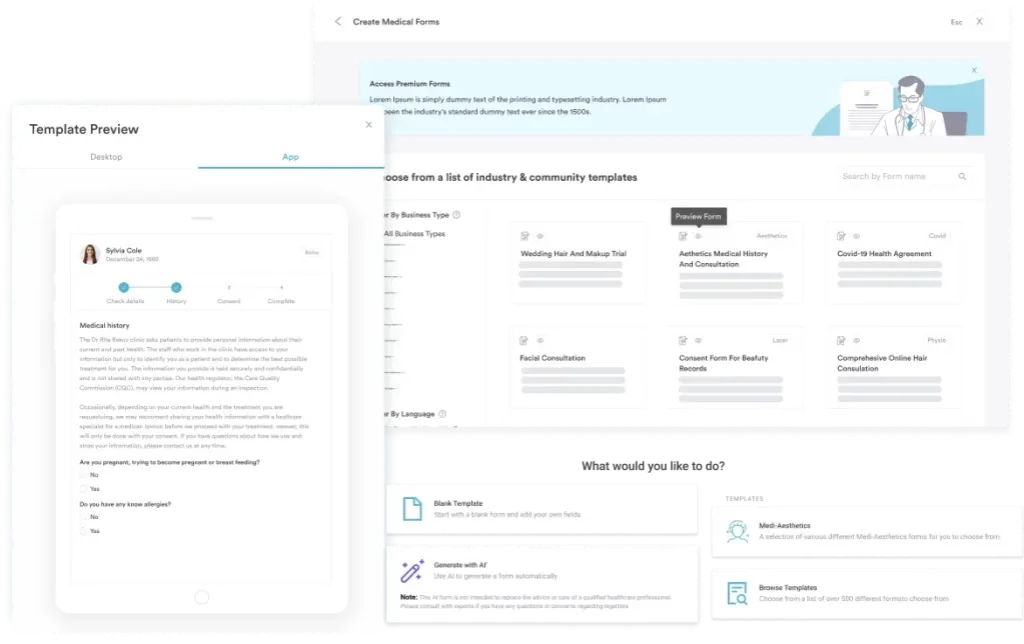
Pabau’s digital forms let a patient complete the HHI on a tablet or through the patient portal before their visit. Responses are auto-scored and saved straight into their record. The subscale breakdown sits next to every past result, so you can see the trend without digging through old notes.
That visibility is what makes serial administration worth doing. A clinician glancing at a client’s file before a follow-up can spot a score sliding for three visits running. That’s a cue to raise it in the conversation instead of discovering the pattern by accident. A therapy practice running weekly sessions accumulates history faster than a paper file can carry.

Pabau’s digital forms and client record log every HHI score automatically. You can see a patient’s trend at a glance instead of digging through paper files. This keeps outcome data consistent across your whole team.

Hope tracks with treatment adherence, psychological adjustment, and recovery in chronic and life-threatening illness, which makes it worth measuring like any other clinical marker. The Herth Hope Index turns that signal into a number you can watch move over time. That beats a vague impression you have to guess at. A dropping score is your cue to act before a patient disengages, and a rising one confirms your plan is working.
Build the HHI into your intake and follow-up protocols instead of treating it as a one-off form. The trend line will tell you more than any single score ever could. Book a demo to see how Pabau’s digital forms and outcome tracking make standardized, routine assessment easier to sustain.

Want to see other validated psychological assessment tools in action? Dark core personality test walks through a different standardized scale used to flag risky personality traits early.
Client anxiety rooted in not knowing what’s next? Intolerance of Uncertainty Scale scores patient responses to uncertainty, with cut-offs for anxiety screening and progress monitoring.
Found a patient who needs a hope-focused intervention? Distress tolerance skills worksheet hands them concrete DBT techniques to build coping capacity.
Working with a patient whose anxiety is dragging their hope score down? Interoceptive exposure worksheet offers a structured way to work through anxiety-driven avoidance.
Want another simple wellbeing exercise? Kindness worksheet offers 10 guided acts of kindness and a closing reflection for clients.
The HHI’s validation studies focus on adult patients, so its norms don’t automatically apply to children or teenagers. Choose an instrument developed and validated for that age group instead.
The HHI has no dedicated billing code of its own. Most practices fold its administration into the visit’s evaluation and management code rather than billing it as a standalone service.
Yes. Send the digital form ahead of the appointment so the patient fills it out from home, then open the visit by discussing the score together. This keeps tracking consistent for patients who split care between in-person and virtual visits.
Not on its own. A low score flags reduced hope, not a psychiatric emergency. If you have safety concerns, use a dedicated depression or suicide-risk screening tool alongside the HHI rather than relying on this score alone.
No certification is required. Any clinician or trained staff member can administer it once they understand the scoring rules. The important part is applying a consistent process at every visit, not mastering a proprietary technique.
The HHI is copyrighted, and Mapi Research Trust manages its licensing. Reword or shorten the items yourself and you lose the psychometric evidence behind the scale, so stick to the exact wording.