Mental health self-care checklist
A mental health self-care checklist is a structured daily tool for tracking the ...

5
Last Updated: Oct 20, 2026

The vibrational emotional scale ranks 22 emotions by frequency, from joy at position 1 down to despair and powerlessness at position 22.
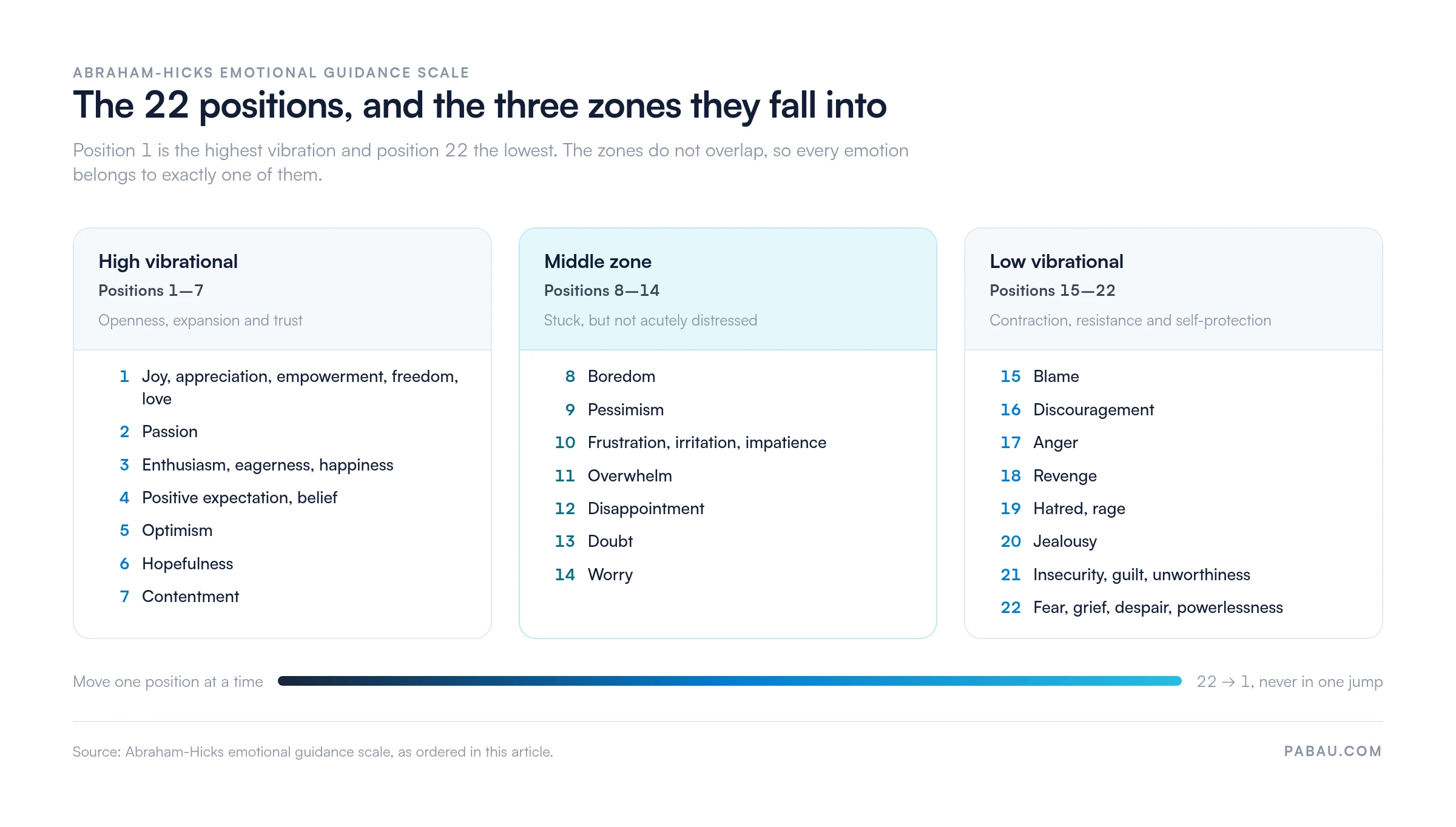
Positions 1 to 7 are high vibrational, positions 8 to 14 sit in the middle zone, and positions 15 to 22 are low vibrational.
Nobody skips a stage. Moving up the scale means one adjacent step at a time, helped by reframing, journaling, or breathwork.
Pabau’s digital forms and client portal let your practice send this worksheet daily and file every response in the client’s record.
A ready-to-use worksheet for daily emotional tracking across all 22 positions of the scale. It includes a check-in log, a frequency finder, shift techniques, and journaling prompts matched to each zone.
Download templateThe vibrational emotional scale is a 22-position ranking of emotions, from joy at the top to despair at the bottom. Its value in session is precision. A client who can name their position can also name the next one up.
Coaches, therapists, and wellness practitioners use it to replace the sad-or-happy question with something a client can act on. The worksheet above turns that into a daily habit. You log a position, pick one technique, then log where you landed.
Below you will find all 22 positions in order, the three zones they fall into, and a prompt for each one. The final sections cover the admin side of managing a therapy practice, from sending the worksheet to reviewing months of responses.
The vibrational emotional scale, created by Abraham-Hicks, ranks emotional states from the highest vibrational frequency to the lowest. Joy, appreciation, empowerment, freedom, and love sit at the top. Fear, grief, despair, and powerlessness sit at the bottom. Twenty-two distinct positions run between those two extremes.
The premise is that every emotion carries its own frequency, and that the frequency shapes how you experience what happens to you. High frequencies such as joy, gratitude, and love line up with resilience and wellbeing. Low ones such as fear, anger, and guilt line up with stress and resistance.
For practitioners, the scale works as both a diagnostic and an intervention tool. Asking a client whether they feel sad or happy rarely captures where they are. The scale gives them a position to point at, and psychology practice software can hold that position alongside the session note.
The Abraham-Hicks emotional guidance scale sets the order below. Knowing it matters, because it tells a client which shift is realistic from where they are standing.
One detail surprises most people. Anger ranks higher than fear or despair. A client stuck in powerlessness can find more agency by moving into anger, because resistance still assumes change is possible. From anger, the climb toward steadier emotions opens up. Skip that step and the shift rarely holds.
The zones do not overlap. Each of the 22 positions belongs to exactly one of them, which is what makes the scale usable in a session.
The middle zone runs from position 8 to position 14, boredom through worry. Clients here feel stuck without being acutely distressed. That makes it the hardest zone to leave, because there is little pain pushing them to change.
Regular check-ins are what get clients moving again. A weekly review of logged positions shows movement they cannot feel day to day. The map below shows which zone each position falls into.
A second framework maps consciousness rather than day-to-day feeling. David R. Hawkins set it out in “Power vs. Force”, ranking states from 1 to 1,000. It serves a similar purpose to the Abraham-Hicks scale, but the structure and the thinking behind it differ.
For daily emotional wellness work, the Abraham-Hicks scale is the more practical of the two. It names granular states a client recognizes. The Hawkins scale is broader and more philosophical, which suits long-term development rather than a weekly check-in. Plenty of practitioners use both, one for sessions and one for patterns.
The common mistake is trying to jump. A shift from despair straight to joy fails, because the nervous system has nothing to hold on to. Incremental movement is what makes the scale work.
Clients who skip steps often slide back down, because the nervous system never finished integrating the last one. Reviewing a month of logged positions tells you who sustains a shift. It also shows who needs more support at one particular point on the scale.
Match the prompt to the position, not to where you want the client to end up. Starting too high is what makes a prompt fall flat.
The download above is built for daily use. This is the routine that gets the most out of it.
For practitioners, medical records management keeps every returned sheet in the client’s file, so a month of positions sits next to the session notes. If you want a shorter daily version, the emotional check-in worksheet covers mood and four written prompts on one page.
Most practices hand out a worksheet on paper and hope it comes back. The client fills in three days, loses the sheet, and the next session opens with “how have you been?” all over again. None of that leaves a record you can review.
Practice management software like Pabau changes the delivery. The worksheet goes out as a digital form on a schedule you set, and the client completes it in the client portal on their phone. Their answers land in their record, not in a folder on your desk.
From there, automated workflows send the daily reminder and chase the responses that never arrive. You can also flag a client whose logged positions have not moved in three weeks. Session time goes on reading the pattern instead of rebuilding it.
The outcome is a client who can see months of their own movement, and a practitioner who can point straight at it. That is a far stronger case for carrying on than any single session gives you.
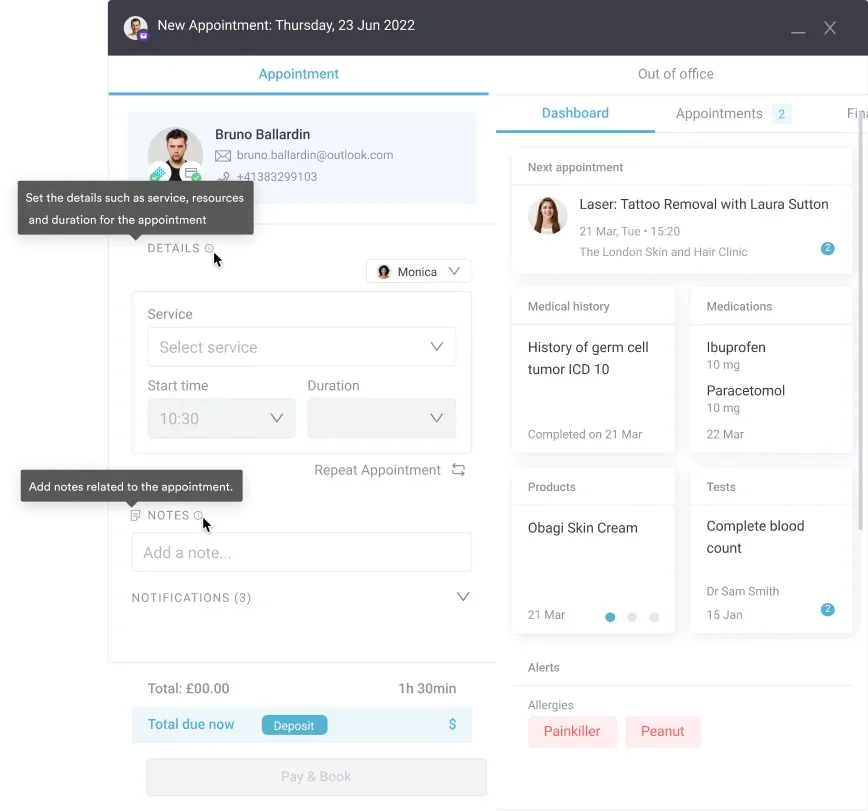

Pabau’s digital forms and client portal deliver this worksheet on a schedule and file every response in the client’s record. Reminders chase the clients who forget, so your session starts with the pattern already in front of you.

The scale earns its place by being small. One position, one technique, one honest answer about where a client actually sits. That is a much lower bar than “think positive”, and it is why clients keep doing it.
Print the worksheet and use it yourself for a week before you hand it to a client. You will learn quickly which prompts feel forced and which ones land. That is worth more than any explanation of the framework.
The trade-off worth remembering is that tracking only helps if the sheets come back. Book a demo to see how Pabau sends this worksheet on a schedule and keeps every response with the client’s notes.

Want a shorter daily version? Emotional check-in worksheet puts a mood checklist and four written prompts on a single page.
Clients who cannot name the feeling? Emotion wheel worksheet gives them precise language for a vague feeling.
Tracking mood over weeks? Daily mood chart template plots the pattern that a single check-in cannot show.
Need something for the lowest positions? Grounding techniques worksheet gives clients sensory options when fear or despair has them frozen.
Building a regulation plan? Emotional regulation checklist turns the techniques above into a routine you can review in session.
The vibrational emotional scale is a 22-position ranking of emotional states, created by Abraham-Hicks. Position 1 is the highest vibration, covering joy, love, and appreciation. Position 22 is the lowest, covering fear, despair, and powerlessness. You use it to find where you are, then move up one step at a time.
Emotional frequency is a metaphor, not a measured phenomenon like sound or light. It describes how different emotional states affect your nervous system, your perception, and your outlook. The scale is useful because its order matches how people experience moving from one state to another.
Your nervous system integrates gradual shifts better than sudden jumps. Going from despair straight to joy usually backfires, because the shift never settles and the client slides back down. Moving through adjacent positions lets each one stabilize before the next.
Anger carries resistance and agency, a sense that something can still change. Fear and despair are passive and immobilizing. Clinically, anger works as a stepping stone. From there a client can reach blame, doubt, worry, and eventually steadier emotions. Fear offers no such route without support.
The Abraham-Hicks scale maps 22 everyday emotional states, which suits a real-time check-in. The Hawkins scale maps consciousness across 1,000 points, which suits long-term patterns of development and resilience. Many practitioners use both, one for sessions and one for the bigger picture.
You can use it on your own for self-awareness and tracking. Working with a coach, therapist, or counselor adds more, because they can spot which techniques suit your nervous system. They also catch patterns you would miss alone.