TLC diet food list
The TLC diet food list is the set of foods the National Heart, Lung, and Blood I...

3
Last Updated: Oct 19, 2026
A grains food list sorts grain foods into whole and refined groups, so patients know which breads, cereals, rice, and pasta to choose more often. The Dietary Guidelines for Americans recommend making at least half of the grains you eat whole grains.
Our free grains food list PDF is a two-page checklist for turning that advice into a shopping or pantry run. Patients write each grain item in its own row, note the quantity and who is bringing it, then mark it confirmed once it is bought.
The checklist handles the shopping side only. Portions and diet history belong in the patient record, and many practices now collect them through digital intake forms.
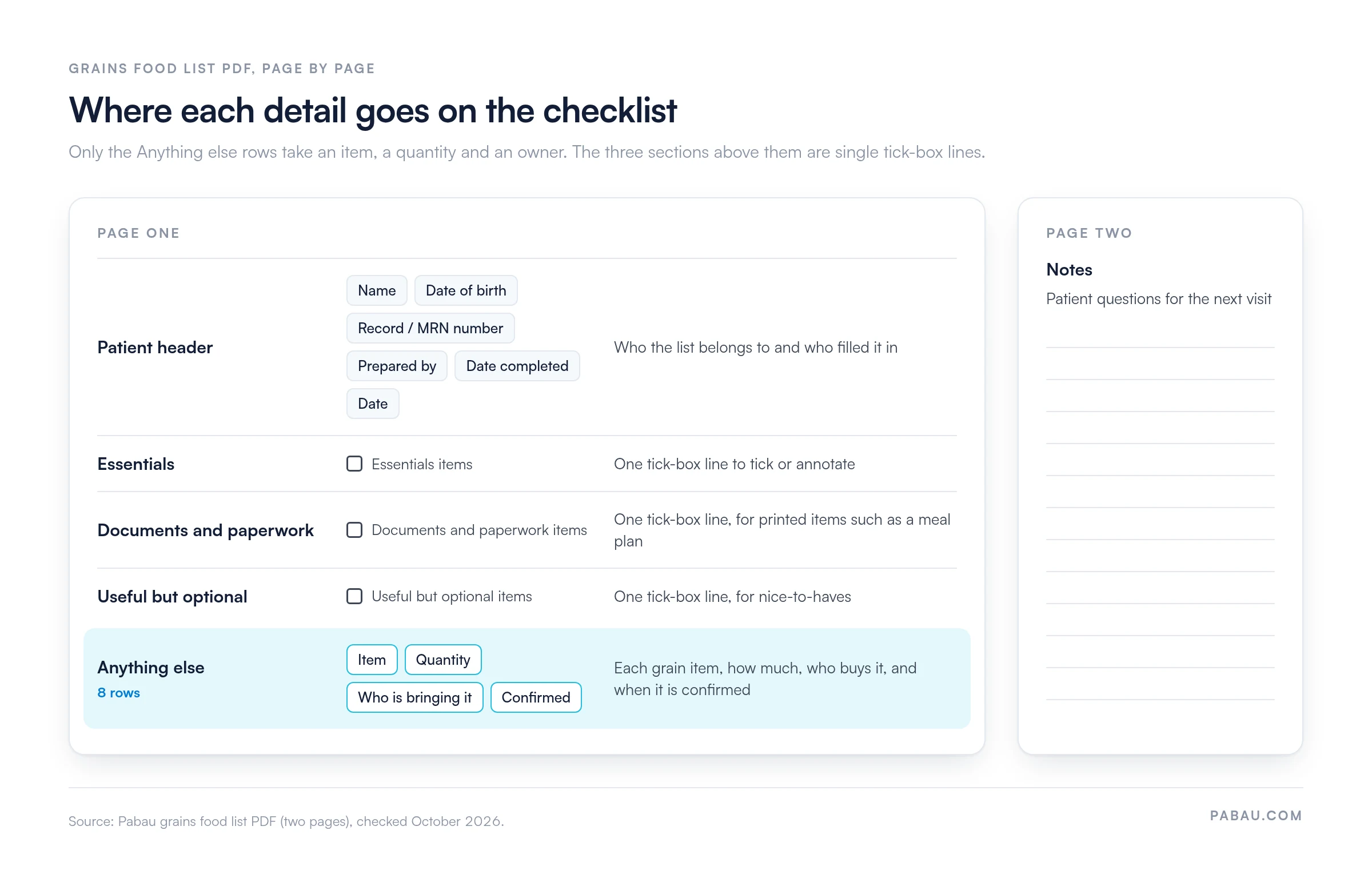
A two-page checklist that opens with a patient header and three tick-box sections: essentials, documents and paperwork, and useful but optional. Below them, the Anything else rows carry Item, Quantity, Who is bringing it, and Confirmed fields, and page two is for notes.
Download template
Whole grains keep the bran, germ, and endosperm, while milling strips the bran and germ from refined grains.
The Dietary Guidelines for Americans advise making at least half of your grains whole grains.
The free PDF puts Item, Quantity, Who is bringing it, and Confirmed fields in its Anything else rows, below three tick-box sections.
Fill the checklist with the grain items you agree on, and keep portions and preferences in your clinical notes.
Check fiber and protein figures per serving in USDA FoodData Central rather than relying on general rankings.
A grain counts as whole when it keeps all three parts of the kernel: the bran, the germ, and the endosperm. Wheat, oats, rice, barley, and corn are common examples, and each appears in both whole and refined forms.
USDA MyPlate groups bread, cereal, rice, and pasta under the grains food group. Most foods on a grains list fall on one side of the whole-versus-refined line:
Whole grains keep the bran, germ, and endosperm, while refined grains have the bran and germ removed during milling. Use the table below as a quick reference when a patient asks why a swap matters.
Labels can mislead, because “multigrain” or “wheat” on the front of a pack does not mean whole grain. Look for a whole grain listed as the first ingredient, or the Whole Grains Council stamp.
Fiber content varies by grain and by whether the bran is kept. Use the per-serving figure from USDA FoodData Central rather than a generic ranking. Oats, brown rice, whole wheat, and barley are common whole grain options, with exact amounts taken from the source.
Quinoa, a pseudocereal usually grouped with grains, is a complete protein, meaning it contains all nine essential amino acids. When comparing grains for protein, use the per-serving data in USDA FoodData Central, since figures differ by variety and preparation.
Breakfast is often the easiest place to add whole grains, which gives the template a practical starting point.
No whole grain is fully keto-friendly. Net carbohydrate content depends on portion size and preparation, so treat each grain as a portion decision. Patients on a strict ketogenic plan may do better with a keto grocery list instead.
Ask patients what portion they usually eat, because portion size often matters more than the grain type alone.
Refined grains such as white bread, white rice, and regular pasta have their bran and germ removed during milling. Treat them as the first swap target rather than an outright ban, so the patient keeps a practical choice.
The PDF opens with one instruction: tick each item once it is confirmed or packed. Page one then holds four sections, and only the last one has write-in fields for each item.
Essentials, Documents and paperwork, and Useful but optional are single tick-box lines, each with a generic label such as “Essentials items”. The fourth section, Anything else, holds eight rows with the same four fields:
Above the sections, page one starts with a patient header: Name, Date of birth, Record/MRN number, Prepared by, Date completed, and Date. Page two is a blank notes page. The map below shows where each detail goes.
The form has no fields for portions, intake history, or adherence. Record those in the patient’s clinical notes, and use the checklist for the shopping side of the plan.
Download the PDF, then fill it in with the patient so each grain item has a clear owner. Work through it in this order:
Bring the completed checklist to the next visit to see which items the patient bought. Record portions and food preferences separately, where AI-powered clinical documentation can draft the session note for you to review before signing.
The checklist suits dietitians and nutrition practitioners who want patients to leave a session with a concrete shopping list. Weight-loss practices can hand it out at meal-planning visits, and weight loss clinic software keeps each completed copy with the patient’s progress notes.
The Who is bringing it field helps where shopping is shared. A patient living with family, a caregiver who does the grocery run, or a group cooking class can split the list without buying twice.
A shared checklist turns dietary advice into a short list of purchases that someone has agreed to make.
A completed checklist also shows what was agreed at the session. Filed with the patient record, it makes each later change to the plan easier to trace.
Fill in the first few Anything else rows with the patient during the session. They can add their own items before they shop, and any blank Confirmed fields give you a starting point at the next visit.
Paper checklists tend to go home in a bag and rarely come back. When one does return, someone still has to scan it into the patient file before the next review.
With Pabau, the practice management platform we build, you can rebuild the checklist as a digital form and send it before or after a consultation. The completed form saves to the patient’s record, next to their session notes.
Pabau Scribe, our AI scribe, drafts the consultation note while you talk through grain swaps. You review and sign it, so the agreed items and the clinical detail sit in one file.

Send dietary checklists as digital forms, and keep every completed copy in the patient’s record next to their session notes.

Whole grain advice changes a patient’s diet only once it reaches the shopping basket. Pair the guidance in this article with the checklist, and each agreed swap gets an item, a quantity, and an owner.
Keep the two jobs separate. The PDF tracks what gets bought, while portions, preferences, and progress belong in your clinical notes.
Book a demo to see how Pabau sends dietary checklists to patients and files the completed copies in their records.

Want a broader list of minimally processed foods? Whole food diet list groups unprocessed foods for patients changing their overall diet.
Need the opposite of a high-fiber plan? Low-fiber food list covers the grains and breads allowed before a colonoscopy or during a flare.
Planning groceries for a patient with diabetes? Diabetic food grocery list helps patients plan a blood-sugar-friendly shop.
Want a general shopping list for patients? Food shopping checklist gives patients a ready-made list to take to the store.
Working with a patient who has IBS? FODMAP food list flags which grains and other foods are high or low in FODMAPs.
A grains food list covers foods made from wheat, rice, oats, cornmeal, barley, or another cereal grain. That includes bread, pasta, oatmeal, breakfast cereals, tortillas, and grits, in both whole and refined forms.
Whole grains keep all three parts of the kernel: the bran, germ, and endosperm. Refined grains are milled to remove the bran and germ, which lowers their dietary fiber.
The Dietary Guidelines for Americans recommend that at least half of the grains you eat are whole grains. A dietitian can tailor the total amount to your calorie needs.
The PDF is a two-page checklist. Page one opens with a patient header and three tick-box lines for essentials, documents and paperwork, and useful but optional items. Its eight Anything else rows carry Item, Quantity, Who is bringing it, and Confirmed fields, and page two is for notes.