CRM for chiropractors: how to manage patients, bookings and marketing
A CRM for chiropractors is a patient relationship management system built around...

Last Updated: Oct 13, 2026
A low-fiber food list sorts everyday foods into what a patient can eat and what to skip while daily fiber stays under about 10-15 grams.
The allowed side is mostly refined grains, peeled and well-cooked vegetables, soft or canned fruit without skins or seeds, lean proteins, eggs, and dairy. Whole grains, legumes, raw vegetables, nuts, seeds, and dried fruit go on the avoid side.
Clinicians use a low-fiber diet during Crohn’s disease and ulcerative colitis flares, after some GI surgery, for acute diverticulitis, and before a colonoscopy. Below you’ll find the full list by category, how it differs from a low-residue diet, current colonoscopy prep timing, and a 3-day meal plan.
A printable one-page food list for patients, with fields for patient details, referring clinician and notes. Ready to hand out at the appointment.
Download template
A low-fiber diet limits fiber to roughly 10-15 grams a day for IBD flares, GI surgery recovery, acute diverticulitis, and colonoscopy prep.
A low-residue diet is stricter than a low-fiber diet and also limits dairy and many cooked vegetables.
Allowed foods include white bread, white rice, peeled cooked vegetables, lean proteins, eggs, dairy, and canned fruit without skin or seeds.
Colonoscopy prep ranges from one to three days of restricted eating, and 2025 US Multi-Society Task Force guidance supports limiting it to the day before.
The performing clinician’s or facility’s instructions always override a general food list, so check them before sharing this one.
A low-fiber diet restricts daily fiber intake to less than 10-15 grams. Most adults are advised to eat 25-30 grams a day.
Dietary fiber comes in two forms. Insoluble fiber (cellulose, hemicellulose) resists digestion and adds bulk to stool, while soluble fiber (pectins, gums) ferments in the colon. A low-fiber diet reduces both, which means less stool bulk and less work for the colon while it heals or before a procedure.
Clinical indications for a low-fiber diet include:
Irritable bowel syndrome with diarrhea (IBS-D) is a different case. A low-fiber diet isn’t a standard first-line approach there, and the main dietary guidance is low-FODMAP. Our FODMAP food list covers that approach food by food.
Patients should check with their healthcare provider or a registered dietitian before starting a low-fiber diet. Fiber thresholds and duration vary by condition and individual tolerance.
Patients often confuse low-fiber and low-residue diets because both reduce stool bulk, but they are distinct protocols.
Both diets show up in colonoscopy prep instructions, and facilities differ on which one they use and for how long. The prep section below covers the timing.
Patients can build every meal from the five food groups below.
Choose refined grains and white flour products:
Cook vegetables until soft and peel when possible:
Choose peeled, canned, or soft fruits without seeds or tough skins:
Select lean, tender, easily digestible proteins:
Low-fiber dairy is generally well tolerated, though lactose sensitivity varies:
Dairy intolerance is common in patients with active Crohn’s disease or ulcerative colitis, so encourage them to test their own tolerance.
High-fiber and high-residue foods need to be restricted to keep intake under 10-15 grams of fiber a day.
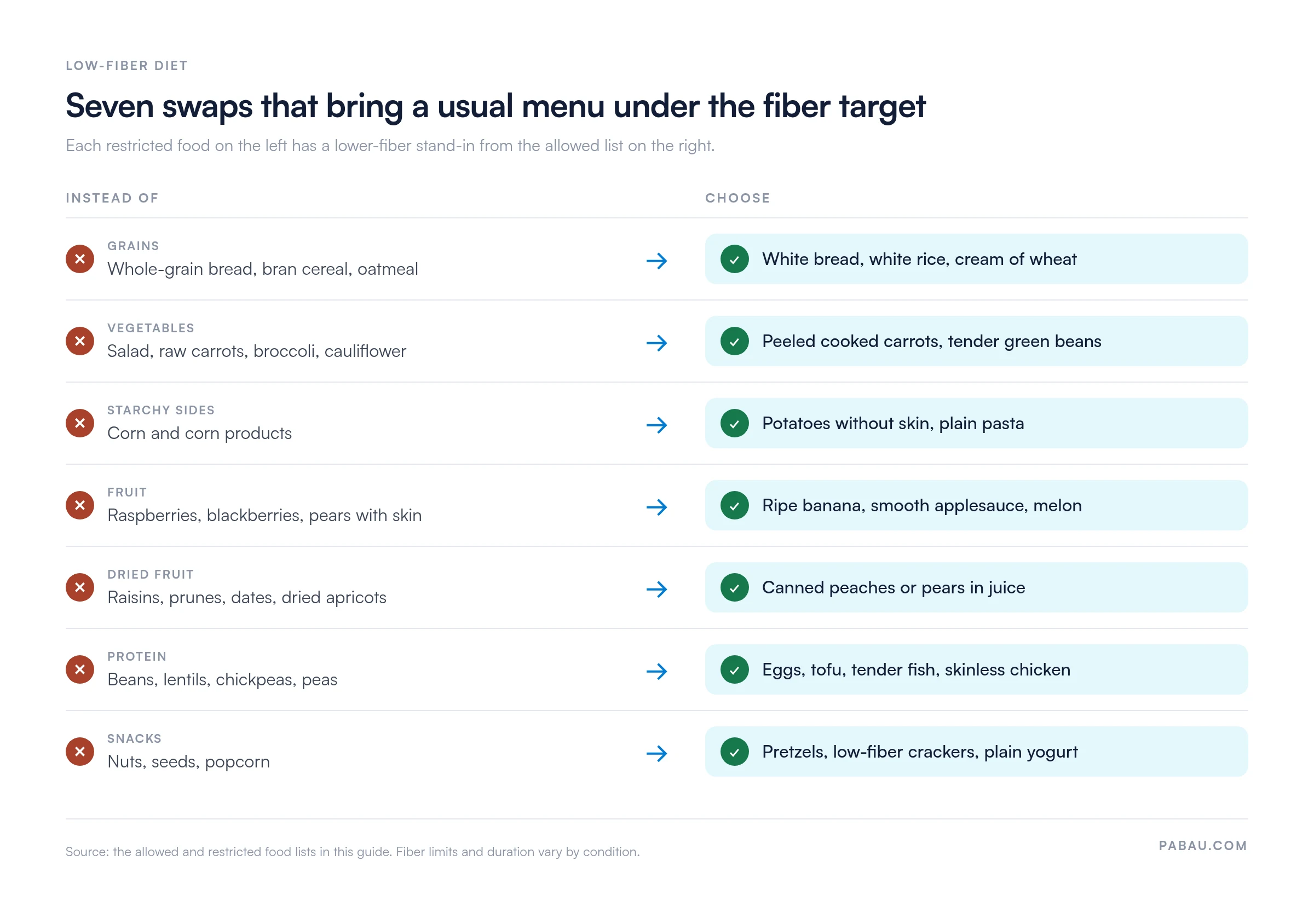
As a rule, whole, unrefined, and raw foods are high in fiber. Patients should avoid them or modify them by peeling, removing seeds, and cooking until soft. The swaps below cover the restricted foods patients miss most.
Colonoscopy needs a clear view of the colon lining, so bowel cleansing starts with a short period of restricted eating.
Facilities vary from one to three days of a low-fiber or low-residue diet. The 2025 US Multi-Society Task Force guidance supports limiting the restriction to the day before for patients at low risk of a poor prep.
On that day, patients can usually have low-fiber or low-residue foods early, then switch to clear liquids. The bowel prep solution, such as polyethylene glycol, is typically split between the evening before and the morning of the procedure. For the liquid stage, our clear liquid diet menu lists what patients can drink.
Always follow the specific instructions issued by the performing gastroenterologist or facility. Protocols vary, and individual instructions override general guidance.
This plan shows how the allowed foods turn into three days of ordinary meals.
At standard portions (about half a cup of each vegetable or fruit), each day comes to roughly 10-12 grams of fiber. That keeps the plan within the low-fiber target. Larger portions raise the total, so adjust them to the patient’s appetite and clinical needs.
Cook vegetables until soft: Steaming or boiling vegetables softens their fiber and makes them easier to digest. Peel them and remove seeds to cut fiber further.
Read nutrition labels: Check the Dietary Fiber line on packaged foods. Aim for products with under 2 grams of fiber per serving, and choose refined grain products over whole grain.
Stay hydrated: Low-fiber diets can cause constipation. Encourage 6-8 glasses of water daily unless the healthcare provider restricts fluids for procedure prep.
Give patients the list in writing: Print this page or send the link. Patients can then check the allowed and avoid lists while shopping or cooking. A written copy also heads off post-visit calls about single foods.
Transition gradually: When a patient comes off the diet, such as after a colonoscopy, reintroduce higher-fiber foods slowly over 2-3 days to avoid GI discomfort. After recovery, patients with diverticular disease are often moved to a high-fiber diet, and a high-fiber meal plan shows what that looks like.
Consult a registered dietitian: Individual tolerance varies. A dietitian can personalize the plan for specific conditions (Crohn’s disease, ulcerative colitis, post-surgical recovery) and food preferences.
Many practices still hand out a diet sheet at the consult, then take calls from patients who lost it or forgot the timing. Prep timing also differs between facilities, so a generic sheet can contradict the one the patient gets later.
Pabau, the practice management platform we build, lets you send the food list and your own prep timeline as digital patient forms before the appointment. Patients complete and sign them, and each response is saved to the patient record.
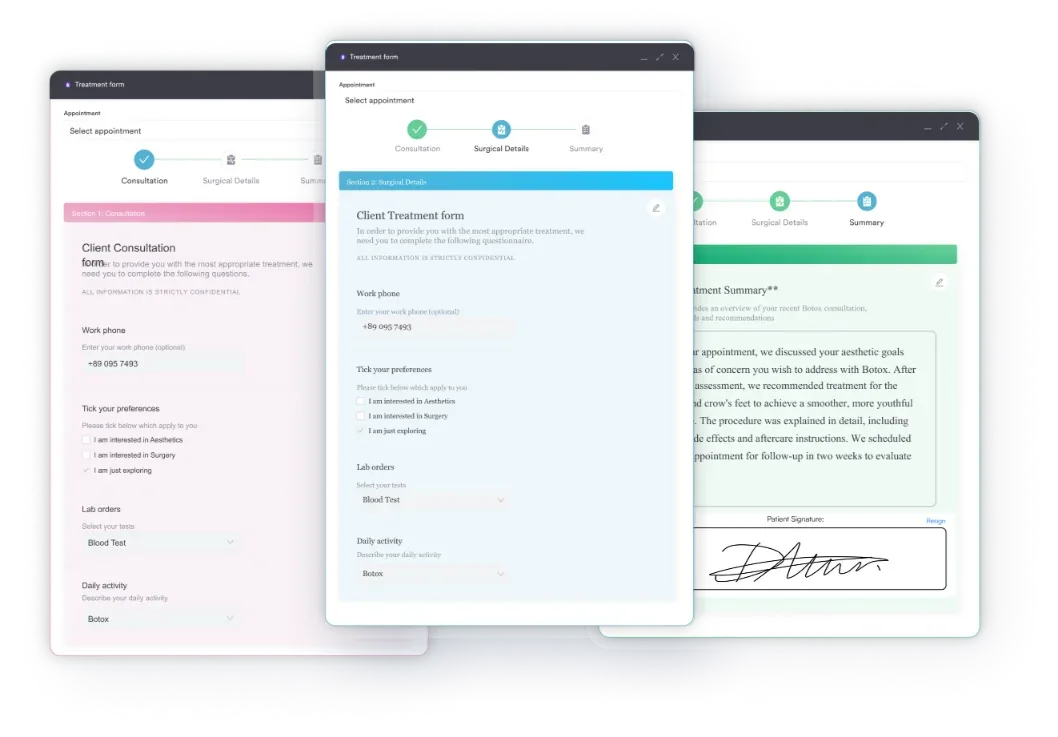
Patients can reopen the instructions in the patient portal whenever they need them. That means fewer calls to your front desk the day before a colonoscopy.
At follow-ups, Pabau Scribe, our AI scribe, drafts the note on dietary counseling and tolerance while you talk with the patient. If your practice also runs medical weight programs, the same tools sit behind Pabau’s weight loss clinic software.

Send diet instructions and prep timelines as digital forms, see who has completed them, and keep every response in the patient record.

A low-fiber diet works best as a short phase with a clear end date. Patients stick to it when they know what to eat, for how long, and what comes next.
For colonoscopy prep, match your handout to the performing facility’s timing. Many still ask for three days, while the 2025 guidance supports one day for most patients. For IBD flares and surgical recovery, set a review date at the start and plan the return to fiber with a dietitian.
The trade-off is nutrition. Weeks of restricted eating can narrow a patient’s vitamin and mineral intake, so keep the phase no longer than the condition needs. Book a demo to see how Pabau sends diet instructions to patients and records who has completed them.

Need a gentler diet after a GI upset? Bland diet food list sorts easy-to-digest foods for patients with an irritated stomach.
Moving a patient past the low-fiber phase? Gastrointestinal soft diet food list covers soft, easy-to-chew foods for recovering patients.
Treating diverticular disease? Diverticulitis diet plan walks patients from the acute phase back to everyday eating.
Planning meals for ulcerative colitis? 7-day meal plan for ulcerative colitis gives patients a week of structured meals.
A low-fiber diet restricts dietary fiber only, typically allowing dairy and some cooked vegetables. A low-residue diet is more restrictive and limits both fiber and residue (undigested matter), often excluding dairy and limiting all vegetables. Both appear in colonoscopy prep instructions, and facilities differ on which one they ask for.
Allowed foods include white bread, white rice, peeled cooked vegetables, canned fruits without skin, eggs, tender fish and poultry, dairy products, and plain pasta. The key is refined (not whole) grains and soft, peeled vegetables.
Duration varies by condition. Colonoscopy prep ranges from one to three days, and 2025 US Multi-Society Task Force guidance supports limiting it to the day before for most patients. Crohn’s disease flares may need 2-4 weeks, and post-surgical recovery often 2-6 weeks. Always follow the healthcare provider’s specific timeline and transition plan.
Yes, eggs are allowed on a low-fiber diet in any preparation (scrambled, boiled, fried). They contain no dietary fiber and are an excellent lean protein source for meeting daily nutritional needs.
No. Both limit fiber to about 10-15 grams daily, but a low-residue list also restricts dairy and many cooked vegetables, so it is stricter. Facilities use either one for colonoscopy prep, and low-fiber is the usual choice for most other GI conditions.
Low-fiber vegetables are cooked, peeled, and seedless. Good options are peeled carrots, potatoes without skin, squash, green beans, asparagus tips, canned vegetables in liquid, and peeled, seeded cucumber. Raw and fibrous vegetables like broccoli, cauliflower, and spinach should be avoided.