Waist-to-hip ratio chart: Risk bands for women & men (free PDF)
A waist-to-hip ratio chart sorts a patient’s waist-to-hip ratio (WHR) into...

3
Last Updated: Oct 14, 2026
A whole food diet list is a reference guide to foods that reach the plate close to their natural state.
It covers vegetables, fruits, whole grains, legumes, nuts, seeds, lean proteins, and plain dairy. Ultra-processed items, refined grains, and added sugars stay off it.
The downloadable template below turns that into something a patient can carry into a grocery store. It holds an approved foods inventory, a shopping list, and a seven-day meal plan. The sorting rule behind it is short. A product with more than five recognizable ingredients sits outside the framework, and so does one that lists additives and preservatives.
The file lists approved foods by category and names the items to leave out. It also carries a printable grocery list and a seven-day meal plan. Hand it straight to a patient starting the switch.
Download template
A whole food diet keeps food close to its natural state and leaves out ultra-processed items, refined grains, and added sugars.
The list covers vegetables, fruits, whole grains, legumes, nuts, seeds, lean proteins, and plain dairy with no added sugar.
Reading the ingredient list is the skill that separates a whole food from a product marketed as healthy.
Practitioners can hand patients the categorized food list, the grocery list, and the meal plan instead of describing them in an appointment.
A whole food diet prioritizes foods as close to their natural state as possible. Minimal processing is the defining characteristic. Preservatives, artificial flavors, refined sugars, and long ingredient lists are what the framework screens out.
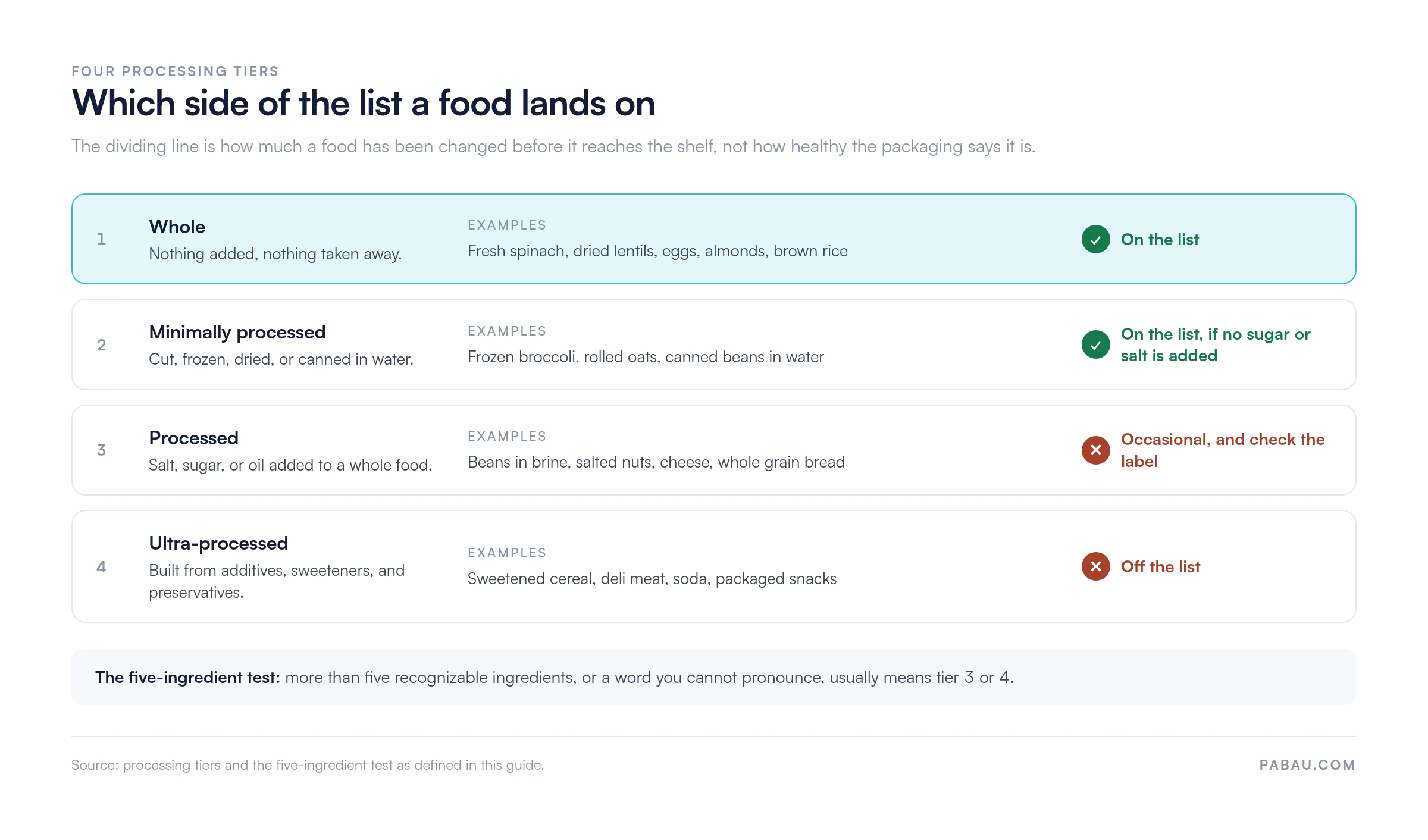
Food splits into four processing tiers, and only the first two belong on the list. Whole foods arrive with nothing added and nothing removed. Minimally processed foods have been cut, frozen, dried, or canned in water. They stay on the list where no sugar or salt has been added.
Processed foods add salt, sugar, or oil to a whole food, so they work as an occasional item rather than a staple. Ultra-processed foods are formulated products built around additives, flavor enhancers, and preservatives. They are the core exclusion. The tiers below show where the line falls, and what each one looks like in a grocery aisle.
The categorized list below covers approved foods by food group. Use it when shopping, when meal planning, and when building patient handouts. Patients managing diabetes also need snack guidance, so our diabetes-friendly snack list groups options by carb and glycemic impact.
Non-starchy vegetables form the foundation of the diet. Leafy greens, cruciferous vegetables, and root vegetables are all approved.
Fresh whole fruits are whole foods. Choose whole fruit over juice to keep the fiber.
Whole grains keep all three parts of the kernel — the bran, the germ, and the endosperm. Refined grains such as white bread, white rice, and regular pasta do not.
Legumes are among the most affordable whole foods and supply plant protein and fiber. Dry legumes qualify, and so do canned legumes packed in water with no added sodium.
Nuts and seeds are whole foods rich in healthy fats and protein. Choose raw, roasted, or lightly salted varieties, and skip the honey-roasted and candied versions.
Both animal and plant proteins fit the framework. Choose unprocessed cuts and simple preparations.
Plain, minimally processed dairy with no added sugar qualifies. Sweetened yogurts, flavored milks, and products carrying additives do not.
Ultra-processed items are the core exclusion. They carry added sugars, refined grains, artificial additives, and preservatives.
Several eating patterns look similar on a plate. Knowing how they differ helps practitioners point a patient at the one that fits their goal.
Whole30 causes the most confusion, because the names overlap and the rules do not. A Whole30 food list drops grains, legumes, and dairy for thirty days. All three stay on a whole food diet, which is built to run indefinitely rather than reset. A grain-free paleo plan drops those three groups too, with no reintroduction date.
The week below shows how whole food meals stack up across breakfast, lunch, and dinner. Hand it over as a starting structure, then adjust portions to the patient.
Starting does not require a perfect week. The sequence below is what a practitioner can walk a patient through at the first appointment.
Label reading is the skill that decides whether the framework holds at the grocery store. It is what stops a patient from buying a product that looks healthy and reads ultra-processed.
Teaching label reading gives patients something they can use without a practitioner in the aisle. A patient portal with a resource library keeps the label guide and the food list somewhere they can find both again.
Nutrient density and the removal of processed additives are what drive the outcomes below.
These five come up in almost every first nutrition appointment.
Yes, unprocessed meat is a whole food. Choose fresh or frozen chicken breast, fish, eggs, and lean cuts of beef or pork without additives or curing agents. Deli meats, sausages, and bacon stay off the list, since they carry preservatives and added sodium.
No. Whole30 is a 30-day elimination protocol that removes grains, legumes, dairy, and added sugars for a temporary reset. A whole food diet is a flexible framework that treats whole grains and legumes as staples and is designed to run for life.
Most dietary guidelines recommend 25 to 35 grams of fiber per day. Whole foods meet that target through vegetables, fruits, legumes, and whole grains. Increase fiber gradually so the digestive system has time to adapt, and our high-fiber meal plan adds 3 to 5 grams at a time.
Yes, for many people. Whole foods are higher in fiber and protein, which support satiety and lower overall calorie intake. Steadier blood sugar reduces cravings. Results still vary by individual, adherence, and activity level, and consistency over time beats rapid restriction.
A whole food diet includes every food group, plants and animal products alike, and judges each one on how far it has been processed. A plant-based diet leads with plant foods and may or may not include animal products. A whole food plant-based diet combines both rules, and our plant-based diet plan sets that version out across 30 days.
Handing over a food list is the easy part. Follow-through is where nutrition guidance usually falls apart. The plan lives in a PDF the patient mislays, and the practice has no record of what was sent or when.
Practice management software like Pabau keeps the document attached to the patient record instead. You send the food list, the grocery guide, and the meal plan from the patient’s file, and the send is logged against it. At the next appointment you can see what they received.
Automated follow-ups carry the same information forward. A check-in at week two asks how the swaps are going, and the reply lands on the patient record rather than in someone’s inbox. Practices running structured nutrition programs usually want that in weight loss clinic software, where the plan, the follow-up, and the outcome sit in one file.

Pabau stores food lists, grocery guides, and meal plans on the patient’s file, then automates the follow-up that checks how the swaps are going. Your team can see what was sent, when, and what changed since.

The list is not what changes a patient’s diet. A rule simple enough to apply in a grocery aisle is. That is why the five-ingredient test earns more of this page than any single food group on it.
The trade-off worth naming is pace. A patient who clears the shelves in one weekend is usually back on packaged food by the second week. Two swaps a week feels slower and lasts a great deal longer.
Give the patient the template, then decide who checks in and when. Book a demo to see how Pabau sends a nutrition plan from the patient record and tracks what happens after.

Ready to turn the list into meals? Whole food diet plan builds the same foods into a structured eating schedule.
Patient asking about clean eating? Clean eating meal plan covers the pattern that overlaps most with whole foods.
Need a heart-friendly alternative? Mediterranean diet plan sets out the olive-oil-led version of minimally processed eating.
Managing blood pressure too? DASH diet food list sorts the same food groups by sodium and potassium load.
Want a general starting point? Healthy meal plan gives patients a simpler weekly structure to build from.
Whole foods include vegetables, fruits, whole grains, legumes, beans, lentils, nuts, seeds, eggs, fish, lean meats, and plain dairy such as yogurt and milk. The core principle is that the food is unprocessed or minimally processed and close to its natural state. Added sugars, refined grains, and artificial additives keep a food off the list.
Avoid ultra-processed foods. That covers refined grains such as white bread and white rice, sugary foods and drinks, and processed meats such as deli meats and sausages. Packaged snacks and flavored yogurts belong in the same group. Also avoid any product with more than five ingredients, or with artificial additives, preservatives, or refined sugars on the label.
Organize the list by category: vegetables, fruits, whole grains, legumes, proteins, nuts and seeds, and dairy. Shop the perimeter of the store, where the produce, meat, and dairy sections sit. The categorized list in this template works as the reference.
Yes. Approved snacks include fresh fruit, nuts, seeds, nut butters, hard cheese, eggs, plain yogurt, and vegetables with hummus. Store-bought granola bars, crackers, and packaged snacks stay off the list unless the label shows five or fewer whole food ingredients and no added sugar.
Results vary by individual and starting point. Many people report improved energy, better digestion, and a steadier appetite within one to two weeks. Weight loss and measurable health improvements typically emerge after four to eight weeks of consistent adherence.