Hypothyroidism diet plan PDF
What is a hypothyroidism diet plan PDF? A hypothyroidism diet plan PDF is a prin...

1
Last Updated: Nov 5, 2026
Does Medicaid cover GLP-1 drugs? Every state program covers them for type 2 diabetes, but only 10 pay for weight loss as of November 5, 2026. Those 10 are Delaware, Kansas, Michigan, Minnesota, Mississippi, Missouri, North Carolina, Tennessee, Virginia and Wisconsin. Michigan and Virginia only approve weight-loss use at a BMI near 40.
In the other 41 programs, the answer turns on the diagnosis rather than the weight. Wegovy has FDA approvals for heart risk and fatty liver disease, and Zepbound for sleep apnea, so most states still cover them with prior authorization. We call that the indication-first coverage check, and it’s the most useful step for anyone outside the 10.

As of November 5, 2026, 10 programs pay for weight loss: Delaware, Kansas, Michigan, Minnesota, Mississippi, Missouri, North Carolina, Tennessee, Virginia and Wisconsin.
Seven programs stopped in 2026: California, New Hampshire, Pennsylvania and South Carolina on January 1, then Utah, Massachusetts and Rhode Island mid-year.
Run the indication-first coverage check first. Heart risk, fatty liver disease and sleep apnea can open GLP-1 coverage where weight loss is excluded.
CMS’s BALANCE model lets state Medicaid programs join through January 1, 2027, but no participating state has launched coverage yet.
Our analysis: programs that have covered weight loss filled a median 230 GLP-1 prescriptions per 1,000 adult enrollees in 2024, against 158 elsewhere.
Only in 10 state programs. Federal law lets each state exclude weight-loss drugs, but not GLP-1s prescribed for other medically accepted uses like diabetes or sleep apnea.
The exclusion comes from Section 1927(d)(2) of the Social Security Act, which lists drugs used for weight loss as ones a state may restrict. So the question of whether Medicaid covers GLP-1 for obesity has 51 answers, one per program. Every program that says yes still requires prior authorization.
Counts online disagree because the list moved all year. KFF counted 13 programs in January 2026. Utah, Massachusetts and Rhode Island stopped after that, which leaves 10. Any page still naming 13 is reading a January snapshot of Medicaid GLP-1 coverage in 2026.
Two rules hold everywhere. A GLP-1 covered by Medicaid for diabetes is covered in all 51 programs. Ozempic or Mounjaro written for weight loss alone is off-label, so no program has to pay for it.
As of November 5, 2026, Delaware, Kansas, Michigan, Minnesota, Mississippi, Missouri, North Carolina, Tennessee, Virginia and Wisconsin cover GLP-1s for weight loss. Michigan and Virginia restrict it to severe obesity.
We checked each program against its own preferred drug list (PDL), bulletin or prior authorization form, linked in the last column. For the 41 programs that don’t pay for weight loss, the drug column shows what they still cover instead.
| State | Weight-loss coverage | Weight-loss drugs on the PDL, or other coverage | Key prior authorization criteria | Effective or last change | Source |
|---|---|---|---|---|---|
| Alabama | Not covered* | Excluded for weight reduction; OSA and cardiac routes reported but unverified | None for weight loss | PDL July 1, 2026 | PDL reference tool |
| Alaska | Not covered | Only diabetes GLP-1s on the PDL | None for weight loss | PDL November 1, 2026 | Alaska PDL |
| Arizona | Not covered | Only diabetes GLP-1s on the drug list | None for weight loss | Drug list October 1, 2026 | AHCCCS drug list |
| Arkansas | Not covered | Wegovy for heart risk; Zepbound 10 and 15 mg for OSA | None for weight loss | Memo May 13, 2026 | Pharmacy memo |
| California | Not covered | Wegovy for MASH and heart risk; Zepbound for OSA | Weight-loss claims reject at any BMI | Ended January 1, 2026 | Medi-Cal Rx notice |
| Colorado | Not covered | Wegovy for heart disease at BMI 25+; Zepbound for OSA at BMI 30+ | Weight-loss-only requests are not approved | PDL October 13, 2026 | Colorado PDL |
| Connecticut | Not covered | Wegovy for heart risk and MASH; Zepbound for OSA | Wegovy needs a heart or MASH diagnosis code | November 3, 2025 | Bulletin 2025-54 |
| Delaware | Covered | GLP-1s for weight management through the DMAP PA form | BMI 30+, or 27+ with a comorbidity; renew at 5% loss | Form April 2026 | DMAP PA form |
| District of Columbia | Not covered | Anti-obesity drugs are an excluded class | None for weight loss | PDL September 18, 2026 | DC PDL |
| Florida | Not covered | No heart, OSA or MASH pathway in the criteria | Diabetes use needs A1c 6.5%+ and a metformin trial | Criteria October 1, 2026 | AHCA GLP-1 criteria |
| Georgia | Not covered | Saxenda for ages 12 to 17 only | No adult pathway | PDL November 1, 2026 | Georgia PDL |
| Hawaii | Not covered | No non-obesity pathway published | None for weight loss | Long-standing | HB 2456 (2026) |
| Idaho | Not covered* | Diabetes only, per secondary trackers | None for weight loss | Not dated | IDHW document |
| Illinois | Not covered | Wegovy for heart risk and MASH; Zepbound for OSA | Not covered for weight loss alone | PDL October 20, 2026 | Illinois PDL |
| Indiana | Not covered | Zepbound preferred for labeled non-obesity uses | New GLP-1 PA criteria from January 1, 2027 | Bulletin October 29, 2026 | Bulletin BT2026184 |
| Iowa | Not covered | Wegovy for heart risk and MASH; Zepbound for OSA | Weight-loss use denied by rule | PA form January 2026 | Incretin PA form |
| Kansas | Covered | Wegovy, Wegovy HD, Zepbound, Foundayo, Saxenda | BMI 30+, or 27+ with a comorbidity; 28-week approvals | November 1, 2026 | KDHE criteria |
| Kentucky | Not covered | Wegovy for heart risk at age 45+ and BMI 27+ | None for weight loss | Criteria January 3, 2026 | Wegovy PA criteria |
| Louisiana | Not covered | Zepbound for OSA; Act 898 requires coverage once funded | None for weight loss | Act signed June 9, 2026 | Act 898 of 2026 |
| Maine | Not covered | Wegovy at BMI 27+, not for weight loss only; Zepbound for OSA | None for weight loss | PDL October 9, 2026 | MaineCare PDL |
| Maryland | Not covered | SB 496 allows coverage from 2027; the state has not opted in | None for weight loss | Not opted in | SB 496 (2026) |
| Massachusetts | Not covered | Wegovy for heart risk and MASH; Zepbound for OSA | Under-21s keep coverage | Ended July 3, 2026 | Pharmacy Facts 276 |
| Michigan | Restricted | Wegovy, Zepbound, Saxenda, liraglutide (all non-preferred) | BMI 40+ after every other option fails; 6-month approvals | January 1, 2026 | MI anti-obesity criteria |
| Minnesota | Covered | Wegovy, Zepbound, Foundayo, Saxenda, liraglutide | BMI 30+, or 27+ with a comorbidity; renew at 5% loss | November 2026 | DHS PA criteria |
| Mississippi | Covered* | Wegovy, Zepbound, Foundayo, Saxenda | Adults with an obesity diagnosis; one GLP-1 at a time | July 1, 2026 | Anti-obesity PA criteria |
| Missouri | Covered | Zepbound, Zepbound KwikPen, Foundayo; Wegovy not for weight loss | BMI 30+, or 27+ with a comorbidity; ages 12+ | April 23, 2026 | GLP-1 PA form |
| Montana | Not covered | Wegovy for heart risk; Zepbound for OSA | None for weight loss | Manual July 9, 2026 | Drug program manual |
| Nebraska | Not covered | Wegovy for heart risk and MASH | None for weight loss | PDL November 1, 2026 | Nebraska PDL |
| Nevada | Not covered | Wegovy for MASH and heart risk; Zepbound for OSA | None for weight loss | Manual August 3, 2026 | Services manual ch. 1200 |
| New Hampshire | Not covered | Diabetes, heart risk, severe OSA and MASH still covered | Applies to fee-for-service and MCOs | Ended January 1, 2026 | DHHS notice |
| New Jersey | Not covered | Wegovy for heart disease and Zepbound for OSA, per an unverified memo | None for weight loss | Long-standing rule | N.J.A.C. 10:51 |
| New Mexico | Not covered | Older weight-loss drugs such as phentermine and orlistat with PA | None for weight loss | Page undated | HCA weight-reduction page |
| New York | Not covered | Wegovy with heart disease and BMI 40+; Zepbound with OSA and BMI 40+ | Two lifetime attempts; lifestyle program | PDL October 22, 2026 | NYRx guidelines |
| North Carolina | Covered | Wegovy, Wegovy HD, Foundayo, Zepbound pen (preferred) | BMI 30+, or 27+ with a comorbidity; renew at 5% loss | PDL October 1, 2026 | NC Medicaid PDL |
| North Dakota | Not covered | Phentermine, bupropion, naltrexone and topiramate only | None for weight loss | June 1, 2026 | Exclusion list |
| Ohio | Not covered | Wegovy for heart risk and MASH; no Zepbound OSA pathway | None for weight loss | UPDL October 2026 | OAC 5160-9-03 |
| Oklahoma | Not covered | Wegovy for heart risk and MASH; Zepbound for OSA | None for weight loss | October 1, 2026 | OHCA PA criteria |
| Oregon | Not covered | Semaglutide for heart disease and MASH; tirzepatide for OSA | Adult exclusion continues after January 1, 2027 | July 1, 2026 | PA criteria guide |
| Pennsylvania | Not covered | Diabetes, OSA, heart risk and MASH with PA; Saxenda dropped | Applies to fee-for-service and managed care | Ended January 1, 2026 | MA Bulletin |
| Rhode Island | Not covered | Heart risk, OSA, MASH and diabetes with a new PA | Under-21s reviewed under EPSDT | Ended October 1, 2026 | EOHHS memo |
| South Carolina | Not covered | Wegovy for heart risk and MASH | None for weight loss | Ended January 1, 2026 | SC PDL |
| South Dakota | Not covered | Wegovy for heart risk (PA form) | None for weight loss | Manual May 2026 | Pharmacy manual |
| Tennessee | Covered | Wegovy, Zepbound pen (preferred); Saxenda, liraglutide | Age 18+, BMI 30+, or 27+ with a comorbidity | PA form August 2026 | Obesity PA form |
| Texas | Not covered | Wegovy for heart risk and MASH; Zepbound for OSA | None for weight loss | May 8, 2026 | Wegovy PA logic |
| Utah | Not covered | Heart risk, MASH and severe OSA still covered | None for weight loss | Ended June 30, 2026 | Bulletin May 2026 |
| Vermont | Not covered | Wegovy for heart risk and MASH; Zepbound for OSA | None for weight loss | PDL April 17, 2026 | Vermont PDL |
| Virginia | Restricted | Wegovy, Zepbound, Foundayo, Saxenda | BMI over 40, or over 37 with a comorbidity; a non-GLP-1 drug first | Form October 20, 2026 | Weight-loss SA form |
| Washington | Not covered | Wegovy for heart disease and MASH; Zepbound for OSA | EPSDT for ages 20 and under | February 1, 2026 | Semaglutide policy |
| West Virginia | Not covered | Wegovy for heart risk and MASH; Zepbound for OSA | None for weight loss | Criteria January 1, 2026 | BMS criteria |
| Wisconsin | Covered | Zepbound, Foundayo (preferred); Wegovy for ages 12 to 17 | BMI 30+, or 27+ with two risk factors | July 1, 2026 | ForwardHealth Update 2026-15 |
| Wyoming | Not covered | Wegovy for heart risk; Zepbound for OSA | None for weight loss | June 8, 2026 | ATCC criteria |
Verified November 5, 2026. An asterisk marks a program whose agency site failed to load that day (Alabama, Mississippi) or whose PDL could not be opened (Idaho). Those statuses rest on secondary trackers and no reported change.
A few rows answer the most searched state questions directly. Does Medicaid cover GLP-1 in Colorado? Only for heart disease, sleep apnea or MASH, since the PDL says weight-loss-only requests will not be approved. Does Medicaid cover GLP-1 in Florida? Only for diabetes, and even that needs an A1c of 6.5% and a metformin trial.
Does Medicaid cover GLP-1 in Michigan? Yes, but only at a BMI of 40 after every other option fails. And does Missouri Medicaid cover GLP-1 for weight loss? Yes for Zepbound and Foundayo, while Missouri limits Wegovy to heart risk and MASH.
Managed care plans mostly follow the state list. New Hampshire’s and Pennsylvania’s notices name both fee-for-service and managed care plans. North Carolina bars its plans from adding extra hurdles to the obesity drug class.
Seven programs stopped paying for GLP-1 weight loss in 2026, one reinstated coverage and one widened it. Every stop notice we read cites budgets.
Does Medicaid cover GLP-1 in PA now? Not for weight loss. Pennsylvania’s Medical Assistance Bulletin ended obesity coverage on January 1, 2026, and voided every prior authorization on December 31, 2025. Saxenda lost coverage for every use.
The bulletin covers fee-for-service and managed care alike. So does Keystone First cover Wegovy for weight loss? No, though it still can for heart risk or MASH with a new prior authorization. Under-21s may still qualify through EPSDT, the federal children’s benefit, according to the Pennsylvania Health Law Project rather than the bulletin.
We compared each group’s 2024 adult obesity rate from CDC survey data. The seven programs that cut coverage have a median rate of 31.1%. The nine that kept it have 36.1%, because Tennessee has no 2024 figure.
A permutation test puts the odds of a five-point split arising by chance at p = 0.02, or about one in 50. The groups are small, and the data can’t show why any state cut. For the all-payer picture, see our breakdown of GLP-1 use by state.
Programs that have covered weight loss at some point filled a median 230 GLP-1 prescriptions per 1,000 adult enrollees in 2024. The 34 that never did filled 158. That’s 1.46 times as many (p = 0.0045), from our analysis of CMS State Drug Utilization Data and CMS enrollment counts.
The count can’t separate diabetes from weight-loss prescriptions, so high rates in uncovered states are mostly diabetes prescribing. Six never-covered programs still fill above the covered median, as the plot below shows.
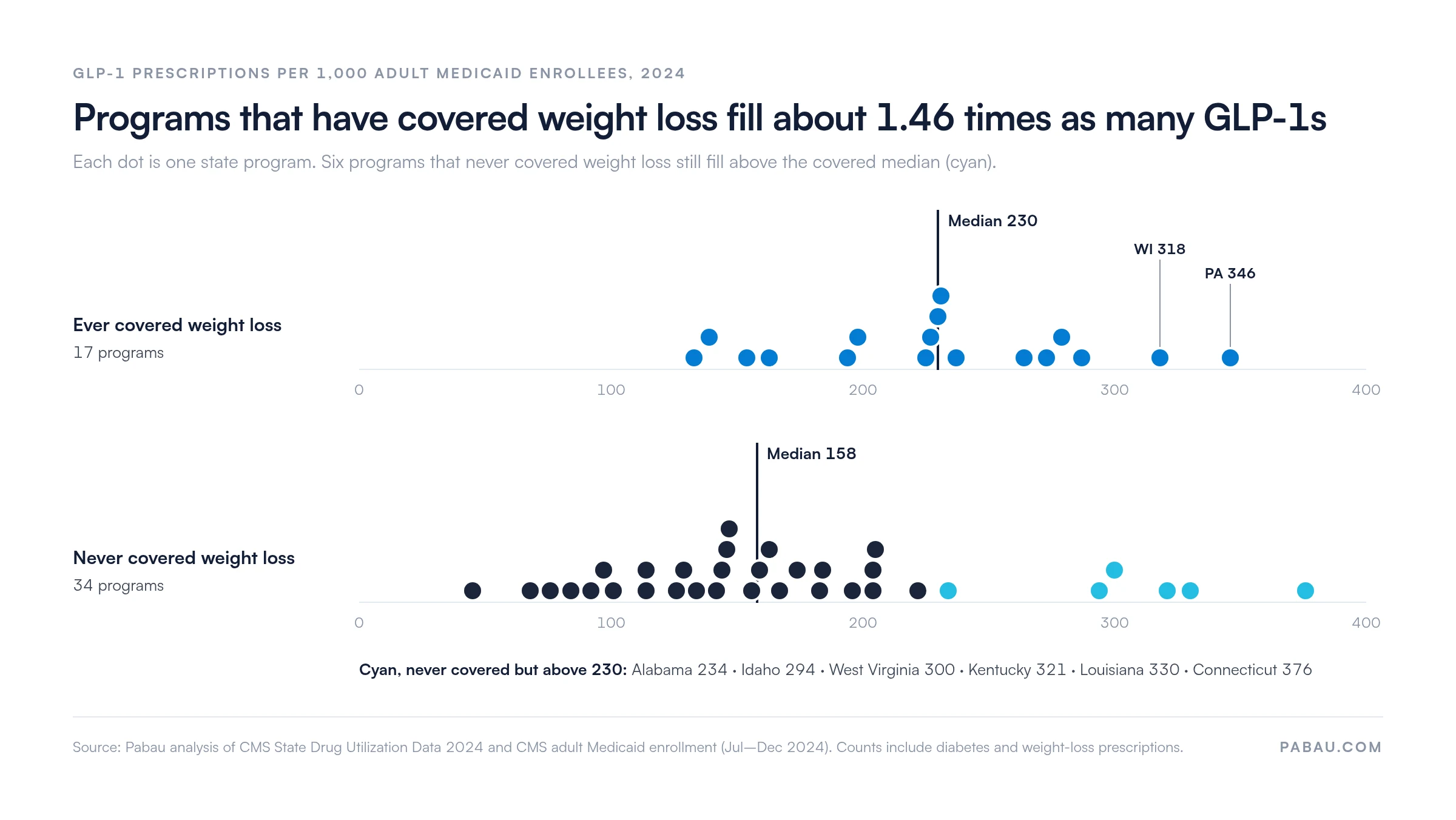
State rankings by fill rate are published elsewhere. Our addition is the split by coverage history, which is the comparison in the plot above.
The indication-first coverage check asks which FDA-approved condition the patient has before asking whether the state covers weight loss. Diabetes, heart risk, fatty liver disease and sleep apnea all open GLP-1 coverage in non-covering states.
States must cover a drug for its medically accepted uses even when they exclude weight loss. That’s why 41 programs that refuse Wegovy for obesity still list it for other conditions.
| Indication | GLP-1 drug | FDA approval | Medicaid rule |
|---|---|---|---|
| Type 2 diabetes | Ozempic, Mounjaro, Trulicity, Victoza, Rybelsus | Approved before 2024 | Required in every program; criteria vary |
| Cardiovascular risk reduction in adults with heart disease and obesity or overweight | Wegovy | March 8, 2024 | Required with PA; most set BMI 27+ and documented heart disease |
| Moderate-to-severe obstructive sleep apnea in adults with obesity | Zepbound | December 20, 2024 | Required with PA; many ask for AHI 15+ and BMI 30+ |
| MASH with moderate to advanced liver scarring, no cirrhosis | Wegovy | August 15, 2025 | Required with PA; California dropped the PA from April 1, 2026 |
| Chronic weight management | Wegovy, Zepbound, Saxenda, Foundayo | Zepbound November 8, 2023; Foundayo April 1, 2026 | Optional; 10 programs cover it |
Take an adult on Pennsylvania Medicaid with a BMI of 32 and diagnosed obstructive sleep apnea. Weight-loss coverage ended on January 1, 2026, so a Wegovy request for obesity is denied.
Run the indication-first coverage check instead. Sleep apnea with obesity is still covered with prior authorization, so the prescriber requests Zepbound for sleep apnea, attaching the sleep study.
The same patient in Ohio would hit a wall, because Ohio’s list has no Zepbound pathway for sleep apnea. Florida’s criteria list no heart, sleep apnea or liver pathway at all. Where a list shows none, ask the state pharmacy help desk about its exception process, like Washington’s exception-to-rule route.
Yes, with prior authorization, for sleep apnea in most programs and for weight loss in the 10 that cover it. Zepbound is preferred in Missouri, North Carolina, Tennessee and Wisconsin.
Does Medicaid cover tirzepatide under its diabetes brand? Mounjaro is a diabetes GLP-1, so it’s covered for type 2 diabetes. Zepbound is the same molecule with weight and sleep apnea approvals, and states treat it under those rules.
Two details trip people up. North Carolina prefers the Zepbound pen and removed the vial on September 4, 2026. Massachusetts covers Zepbound for sleep apnea only after a Wegovy trial.
Does Medicaid cover Foundayo? Foundayo is orforglipron, Eli Lilly’s daily GLP-1 pill, and seven covering programs list it. Missouri, North Carolina and Wisconsin prefer it.
No. Ozempic is approved for type 2 diabetes, so prescribing it for weight loss is off-label and no Medicaid program has to pay. Covering states list Wegovy instead.
Wegovy is the same molecule, semaglutide, at a different dose with its own weight-management approval. Our GLP-1 medication list pairs each diabetes brand with its weight-loss counterpart.
Does Medicaid cover Ozempic for prediabetes? Generally not. Prediabetes on its own isn’t a type 2 diabetes diagnosis, and Florida’s criteria require an A1c of 6.5% or higher. In Missouri, prediabetes counts as a comorbidity for weight-loss coverage at a BMI of 27.
All 10 covering programs require prior authorization, and their forms ask for much the same evidence. The common criteria follow, with the outliers named.
If a request is denied, the denial letter states the appeal route and the deadline. Act on that letter rather than a general rule, because the deadlines differ by state and by plan.
Only where a state opts in. CMS’s BALANCE model lets Medicaid programs join through January 1, 2027, but no state has launched coverage through it yet.
The BALANCE model page, updated September 29, 2026, says applications were due July 31, 2026, and names no participants. Indiana announced on July 30, 2026 that it will join, with no start date. Maryland’s drug affordability board recommended joining, and Delaware’s state plan now allows it.
The state net price is confidential, according to KFF. CMS also dropped the Medicare Part D side for 2027 after too few plans signed up.
For GLP-1 insurance coverage in 2026 outside Medicaid, the Medicare GLP-1 Bridge runs from July 1, 2026 to December 31, 2027 at $50 a month. The Bridge is for Medicare enrollees only. Our GLP-1 statistics roundup tracks spending across payers.
In the weight-loss practices we work with, the Medicaid question usually reaches the front desk before it reaches the prescriber. A fixed order keeps the answer consistent.
Manufacturer copay cards exclude Medicaid, so the self-pay prices above are the realistic fallback. Keeping these steps in one EMR for weight loss saves the front desk from rebuilding each request.
A Medicaid GLP-1 request is only as strong as the evidence attached to it, and that evidence is scattered across intake, notes and letters. Pabau, the all-in-one practice management system we build, keeps it in one place for weight-loss practices.
Intake forms capture BMI, comorbidities and lifestyle program details before the first visit. The details a PA form asks for are then already on file. Approval letters and sleep study results sit in Client records next to the treatment notes, so nobody hunts for them at renewal.
Pabau also handles insurance billing. In the US, eligibility verification runs through Claim.MD before the visit. Prior authorizations are stored as cases that show how many approved sessions have been used.
Follow-up appointments with automated reminders keep the reauthorization weigh-in on the calendar. See how it fits a full weight loss clinic software setup.

Pabau keeps intake data, approval letters and renewal weigh-ins in each patient’s record, so your team submits complete requests and renews them on time.

For most Medicaid patients, the weight-loss answer is no, and that will hold until a state funds BALANCE or reverses a cut. The coverage question then becomes a diagnosis question, and that one often has a yes.
Practices that ask about heart disease, liver disease and sleep apnea first will get approvals that weight-first practices never request. The trade-off is documentation, because every route runs through prior authorization and a renewal date. Book a demo to see how Pabau keeps GLP-1 approvals, renewals and patient records together for weight-loss practices.

Screening patients before a semaglutide start? Ozempic questionnaire gives you a ready intake form for GLP-1 candidates.
Starting patients on tirzepatide? Tirzepatide informed consent template covers the consent wording for Mounjaro treatment.
Pairing medication with nutrition? GLP-1 diet plan sets out meals that suit patients on GLP-1 therapy.
Planning care for patients with obesity? Obesity nursing care plan structures goals, interventions and follow-up.
Weighing the economics of a GLP-1 program? How weight loss clinics make money breaks down revenue models for weight-loss practices.
Yes. North Carolina reinstated weight-loss coverage on December 12, 2025, so GLP-1s are covered by Medicaid there for obesity as well as diabetes. The October 2026 preferred drug list prefers Wegovy, Wegovy HD, Foundayo and the Zepbound pen. Adults need a BMI of 30 or more, or 27 or more with a weight-related condition.
Not for weight loss. New York’s NYRx manual lists weight-loss drugs as non-reimbursable. NY Medicaid GLP-1 coverage for other uses is narrow. Wegovy needs cardiovascular disease and Zepbound needs sleep apnea, each with a BMI of 40 or more and a lifestyle program.
Every program covers diabetes GLP-1s such as Ozempic, Mounjaro and Trulicity. Wegovy for heart or liver disease and Zepbound for sleep apnea are covered with prior authorization in most states. Medicaid covers GLP-1s for obesity, meaning Wegovy, Zepbound, Saxenda or Foundayo for weight loss, in 10 programs.
Generally no. Prediabetes on its own isn’t an FDA-approved use of Ozempic or Mounjaro, and Florida’s criteria require an A1c of 6.5% or higher. In a covering state the weight-loss route can still apply. Missouri counts prediabetes as a qualifying condition at a BMI of 27 or more.
Foundayo (orforglipron) is a daily GLP-1 pill the FDA approved on April 1, 2026. It’s on the weight-loss lists in Kansas, Minnesota, Mississippi, Missouri, North Carolina, Virginia and Wisconsin. North Carolina also prefers the Wegovy tablet. Some non-covering states pay for older pills instead. North Dakota covers phentermine, bupropion, naltrexone and topiramate.