Maja Popovska
Nutrition intake form
A nutrition intake form is a structured questionnaire that records a patientR...

5
Last Updated: Oct 22, 2026
Free PDF 3 pages, print-ready Clinician-reviewed
A FODMAP food list is a structured reference that organizes foods by their fermentable carbohydrate content. It separates the low FODMAP options a patient can eat freely from the trigger foods highest in FODMAPs.
FODMAPs (fermentable oligosaccharides, disaccharides, monosaccharides, and polyols) are short-chain carbohydrates the small intestine absorbs poorly. They ferment in the large bowel, where they trigger bloating, gas, and pain in people with IBS and related functional gastrointestinal disorders.
This guide breaks the food down across every major category, so dietitians and practitioners can walk patients through the elimination and reintroduction phases. The low FODMAP diet was developed by researchers at Monash University and remains the gold standard for IBS dietary management. Clinical evidence supports it for reducing symptom severity in 50-76% of IBS patients under professional supervision.
Low and high FODMAP foods listed by category, with the serve sizes that keep a food safe. Includes the three-phase protocol timeline and clinical context for IBS and SIBO management.
Start from scratch, or upload this PDF or any form you already use, and Pabau's AI Form rebuilds it with tick boxes, text fields and a signature. Attach it to the treatment once, and every patient gets it on time.
AI Form rebuilds the consent, history and aftercare forms you already use. You review each one, then publish.
Patients complete forms on their phone before they arrive, so the front desk stops retyping paper.
Every signed form is versioned and attached to the treatment record, ready when you need it.
Set how long a consent stays valid. Returning patients skip forms they have already signed.
Supports HIPAA and GDPR compliance AES-256 encryption 4.8 on G2 4.7 on Capterra Trusted by 4,000+ practices worldwide

A FODMAP food list organizes foods by fermentable carbohydrate content, so you can guide patients through elimination and reintroduction.
Low FODMAP foods are safe in standard portions, while high FODMAP foods are avoided completely during the elimination phase.
The protocol runs in three phases: Elimination over 2-6 weeks, reintroduction over 6-8 weeks, then long-term personalization.
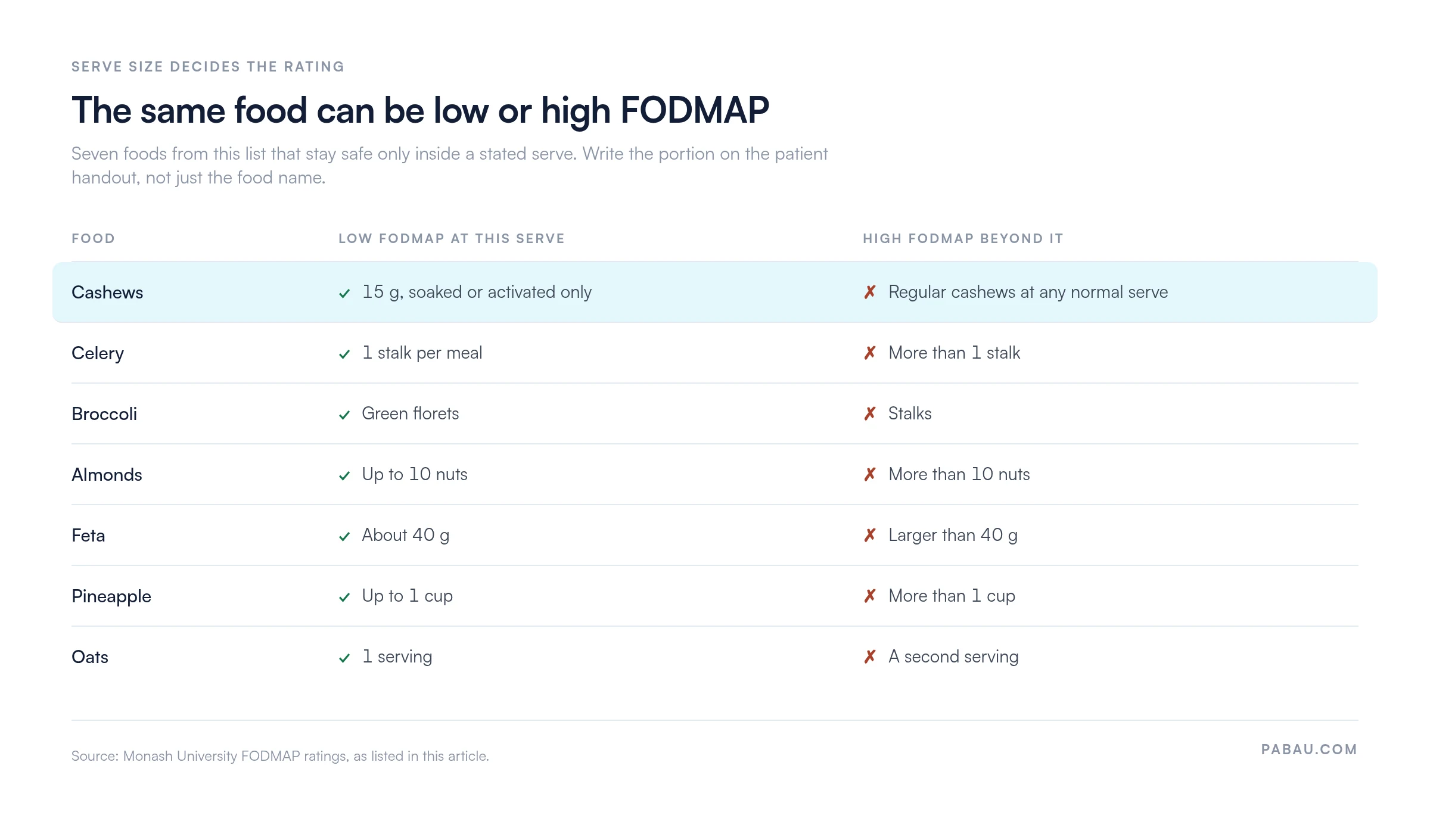
Portion size decides the rating, so a handout that names a food without its serve size will mislead the patient.
Practice management software like Pabau lets you share the list, track adherence, and record tolerance patterns in one system.
The FODMAP food list separates foods into low (safe) and high (trigger) categories based on how fermentable their short-chain carbohydrates are. FODMAP stands for fermentable oligosaccharides, disaccharides, monosaccharides, and polyols. These carbohydrates pass into the large intestine largely unabsorbed.
Gut bacteria ferment them there, producing gas and bloating. They also draw water into the bowel, which is what turns a meal into cramping and urgency a few hours later.
Patients with irritable bowel syndrome (IBS), small intestinal bacterial overgrowth (SIBO), or another functional GI disorder react to high FODMAP foods. The result is abdominal pain, distension, diarrhea, and constipation. A consultation structured around the list helps practitioners find and remove those triggers, which reduces flares and improves quality of life.
Low FODMAP foods are safe in standard portions during the elimination phase. Portion size is what decides the rating. One stalk of celery is low FODMAP, and two stalks are high. The reference below is organized by food group and follows Monash University FODMAP research, the authoritative source for food ratings.
Low FODMAP and gluten-free are separate restrictions, so check certified products rather than assuming the two overlap. A patient who needs both can work from a gluten-free diet plan alongside this list.
High FODMAP foods are the primary trigger sources, and they are removed completely during the elimination phase of 2-6 weeks. Each one carries fermentable carbohydrates at concentrations shown to provoke GI symptoms in susceptible patients.
The low FODMAP diet runs as a three-phase protocol, and each phase has its own clinical objective. Success rests on patient adherence and on systematic tracking of the symptom response.
The elimination phase removes all high FODMAP foods to establish a symptom-free baseline. Most practitioners recommend 2-6 weeks under dietitian supervision, depending on symptom severity. Patients eat only low FODMAP foods and beverages, and they record symptom frequency, severity, and suspected triggers.
A printable food diary template keeps that record consistent enough to read back at the next appointment.
Once symptoms settle, reintroduction tests one high FODMAP food at a time over 3-7 days. Monash and clinical guidance put the full reintroduction process at roughly 6-8 weeks. Each food is tested in increasing portions, and the symptom response is documented against the portion that produced it.
Many patients discover during this phase that they tolerate small quantities of foods they had cut out entirely.
The personalization phase builds each patient’s own tolerance map. The aim is a sustainable long-term diet that keeps food variety as wide as possible while symptoms stay quiet. Many patients bring back 50-70% of previously avoided foods at lower portions.
The downloadable PDF is formatted for practice use. Print it, share it through a secure patient portal, or attach it to your consultation notes.
Handing the list over once is not patient education. Weight loss practices that already run structured diet programs have most of this workflow in place, and the same five steps apply to FODMAP work.
Small intestinal bacterial overgrowth overlaps with IBS but has a different mechanism. The excess bacteria sit in the small intestine itself, rather than arising from colon dysbiosis. The low FODMAP diet is one of several dietary approaches used for SIBO, and it is usually combined with further restrictions.
Antimicrobial or probiotic protocols run alongside it under gastroenterology supervision. For SIBO-specific guidance, follow the patient’s gastroenterologist and Cleveland Clinic low-FODMAP diet guidance, because SIBO management is more nuanced than IBS dietary modification alone.
Dietitian supervision is strongly recommended. This list is a comprehensive reference, but individual FODMAP tolerance varies widely from patient to patient.
A registered dietitian experienced in the low FODMAP protocol can tailor elimination timelines, portion guidance, and reintroduction sequencing. That tailoring is what holds adherence together across the 8-14 weeks the full protocol usually takes.
Food ratings are revised as new testing data arrives, so check the Monash University FODMAP app before you print an updated handout. A nutrition assessment form captures the dietary history and symptom baseline you will measure that progress against.
Most practices email the list as a PDF attachment and then wait for the patient to bring a paper diary to the next appointment. The diary gets lost, the elimination start date lives in somebody’s memory, and the reintroduction schedule is rebuilt from scratch at each visit.
Pabau keeps the whole program on one patient record. You share the food list through the patient portal and collect the food and symptom diary as a digital form. Each response then sits beside the appointment it belongs to.
The result is a tolerance map you can read in seconds at the next consultation. Nobody retypes a diary, and the reintroduction sequence picks up where the last visit left it.

Share the food list through the patient portal, collect food and symptom diaries as digital forms, and keep tolerance notes on the patient’s record.

The FODMAP food list turns IBS management from trial and error into a structured three-phase protocol. Eliminate the triggers, reintroduce them one at a time, then personalize what the patient keeps.
Applied under supervision, that sequence brings significant symptom relief to 50-76% of IBS patients. The trade-off worth remembering is the portion line. A food named on a handout without its serve size will send a patient straight back into symptoms.
Download the free PDF above and pair it with a dietitian’s supervision. Then book a demo to see how Pabau keeps the diary, the notes, and the tolerance map on one record.

Managing a different GI trigger list? Diverticulitis diet plan sets out the same eliminate-then-rebuild structure for a different condition.
Need a gentler starting point? Bland diet food list template gives patients a short, low-irritant food list while symptoms are still acute.
Is reflux in the picture too? 7-day GERD diet plan maps a week of meals for patients whose symptoms overlap with reflux.
Rebuilding fiber after elimination? High fiber diet plan helps you raise intake again without undoing the reintroduction work.
It guides dietary management of irritable bowel syndrome and other functional GI disorders by naming the foods that trigger digestive symptoms. Patients remove the high FODMAP foods during the elimination phase, then reintroduce them one at a time to find their own tolerance thresholds.
Yes. The Monash FODMAP app was developed by Monash University’s Department of Gastroenterology and is the gold standard for food ratings. Its researchers test foods continuously and update the app as new data arrives, which makes it the most reliable reference for clinicians and patients.
The elimination phase typically lasts 2-6 weeks under dietitian supervision, depending on symptom severity and response. Some patients see symptoms resolve within 2-3 weeks. Others need the full 6 weeks to reach a clear symptom-free baseline before reintroduction testing begins.
It may reduce symptoms in some SIBO patients, but SIBO management is more complex than IBS dietary modification. Most cases also need antimicrobial treatment, probiotics, and specialized gastroenterology guidance. SIBO patients should build a personalized protocol with a gastroenterologist and a dietitian.
The two address different conditions. Low FODMAP targets fermentable carbohydrates to reduce IBS symptoms, while gluten-free removes gluten protein for celiac disease and gluten sensitivity. Rice is both low FODMAP and gluten-free, but many foods sit in only one category, so the overlap is never automatic.
Regular cashews are high FODMAP at any normal serve, so they belong on the avoid list during elimination. Only activated or soaked cashews reach a low FODMAP rating, at a serve of about 15 g. Almonds are the safer nut here, at up to 10 nuts per serving.