Physician credentialing checklist
A physician credentialing checklist lists every license, certificate, verificati...

Last Updated: Oct 23, 2026

A gluten free nutrition plan removes all wheat, barley, rye, and their derivatives, and it treats celiac disease and gluten sensitivity.
B vitamins, iron, calcium, fiber, and vitamin D run low on a gluten-free diet, because most substitute grains are not fortified.
Trace gluten from a shared toaster or fryer can still damage the intestine, so label literacy is a clinical skill.
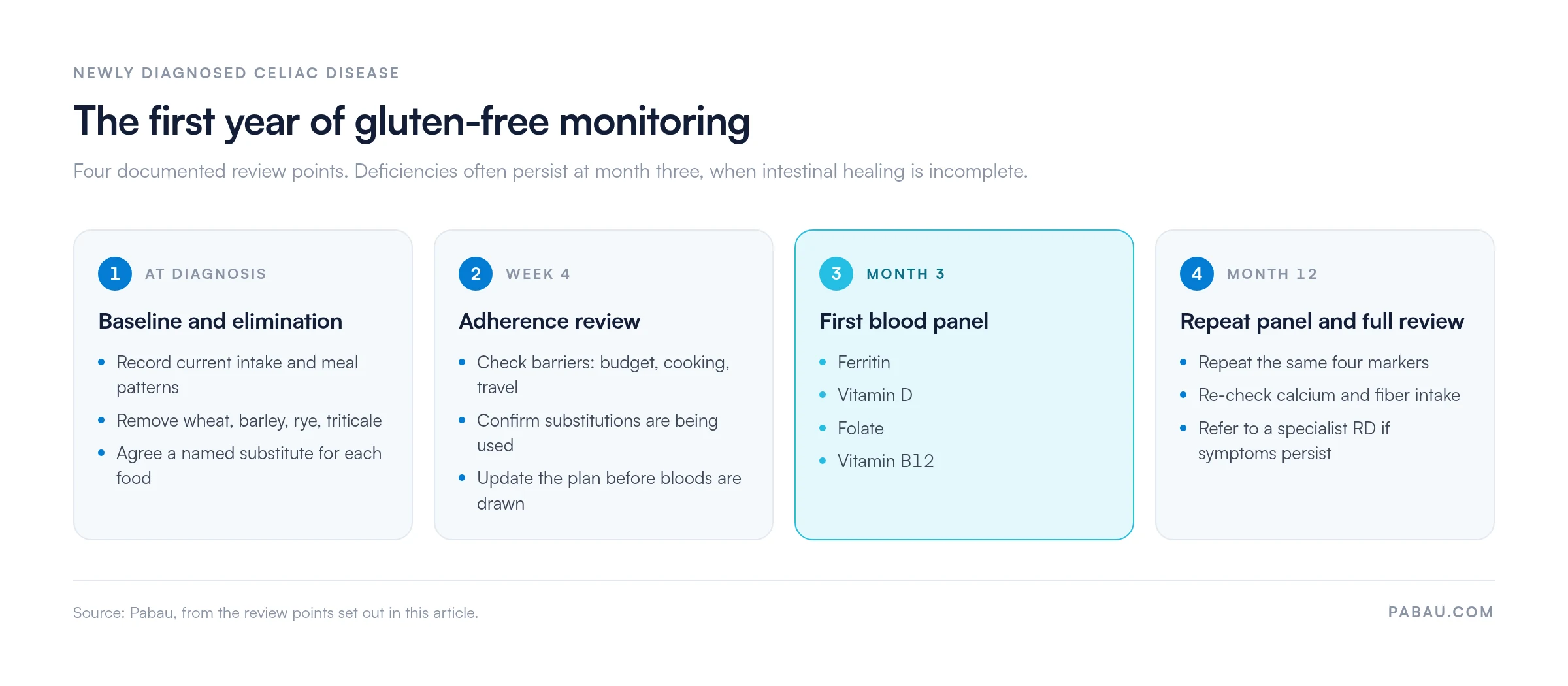
Book the first blood panel at three months and repeat it at twelve, testing ferritin, vitamin D, folate, and B12.
Practice management software like Pabau keeps the plan, the food diary, and the review dates in one patient record.
A dietitian-ready form covering baseline dietary intake, the foods to eliminate, agreed substitutions, a 7-day meal grid, and adherence barriers. It closes with a review section for the follow-up appointment.
Download templateFor a patient with celiac disease or non-celiac gluten sensitivity (NCGS), diet is the treatment. According to the National Institute of Diabetes and Digestive and Kidney Diseases (NIDDK), a strict gluten-free diet is the only approved treatment for celiac disease. Plenty of patients still leave the consultation with a verbal instruction and no written plan.
This template gives dietitians and practice teams a documentable starting point for that conversation. Below you get what the plan covers and how to work through it in a consultation. Then come the nutrients worth monitoring in year one, and when to refer on.
A gluten free nutrition plan is a structured dietary framework that removes all foods containing wheat, barley, rye, and their derivatives. That includes triticale, a wheat-rye hybrid that patients rarely recognize on a label. It is the medical standard of care for celiac disease and the usual approach for NCGS.
It is also used in autoimmune conditions such as Hashimoto’s thyroiditis, where some emerging evidence suggests benefit. Present that to patients as an area of ongoing research rather than settled protocol.
Unlike a general healthy-eating plan, this one needs ongoing clinical oversight. Patients have to spot hidden gluten in processed foods and manage cross-contamination at home and when eating out. They also have to make up the nutrients they lose once fortified grain products leave the shopping list.
Patients consistently underestimate how many foods contain gluten. The primary culprits are straightforward. The hidden sources are where adherence breaks down, so walk patients through both categories at the first consultation.
Under FDA regulations (21 CFR 101.91), a US packaged food labeled “gluten-free” must contain fewer than 20 parts per million (ppm) of gluten. Ask patients to log what they ate and how they felt between appointments. A food diary template turns that recall into something you can actually review at follow-up.
Whole, unprocessed foods are inherently gluten-free, and there is no shortage of safe grain substitutes. So this does not have to be a restrictive diet. The challenge is helping patients identify those foods and cook with them week after week.
Build the patient’s grocery list around these whole-food categories first. Packaged gluten-free products then work as supplements rather than the foundation of the diet, which keeps both cost and fiber intake in a better place.
The table below is a sample framework, not a prescriptive protocol. Adjust portions and calorie targets to each patient’s clinical needs, weight management goals, and any co-existing conditions.
Most gluten-free grain substitutes are not fortified the way conventional wheat products are. According to the Academy of Nutrition and Dietetics, people following a gluten-free diet run a measurable risk of deficiency in several key nutrients.
A registered dietitian (RD) should review the patient’s full dietary intake and consider blood panel monitoring. That matters most in the first 12 months after diagnosis. Keep supplement advice at the nutrient-category level and leave brand choices to clinical judgment.
When symptoms persist and the patient reports full adherence, check the medicine cabinet before you doubt the diet. Wheat starch is a common tablet excipient, and patients almost never count medication as food.
Label literacy is one of the most practical skills a dietitian can teach a newly diagnosed patient. Adherence rarely fails because someone chose to eat gluten. It fails because an unfamiliar ingredient name went unnoticed on a packet.
Send this checklist home with the patient rather than reciting it twice. A nutrition label worksheet gives them a packet to practice on, so the follow-up appointment can go straight to clinical review.
Cross-contamination is a clinically significant risk. Even trace gluten exposure at shared cooking surfaces can trigger intestinal damage in patients with celiac disease, according to Beyond Celiac. That applies in home kitchens and restaurants alike.
Risk of accidental exposure is highest in the first few months, while the habits are new. An automated reminder two weeks after the consultation takes no staff time and catches the slips early.
A structured template is a useful clinical starting point. Several patient presentations still warrant formal referral to a registered dietitian with specialist celiac or gastrointestinal experience.
Document why you referred and whether the review happened, so the care pathway stays visible to the whole team. Practices that run nutrition alongside weight management get the most from this. Purpose-built weight loss practice software keeps the dietitian’s plan and the physician’s notes in one record.
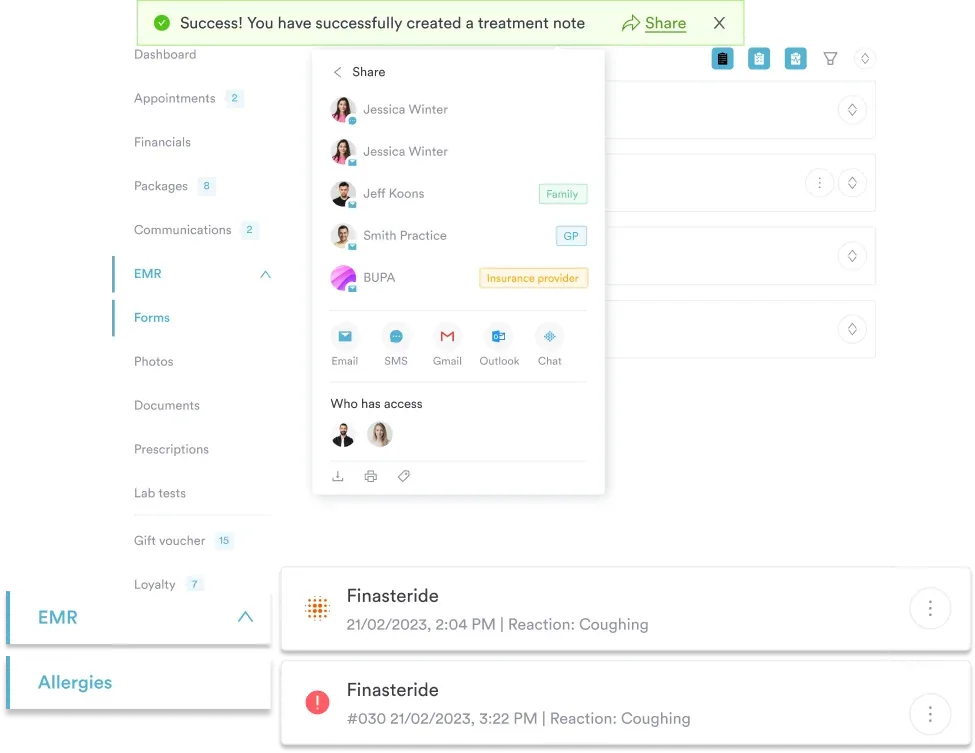
The form is built to follow a dietitian-led consultation from start to finish. The five steps below reflect how it is typically used.
Set the 4-week follow-up task the moment the plan is agreed. Reviewing adherence before the blood panel is drawn means you read the results against a diet the patient is actually following.
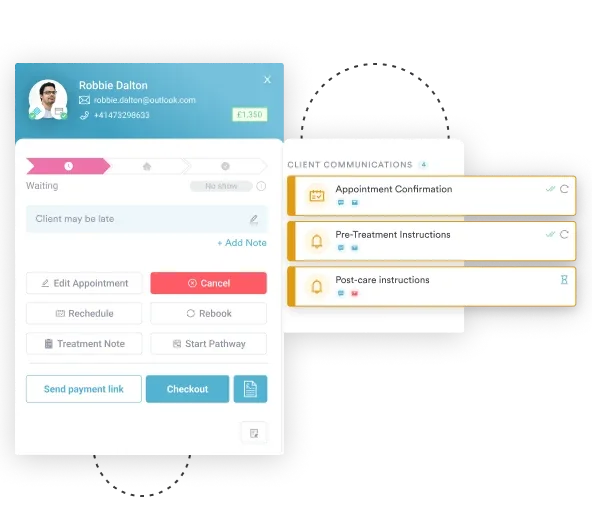
The template suits a range of clinical and wellness settings. These are the patient groups that get the most out of a documented, dietitian-supported plan.
Practices running metabolic health or longevity programs will find the template slots into a broader wellness assessment without much rework. That helps most with patients juggling several dietary restrictions at once.
In a lot of practices the nutrition plan is still a printed sheet. The patient takes it home and the practice keeps a photocopy. The food diary comes back as a verbal summary three months later. Nobody can see at a glance which patients are overdue a review.
Practice management software like Pabau handles it differently. You send the plan as a digital intake form and the patient completes it on their phone. The answers land in their record, next to the appointment history. The food diary, the substitutions you agreed, and the blood results all sit on one screen.
From there the follow-up runs itself. A 4-week adherence task and a 3-month panel reminder fire automatically, and any team member can see the referral status without chasing a colleague. So the dietitian spends the consultation on clinical review instead of reconstructing what was agreed last time.
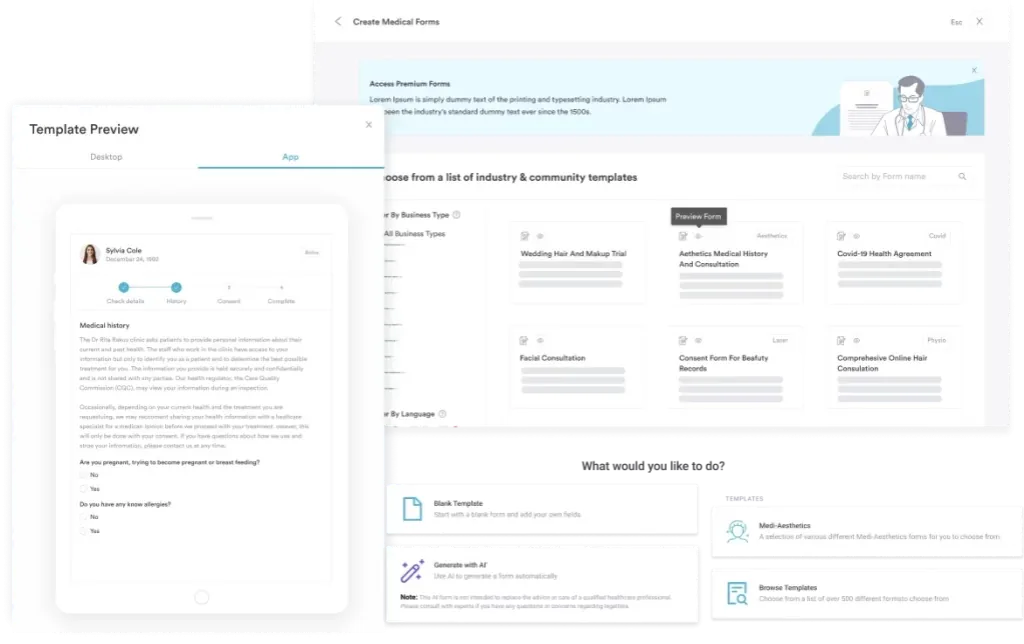

Pabau sends the plan as a digital form and files the completed version in the patient record. The 4-week and 3-month reviews trigger on their own. Your dietitian spends the appointment on clinical judgment.

The hard part of gluten-free care is not the first consultation. It is month four, when the patient has stopped reading labels closely and nobody has looked at their ferritin. A written plan with dated review points is what stops that drift, and it is the difference between advice given and treatment delivered.
Download the template, use it in the next new diagnosis you see, and set the 4-week review before the patient leaves. The trade-off is worth naming: this takes about ten extra minutes in the room and saves a wasted blood panel later. Book a demo to see how Pabau keeps nutrition plans, food diaries, and review dates in one patient record.

Need to document the consultation itself, not just the plan? Nutrition SOAP note gives you a structured format for recording assessment, intervention, and review in the patient record.
Seeing patients with autoimmune thyroid or inflammatory conditions? Anti-inflammatory meal plan covers a dietary pattern that overlaps with gluten-free eating for several of the same patients.
Managing a patient whose symptoms point at the gut rather than gluten? Diverticulitis diet plan sets out a staged dietary approach for a different gastrointestinal presentation.
Want a quick reference for the whole nutrition caseload? Nutrition cheat sheet pulls the numbers a dietitian reaches for most often into a single page.
A gluten free nutrition plan is a structured dietary framework that removes wheat, barley, rye, and their derivatives. It replaces them with naturally gluten-free whole foods and certified gluten-free alternatives. It is the primary treatment for celiac disease, and it is also used for non-celiac gluten sensitivity and certain autoimmune conditions. A dietitian typically documents current intake, safe substitutions, a weekly meal plan, and follow-up review dates.
Avoid all foods containing wheat, barley, rye, and triticale. That covers bread, pasta, most cereals, baked goods, beer, malt vinegar, and conventional soy sauce. Hidden sources include soups, gravies, processed meats, and some medications. Standard oats are excluded unless certified gluten-free, because cross-contamination is common in conventional oat processing.
B vitamins, iron, calcium, dietary fiber, and vitamin D are the nutrients most often found low. Folate and B12 are the B vitamins to watch. This happens because many conventional grain products are fortified and most gluten-free substitutes are not. Run a blood panel at three months and again at twelve months after diagnosis.
In celiac disease, a strict gluten-free diet lets the intestinal lining heal, reduces malabsorption, and resolves most gastrointestinal symptoms over time. In non-celiac gluten sensitivity it usually reduces bloating, fatigue, and abdominal discomfort. Some people lose weight as a side effect. The diet is not an evidence-based weight loss intervention for the general population.
Working with a registered dietitian is strongly recommended, particularly after a new celiac diagnosis. A dietitian can screen for deficiencies, personalize the plan, and spot the hidden gluten sources a patient is still eating. Ongoing support also improves long-term adherence. This template is a clinical starting point rather than a substitute for professional guidance.
Use dedicated gluten-free cookware, cutting boards, and toasters at home, and store gluten-free products separately from foods that contain gluten. When eating out, call ahead and ask about shared fryers and preparation surfaces. In celiac disease, even trace exposure at a shared surface can trigger intestinal damage, so speaking to kitchen staff directly matters.