Physician credentialing checklist
A physician credentialing checklist lists every license, certificate, verificati...

Last Updated: Oct 23, 2026
A family medical leave form is the paperwork employers use to request, certify, and approve leave under the Family and Medical Leave Act (FMLA).
It records the employee’s request, the healthcare provider’s certification, and the employer’s eligibility and designation decisions.
The US Department of Labor (DOL) publishes optional prototype forms, and employers may use their own version if it asks for the same information. The template below brings those pieces into one form your practice can customize, with the deadline each party has to meet.
A printable form with an employee request section, a healthcare provider certification section, and an employer section for eligibility and designation. Add your practice’s details and hand it to staff when they ask for leave.
Download template
A family medical leave form records the employee’s request, the provider’s medical certification, and the employer’s eligibility and designation decisions.
The DOL’s WH-380-E, WH-380-F, WH-381, WH-382, WH-384 and WH-385 are optional prototypes, so employers can use their own form with the same information.
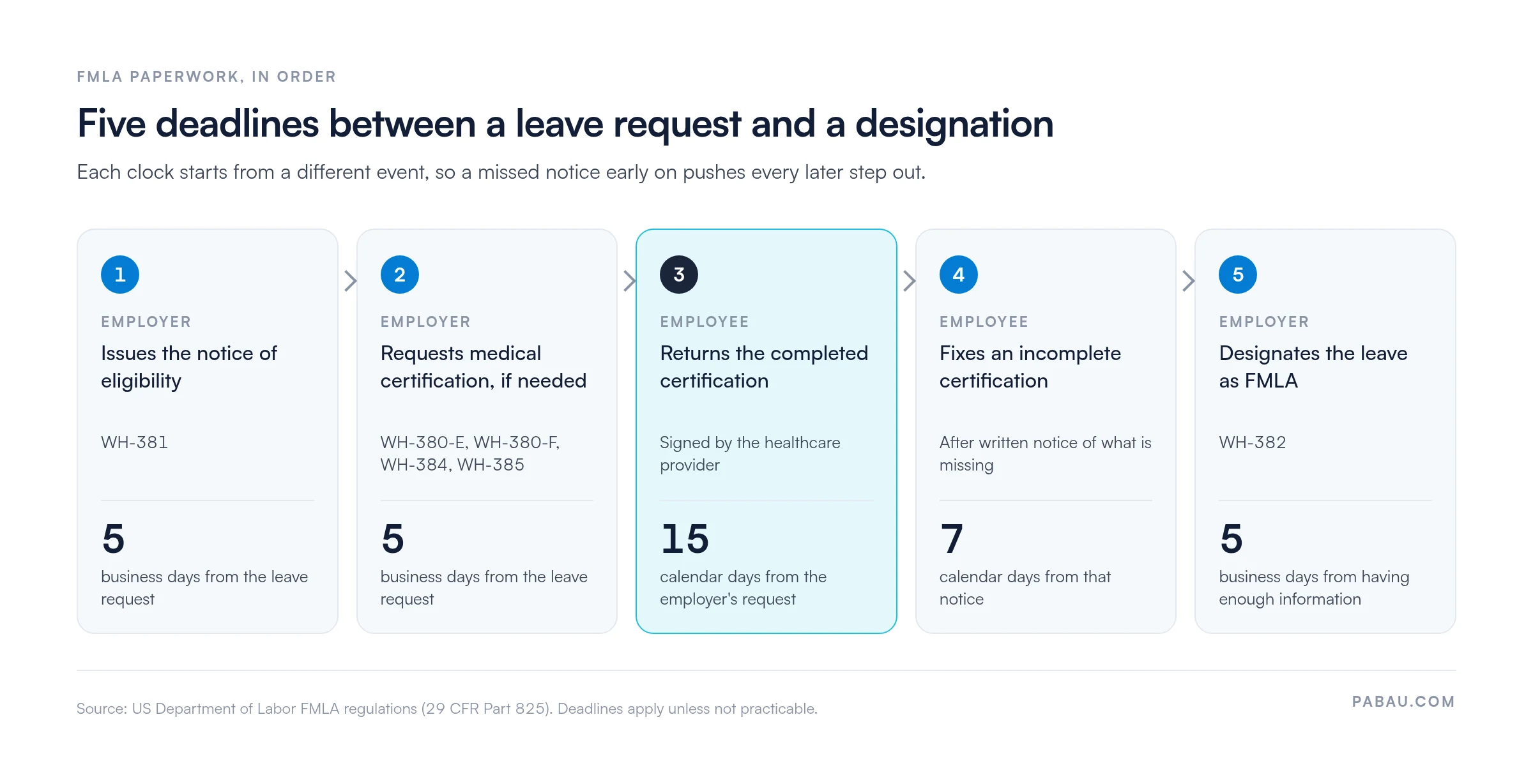
Employers issue the eligibility notice within 5 business days of a request and designate leave within 5 business days of having enough information.
Employees get 15 calendar days to return a medical certification and 7 calendar days to fix an incomplete one.
FMLA covers practices with 50 or more employees within 75 miles, but smaller practices still benefit from documenting every leave request.
It is the written record of an employee’s request for job-protected leave under the FMLA. The record shows that the employer received the request, checked eligibility, asked for certification where allowed, and designated or denied the leave on time.
The FMLA is administered by the DOL’s Wage and Hour Division. Covered employers must give eligible employees up to 12 workweeks of unpaid, job-protected leave in a 12-month period. Qualifying reasons include:
FMLA leave is unpaid. Several states, including Washington, Massachusetts, and Minnesota, run separate paid family and medical leave programs with their own claim forms. A practice in those states may handle two sets of paperwork for one absence.
The DOL publishes prototype FMLA forms, and these six cover most leave requests. Your own template can replace them, as long as it collects the same information.
A leave request moves through five stages, from the employee’s request to the signed records in their file. Each stage has its own clock, and the timeline below shows how the deadlines stack up.
When an employee requests leave for their own serious health condition, the employer may require a completed WH-380-E medical certification. The provider describes the relevant medical facts, the likely duration, and how often treatment or incapacity will occur.
The employer can’t ask for more than the certification covers. If an answer is unclear, an HR professional, leave administrator, or healthcare provider may contact the certifying provider to clarify it. The employee’s direct supervisor may not make that call.
That rule matters in a medical practice. If a nurse reports to the practice’s medical director, the director can’t phone the nurse’s doctor about the form, even as a fellow clinician.
For a family member’s care, the WH-380-F follows the same 15-day return rule. It also confirms that the spouse, child, or parent needs the employee’s care.
A complete leave file has three sections, each owned by a different person. Knowing who fills in what prevents most errors and missed deadlines.
Digital leave documentation cuts manual form handling. Details carry over between sections, finished PDFs are filed automatically, and reminders go out when a certification is due back.
FMLA compliance hinges on timing. The DOL sets separate clocks for the employer’s notices and the employee’s certification.
The 15-day and 7-day windows can stretch when the employee is making diligent, good-faith efforts. Log each extension and the reason for it in the leave file.
FMLA applies if your practice has 50 or more employees within 75 miles of the worksite. A solo practice or a 10-person practice isn’t covered, but a multi-location group with 50 or more staff in that radius is.
Documenting leave still protects a smaller practice. A standard form creates a consistent record if a dispute arises. Many practices also write the process into their employee handbook, so staff know how to ask.
Planned leave gives you time to cover shifts before patients feel it. Block the dates on a shared staff work schedule as soon as leave is approved, so no bookings land on an absent clinician.
FMLA includes two military-related leave types, each with its own form.
These errors come up in DOL investigations and employee disputes, and each one has a simple fix.
The DOL’s Wage and Hour Division enforces the FMLA, and employees can also take a claim to court. In an investigation, the first request is usually the leave file: requests, certifications, notices, and the dates taken.
Leave often overlaps with laws the EEOC enforces. A serious health condition may also be a disability under the Americans with Disabilities Act (ADA), as the EEOC’s FMLA and ADA guidance explains. A complete file shows how each request was handled under every law that applies.
In many practices, leave lives in a shared inbox, a paper folder, and one person’s memory of when a certification is due back. When the practice manager is out, the deadlines go with them.
With all-in-one practice management software like Pabau, leave paperwork sits next to the schedule it affects. Staff request time off through Pabau’s team management tools, a manager approves it, and the approved leave shows up in the schedule straight away.
You can upload each signed form to a folder against the staff member it belongs to. Tasks with due dates chase the certification that hasn’t come back, so the 5-business-day designation window doesn’t depend on anyone’s memory.
The result is a leave file you can hand over in minutes, and a schedule that already shows who is out.

Pabau handles time-off approvals, stores signed leave forms against each staff member, and chases certifications before the deadline passes.

The form itself is simple. The calendar is where employers slip, because five separate clocks start from different events and one late notice pushes back the rest.
Download the template, add your practice’s details and leave policy, and decide now who owns each deadline. If you’re under the 50-employee threshold, use it anyway. The habit costs little, and the record protects you if a dispute ever comes.
For questions about your practice’s size or structure, check the DOL’s FMLA guidance or speak with employment counsel. Book a demo to see how Pabau tracks time off, leave forms, and certification deadlines in one place.

Documenting a conversation about attendance? Employee counseling form gives you a structured record of the issue, the expectations, and the follow-up.
Need a fair, documented process for performance concerns? Performance improvement plan template sets out targets, support, and review dates in one document.
Seeing more stress-related leave requests? Burnout in healthcare covers the warning signs and what practice leaders can change.
Running yearly staff reviews? Annual review template helps you record performance and goals the same way across the team.
The employee completes their section with their name, role, reason for leave, and expected dates. Within 5 business days, the employer issues the WH-381 eligibility notice. For medical leave, the employer can request the WH-380-E or WH-380-F, which the employee returns within 15 calendar days. Within 5 business days of having enough information, the employer issues the WH-382 Designation Notice. All forms go into the leave file with dates and signatures.
The provider completes the WH-380-E or WH-380-F with their contact details and the relevant medical facts. They add the dates of treatment or hospitalization, how often ongoing treatment will occur, and how long the condition is likely to last. They also confirm it meets the FMLA definition of a serious health condition. Examples include inpatient care, incapacity of more than three consecutive days with continuing treatment, or a chronic condition that needs periodic visits.
No. The FMLA regulations don’t allow medical certification for bonding leave after a birth or placement. The employer may ask for reasonable documentation of the family relationship, such as a birth certificate or adoption papers. Medical certification applies to serious health conditions and military caregiver leave.
The employer issues the WH-381 within 5 business days of a leave request. The employee returns any requested certification within 15 calendar days and gets 7 calendar days to fix an incomplete one. The employer designates the leave with the WH-382 within 5 business days of having enough information. Missing these deadlines can expose the employer to an FMLA interference claim.
If a certification is incomplete, the employer must say in writing what is missing and give the employee 7 calendar days to fix it. If no certification arrives within 15 calendar days and the employee hasn’t made good-faith efforts, the employer may deny FMLA protection until it arrives. Record every follow-up attempt in the leave file.