Fertility clinic marketing: Strategies that attract & convert patients
Fertility clinic marketing is how a fertility practice attracts, educates, and c...

Last Updated: Oct 14, 2026
A marketing plan template for event promotion is a fill-in document that sets out who your practice event is for and what it should achieve.
For an open day, workshop or treatment showcase, it puts your goals, channels, budget, timeline and follow-up in one place.
Our free template gives you the frame. It has a goals table, an actions table with owners and review dates, and a review record. Below, you’ll find what each part of the plan should cover, how to fill it in and a sample eight-week campaign timeline.
A printable one-page PDF with space for the event background and up to five goals, each with a measure and a target date. An actions table records owners, start dates and review dates, and a review record at the end tracks progress and changes.
Download template
A marketing plan template for event promotion puts your goals, audience, channels, budget, timeline and follow-up on one page.
Set separate targets for registrations and for consultations booked, because not every attendee will become a patient.
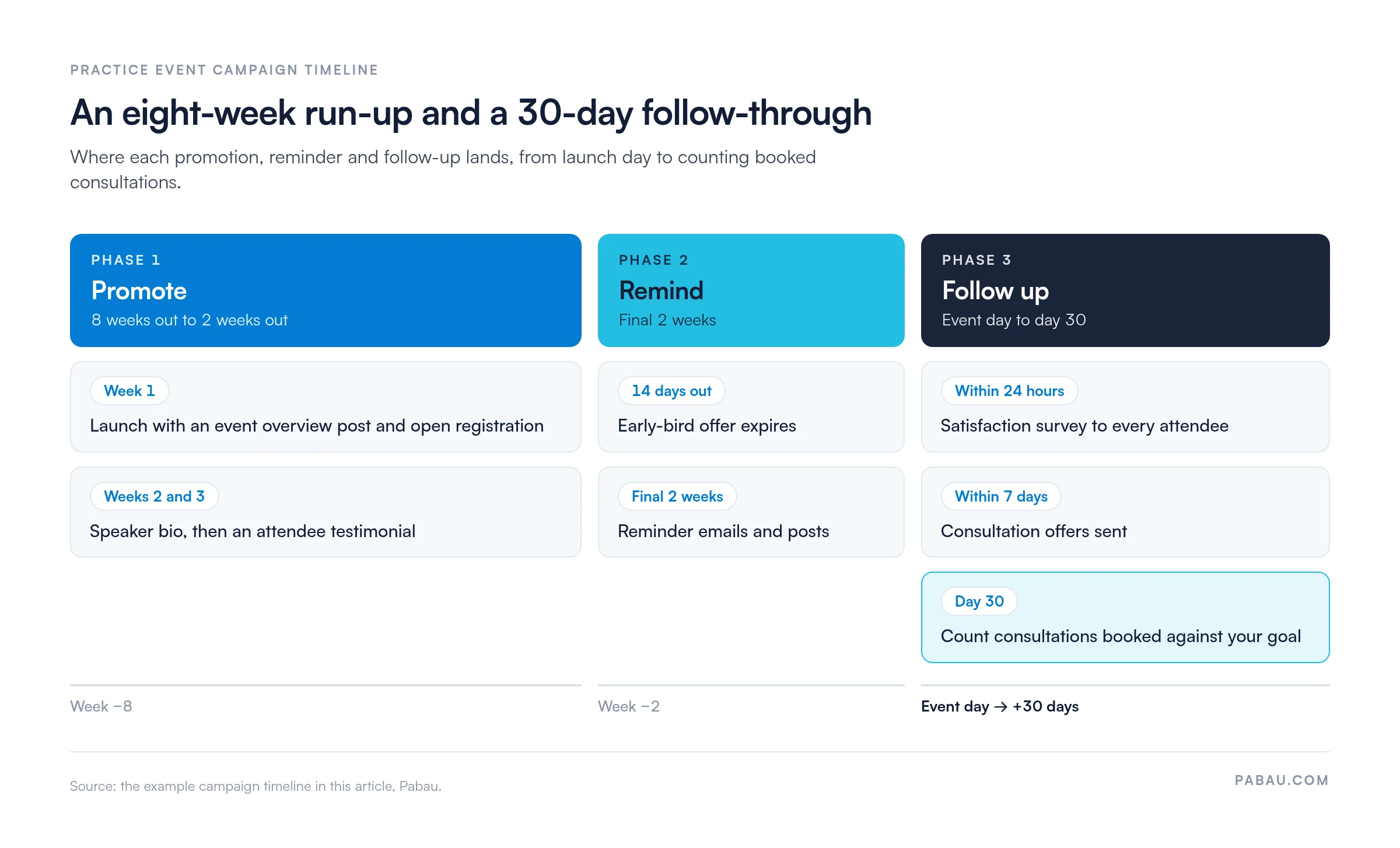
Launch promotion about eight weeks out, run a reminder push in the final two weeks, and send consultation offers within seven days.
Get written consent before using patient photos or testimonials in any event promotion.
Practice management software like Pabau can send the reminders, surveys and consultation offers once the plan is signed off.
An event marketing plan template is a document that walks you through promoting a practice event. That might be a Botox workshop, a patient appreciation open day or a fertility information evening. It records the event’s purpose, who you want in the room, the budget, the channels, the timeline and how you’ll measure results.
Practices use events to build patient relationships, earn word-of-mouth referrals and show clinical expertise. Writing the plan down keeps your messaging consistent across every channel. It also makes you decide early how you’ll collect attendee details in line with HIPAA or GDPR.
An event plan uses the same building blocks as your wider marketing for clinics, scaled down to a single date. Whatever tool you write it in, a complete plan covers the nine areas below.
The template is a printable PDF. Fill it in by hand at a planning meeting, then share the finished copy as the signed-off plan. Work through these five steps in order.
If social media carries most of your promotion, a separate social media marketing plan maps each post in more detail. Laid out as a timeline, a typical campaign runs in three phases, and the last one is where attendees become booked consultations.
Assign each section to a named person. Your practice manager might own the timeline and budget, a marketing coordinator the content and channels, and your receptionist registration and follow-up.
Open days, treatment showcases and expert talks are a staple of med spa marketing, because they build awareness and let people try a treatment. Promoting them comes with compliance rules. Get written consent before using patient photos or testimonials, be honest about treatment limitations and never guarantee outcomes.
From there, weight the plan toward the sections that matter most for your event type.
Without a written plan, event promotion drifts. Posts go out unevenly, spend goes untracked and follow-up emails never get sent. A plan documents and assigns each step, from the first teaser to the last follow-up message.
The bigger payoff comes after the event. With registrations, attendance and consultations booked recorded against your targets, you can see which channels earned their budget. That record gives your next event a stronger starting point.
Once the plan is signed off, most of the work is sending the right message on time. Invitations, reminders, thank-you notes and consultation offers all fall to your front desk, squeezed in between patients.
Practice management software like Pabau runs that sequence from the patient records you already hold. Its built-in clinic marketing software sends email and SMS campaigns to a filtered patient list. Online booking then lets attendees book their consultation straight from the offer.
Automated workflows handle the timing. They can send the satisfaction survey the day after the event and the consultation offer within the week, so your follow-up lands on schedule. Reporting then shows how many attendees booked, which gives your review record its numbers.

Pabau sends your event invitations, reminders and consultation offers from the patient records you already hold. Online booking then lets attendees book their consultation on the spot.

An event only pays off if the follow-up happens, and that is the part a written plan protects. Set your consultation target before you set your budget, and give every action a named owner.
Start with the template for your next event, even a small one. Its review record becomes the baseline for the event after it. Book a demo to see how Pabau sends your event reminders and consultation offers automatically, so fewer attendees drift away after the day.

Need a plan for the rest of the year? Healthcare marketing plan template gives you a year-round plan your events can slot into.
Running most of the promotion on Instagram? Social media marketing plan template maps posts, formats and timing across your channels.
Building a wider marketing strategy? Marketing plan for private practice walks through goals, budgets and channels step by step.
Want more new patients from each event? Patient acquisition strategies covers the tactics that turn interest into first appointments.
Tracking where your leads come from? Healthcare lead generation strategies explains how to capture and follow up on enquiries from every channel.
An event marketing plan covers nine areas: the event overview, goals, target audience, channels, budget, campaign timeline, content calendar, registration and post-event follow-up. Each one needs an owner and a deadline.
Define the event and its SMART goals, then build two or three attendee personas. Choose channels, split the budget, and map a timeline from eight weeks before the event to 30 days after. Finally, decide which metrics you’ll review and assign each section to a team member.
Use SMART goals, which are specific, measurable, achievable, relevant and time-bound. “50 registrations” is specific, while “lots of attendance” isn’t. Base your targets on past events and measure them within 30 days. Set separate registration and consultation targets, because not every attendee will book.
Compare your cost per registration with your cost per acquired patient. Cost per registration is the total budget divided by registrations. Cost per acquired patient is the budget divided by consultations booked within 30 days. Track email opens and registration clicks too, and survey attendees to learn which channels brought the best leads.
A marketing plan covers how you attract and convert attendees, from audience and channels to messaging, budget and follow-up. An event planning checklist covers logistics such as the venue, catering, speakers and A/V setup. You need both. The plan fills the room, and the checklist makes sure the day runs smoothly.
Most practice events need a mix of four channels. Email reaches your existing patients, and social media builds awareness. Paid ads on Google or Meta reach people beyond your followers, and word of mouth brings in friends of current patients. Choose the combination that fits your audience and budget.