CRM for chiropractors: how to manage patients, bookings and marketing
A CRM for chiropractors is a patient relationship management system built around...

Last Updated: Oct 13, 2026

A performance improvement plan (PIP) is a formal HR document that sets out the performance problem, the goals, and the timeline for fixing it.
An effective PIP names measurable targets, action steps, the support on offer, a check-in cadence of 30 to 90 days, and the consequences.
Healthcare plans also have to cover clinical competency, patient safety standards, and the rules you work under, such as CQC, HIPAA, and ACAS guidance.
Before you issue a plan for missed paperwork, check whether the software or the schedule caused the problem.
Pabau keeps staff records, check-in notes, and documentation audits in one place, so your PIP evidence stays defensible.
This editable plan covers employee details, the performance concern, SMART goals, and the support on offer. It also includes timeline milestones, a manager check-in schedule, and the consequences of no improvement.
Download templateA performance improvement plan (PIP) gives a practice manager a documented way to address an employee’s performance without going straight to discipline. It sets out the problem, the target, the support on offer, and the deadline. The employee knows what has to change and by when.
The template above is ready to fill in. The rest of this page explains how to complete each section and how to word goals that hold up under scrutiny. It also covers where healthcare plans differ from the generic HR version.
A performance improvement plan is a formal, documented process for addressing specific performance problems. It names the problem, sets out a route to improvement, and defines how success gets measured.
For healthcare staff, including nurses, clinicians, and administrative staff, it also records expectations tied to clinical governance and patient safety.
A PIP serves two purposes at once. It gives the employee a fair chance to improve, and it documents the process for the practice.
Under UK employment law and ACAS guidance, a well-documented plan strengthens your position if dismissal later becomes necessary. In the US, at-will employment means a plan is not required. It still shows that you followed a fair process.
Not every performance problem warrants a formal plan. Use a PIP when:
For clinical teams, a plan works well for weak clinical documentation, infection control adherence, patient communication.
It fits front-desk work too. It is the wrong tool for disputes about scope of practice or for clinical decisions that need a fitness-to-practice review.
Missed notes and unsigned forms often trace back to the workflow rather than the person. Check three things before you formalize anything. Was the employee ever trained on the software? Is the template they need buried several clicks deep? Does their schedule leave any time to chart at all?
Then run the same report for the whole team. If four of six clinicians miss the same 24-hour note deadline, you have a process problem rather than an individual one. A plan issued in that situation tends to fail, and it costs you trust with everyone else.
If the check clears and the shortfall belongs to one person, you have the evidence a plan needs. That evidence is also what makes the plan defensible months later. Where the software is the obstacle, structured EHR training is the cheaper first move.
A patient management platform stores every completed form against the right patient record automatically.
Every effective plan includes the following sections:
Alongside those sections, the plan records the employee’s own details, such as role, start date, and reporting manager. Keep those current on an employee information form so the plan matches your staff record.
Follow this process to produce a plan that is both supportive and legally sound:
The difference between a vague plan and one that works usually comes down to goal wording. SMART goals remove ambiguity and give the employee a target they can hit.
Therapy teams already write goals this way.
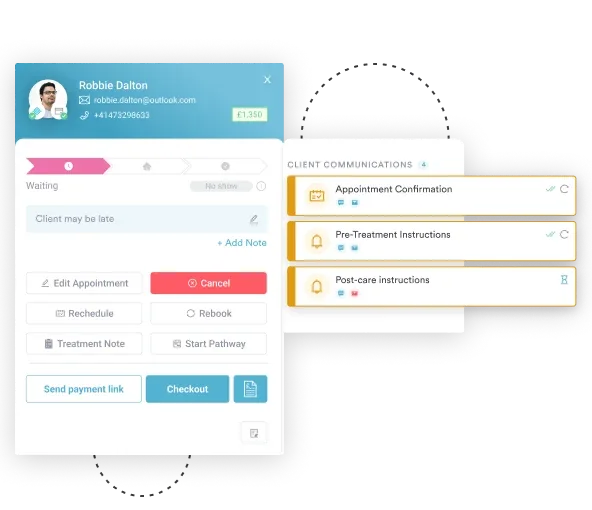
Most plans run 30, 60, or 90 days, and the length follows the severity of the issue. Practice managers can use automated workflows to schedule and track every check-in meeting, so the documentation stays consistent from day one to day 60.
A typical 60-day schedule looks like this:
Scenario: a nurse practitioner in one of your dermatology practices has missed follow-up appointments for three weeks running. Post-treatment notes are also incomplete, which breaks continuity of care for those patients.
A well-documented plan protects the employee and the practice at the same time. Some legal obligations apply either way.
UK context: under the Employment Rights Act 1996 and ACAS guidance, employees are entitled to fair treatment during performance management. A plan does not make a later dismissal fair on its own. Sound documentation and a consistent process are what strengthen your position, and staff should be able to bring a representative to meetings.
US context: in at-will employment states a plan is discretionary but advisable, because it creates a clear business record. The EEOC requires that plans never discriminate on protected characteristics such as age, race, gender, or disability.
For staff in regulated settings, including CQC-registered practices in the UK, performance records feed straight into the “well-led” key question.
A PIP is supportive and developmental, and it exists to help the employee improve. Disciplinary action is punitive, and you use it when someone has breached conduct standards. The two processes are related, and they are not interchangeable.
Most practices run this process across three disconnected places. The plan sits in a shared drive and the check-in notes live in a manager’s inbox. The evidence stays in the clinical system that nobody exports from. Six weeks later, nobody can show what was agreed on day 15.
Practice management software like Pabau closes that loop. Note completion and appointment history come from the same system the employee uses every day. Your success criteria get measured rather than argued about.
Achievable targets need honest baselines, and that is where per-staff scheduling helps. The same setup works in a med spa or a physical therapy practice.
The outcome is a plan you can defend. Every check-in, note, and audit result sits in one timeline, and you spend the review meeting talking about the work rather than hunting for proof.

Track the note completion and appointment data your plan depends on. Keep every check-in in one auditable record, and stop assembling HR paperwork by hand.

Fill the template in with numbers you can pull from a report, not adjectives. A plan built on measured note completion or booked follow-ups gives the employee something to aim at. It also gives you something to stand behind if the outcome is dismissal.
The trade-off worth remembering is time. Daily note reviews and weekly 1:1s are expensive for a manager, so only start a plan you intend to run properly. A half-run plan is worse than no plan, because it reads as evidence that you tolerated the shortfall.
Book a demo to see how Pabau keeps staff records, check-in notes, and documentation audits in one auditable place.

Need to document informal feedback first? The employee counseling form records the conversation that has to happen before a formal plan.
Hiring to fill the gap? LPN interview questions are written for the person doing the hiring, not the candidate.
Also reviewing a physician’s contract? Physician non-compete agreements are void in at least 14 states, so check where your contract stands.
Standardizing performance reviews across sites? Annual review template comes with sample comments, SMART goal examples, and ready-to-use review questions.
Assigning tasks across a CNA shift? CNA daily assignment sheet gives every CNA a clear structure for patients, tasks, and care requirements each shift.
A PIP is a formal HR document that names specific performance problems, sets measurable improvement goals, and fixes a timeline. It also records the check-in schedule and the consequences of no improvement.
Most plans run 30, 60, or 90 days, and the length follows how serious and how complex the issue is. Check in weekly or biweekly so progress is never a surprise at the end.
Yes, if the employee misses the documented targets and the process was run fairly throughout. Clear records of each check-in are what make that dismissal defensible.
A PIP is supportive and developmental, and it aims to help the employee improve. Disciplinary action is punitive, and it addresses conduct breaches or rule violations.
Under UK employment law, employees are entitled to fair treatment and clear written documentation. They can bring a support person or representative to meetings. They must also be told what happens if performance does not improve, and be given adequate support.
SMART goals are specific, measurable, achievable, relevant, and time-bound. One example is completing 100% of post-treatment notes within 24 hours by the end of week 4.