Free model waiver form + what it is and when your practice needs one
A model waiver form is a signed document that lets a healthcare practice use a p...

7
Last Updated: Sep 29, 2026
A facial skin treatment consent form is the signed proof that a patient was screened, warned about the risks and given aftercare before treatment started. This free version is built for the Philings technique, which covers microneedling and phi-ion plasma treatments.
It covers client details, a 35-question health and contraindication questionnaire, consent and risks, aftercare acknowledgment and signatures. The questionnaire carries the most weight. One unread “yes”, such as past Accutane use or a tendency to keloid scars, can turn a routine facial into a complaint.
Below, you’ll find the download, a section-by-section walkthrough and the edits to make before your first patient signs.
A five-page consent form for facial treatments using the Philings technique, with microneedling and phi-ion sections. It covers client details, a health and contraindication questionnaire, consent and risks, aftercare acknowledgment and signatures.
Download template
The free form covers client details, a health and contraindication questionnaire, consent and risks, aftercare acknowledgment and signatures.
It is written for the Philings technique, so rewrite the risk and aftercare sections before using it for other facials.
Every “yes” on the 35 health questions needs a written explanation, matched to its question number, before you treat.
Consent wording should be specific to each treatment, such as the microneedling and phi-ion sections in this form.
The form has no skin-type field or session record, so add both alongside it.
The form runs in a fixed order, so the patient discloses their health before reading the risks. Here’s what each numbered section does, and what to check as you go.
Regulators expect this kind of paper trail. In the UK, the Care Quality Commission (CQC) inspects record keeping at the services it regulates. In the US, HIPAA sets the rules for protecting the health information a form like this collects.
The form is clear that a “yes” doesn’t rule the patient out. Instead, the patient explains each one next to its question number. You then decide whether to treat, adjust the plan, delay or refer them to their physician.
The questions aren’t grouped on the page, which makes them easy to skim past. Sorted by what they protect against, they fall into six groups.
The form asks only one skin question: “Is your skin oily?” It has no skin-type or Fitzpatrick field. If your practice assesses skin type, add the fields below or attach a separate skin assessment form.
For laser and light-based work, a Fitzpatrick skin type chart gives every practitioner the same scale to score against.
Section 5 opens with three general risks. Injury is possible despite precautions. Allergic reactions are possible but rare. Temporary swelling, redness or itching may follow treatment.
The form then explains each part of the technique separately. The two recover on very different timelines, so it helps to walk the patient through both.
The form also states there’s no guarantee of results, because skin quality varies. Point to that line during the consultation, so expectations are set before the patient signs.
This download doesn’t cover dermaplaning, microdermabrasion, chemical peels or laser. If you offer them, keep the questionnaire and signature pages. Then add a treatment-specific section, like the examples below.
Deeper peels and prescription-strength ingredients count as medical procedures in many jurisdictions. Confirm with your regulator whether each treatment falls within your practitioners’ scope.
The aftercare on this form is written for Philings only. The patient acknowledges it in writing, and the form says the practice isn’t liable for problems caused by poor aftercare.
The timeline below shows how long each restriction lasts.
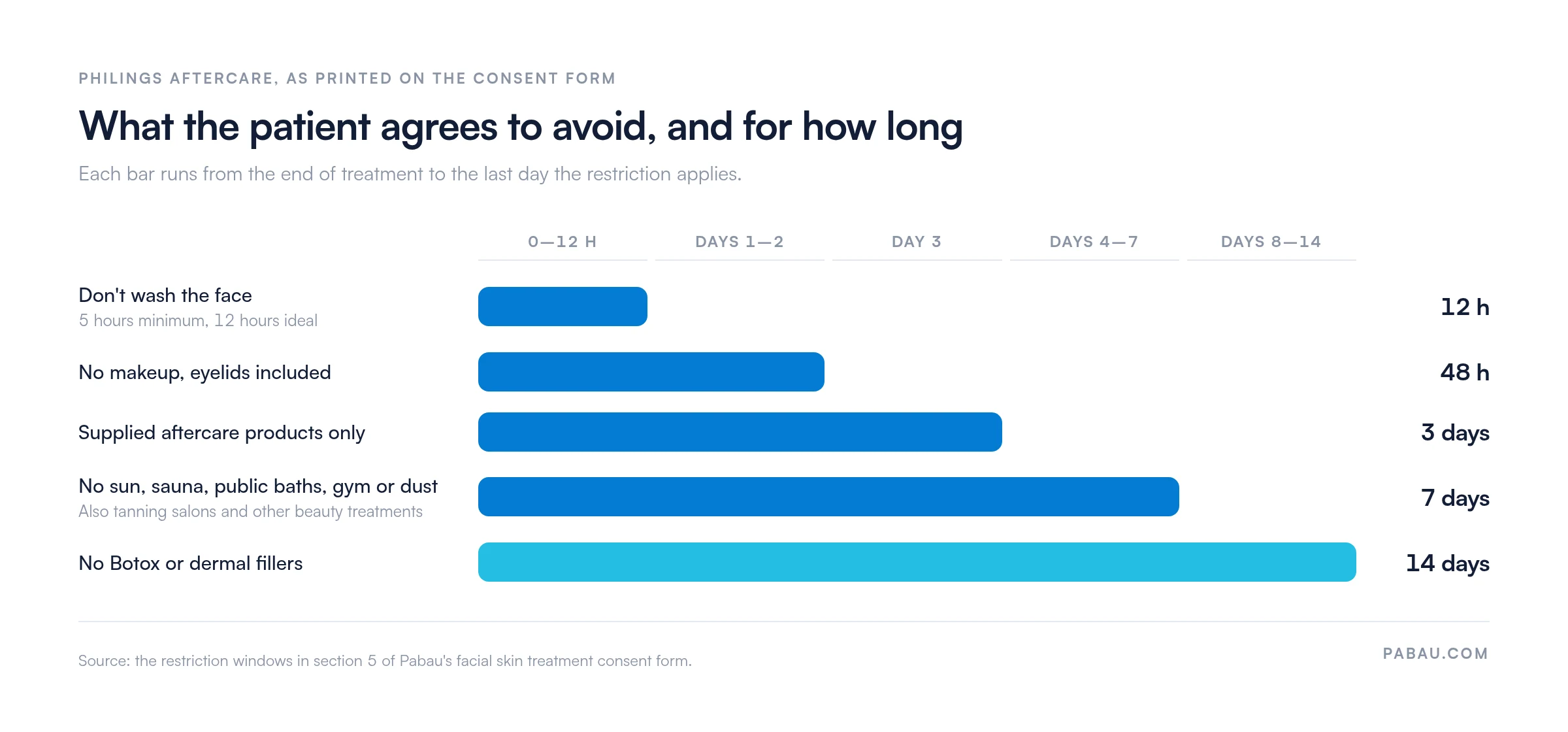
The form also tells patients to use only the Phi aftercare products it names for the first three days. If you stock different products, change the names before you print it.
You don’t have to write these from scratch. Our microneedling aftercare and dermaplaning aftercare templates give patients instructions they can take home.
The PDF records consent, not the treatment itself. It has no space for settings, products or how the skin responded. Keep a treatment record for each session, and cover these four points.
Keep notes factual and dated. Write what you observed, such as “pinpoint bleeding settled within 10 minutes”, rather than how you assume the patient felt.
The form is ready to print, but a few lines need work before it suits a medical practice. Run through these edits first.
On paper, this form means five pages filled in at reception, then scanned into a patient file. A “yes” written in a hurry can sit unread until the patient is already on the couch.
Pabau, the software for med spas and skin practices we build, sends the questionnaire and consent ahead of the appointment through its digital forms. Patients sign on their phone, and the answers land in their patient record.
That gives you time to read every answer before the patient walks in. Once the treatment is recorded, Pabau’s pre and post care tools can send the matching aftercare. The 48-hour makeup rule then reaches the patient in writing.

Pabau sends your consent form and health questionnaire before the appointment and files the signed copy in the patient record. Matching aftercare can follow once the treatment is recorded.

This form is ready for Philings treatments today. For any other facial, rewrite the risk and aftercare pages first, because they describe one technique in detail.
Make the five edits, review every “yes” before you treat, and keep a session record beside the signed form. Together, they give you a file that stands up if a patient later questions a result. Book a demo to see how Pabau sends, signs and files facial consent forms before each appointment.

Offering other plasma treatments? Plasma IQ consent form covers the protocol, risks and aftercare for a different plasma device.
Setting needle depth by area? Microneedling depth chart gives you a quick reference for each treatment zone.
Need a consultation step before consent? Facial consultation form captures goals and history before you recommend a treatment.
Offering microneedling on its own? Skin needling consent form covers needling without the plasma step.
Comparing plasma resurfacing options? Portrait plasma skin regeneration template documents another plasma treatment from consent to aftercare.
It proves the patient was informed, but it doesn’t excuse negligence. This form’s own warranty section accepts liability for negligent injury. Ask a lawyer to check the release wording for your jurisdiction.
Ask for a new form whenever the treatment, the products or the patient’s health changes. Many practices also refresh consent once a year for returning patients.
Yes, in most places. In the US, the ESIGN Act and UETA recognize electronic signatures. In the UK, the Electronic Communications Act 2000 makes them admissible as evidence. Store the signed copy with the patient record.
It’s good practice. This form only asks about using photos for advertising. Add a separate line for clinical photos kept in the record, and explain who can see them.