Facial skin treatment consent form template: Microneedling and phi-ion
A facial skin treatment consent form is the signed proof that a patient was scre...

3
Last Updated: Oct 21, 2026

A skin assessment form is a structured clinical record of skin type, condition, history, and treatment goals. It gives every practitioner the same baseline before treatment.
The five parameters you record are color, turgor, moisture, texture, and lesions. Each one feeds a clinical decision in aesthetic and nursing settings.
Aesthetic practices need Fitzpatrick classification and contraindication screening. Nursing settings prioritize pressure injury risk and integumentary integrity.
A digital version of the form removes paper filing, cuts data entry errors, and keeps the record accessible at the next appointment.
A ready-to-use form for evaluating skin health, presenting concerns, and treatment suitability. It carries patient information, Fitzpatrick skin type classification, the five assessment parameters, and space for clinical findings and a practitioner signature.
Download templateA skin assessment form is a structured clinical document covering the skin, hair, and nails.
Practitioners use it to set a baseline, flag abnormalities, and judge whether a treatment is safe to proceed. Aesthetic practices, medical spas, dermatology practices, and nursing teams all use one, though what each emphasizes differs.
The form works two ways. Clinically, it records existing conditions and contraindications. Administratively, it becomes the audit trail that CQC and HIPAA inspections ask for. Used alongside other skin assessment tools, it keeps findings consistent between practitioners and between visits.
Below you get the fields the form must carry and the five parameters you actually assess. You also get the Fitzpatrick chart that governs treatment settings, plus the nine-step procedure for filling the form in.
Every skin assessment form should carry these core sections.
Those eight sections give the practitioner enough to make a treatment decision. They also leave a record an inspector can follow without asking you to explain it.
Five parameters carry most of the clinical weight. Knowing what each one measures is what makes the assessment objective rather than impressionistic.
Recorded the same way at every visit, these five give you a baseline to compare treatment outcomes against.
The Fitzpatrick scale sorts skin into six phototypes based on melanin production and UV response. The type you record changes laser fluence, peel depth, and the sun protection advice you give.
Recording the phototype on the form ties your treatment settings to the skin in front of you. That is what keeps burns and post-inflammatory hyperpigmentation out of your complication log.
Aesthetic and nursing assessments use the same parameters for different ends. Nursing assessments prioritize pressure injury risk and integumentary integrity. Aesthetic assessments turn on treatment candidacy and the client’s cosmetic goals.
Two of those sections usually belong on separate documents. Candidacy questions sit better on a facial consultation form, and the risk acknowledgment belongs on a treatment-specific document such as an acne treatment consent. Keep the skin assessment for what you observed, and the consent for what the patient agreed to.
The nine steps below run in a deliberate order, and they group into four working phases. Screening for contraindications comes after you have recorded findings, so the decision rests on documented observations rather than a first impression.
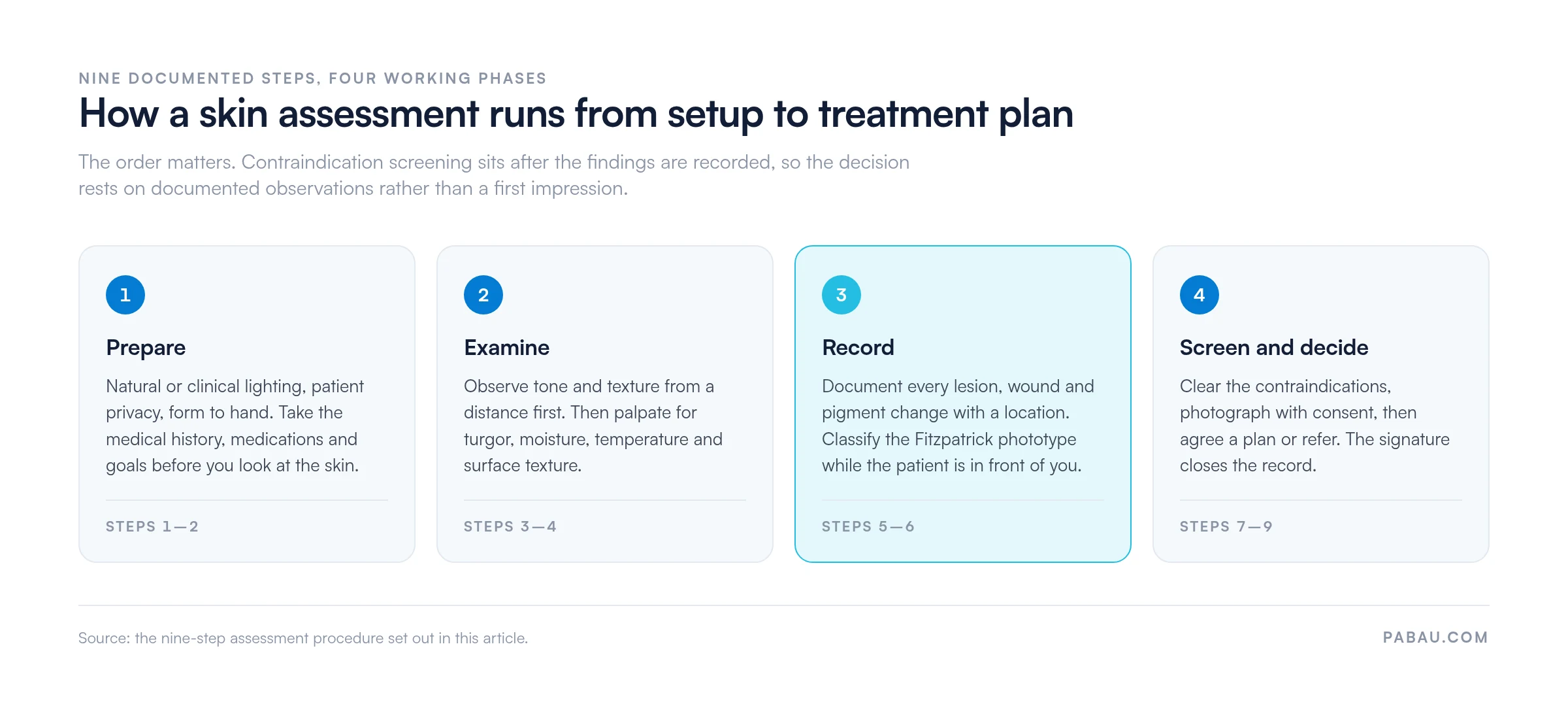
Work through the steps in sequence, and complete each one on the form before moving on.
Accurate documentation is a legal requirement and clinical best practice. Whether the form is paper or digital, it has to be clear enough for a colleague to act on without asking you what you meant.
Objective language does the most work of the seven. Write what you saw rather than what you concluded, and the record still holds up years later.
Printing the PDF and filing it is where the value leaks out. The form sits in a cabinet, so the practitioner at the next appointment starts from a blank page. Practice management software like Pabau keeps the same fields, and keeps the answers with them.
With Pabau’s digital intake forms, the assessment reaches the client before the appointment. They complete the history and their concerns at home, so you start on the examination rather than the paperwork. The answers save straight onto the client record.
From there the client record carries the rest of the work.
Pabau users report saving over 10 hours a week on paperless admin, and fewer transcription errors along with it. For medical spas and aesthetic practices, purpose-built med spa software makes the digital assessment record the default rather than a project.

Pabau’s digital intake forms, AI clinical notes, and integrated client records keep every skin assessment on the record it belongs to. Findings stay accessible at the next appointment and ready for inspection.

The form is the easy part. What decides whether it earns its place is whether the findings on it reach the next appointment in a state someone else can act on.
So download the PDF, then decide where the completed copies will live. A filing cabinet works until the practitioner who wrote the note is on leave. A client record works every time, and it is what an inspector asks to see.
Whichever route you take, hold the objective-language discipline. Book a demo to see how Pabau stores skin assessments against the client record and keeps them ready for inspection.

Setting up a new dermatology intake process? Dermatology intake form covers the demographic and history fields that sit upstream of the skin assessment.
Need the consent document that pairs with it? Dermatology consent form records what the patient agreed to once the assessment has cleared them for treatment.
Scoring eczema severity rather than describing it? EASI score calculator turns area and severity observations into a number you can track between visits.
Comparing the tools behind the form? Skin assessment tools reviews the instruments and scales practitioners use to make findings reproducible.
A complete form captures patient demographics, Fitzpatrick skin type, and the five assessment parameters. It also records presenting concerns, medical history, contraindication screening, and treatment history. Close it with your clinical findings, the date, and a practitioner signature.
The five core parameters are color, turgor, moisture, texture, and lesions. Color reflects pigmentation and circulation, turgor reflects elasticity and hydration, and moisture reflects sebum level. Texture covers smoothness and pore size. Together they give you an objective baseline.
Work through it systematically. Take the history first, then observe the skin from a distance and palpate the five parameters. Record your findings, classify the Fitzpatrick type, and screen contraindications. Photograph with consent, then discuss the plan with the patient.
Yes. The form at the top of this page downloads as a free PDF. It gives aesthetic practices, medical spas, and nursing teams a ready-to-use structure. Print it, or import the fields into a digital system like Pabau.
The Fitzpatrick scale sorts skin into six phototypes based on melanin production and UV response. Type I always burns and never tans. Type VI never burns and tans deeply. The type you record decides laser fluence, peel depth, and hyperpigmentation risk.
Describe what you observe rather than what you conclude. Write ‘pustules on the forehead and chin’ instead of ‘bad acne’. Include lesion size, location, dates, your credentials, and the patient’s consent. Store the record in a HIPAA or GDPR compliant system.