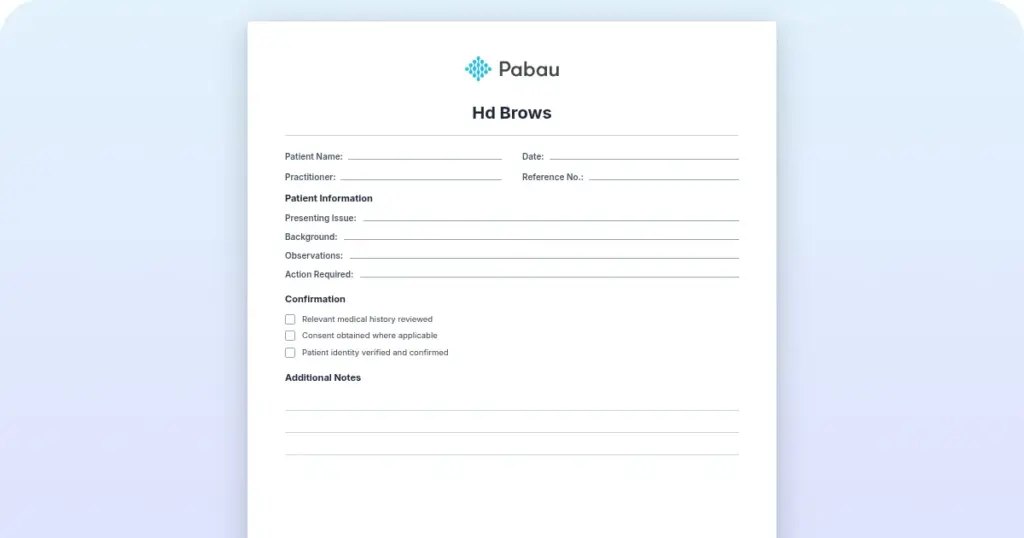
HD Brows consultation form: Free template and guide
HD Brows is a seven-step brow treatment that combines consultation, tinting, wax...

2
Last Updated: Oct 13, 2026

Comprehensive documentation form that captures patient intake, informed consent, and contraindication screening before Portrait plasma treatment
Tracks all three PSR energy protocols (PSR1 superficial, PSR2 mid-depth, PSR3 deep dermal) with clinical parameters and expected outcomes
Includes structured aftercare instructions covering timeline, recovery expectations, and warning signs that require clinician contact
Ensures compliance with patient safety standards and reduces liability through documented informed consent and risk acknowledgment
A ready-to-use patient documentation template covering pre-treatment assessment, PSR energy level selection (PSR1/PSR2/PSR3), informed consent declarations, contraindication screening, recovery timeline guidance, and post-treatment care instructions for plasma skin regeneration procedures.
Download templatePortrait plasma skin regeneration is a non-invasive treatment that delivers radiofrequency-generated plasma energy to rejuvenate skin. The skin clinic environment requires comprehensive documentation to protect patients and practitioners. This guide covers everything aesthetic clinics need to implement a portrait plasma skin regeneration template-from patient screening through aftercare coordination-to ensure safe, compliant treatment delivery across all energy protocols. To keep these treatment records and your schedule in one place, compare the platforms in our list of medical spa systems.
A portrait plasma skin regeneration template is a structured clinical documentation form designed for aesthetic clinics and dermatology practices offering Portrait PSR treatments. The template captures the complete patient journey: initial intake, informed consent, pre-treatment contraindication assessment, treatment protocol selection (PSR1/PSR2/PSR3 energy levels), clinical parameters, and post-treatment recovery guidance.
Portrait® by Rhytec is the pioneering plasma skin regeneration device approved by the FDA for skin resurfacing. According to DermNet NZ, the system transfers energy without direct contact to the skin, preserving outer skin layers as a protective biological dressing during healing. This mechanism differs fundamentally from traditional laser resurfacing and requires specific patient counselling about timeline and downtime expectations.
The template provides legal protection through documented informed consent, compliance with data protection regulations (HIPAA in the US, GDPR in the UK/EU), and audit-ready clinical records. A well-structured portrait plasma skin regeneration template reduces miscommunication, supports clinical decision-making, and demonstrates practitioner duty of care during regulatory inspections (CQC in the UK, state boards in the US).
Implementing a portrait plasma skin regeneration template follows a structured five-step workflow that integrates with your digital forms system and clinical documentation process:
Use AI-powered clinical documentation to populate standard aftercare text automatically post-treatment, then personalise based on the energy level and individual healing response. Link the portrait plasma skin regeneration template to your client record system to auto-populate patient details and flag contraindication alerts before appointments.
This template serves multiple healthcare specialties and settings:
The template is equally valuable for solo practitioners and multi-location medical spas. With integrated clinic software, aesthetic clinics can standardise consent language, contraindication checklists, and treatment protocols across all locations-ensuring consistent documentation and reducing liability exposure.
Compliance & Legal Protection: Documented informed consent satisfies practitioner duty of care, reduces liability in adverse events, and supports defence during regulatory inspections or patient complaints. HIPAA and GDPR compliance is built into template structure.
Workflow Efficiency: Pre-populated intake fields and checkbox contraindication lists eliminate repetitive data entry. Treatment protocols are standardised-clinicians select PSR1/PSR2/PSR3 from a dropdown rather than free-texting energy parameters, reducing documentation errors.
Documentation Clarity: Structured form fields force systematic recording of treatment details: zone treated, number of passes, cooling intervals, patient response (erythema intensity, comfort level). This clarity supports accurate follow-up assessment and outcome tracking.
Patient Safety: Risk disclosure and contraindication screening happen before treatment, not after complications emerge. Digital before-and-after photo documentation with clinical outcome tracking enables evidence-based protocol optimisation and complication pattern recognition.
The portrait plasma skin regeneration template must accommodate three distinct treatment protocols, each with specific clinical outcomes and recovery profiles:
Document energy level selection based on clinical assessment (skin type, laxity, target area, healing capacity, downtime tolerance). Fitzpatrick types IV-VI require protocol modification to minimise hyperpigmentation risk; PSR1 or very conservative PSR2 with extended cooling intervals is standard. According to a pilot study published in Lasers in Medical Science, the Portrait PSR3 system provides clinically proven collagen remodelling with patient tolerance rates favourable compared to traditional CO₂ resurfacing.
Patient Demographics & Medical History: Name, date of birth, contact information, medical conditions (active herpes simplex virus, immunosuppression, keloid tendency), medications (anticoagulants, isotretinoin, photosensitising agents), and previous aesthetic treatments (lasers, microneedling, chemical peels).
Absolute & Relative Contraindication Checklist: Absolute contraindications (active infection, severe active acne, recent isotretinoin use, open lesions) trigger treatment deferral. Relative contraindications (mild rosacea, darker skin types, high photosensitivity) require clinician judgment, modified protocol, or informed consent with enhanced risk documentation.
Informed Consent Declarations: Numbered consent statements covering treatment mechanism, expected timeline (6-12 month collagen remodelling), realistic outcomes (improvement not elimination of all lines), and risks specific to plasma resurfacing. Patient signature and date are mandatory.
Treatment Record: PSR protocol selected (1/2/3), anatomical zones treated, cooling methodology, patient tolerance, any modifications during treatment, and immediate post-treatment appearance (erythema grade).
Aftercare & Recovery Timeline: Day-by-day guidance through typical healing (immediate erythema → brownish crusting by days 2-4 → natural peeling days 5-7 → final resolution). Explicit instructions: gentle cleanser, SPF 30+, avoid exercise/heat/swimming for 5 days, notify clinic if signs of infection appear.
Modern aesthetic clinics benefit from integrated practice management systems that streamline the portrait plasma skin regeneration template across patient journeys. Store the template in your compliance management system so it auto-populates during appointment booking and flags contraindications based on medical history already in the patient record.
Digital signature capture on tablets during consultation ensures paper-free compliance. Automated aftercare email sequences deliver recovery milestones and follow-up prompts. Use your practice management system to schedule post-treatment check-ins and generate outcome reports for clinical review.
For practitioners new to plasma resurfacing, several evidence-based resources provide clinical depth. Portrait® by Rhytec’s clinical documentation includes protocol videos, case studies, and complication management guidance. Peer-reviewed literature in dermatology journals covers patient selection, outcomes data, and long-term collagen remodelling trajectories.
CME courses from dermatology associations (AAD, ASDS in the US; BAD in the UK) provide formal training on plasma technology mechanism, patient counselling, and complication recognition.
Yes. Fitzpatrick scale assessment determines protocol modification. Darker skin types (IV-VI) require longer cooling intervals, lower energy, and closer post-treatment monitoring for transient hyperpigmentation. Build skin type-specific protocol branches into your template or use conditional form logic in your practice management system to auto-adjust contraindication and consent language.
PSR1 is low-energy superficial treatment (1-3 days erythema, minimal results, suited to maintenance). PSR2 is mid-energy mid-dermal heating (3-5 days erythema, moderate wrinkle improvement). PSR3 is high-energy deep dermal regeneration (5-7 days erythema, pronounced skin tightening, 6-12 month remodelling). Protocol selection depends on target concerns, downtime tolerance, and baseline skin laxity.
Absolute contraindications include active herpes simplex virus, open lesions, severe active acne, and use of isotretinoin within 6-12 months (compromised skin barrier healing). Relative contraindications include darker skin types (higher hyperpigmentation risk), recent sun exposure, keloid tendency, and photosensitising medications. Always screen before booking and defer treatment when absolute contraindications are present.
The portrait plasma skin regeneration template should include realistic recovery expectations: PSR1 allows return to normal activities immediately, PSR2 requires 3-5 days low-activity, PSR3 requires 5-7 days avoiding exercise, heat, and swimming. Visual examples (before-and-after photos at days 2, 4, 7) and patient testimonials in your template help set accurate expectations and reduce post-treatment disappointment or regret.
CQC inspections (UK) and state board audits (US) require signed informed consent, documented contraindication screening, treatment parameters (energy level, zones, passes), clinician name/credentials, patient outcome notes, and aftercare instructions. A well-structured portrait plasma skin regeneration template checklist ensures all elements are captured and retrievable in audits.
A portrait plasma skin regeneration template is essential infrastructure for aesthetic clinics and dermatology practices offering plasma resurfacing. It protects patients through documented informed consent, supports clinical decision-making by systematising contraindication screening and energy protocol selection, and provides compliance-ready records for regulatory oversight.
The template standardises PSR1/PSR2/PSR3 treatment documentation, ensures consistent aftercare messaging across staff, and enables outcome tracking that builds practitioner expertise. Whether you adopt the downloadable form above or integrate similar logic into your practice management system, the portrait plasma skin regeneration template is a non-negotiable component of safe, professional plasma treatment delivery. Book a demo to see how integrated clinic software can automate these workflows and reduce documentation burden.