Mental health self-care checklist
A mental health self-care checklist is a structured daily tool for tracking the ...

6
Last Updated: Oct 20, 2026

An emotional intelligence test measures how well you recognize, understand, and manage emotions in yourself and others.
EI assessment typically evaluates five core dimensions: self-awareness, self-regulation, motivation, empathy, and social skills.
Self-report tests are susceptible to social desirability bias. Ability-based assessments measure emotional competencies more objectively.
Practice management software like Pabau can help you administer EI assessments consistently and store results securely in client records.
A comprehensive assessment tool for evaluating emotional intelligence across five key dimensions: self-awareness, self-regulation, motivation, empathy, and social skills. Includes an overall scoring guide and space to document interpretation notes for each dimension.
Download templateEmotional intelligence shapes how clients manage stress, communicate in relationships, and engage with therapeutic work. Testing it gives you a starting point: a clear picture of which skills are already strong and which ones therapy should target next. The free emotional intelligence test PDF above scores five EQ dimensions and gives you space to record interpretation notes for each one. This guide covers what the test measures, how to administer it with clients, and how to document results as part of ongoing care. Assessment results kept on paper get filed and forgotten, so practice software for psychologists keeps them beside the notes.
An emotional intelligence test is a standardized assessment designed to measure how well individuals recognize, understand, and manage emotions — both their own and those of others. Unlike IQ tests, which measure cognitive ability, an emotional intelligence assessment evaluates emotional competencies and interpersonal awareness.
The term “emotional intelligence” (EI) was popularized by psychologist Daniel Goleman in 1995. Goleman’s research identified five core dimensions that define emotional competence: self-awareness, self-regulation, motivation, empathy, and social skills. These dimensions have become the foundation for most modern EI assessments used by therapists, coaches, and healthcare practitioners.
Self-report EI tests ask clients to rate their own emotional abilities and responses to hypothetical scenarios. However, research from the U.S. Office of Personnel Management shows that self-report measures can be susceptible to social desirability bias — the tendency to answer in ways that appear more emotionally intelligent than actual behavior demonstrates.
Ability-based tests, by contrast, measure performance on emotion-recognition tasks and are less prone to faking.
Whichever format you use, pairing it with a broader intake questionnaire creates a fuller clinical picture at the start of care. Templates like an adolescent intake questionnaire or an adult counseling intake form work well alongside an EI test for new clients.
Administering an EI assessment in your practice requires a clear workflow: introduction and consent, assessment completion, scoring and interpretation, and feedback discussion. Here are the five operational steps clinicians use in session:
The downloadable emotional intelligence test template provided above includes an overall scoring guide with space to document interpretation for each dimension. Practitioners typically complete the five steps within two to three sessions, incorporating feedback and action planning into ongoing therapy.
EI assessments are valuable across multiple healthcare and coaching settings. Mental health practitioners use them to assess clients with anxiety, depression, or relationship difficulties. Individual therapists working in comprehensive mental health EMR systems can integrate test results into treatment planning.
Research from the Greater Good Science Center at UC Berkeley demonstrates that EI is learnable and improvable through targeted practice. Clients benefit most when assessments are paired with concrete strategies for emotional regulation and social skills development.
EI assessments provide structure and standardization to clinical conversations about emotional awareness. Rather than relying on informal observation, a validated test offers concrete data on how your client perceives their emotional abilities — data that can be tracked over time to measure therapy progress.
Three operational benefits stand out:
Document the test administration date, client demographic information, and any contextual factors (stress, recent life events, medication changes) that may influence results. This context helps you interpret EI scores accurately and explains variation on future retests.
Most emotional intelligence assessments measure performance across five interconnected dimensions. Understanding each helps you translate test scores into actionable therapeutic work and support patient engagement with emotional development goals.
Self-awareness is the foundation — recognizing your own emotional states, triggers, and impact on others. Clients with low self-awareness often struggle to notice when anxiety escalates or when they become defensive in relationships.
Self-regulation (sometimes called self-management) refers to managing emotional responses and impulses. Therapy targeting self-regulation teaches distress tolerance and emotional control through techniques like cognitive restructuring or somatic awareness.
Motivation (or internal drive) reflects intrinsic drive and resilience. Clients with low motivation scores may struggle with engagement in therapy itself or experience learned helplessness.
Empathy is the ability to understand and resonate with others’ emotional experiences. Empathy deficits appear in some personality disorders but can also develop through deliberate practice and perspective-taking work in therapy.
Social skills (relationship management) measure communication, conflict resolution, and interpersonal effectiveness. Low scores often co-occur with social anxiety or attachment difficulties.
EI is not fixed. Research consistently shows that emotional competencies improve with targeted practice and feedback, which is what makes them worth testing in the first place. After administering the emotional intelligence test, your next step is collaborative goal-setting around specific dimensions.
Integrating EI development into your clinical workflow — alongside broader therapy goals — addresses the emotional competencies underlying many presenting problems. A client with anxiety benefits not just from exposure therapy but from increased self-awareness and emotional regulation skills. A client with relationship difficulty benefits from empathy and social skills development tracked through repeated assessment.
Modern practice management systems allow you to gather client feedback and administer standardized assessments digitally. Distributing an emotional intelligence test as a pre-session digital intake form saves appointment time and creates an audit trail of assessment administration.
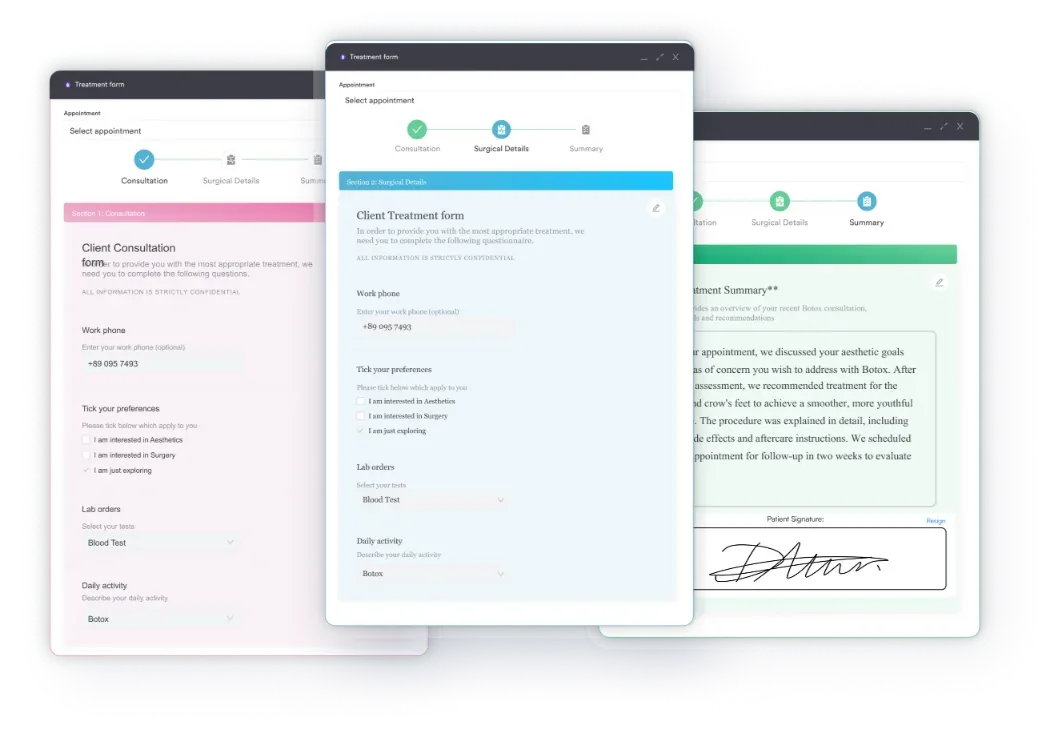
When administering electronically, ensure the assessment environment is still private and unhurried. Some clients prefer a printable PDF, while others prefer a digital questionnaire on a tablet or laptop. Offering both formats respects client preferences and accommodates accessibility needs. Store all completed assessments in encrypted client records with version control so you can track changes across multiple administrations.
Three implementation practices improve digital EI assessment:

Administer emotional intelligence tests and other clinical assessments through digital forms. Store results securely in client records and track progress across multiple dimensions.

Emotional intelligence tests and personality assessments measure different constructs and serve different clinical purposes. Understanding the distinction helps you select the right tool for your client and therapy goals.
Personality assessments (like the Big Five or Myers-Briggs Type Indicator) describe stable traits — how a person typically thinks, feels, and behaves across situations. These traits are relatively fixed and change little over time. By contrast, an emotional intelligence test measures skills and competencies — abilities that are learnable and improvable through practice and therapy.
A client may score high on extraversion (a personality trait) yet low on social skills (an EI dimension). Conversely, a reserved, introverted person may develop strong empathy and relationship management abilities. EI assessments target the emotional competencies underlying healthy relationships and emotional regulation — areas where therapy directly intervenes.
For clinical practice, EI tests are more useful than personality assessments because they identify specific, actionable areas for therapeutic work. If a client scores low on empathy, you can design interventions to develop empathic accuracy and perspective-taking. If a client scores low on extraversion (a personality trait), personality change is neither a realistic nor necessary goal.
An emotional intelligence test provides structure for assessing how your clients understand and manage emotions — core competencies underlying resilience, relationship quality, and therapy success. The downloadable template above includes everything needed to administer, score, and interpret EI assessments in your practice.
Start with the five-dimension framework (self-awareness, self-regulation, motivation, empathy, social skills) and match therapeutic interventions to dimensions where your client scores lowest. Track progress with quarterly re-testing, and watch emotional competency become visible, measurable, and improvable.
Book a demo to see how digital assessment administration supports evidence-based practice.

Want to build on emotional intelligence results? Emotional boundaries list covers boundary styles, triggers, and communication examples for healthier emotional limits.
Need a quick check-in between sessions? Emotional check-in worksheet offers a mood checklist, a trigger question, and space for free-text notes.
Exploring purpose alongside emotional intelligence? Ikigai worksheet uses a four-circle diagram and guided prompts to explore purpose with a client.
Emotional intelligence is the ability to recognize, understand, and manage emotions in yourself and others. It typically comprises five dimensions: self-awareness, self-regulation, motivation, empathy, and social skills. Unlike IQ (which measures cognitive ability), EI focuses on emotional and interpersonal competencies that are learnable and improvable.
Most self-report emotional intelligence tests take 15-30 minutes to complete, depending on the specific instrument and number of items. Ability-based tests (which measure performance on emotional reasoning tasks) may take 45-60 minutes. In a therapy session, allow an additional 10-15 minutes for scoring and initial interpretation.
Yes. Research confirms that emotional intelligence is a learnable set of skills. Through targeted practice, mindfulness work, therapy, and repeated feedback, individuals improve across all five EI dimensions. Regular reassessment (quarterly or annually) tracks progress and motivates clients to continue developing emotional competencies.
Self-report tests ask clients to rate their own emotional abilities, which is faster and more practical for routine clinical use — but susceptible to social desirability bias. Ability-based tests measure actual performance on emotion-recognition tasks, offering greater objectivity but requiring more time and specialized scoring. Most practitioners use self-report assessments clinically.
No. An emotional intelligence test is a screening and assessment tool, not a diagnostic instrument. It measures emotional competencies and identifies areas for therapeutic development but does not diagnose mental health conditions. Always clarify this distinction to clients before administration.
A lower-than-average EI score indicates the client has opportunity to develop emotional competencies in that dimension. Discuss specific areas (e.g., “Your empathy score suggests you might benefit from perspective-taking work”) and collaborate on therapeutic goals. Avoid labeling low scores as “bad” or suggesting the client is emotionally deficient.