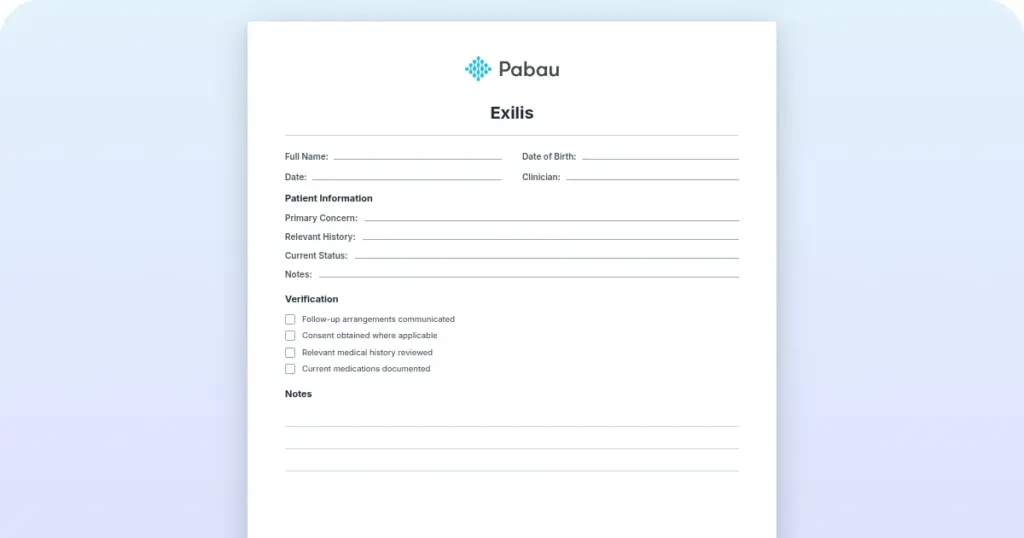
Exilis patient treatment record: Free PDF for RF sessions
An Exilis patient treatment record is the session log for BTL’s radiofrequ...

1
Last Updated: Oct 23, 2026

The personal hygiene checklist is a one-page form patients complete themselves, checking off the practices they already follow.
It groups 32 practices under eight topics, from daily washing and oral care through to foot hygiene and bedding.
The blank boxes carry the information, because they show which two or three habits to raise at the next appointment.
There is no scoring, no clinician section, and no daily versus weekly split, so nail trimming sits under daily practices.
Practice management software like Pabau sends the checklist to patients online and files their answers in the patient record.
A one-page checklist patients fill in themselves, with 32 items grouped under eight topics. It covers daily practices, body odor and sweat, oral hygiene, intimate hygiene, cough etiquette, foot hygiene, shared items, and bedding.
Download templateA personal hygiene checklist gives patients a private way to answer a question they usually dodge. Ask how their hygiene is going and most people say it is fine, because the question sounds like a judgment.
The form above fits on one page, and the patient completes it alone. They check off 32 practices under eight plain topics, from daily washing through to bedding. Nothing is scored.
The blanks are the useful part. They show you which two or three habits are worth raising, so how you introduce the form matters more than how you file it. What follows covers the items, the workflow, and the limits.
The checklist is a single page carrying a name field, a date field, and 32 checkbox items grouped under eight topic headings. One line of instruction sits at the top. It asks the reader to review each item and mark it with a check once that practice is complete.
There are no rating scales, no free-text boxes, and no space for practitioner notes. The eight sections are:
Nail trimming sits in the daily section rather than a weekly one, because the form carries no weekly column at all. It also has no grouping by body area, so a patient works through habits instead of a head-to-toe survey.
Nothing on the form is novel. It tracks mainstream public health guidance, so the handwashing items follow current CDC advice. For toothbrushes, the three-to-four-month replacement rule comes from the American Dental Association.
Give the checklist to the patient, let them complete it privately, then read it together and act on the items they left blank. Five steps cover the whole workflow.
These three turn a completed page into paperwork.
Nothing on the page asks the patient to explain themselves, which is why it comes back completed. The explaining happens in the appointment, and it starts from a page of answers rather than a blank one.
Each of the eight sections appears below, in the order it occupies on the form. The right-hand column does the practical work, naming what an unchecked box usually points to.
Read across a row and the follow-up question writes itself. A patient who leaves foot hygiene blank gets asked whether they can still reach their feet.
The topic grouping decides the limits. There is nothing on hair washing, eye care, or ear care, so cover those separately if they matter to your assessment. Postpartum patients need more than the four intimate hygiene items, so pair the checklist with a postpartum care plan.
The cough and sneeze section carries most weight in shared settings. It lines up with WHO infection prevention principles, which matter far more in a group program than in a single-occupancy home.
Date every completed copy and keep the last two side by side. A section fully checked in March and half blank in June is a stronger prompt for a health review than any single form.
The checklist suits any setting where self-care capacity forms part of the clinical picture.
The form was written for the patient to hold. Handing it over works better than working through it question by question in the room. Patient portal access lets them revisit it between visits.
A written checklist takes the awkwardness out of a subject most patients would rather skip. The form asks the question, so you do not have to.
It also standardizes what your team asks. Two practitioners working from the same 32 items produce comparable records, which makes a change over six months meaningful rather than anecdotal.
For the patient, a page of small, concrete actions is easier to face than an instruction to look after themselves. That matters most for patients managing depression, ADHD, or cognitive decline, where breaking a routine into steps is the whole intervention. The same logic sits behind the SNAP-IV assessment, which turns behavior into specific, ratable items.
Documented assessments carry weight for clinical governance and safeguarding too. HIPAA rules require secure, auditable records, and a loose paper form in a drawer meets neither test.
Compliance workflows that log every version of a completed form keep that record defensible. If a patient wants it shared with another provider, an information release form documents the consent first.
This form usually goes out on paper, and paper is where it stops. The completed page goes into a folder, the next copy is never compared to the last one, and nobody sees the trend.
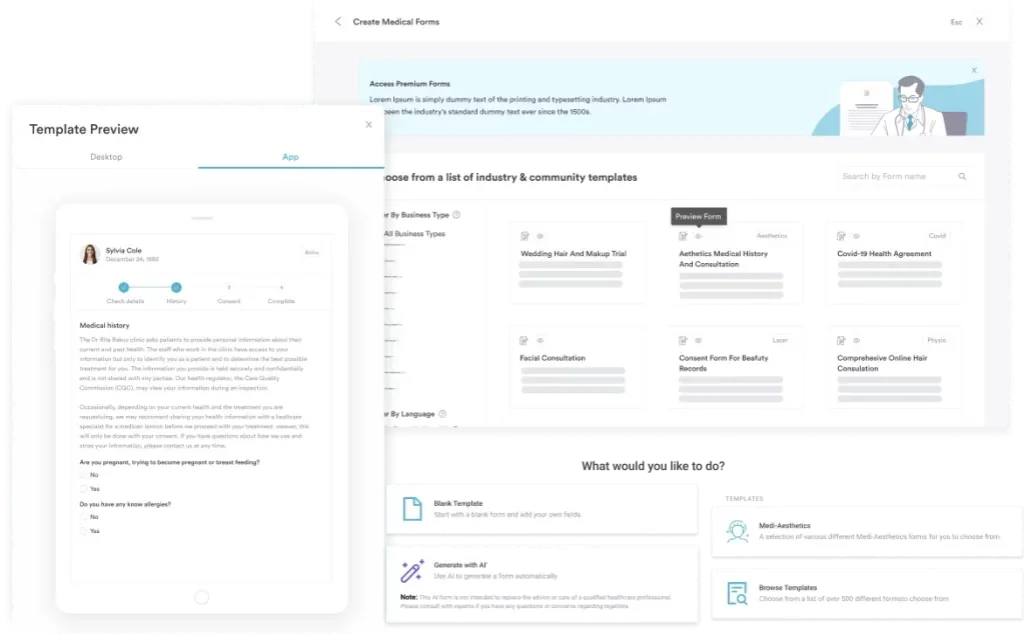
Practice management software like Pabau handles the same 32 items digitally. You build the checklist once as a digital form, then send it out before an appointment. Patients complete it on a phone, and the answers land in their record without anyone retyping them.
Because every copy is dated and stored, the March version and the June version sit side by side. Going paperless also removes the scanning step entirely.
The conversation that follows the checklist matters more than the checklist itself. If you dictate it, Pabau Scribe, our AI scribe, drafts the note into the same appointment record. The form and the plan you agreed then live in one place.
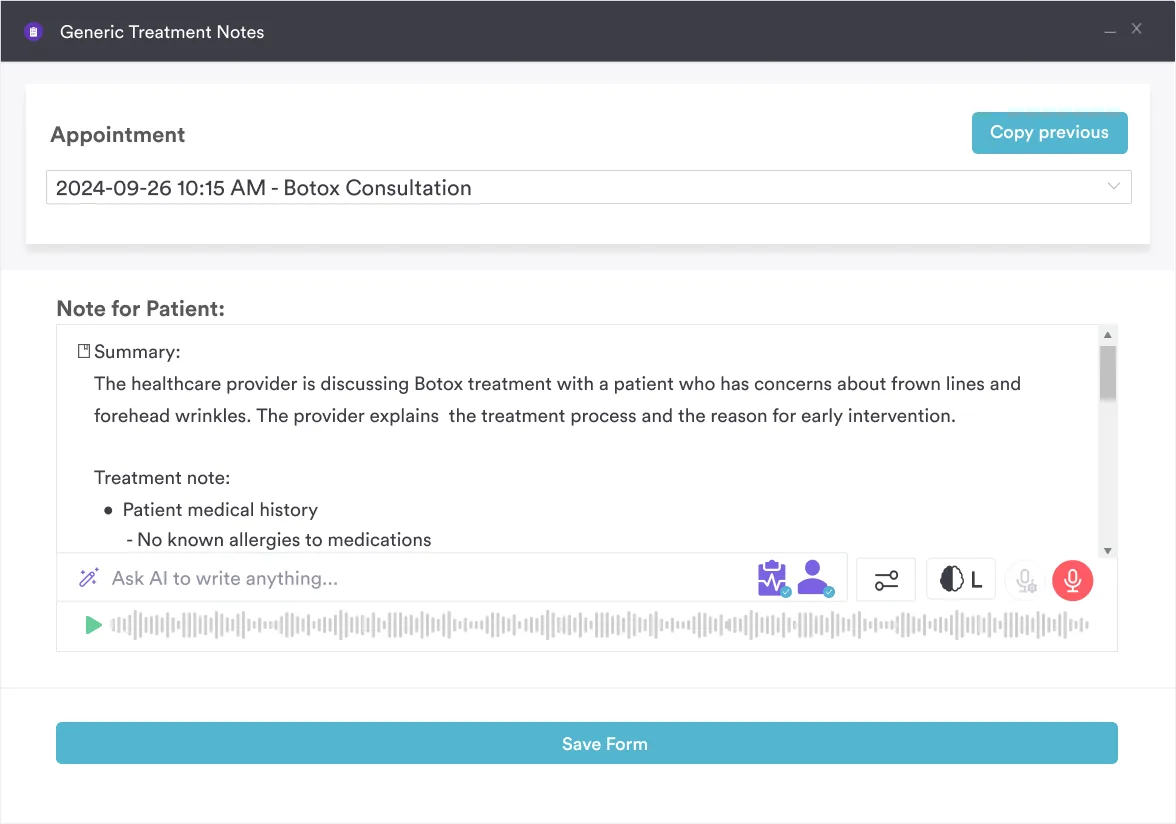

Pabau turns the personal hygiene checklist into a digital form you send before an appointment. Answers file straight into the patient record, so you can compare one copy against the last without chasing paper.

The personal hygiene checklist is deliberately plain, and that is why patients finish it. Thirty-two checkboxes across eight topics fit on one page, with no scoring to interpret and nothing to explain in writing.
Treat it as a conversation starter rather than an assessment instrument. Its accuracy rests entirely on the patient answering honestly, so how you introduce it decides what the page is worth.
Two or three agreed changes beat a fully checked page every time. Book a demo to see how Pabau sends hygiene checklists to patients and files their answers in the record.

Wondering how private referrals work? Private GP referrals to NHS explains how a private GP can refer a patient to an NHS specialist.
Need a full head and neck exam guide? Head and neck assessment guide walks through the exam so lymph nodes and thyroid findings do not go undocumented.
Working through a headache complaint next? Headache physical exam guide walks through the exam in order, so signs like papilledema are not missed.
Checking your practice meets HIPAA rules? HIPAA compliance checklist sets out how to safeguard, store and share protected patient data correctly.
Working with younger patients? Pediatric assessment walks through age-appropriate history taking and examination for children.
Yes, and that is common in home care and dementia settings. Record who completed it, because a caregiver reports what they can observe. Bathing and bedding are visible to them, while oral and intimate hygiene often are not.
The form sets no interval, so choose one that fits the care you provide. Intake plus every review appointment gives you two dated copies to compare. Monthly repeats suit recovery, mental health, and geriatric settings, where self-care changes quickly.
Not as written. The intimate hygiene and body odor items assume an adult, and younger children need pictures rather than text. For a pediatric visit, keep the handwashing, oral, and foot items and rebuild the rest at the right reading age.
An activities of daily living checklist covers dressing, feeding, toileting, and mobility. This one covers hygiene habits only, in far more detail. Occupational therapists often run both, since the hygiene items show which part of self-care has slipped.
Yes. The checklist at the top of this page downloads as a free PDF, ready to print or send. You can also rebuild the same 32 items as a digital form and send it through a patient portal.