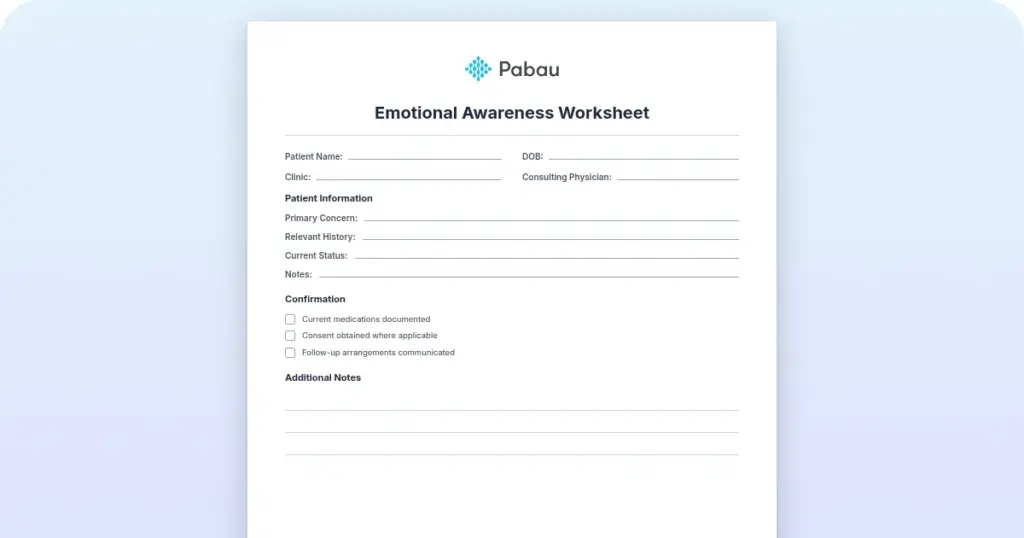
Emotional awareness worksheet
An emotional awareness worksheet is a structured psychoeducational tool that hel...

2
Last Updated: Oct 16, 2026

An emotional intelligence worksheet is a structured assessment tool that measures self-awareness, emotional regulation, empathy, and social skills across Goleman’s five-domain EQ framework.
The worksheet helps therapists, coaches, and healthcare practitioners identify client emotional strengths and development areas in a single, ready-to-use clinical tool.
Emotional intelligence can be improved through repeated practice with targeted exercises; worksheets provide the structure to track progress over time.
Practice management software like Pabau streamlines the administration and storage of completed EQ worksheets within client records, ensuring HIPAA-compliant documentation workflows.
Emotional intelligence worksheet
A comprehensive assessment tool covering self-awareness, emotional regulation, empathy, and social skills development for individual therapy, group sessions, and workplace training.
Download templateEmotional intelligence is the ability to recognize, understand, and manage emotions in yourself and others. It’s a cornerstone of effective therapy, coaching, and clinical practice. An emotional intelligence worksheet gives practitioners a structured, evidence-based method to assess where clients stand across the core EQ competencies.
Instead of relying on informal observation, therapists and coaches can use a dedicated worksheet to establish baseline emotional skills, track progress, and guide targeted interventions.
An emotional intelligence worksheet is a structured tool that measures how well a client recognizes emotions, manages reactions, empathizes with others, and builds relationships.
The most widely used framework comes from psychologist Daniel Goleman, who identified five core EQ components: self-awareness, self-regulation, motivation, empathy, and social skills. A worksheet mapping these domains provides a systematic way to evaluate strengths and development areas.
Why use a worksheet instead of informal assessment? Structured tools reduce clinician bias, create consistent documentation for progress tracking, and give clients concrete language to describe their emotional experiences. When a client sees a written record of their EQ growth over weeks or months, the evidence of change motivates continued engagement in therapy.
Daniel Goleman’s research identified the following five pillars of emotional intelligence. Each can be developed through practice and reflection.
The first step in emotional intelligence development is learning to name and recognize emotions as they arise. Many clients struggle to move beyond “I feel bad” or “I’m stressed.” A self-awareness worksheet breaks this down into concrete steps: identifying the physical sensation, naming the emotion, and tracing it back to a trigger.
Practitioners guide clients through reflection prompts such as “Where do you feel this emotion in your body?” and “What happened right before you felt this way?” Over repeated sessions, clients develop faster recognition of emotional states, which is the foundation for all other EQ skills.
Pairing the worksheet with a broader self-reflection journal gives clients space to keep exploring these patterns between sessions.
Psychologists often assign tools like this through psychology practice software, tracking completion between sessions.
Once a client can identify emotions, the next challenge is managing them effectively. An emotional regulation worksheet guides clients through a structured pause: recognize the emotion, acknowledge its validity, consider available coping options, and select a strategy that fits the moment.
This is where DBT-informed practice shines.
Empathy is the ability to step into someone else’s emotional world. An empathy worksheet asks clients to consider a recent interaction and identify: What emotions was the other person feeling? What need or fear might underlie their behavior? How did your response affect them?
This is particularly valuable in couples therapy, family work. When clients practice perspective-taking on paper, they build neural pathways that make compassion automatic in real-world interactions.
The final EQ domain brings everything together: using emotional awareness to build strong relationships. A social skills worksheet presents realistic scenarios and guides clients through a structured response that honors their own needs while respecting others. Common scenarios include:
Clients learn assertive communication, active listening, conflict resolution, and how to influence others without manipulation. Practicing these skills on paper before high-stakes conversations reduces anxiety and increases effectiveness.
Group programs run these domains with several members in the room at once. A co-facilitator working from a behavioral observation checklist marks how often each member withdraws from discussion or escalates a disagreement.

Track client EQ progress, store completed worksheets securely, and integrate emotional intelligence assessments into your practice management system.

A self-assessment worksheet asks clients to reflect in writing on each of the five EQ domains, rather than assigning a numeric score. Used at intake and revisited periodically throughout treatment, it gives clients a written record of how they describe their own self-awareness, regulation, motivation, empathy, and social skills.
Comparing entries side by side often reveals shifts in language and self-understanding that reinforce therapeutic gains.
Many mental health clinicians use EQ self-assessment as part of intake. A handful of open-ended reflection prompts takes minutes to complete but provides rich clinical insight for treatment planning.
EQ worksheets aren’t just for therapy. Many practitioners use them in coaching, organizational development, and staff training. High-EQ leaders show better team engagement, lower turnover, and stronger conflict resolution. A workplace-focused emotional intelligence worksheet adapts the five domains to professional scenarios: managing stress under deadline pressure, giving and receiving feedback, leading through change, and building trust with team members. A therapy practice running weekly sessions accumulates history faster than a paper file can carry.
Coaches and corporate trainers distribute these tools to participants in leadership development programs, creating both a diagnostic baseline and a take-home learning resource.
Integrate EQ worksheets into your workflow by introducing one during the intake session or when emotional regulation becomes a treatment focus. Assign it as homework: “Complete this worksheet this week and we’ll review it together next session.”
Low motivation and unreturned homework can have a physiological driver worth ruling out. The Epworth Sleepiness Scale rates how likely a patient is to doze off in eight everyday situations, and it takes under five minutes.
This systematic approach transforms the worksheet from a one-time tool into a continuous progress-tracking mechanism woven into your practice workflow.
Many practitioners pair EQ worksheets with mindfulness practice. Body-scan exercises teach clients to notice physical sensations tied to emotions. Breath-awareness techniques activate the parasympathetic nervous system, naturally calming an activated emotional state. A mindfulness-informed emotional intelligence worksheet bridges acceptance-based therapy and cognitive approaches, offering clients multiple pathways to regulate.
Research supports the integration of mindfulness into emotional regulation training, particularly for anxiety and mood disorders.
The true power of a structured emotional intelligence worksheet emerges when used longitudinally. Ask clients to complete the same self-assessment worksheet every 4-8 weeks, then compare the new responses against earlier ones.
A client who once wrote short, vague answers about self-regulation may start describing specific coping strategies and calmer reactions in detail. That written contrast makes therapy outcomes visible and motivating.
File each completed worksheet in your clinical notes so you can compare entries side by side. Over a year of treatment, the collection of worksheets becomes a written record of emotional growth, reinforcing why your client continues investing in therapy.
An emotional intelligence worksheet transforms vague emotional struggles into concrete, addressable competencies. Whether you work in therapy, coaching, healthcare, or organizational development, a structured EQ tool grounds your work in the Goleman framework — the most widely used model for understanding emotional intelligence.
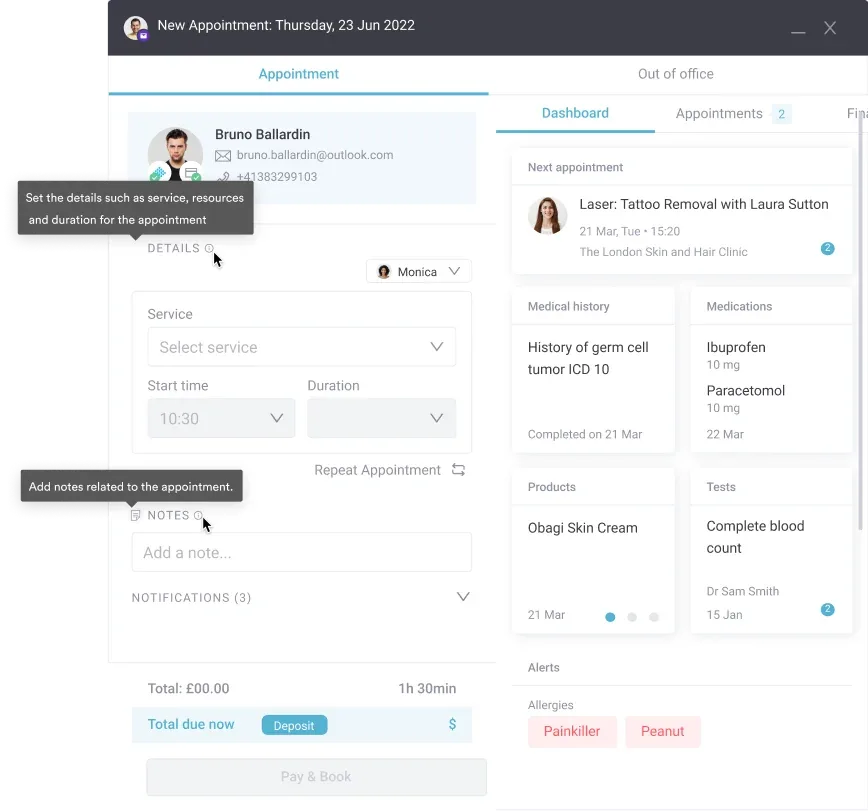
Download the free template above and integrate it into your next client session to start building emotional skills systematically. See how Pabau’s digital forms simplify worksheet administration and progress tracking within a unified practice management system.

Working with clients who cope poorly with stress? Ineffective coping care plan uses the NANDA-I framework to address why patients struggle with stress management.
Screening for sleep issues alongside EQ? Insomnia Severity Index scores insomnia severity out of 28 across seven questions, with four score bands.
Need a broader intake assessment tool? Mental state examination explains how to structure a full clinical intake alongside EQ and mood-focused worksheets.
An emotional intelligence worksheet is a structured assessment tool that measures how well someone recognizes, understands, and manages emotions in themselves and others. It typically covers Goleman’s five EQ domains: self-awareness, self-regulation, motivation, empathy, and social skills.
Therapists, counselors, coaches, organizational trainers, and any healthcare practitioner working on emotional regulation or interpersonal skills. They’re equally effective in individual therapy, couples work, group settings, and corporate leadership training.
Introduce a self-assessment worksheet at intake to establish a written baseline, then repeat every 4-8 weeks to compare responses and track qualitative progress. Assign skill-building worksheets (self-awareness, regulation, empathy exercises) as weekly homework during active treatment phases.
No. Self-report worksheets are reflective learning tools, not validated psychometric instruments like the Mayer-Salovey-Caruso Emotional Intelligence Test (MSCEIT). Use worksheets as a clinical aid alongside formal assessments when diagnostic precision is required.
Yes. Research supports that EQ skills develop through structured practice. Worksheets provide the scaffolding for clients to practice emotion identification, regulation techniques, empathy, and social skills. Repeated practice over weeks and months builds neural pathways and automatic emotional competence.
Goleman identified self-awareness (recognizing emotions), self-regulation (managing reactions), motivation (finding resilience), empathy (understanding others’ emotions), and social skills (building relationships). Most EQ worksheets map exercises to these five pillars.