Monika Lazarevska

Self-love meditation script: Free PDF and 5-minute version
A self-love meditation script is a ready-to-read guide that takes a listener thr...

3
Last Updated: Nov 9, 2026
Free PDF 2 pages, print-ready Clinician-reviewed
When a patient says they're "too emotional", the emotion reactivity scale (ERS) shows what that means in numbers. It's a 21-item self-report questionnaire covering how easily emotions are triggered, how strongly they land and how long they last.
Patients rate each statement from 0 (not at all like me) to 4 (completely like me). The ratings add up to a total between 0 and 84, plus Sensitivity, Arousal/Intensity and Persistence subscale scores. Our free PDF prints the options as 1 to 5, so subtract 1 from each rating before you score it. DBT and self-harm teams use the total as a baseline to repeat at each review.
A two-page self-report form with all 21 ERS statements and a 1 to 5 rating row under each one. It closes with the subscale item key, score boxes for each subscale and the total, and a clinician signature line.
Start from scratch, or upload this PDF or any form you already use, and Pabau's AI Form rebuilds it with tick boxes, text fields and a signature. Attach it to the treatment once, and every patient gets it on time.
AI Form rebuilds the consent, history and aftercare forms you already use. You review each one, then publish.
Patients complete forms on their phone before they arrive, so the front desk stops retyping paper.
Every signed form is versioned and attached to the treatment record, ready when you need it.
Set how long a consent stays valid. Returning patients skip forms they have already signed.
Supports HIPAA and GDPR compliance AES-256 encryption 4.8 on G2 4.7 on Capterra Trusted by 4,000+ practices worldwide

The emotion reactivity scale (ERS) is a 21-item self-report measure of emotional sensitivity, arousal/intensity and persistence.
Patients rate each statement from 0 (not at all like me) to 4 (completely like me). Our PDF prints the options as 1 to 5, so subtract 1 from each rating.
The total is the sum of all 21 items (0 to 84). Each subscale is the sum of its own items, using the key for your version.
The total is the best-validated score, while the subscale profile is a clinical aid for the conversation. Neither one makes a diagnosis.
Record the scale version and the date with every score, so results stay comparable from one review to the next.
The emotion reactivity scale (ERS) measures how strongly a person reacts to emotional triggers, across three dimensions. Matthew Nock and colleagues at Harvard published the scale in 2008, testing it with 87 adolescents and young adults.
Keeping the three apart changes the treatment plan. One patient is highly sensitive yet recovers within minutes. Another reacts less often but stays upset for days. Both might call themselves “very emotional”, yet they need different skills work.
The original study also found that emotion reactivity partly explained the link between psychopathology and self-injurious thoughts and behaviors. That finding is why the ERS appears so often in self-harm research and DBT-informed care.
The ERS-21 is the full 21-item version. Each item is a first-person statement, such as “My feelings get hurt easily”, rated on a five-point scale. The anchors are 0 = not at all like me and 4 = completely like me.
The items feed three subscales: Sensitivity, Arousal/Intensity and Persistence. The original paper names the middle one “Arousal/Intensity”, so use that label in your notes to match the published key.
Our free PDF prints the five options as 1 to 5 and leaves the anchor words off. Read 1 as “not at all like me” and 5 as “completely like me”. Then subtract 1 from each rating, so the scores line up with the published 0 to 84 range.
Scoring by hand takes a few minutes once you have the item key. Work through these steps with the completed form in front of you, in this order.
The ERS total is the sum of all 21 items, giving a range of 0 to 84. None of the items is reverse-scored, so a higher number always means more reactivity.
Because each subscale’s items are scattered across the form, the key below is the quickest way to sort ratings before you add them.
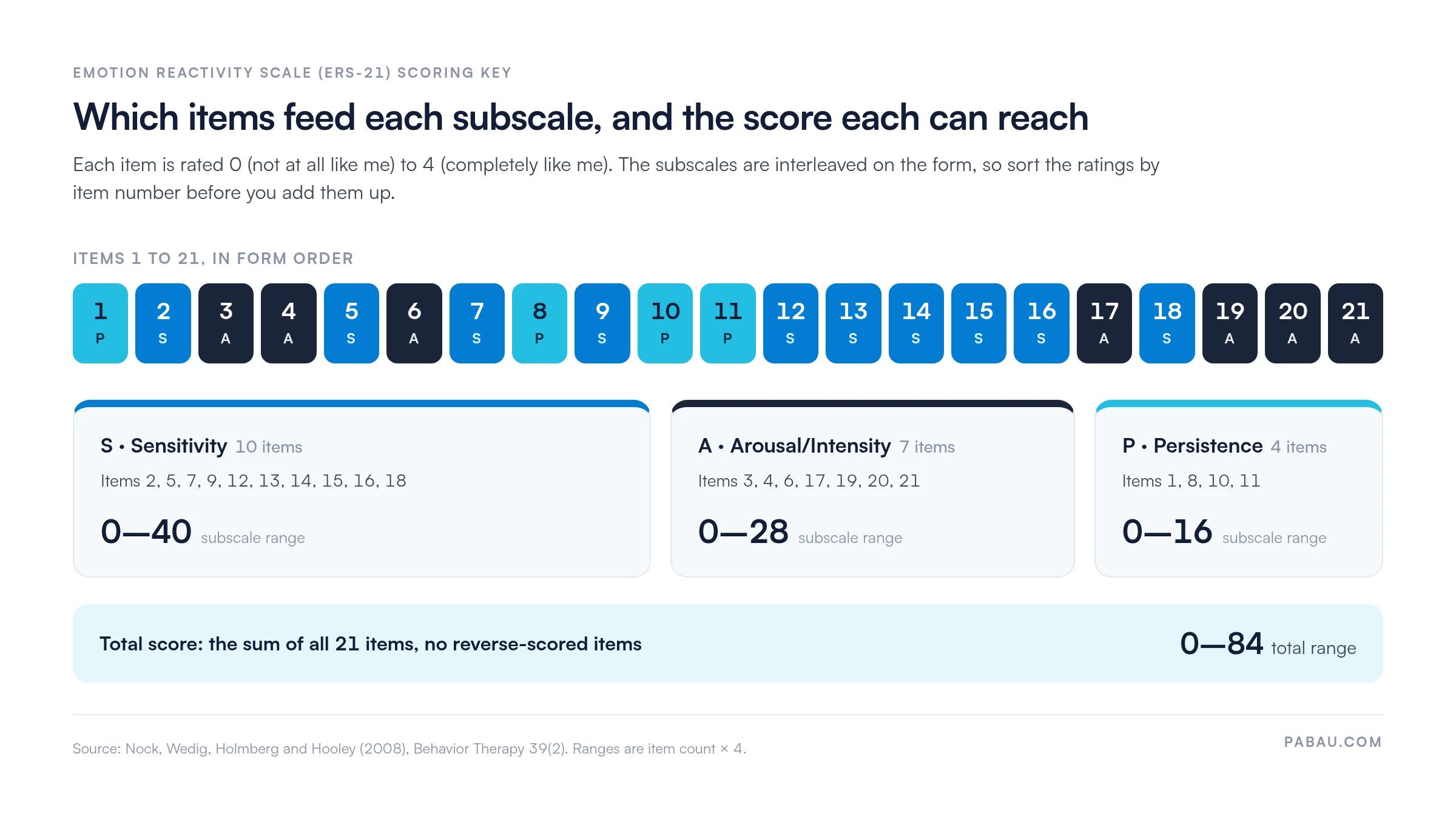
Here’s a quick worked example. Suppose a patient rates every Sensitivity item 3, every Arousal/Intensity item 2 and every Persistence item 1. That gives subscale scores of 30, 14 and 4, for a total of 48.
The total sits mid-range, and it is the number to track from one review to the next. The profile then gives you a starting point for the conversation. Sensitivity is close to its ceiling of 40 while Persistence is low, so this patient may react fast and recover fast.
Most scoring errors come from habits carried over from other questionnaires. Watch for these five.
With the scores on the form, the next job is reading them. Higher scores mean stronger reactivity. The original validation paper did not set a clinical cut-off, so read scores against the patient’s history and their own earlier results.
The total is the best-validated score, because factor analyses favor a single reactivity factor. Use the subscale patterns below as a clinical aid to guide the conversation, not as three separate measures.
High reactivity was linked with self-injurious thoughts and behaviors in the original study. So treat an elevated profile as a prompt to ask about self-harm, and use a structured self-harm assessment to keep that conversation consistent across clinicians.
If a US patient is in distress or thinking about self-harm, share the 988 Suicide & Crisis Lifeline. They can call or text 988 at any time, day or night.
Emotional dysregulation is a core target in dialectical behavior therapy (DBT), so the ERS gives DBT teams a baseline before skills training starts. Repeat it at review points, alongside a DBT diary card that tracks day-to-day urges and skills use.
The ERS pairs well with the Emotion Regulation Questionnaire. The ERS shows how strongly emotions arrive, while the ERQ shows which strategies the patient uses to manage them.
Psychologists, therapists, psychiatrists, mental health nurses and counselors can all use it. It does not diagnose borderline personality disorder or any other condition, and it should never be the only basis for a risk decision.
Before you lean on those numbers, it helps to know how well the scale holds up. The original study reported strong internal consistency, with a Cronbach’s alpha of .94. It also showed convergent and divergent validity against measures of behavioral inhibition, activation and temperament.
Factor analysis in that study found that a single reactivity factor fit the data best. A Dutch validation in 615 high school students (Claes and colleagues, 2014) later confirmed both a one-factor and a three-factor structure.
Because the three subscales correlate very highly (r = .87 to .94 in the Dutch study), the authors preferred a single total score. Treat subscale profiles as a descriptive aid for clinical conversation, not as independent measures.
Keep the limits in mind. The original sample was small and young, and every self-report scale depends on the patient’s insight and candor. Check which language version your patient completes, since results can differ between versions.
If a colleague suggests a different reactivity measure, it is usually this one. The Perth Emotional Reactivity Scale (PERS) is a separate instrument from Australian researchers. It splits reactivity by emotional valence, so it suits work where positive emotions matter too.
Choose the ERS for DBT and self-harm work, where its research base is strongest. Choose the PERS when you also need to see how a patient reacts to positive emotions.
A few minutes of setup keeps ERS scores comparable from one review to the next. Run through this list before each administration.
Many practices send the scale with their digital intake forms before the first session. The patient completes it at home, and you start the appointment with the scores already in front of you.
Record the date and version of the template with each completed scale. Scores from different versions cannot be compared directly, so the version label keeps your progress data reliable over time.
Paper scoring works for a small caseload, but it gets messy across a team. Forms go missing, totals get added up twice, and earlier scores end up in a filing cabinet.
In Pabau, the practice management platform we build, you set up the ERS once as a digital form. Each answer maps to its 0 to 4 value, so nobody converts ratings by hand. With automated assessment scoring, the total is calculated the moment the patient submits and saved to their record.
Each new score lands on a trend graph next to earlier results, so progress through a DBT program is visible at a glance. Results sit in the patient’s file through patient record management, next to session notes and appointments.
The same setup handles the PHQ-9, GAD-7 and other scales in our software built for therapists. The ERS slots into an assessment routine your team already knows.
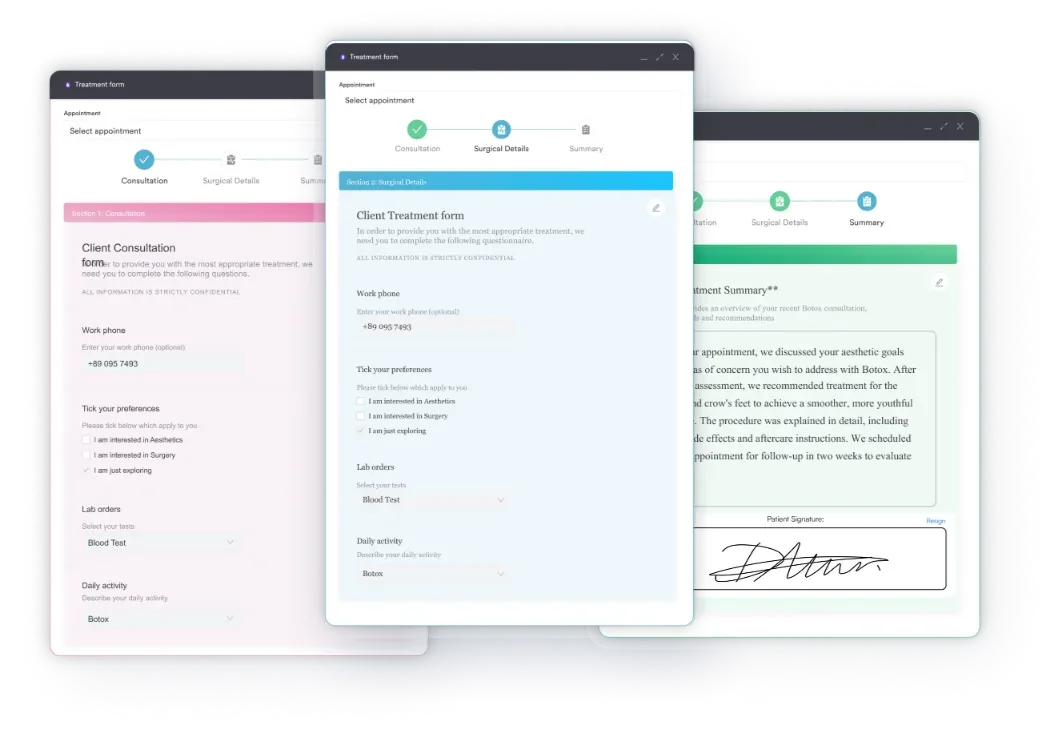

See how Pabau totals submitted questionnaires, stores each score in the patient record and charts progress across sessions.

The ERS earns its place when you score it the same way every time. Convert to the 0 to 4 scale, sum each subscale from the published key, and record the version and date with every result.
Do that, and a vague sense that a patient is “very reactive” becomes a total you can follow through treatment. The profile then helps you steer each review. The trade-off is that it stays a self-report screen. Pair it with your interview and a risk assessment whenever scores run high.
Book a demo to see how Pabau scores emotional reactivity questionnaires and keeps every result in the patient’s record.

Building skills after a high Sensitivity score? Opposite action worksheet helps patients act against an unhelpful emotional urge.
Working on reactions that outrun the situation? Checking the facts DBT worksheet guides patients to test whether a reaction fits the facts.
Need a grounding skill for DBT sessions? Wise mind worksheet helps patients balance emotion and reason before acting.
Want a structured regulation exercise? Emotional regulation worksheet walks patients through naming and managing strong feelings.
Measuring self-control alongside reactivity? Self-regulation questionnaire assesses how patients plan, monitor and adjust their behavior.
There’s no published cut-off. Compare the total with the patient’s own earlier results and history. A total that climbs between reviews matters more than any single number.
No. Reactivity describes how quickly, strongly and lastingly emotions arise. Dysregulation describes difficulty managing them, and it’s usually measured with the Difficulties in Emotion Regulation Scale (DERS).
No. It’s a trait that varies from person to person, and the ERS has no diagnostic cut-off. High reactivity shows up in several conditions, including borderline personality disorder, so a diagnosis needs a full clinical assessment.
Yes. It was first tested with 87 adolescents and young adults. A Dutch validation later used it with 615 high school students.
Most patients finish the 21 items in a few minutes. Scoring by hand takes a couple more minutes once you have the item key.
Yes. Keep the same 21 statements and the 0 to 4 anchors, so online scores compare with paper ones. Note the format used beside each result.
There’s no fixed schedule. A practical rhythm is to repeat it at planned review points, such as the start and end of a DBT skills module. Use the same version each time.