Reflection questions: 14 examples and a free template
Reflection questions are open-ended prompts that guide a person through structur...

1
Last Updated: Oct 16, 2026

This free worksheet is a printable CBT-style emotion and thought record for use in session and as take-home practice.
Its fields cover current emotions, triggers, thoughts and beliefs, cognitive reframing, physical sensations, behavioral responses, coping strategies, and goal setting.
The form itself does not name DBT skills. This guide explains Check the Facts, Opposite Action, PLEASE, and Mindfulness of Current Emotion so you can coach them alongside it.
Therapists use the record to structure sessions, track client progress, and reinforce learning between appointments.
Practice management software like Pabau lets you assign the worksheet digitally, track completion, and file responses in the client record.
A printable emotion and thought record. Fields cover current emotions, triggers, thoughts and beliefs, cognitive reframing, physical sensations, behavioral responses, coping strategies, and goal setting. It also carries patient and therapist details plus space for notes.
Download templateAn emotional regulation worksheet gives your clients a structured way to move from emotional reactivity toward a considered response. This free template is a printable emotion and thought record. It follows the CBT sequence of trigger, thought, physical sensation, behavior, and coping choice. A client can reconstruct one emotional episode on a single page.
Below the download you will find the full field list and a five-step session plan. There is also a clinician guide to four DBT emotion regulation skills worth teaching alongside the form. Those skill names are not printed on the worksheet. The explanations here are background for you, not instructions the client reads off the page.
The PDF is a single, framework-neutral record with ten labeled sections. Here is what a client fills in, in order:
Because the form records the episode rather than scoring a named skill, it drops into CBT, DBT, and integrative caseloads without editing. If you need a fuller assessment document for intake instead, use our psychiatric evaluation template.
Emotional regulation refers to the ability to identify, understand, and manage emotional experiences in ways that support wellbeing and healthy functioning. An emotional regulation worksheet is a clinically structured document that walks a client through that process step by step.
The worksheet helps clients recognize what triggers their emotions, notice physical and cognitive responses, and choose from a toolkit of coping strategies. Unlike generic stress-relief advice, its structure comes from the thought record used in Cognitive Behavioral Therapy (CBT). That format also sits comfortably beside Dialectical Behavior Therapy (DBT), and both frameworks are backed by decades of clinical research.
This section is clinician background, not a description of the form. The worksheet leaves the skills open, so you decide what to coach into the thoughts, reframing, and coping fields. Marsha Linehan developed these four skills as part of DBT treatment protocols. Each one gives you concrete coaching language.
Each skill has a natural home on the page, even though the page never names it. Mindfulness of Current Emotion supports the emotions and physical sensations fields. Check the Facts drives the thoughts, beliefs, and reframing lines. Opposite Action becomes the plan in behavioral responses. PLEASE belongs in coping strategies and goal setting.
Three fields carry no skill at all. Patient information, the trigger line, and the notes box simply record the episode, so leave them alone in your coaching. The mapping below shows this across the whole form.
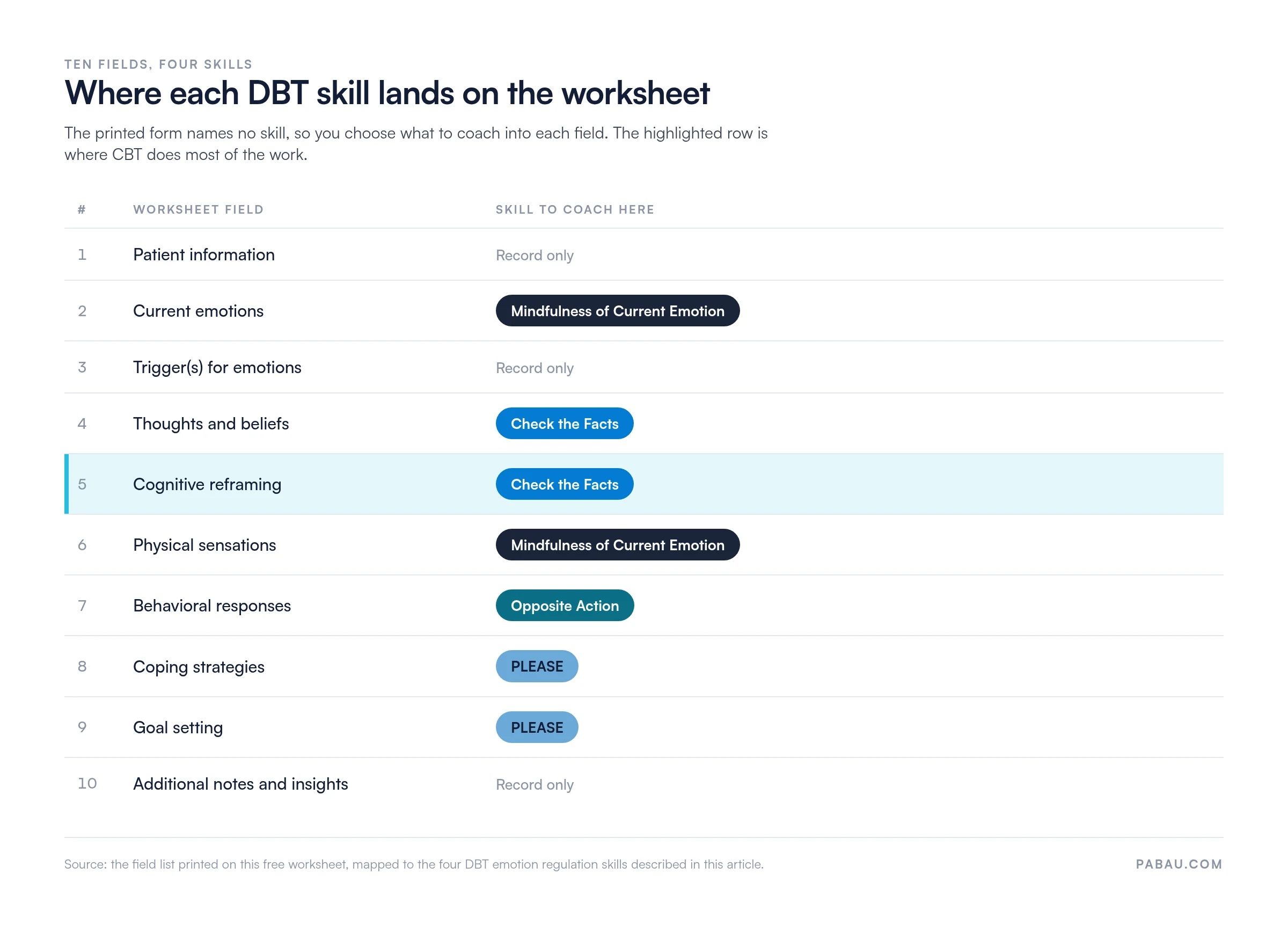
If you want a form that prints the skill names on the page instead, the DBT therapy worksheet is built around them. Reach for that one during a formal skills module rather than a single episode.
Hand the sheet over in a set sequence, so the client learns the skill rather than filling in boxes. Five steps cover it:
When you use therapy practice management software like Pabau, you can digitize this workflow. You assign the worksheet through the client portal, receive completed responses automatically, and store them in the clinical file for continuity of care.
Any client who needs to slow an emotional reaction down can use this record. What changes across groups is how much writing the format should ask for.
The clinical payoff is faster skill acquisition. The operational payoff is a dated trail of what you taught and what it produced.
The cognitive reframing field is where CBT does most of the work on this sheet. Cognitive reappraisal is the shared root of that field and of the DBT Check the Facts skill. It comes from CBT’s focus on the thought, emotion, and behavior loop.
CBT practice emphasizes identifying automatic thoughts, evaluating their accuracy, and generating more realistic alternatives. A client might notice the automatic thought that they are going to fail a presentation. They then weigh the evidence for and against it, and reframe it as having prepared well and managed presentations before. That shift reduces anxiety and opens up more effective behavioral options.
Age and cognitive development call for adaptation. For teens, use shorter written answers, relatable scenarios such as peer conflict or academic pressure, and language that does not sound clinical. Children do better with emotion wheels, simple face drawings, color-coded coping cards, and space to draw instead of text fields.
Adults can use the full ten-section sheet as downloaded. Clients with ADHD or reading challenges benefit from a visual-first version with icons and minimal text. Alternatively, complete the sheet together in session rather than sending it home. If the format stops a client from learning the skill, adapt the format.
Track completion trends. Assign emotional regulation worksheets to 10 or more clients over several months. Then review which fields each person answers fully, and which sections keep generating questions. Use that to refine how you introduce the sheet and to build tip sheets for the common sticking points. Over time it becomes your own emotion regulation curriculum.
When a client completes an emotional regulation worksheet, your note should capture what they learned and how it shapes treatment. Rather than filing the form and moving on, record four points. Name the trigger they worked through, the skill they applied, the outcome, and the skill to prioritize next session.
An example entry reads: client completed the emotion regulation worksheet for an interpersonal conflict with her partner. She applied Check the Facts and found her catastrophic interpretation lacked evidence. Her recorded behavioral response was Opposite Action, engaging in conversation rather than withdrawing. She reports reduced anxiety and a positive response from her partner.
Notes in that shape create continuity. Any clinician picking up the case can see what worked, what the client learned, and where to focus next. Across a course of treatment, the sheets accumulate into a dated record of skill acquisition and symptom change.
A printed worksheet goes out at the end of a session and often never comes back. The pages sit in a folder, and the answers never reach the clinical record where the next session gets planned.
Pabau replaces that loop. Digital intake forms and the client portal let you assign the worksheet electronically and see completion as it happens. The client’s answers are added to their record automatically. Every client gets the same structured sheet, and no part of the workflow depends on a piece of paper coming back.
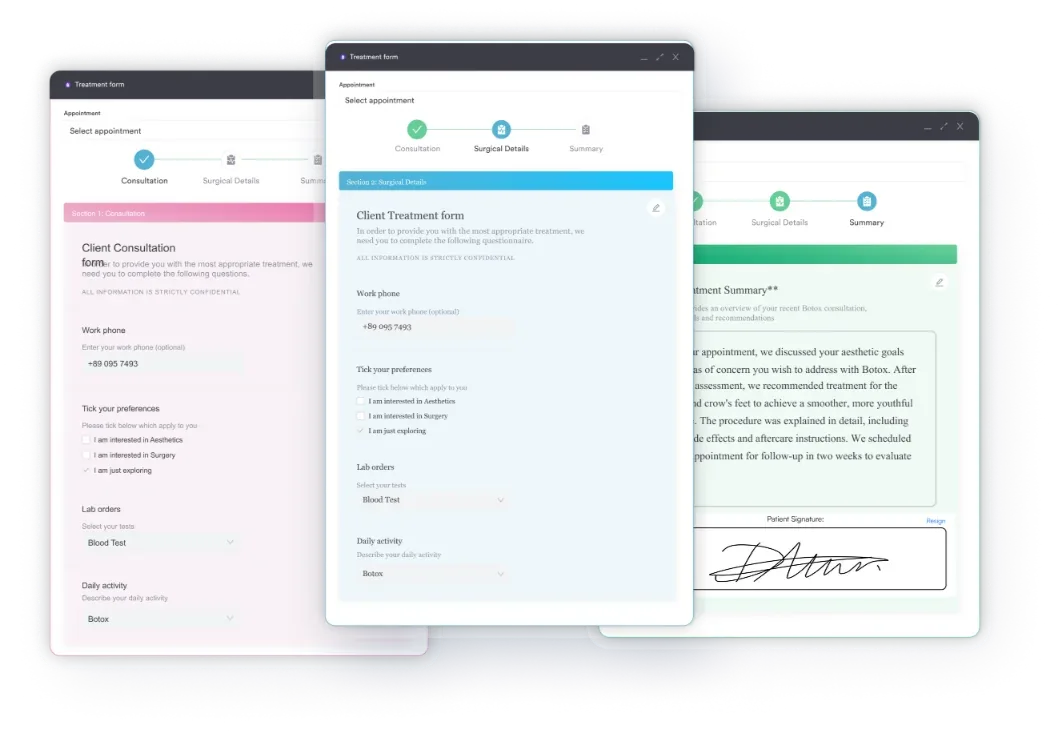
Because the responses are stored rather than filed, between-session progress becomes visible. You can see that one client keeps choosing avoidance in the behavioral response field while another is now reframing without prompting. That visibility turns the worksheet from a static download into a tracked therapeutic tool.
The organizational load drops too, which matters when therapist burnout is a live risk. A repeatable assignment and review workflow means each session starts with the material already in front of you.

Assign worksheets electronically, track completion instantly

Treat this worksheet as the record, not the curriculum. The sheet captures one emotional episode in ten fields, and the clinical value comes from the skill you coach into the reframing and coping lines. Choose that skill deliberately, and the same page works for a CBT thought record or a DBT skills practice.
The trade-off worth remembering is consistency. A worksheet used once tells you little, while a series of them shows you which triggers keep recurring and which strategies hold up. Download the free emotional regulation worksheet, assign it on a schedule, and review each one in session.
Book a demo to see how Pabau assigns worksheets, tracks completion, and stores every response in the client’s secure record.

Need consent documented before a group skills session? Group therapy informed consent covers what to record when clients practice regulation skills together.
Feeling the admin load of chasing paper worksheets? Therapist burnout signs, causes and prevention sets out the workload patterns that wear clinicians down.
Want a quick way to rate anger in session? Anger meter worksheet helps a client score how intense their anger is before it escalates.
Working with a client on a specific behavior change? Change plan worksheet turns that goal and the steps toward it into one printable page.
Need to challenge feelings that are treated as evidence? Emotional reasoning worksheet targets the distortion where an emotion is taken as proof of a fact.
Emotional regulation is the ability to identify, understand, and manage emotional experiences in healthy ways that support wellbeing. It involves recognizing what triggers emotions, noticing your physical and mental responses, and choosing coping strategies that let you respond effectively rather than react impulsively.
No. The downloadable PDF is a CBT-style emotion and thought record. Its fields cover emotions, triggers, thoughts and beliefs, cognitive reframing, physical sensations, behavioral responses, coping strategies, and goal setting. The DBT skills are explained in this article so you can coach them in session while the client completes the form.
Therapists introduce the worksheet as a structured skill-practice tool in session and complete one example with the client. The client then works through triggers, thoughts, and coping strategies between appointments. At the next session the therapist reviews the completed sheet, notes progress, and builds on the techniques that worked.
Yes. Practice management software with digital forms and a client portal lets you assign worksheets electronically. Completed responses arrive automatically and are stored securely in each client’s record. That creates a searchable archive of their skill practice and progress over time.